An operating partner who waits until the data room is open to think about exit readiness and post-merger integration has already lost months of value. The work that makes a company sell cleanly in year four, and the work that makes an add-on hold together in the first quarter, are the same work: a clean financial model, systems that reconcile, revenue data that a buyer’s diligence team cannot pick apart. The commercial consequence of getting this wrong shows up twice, once as a slower integration that burns the thesis, and again as a discount at exit when a buyer’s quality-of-earnings team finds revenue it cannot verify.
This guide is for the person accountable for revenue systems in a portfolio company, the one who gets the integration workstream and the exit-prep workstream dropped on their desk and is expected to decide, not to study. It names the decisions, the owner for each, and how to judge whether the work is actually done.
1. Why these two problems are one problem
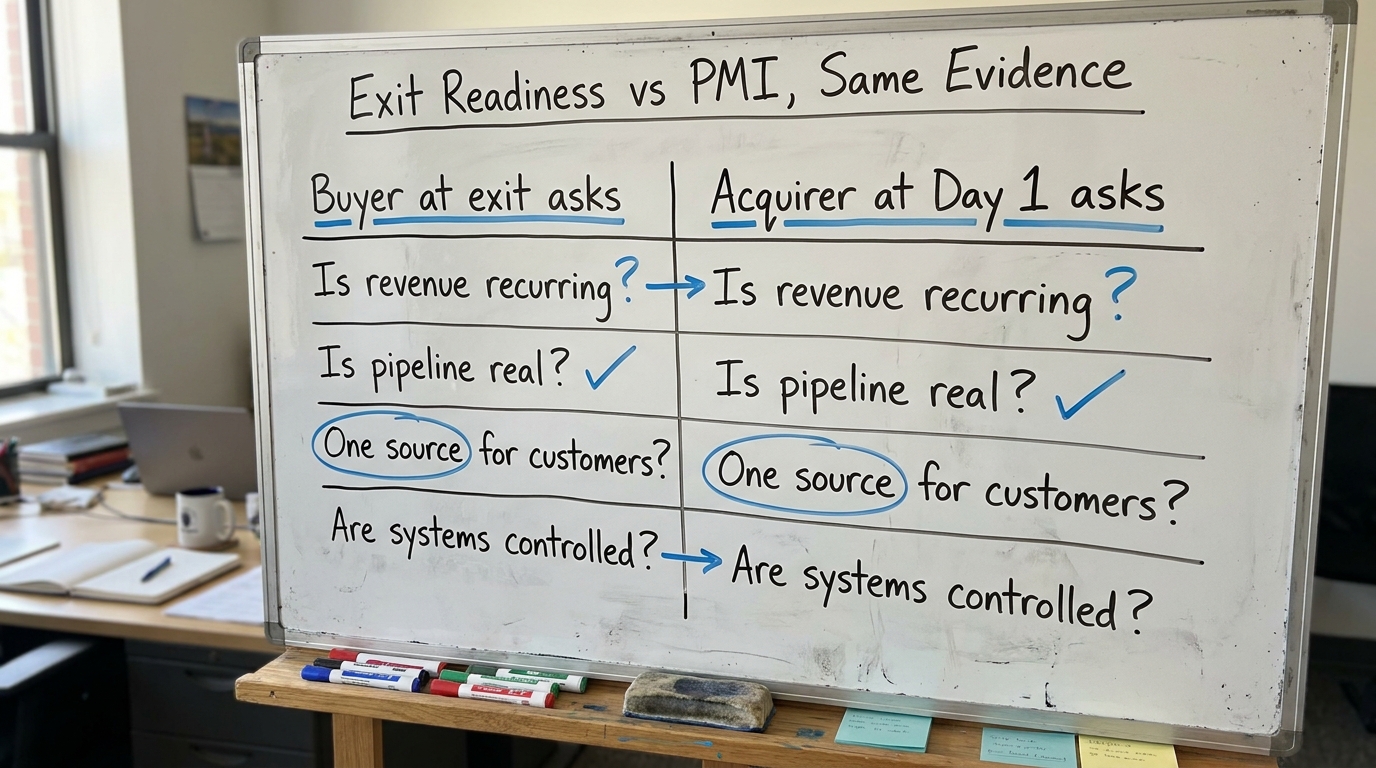
The reason to treat exit readiness and post-merger integration together is that both are governed by the same evidence. A buyer at exit asks whether reported revenue is recurring, whether the pipeline is real, and whether the systems producing those numbers are controlled. An acquirer running an add-on asks the same questions about the target before Day 1. If the revenue systems cannot answer them for your own house, they will not answer them for a deal you bolt on.
Bain’s annual private equity report has tracked how holding periods and exit conditions move with the cycle, which is a useful reminder that the window to fix systems is finite and rarely as long as the original model assumed. You can review the themes in Bain & Company’s Global Private Equity Report. The practical takeaway is that system cleanup is cheaper when it is not under a deadline, and most of it is under a deadline by the time anyone raises it.
2. Decide what counts as evidence before you spend
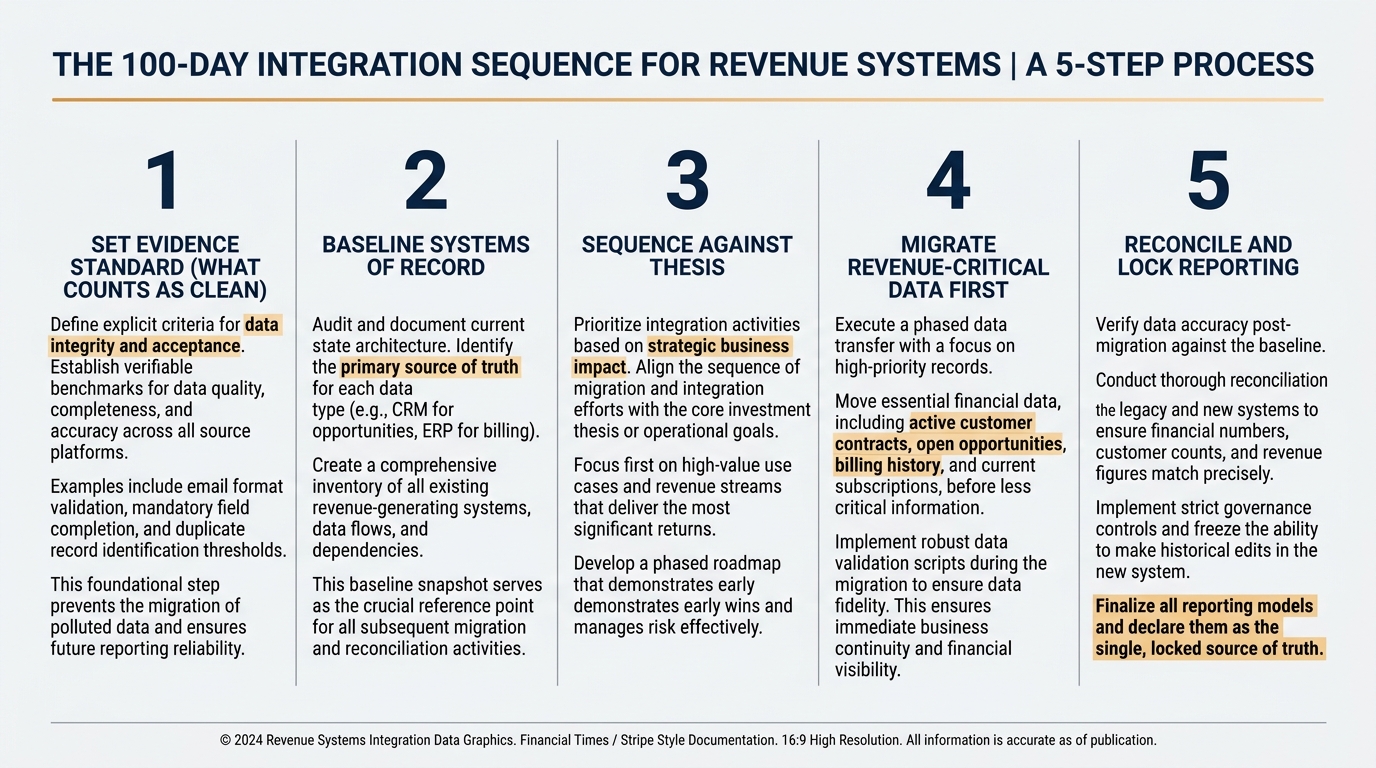
The first decision is definitional, and it is the one most teams skip. Before any integration or exit-prep budget moves, fix what a clean answer looks like for each number the deal depends on. Recurring revenue needs a definition the finance team and a future buyer would both accept. Pipeline needs a stage model with entry and exit criteria tied to buyer activity and timestamps. Customer counts need a single source, not three systems that disagree.
This is the same discipline that governs technology due diligence on the buy side. The operating partner who sets the evidence standard for the portfolio company is doing confirmatory diligence on their own asset, early enough to fix what fails.
3. Baseline the revenue systems you actually have
You cannot integrate or prepare for exit on a map you have not drawn. The baseline is an honest inventory: which system is the system of record for each object (accounts, contacts, opportunities, contracts, invoices), where the data is duplicated, and where it is reconciled by a person pasting into Excel every month. That last category is the risk register for this entire program because manual reconciliation breaks when you move data between systems and fails again when a diligence team starts testing it.
For revenue data specifically, the integration mechanics are worth studying in detail. The decisions that determine whether merged revenue data holds up are laid out in post-acquisition RevOps integration and the calls that decide whether the deal model holds, which treats the problem as a set of owned decisions rather than a systems project.
4. Sequence the integration against the thesis, not the org chart
The common failure in post-merger integration is sequencing by convenience, merging the easy systems first and leaving the revenue-critical ones for later. Sequence instead by what the deal model needs to prove. If the thesis is cross-sell, the customer and product data have to reconcile before anything else. If it is margin expansion through consolidated operations, the cost and headcount data lead. The integration dependency map should read directly off the value creation plan.
Pre-close is where this sequencing gets decided, or should. The calls that cannot be deferred to Day 1 are covered in pre-close value creation planning and the decisions that cannot wait for Day 1. Deciding integration sequence after close means deciding it under time pressure, which is how revenue data gets merged badly.
5. Assign a single owner to the revenue-data workstream
Integration programs fail on ownership more than on technology. The revenue-data workstream needs one named owner with the decision right to pick the surviving system, resolve field-mapping disputes, and sign off that reconciliation is complete. A committee cannot own this, because every system merger produces a dozen small conflicts a week that need a decision the same day, not a meeting next week.
What that owner has to deliver in the opening stretch, and how to judge whether they are delivering, is set out in what a value creation execution partner has to deliver in the first 100 days. Judge them on adoption and reconciled numbers.
6. Build the model finance and the board can both read
Two audiences consume the output of a cleaned-up revenue system, and they need different formats on the same data. Finance keeps its Excel, working off a model that ties to the general ledger and survives a quality-of-earnings review. Leadership and the board get dashboards that flag what moved and why, without a reconciliation step in between. When these two run on different numbers, exit diligence finds the gap, and a buyer prices the uncertainty into the offer.
McKinsey’s private capital research has documented how reporting discipline correlates with smoother diligence and value capture; the broader body of work is at McKinsey. The operating point is that reporting built for the board and reporting built for a buyer should be the same reporting, produced once.
7. Fix attribution and capture before you automate anything
A frequent waste in this program is automation layered on top of broken data capture. If the CRM has inconsistent stage definitions, last-touch attribution, and fields that sales fills in optionally, no automation or AI co-pilot will produce a number a buyer trusts. The foundation comes first: governance on what gets captured, when, and by whom, and reporting that reflects how revenue is actually earned in this business model.
This matters most for publishers and content-led revenue businesses, where the revenue model does not look like SaaS and templates built for SaaS produce the wrong reports. The sequence is foundation, then visibility, then automation, and taking it out of order wastes the budget on cleverness the data cannot support.
8. Price the cleanup against the discount it prevents
The spend decision is easier when it is framed against the alternative. Unreconciled revenue data at exit feeds directly into the buyer’s offer, because a quality-of-earnings team that cannot verify a revenue stream treats it as at risk. The cost of fixing the systems during the hold is almost always smaller than the discount applied to revenue a buyer cannot confirm.
How to judge that spend, and what a real diagnostic should cost, is covered in what a value creation diagnostic costs and how to judge the spend. Apply the benchmark of whether the work produces a working artifact a buyer would accept.
9. Treat the add-on like a mini exit in reverse
When the portfolio company is the acquirer in an add-on, the diligence it runs on the target is the diligence a future buyer will run on the combined entity. The same evidence standard applies both directions. The call list that decides an infrastructure-asset acquisition, for instance, is a useful template for the questions that actually move price, covered in due diligence for infrastructure assets and the calls that decide the deal.
Harvard Law School’s Forum on Corporate Governance publishes regularly on diligence and disclosure practice that bears on how combined entities get scrutinized; the archive is at the Harvard Law School Forum on Corporate Governance. Running an add-on to that standard means the integration leaves the combined company more sellable.
10. Judge the work by what a buyer could test
The final discipline is a judging standard, and it is simple to state. Every claim the integration or exit-prep program produces should survive a buyer’s test. The recurring-revenue number should trace to contracts. The pipeline should reconstruct from CRM records with timestamps. The customer count should reproduce from one system. If a claim only holds because someone explains it in a meeting, it will not hold in a data room.
The link between first 100 days execution and exit outcome is that the numbers you lock early are the numbers you defend later. Firms that run disciplined value creation inside private equity portfolios treat the two as one continuous program, not two projects with a gap in the middle.
11. The decision checklist before you commit budget
Before the operating partner or portfolio executive approves spend on either workstream, these decisions should already have named owners and dated answers:
- What counts as verifiable evidence for recurring revenue, pipeline, and customer count, agreed with finance.
- Which system is the system of record for each revenue object, and where manual reconciliation currently hides.
- The integration sequence, read off the value creation plan rather than off the org chart.
- One named owner for the revenue-data workstream, with the decision right to resolve conflicts same-day.
- A single model that feeds both the finance Excel and the board dashboard off the same data.
- Data capture and attribution fixed before any automation or AI layer is funded.
- The cleanup cost is priced against the exit discount it prevents.
PitchBook’s data on exit activity and holding periods, available through PitchBook research, reinforces how much the timing of this work matters; the companies that enter a sale process with systems already clean move through diligence faster and defend their numbers better.
12. Where to go next
The through-line from pre-close planning to a defensible exit is a single execution program, and it rewards starting early. If the revenue systems in your portfolio company need to be made integration-ready and exit-ready at the same time, review how the DevriX and GrowthShuttle private equity execution offer structures 100-day digital execution against the decisions this guide names.