The gap most operating partners run into shows up around week six. The value creation plan is written, the board has signed off, and nothing in the portfolio company has actually moved. The CRM is still half-populated, the revenue numbers still live in three Excel files that disagree with each other, and the one hire who was supposed to own revenue systems has not landed. A value creation execution partner in private equity exists to close that gap between the plan and the result, and choosing the wrong one costs a quarter you do not get back before the first real board review.
This guide is for the operating partner or portfolio company executive deciding what to buy, in what order, and how to judge whether the partner in front of them will deliver.
1. Decide what the partner is actually on the hook for
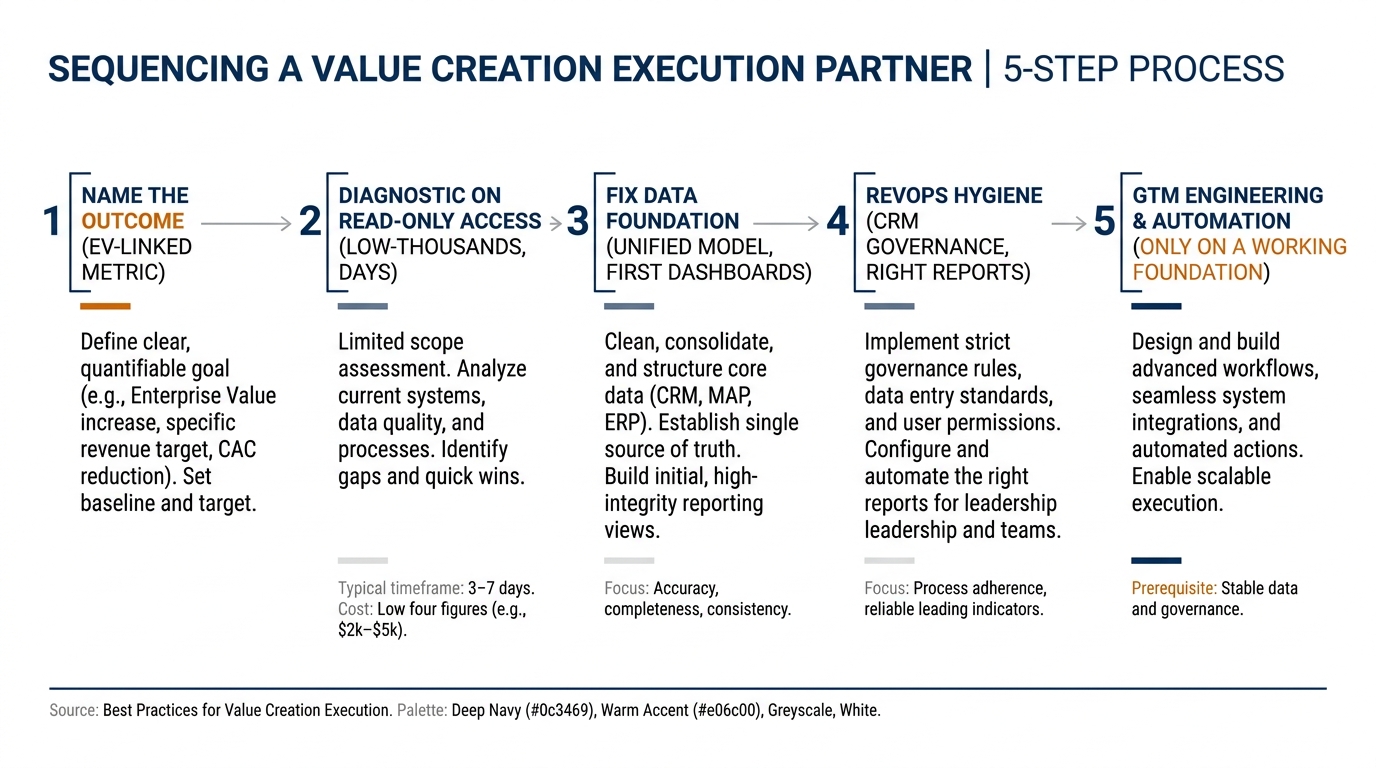
Most firms sell a value creation execution partner in private equity as a bundle of activity: dashboards, campaigns, a RevOps retainer, some AI pilots. That is the wrong unit to buy. The unit to buy is a measurable change in how the business runs, tied to enterprise value. Before any scoping call, write down the one or two outcomes you will hold the partner to, in your company’s own terms.
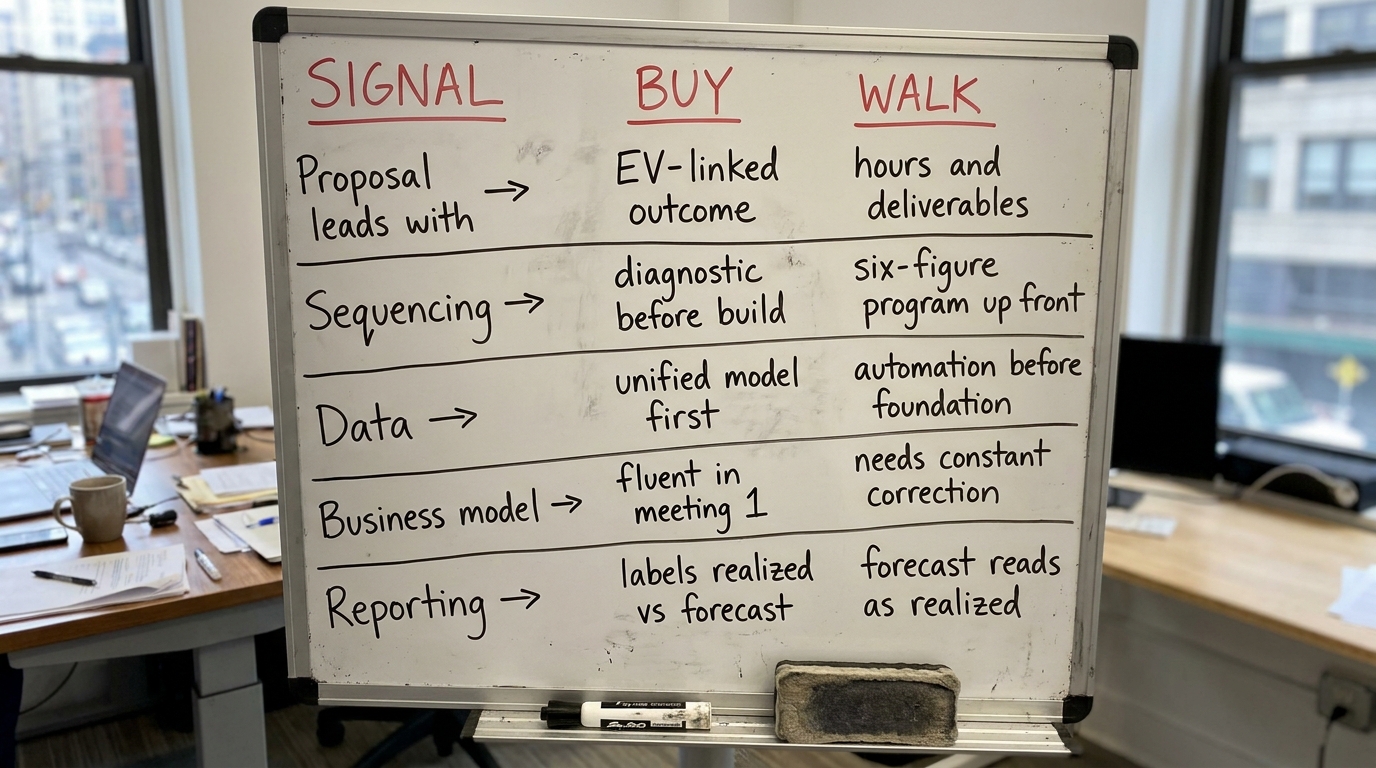
For a distributor that might be order-to-cash cycle time. For a project-delivery firm it might be utilization visibility and quote-to-win rate. The partner’s job is to move that number and to show the baseline it moved from. If the proposal leads with hours and deliverables rather than the outcome, it is a staffing arrangement wearing a value creation label.
2. Separate the diagnostic decision from the build decision
The expensive mistake is committing to a six-figure, multi-month program before anyone has confirmed what is broken. The sequence that protects the quarter is a short, cheap diagnostic first, then a staged build only against what the diagnostic found.
A good diagnostic runs on read-only access under an NDA, costs in the low thousands, and ends with a baseline and a ranked list of what to fix. Bain’s annual global private equity report has tracked for years how much of the return now has to come from operational improvement rather than multiple expansion, which is exactly why the diagnostic has to be honest about where the operating gains actually are. Pay for the finding before you pay for the fix.
3. Fix the data foundation before anything clever
The most common finding in a portfolio company is that the business cannot see its own numbers. ERP, CRM and marketing tools are disconnected, and leadership runs the company on spreadsheets that are reconciled by hand. Automation, AI copilots and predictive scoring pitched on top of that foundation will produce confident, wrong answers.
The right first workstream is almost boring: read-only connections into the source systems, one unified data model, and the first dashboards standing within days rather than months. Finance should keep its Excel view on the same underlying data, and leadership should get the visual version with insights flagged. If the partner wants to start with advanced automation before this exists, that is a reason to walk.
What good data visibility looks like in practice
- Revenue, pipeline and delivery numbers that agree across finance and operations because they come from one model.
- A dashboard the CEO trusts enough to bring to the board without a manual rebuild each month.
- Insights flagged, not just charts drawn, so the operating partner knows where to look.
For the full scope of what a technical diagnostic should surface, including systems risk, the technology due diligence view is the companion to the commercial one, and the two should not be run by people who never talk to each other.
4. Judge the partner on business-model fluency, not slides
The partners worth signing arrive at the first meeting already fluent in how the company makes money. They have done the outside-in work and built something specific to a distributor, a clinic group or a services firm. A partner who needs constant correction about the business model in the first meeting will keep needing it for the length of the engagement, and that correction time comes out of your quarter.
Ask the partner to describe your revenue motion back to you before they describe their methodology. If they cannot, the methodology does not matter yet.
5. Get RevOps hygiene in before you buy automation
Between the data foundation and anything ambitious sits the unglamorous middle: CRM governance, consistent data capture, the right reports, and attribution that is not just last-touch. This is where most revenue systems in portfolio companies actually leak. The execution partner should name which reports leadership is currently misreading and what is not being captured at all, then fix that before building a GTM engine on top of it.
This ordering is the difference between a partner who sells motion and one who sells a result. McKinsey’s private capital research has repeatedly made the point that operational value depends on getting the fundamentals right before layering on sophistication, and RevOps is a clean example of that discipline.
6. Decide the hire-versus-rent question explicitly
Underneath the execution partner decision sits a staffing one: does the portfolio company hire a RevOps lead or GTM engineer, rent the capability, or run a hybrid while a hire is found. A good execution partner will give a recommendation against your situation rather than defaulting to the answer that keeps them billing. The honest version runs the system now, builds it so an internal hire can take it over, and does not lock you in.
Prevention is cheaper than firefighting here. The right trigger to bring a partner in is a platform acquisition or the gap before a key hire lands, not the moment the forecast has already broken.
7. Tie the work to the integration calendar
If the portfolio company is a platform doing add-ons, the execution partner’s work has to run against the integration timeline, not beside it. Revenue systems, data models and reporting all become integration dependencies the moment a second company arrives. The sequencing of what to merge, what to keep separate and what to rebuild belongs to the operating partner, and the execution partner’s job is to make those calls executable on time.
The decisions that cannot wait in that window are worth treating as their own workstream, which is the subject of post merger integration for revenue systems and, where a carve-out is involved, IT carve-out separation decisions.
8. Check AI search visibility as a demand question
For many portfolio companies, buyers now shortlist in AI assistants before any sales contact, and the top answer takes most of the demand. An execution partner working on the revenue system should be able to tell you which prompts matter for your ideal customer, where the company shows up against named competitors, and what to do about it on a weekly loop. The work is a pipeline input that increasingly sits upstream of everything the CRM later records.
9. Set the evidence standard before you sign
Decide in advance what proof the partner owes the deal team. A credible execution partner gives the operating partner something low-risk to sell internally: read-only access under NDA and MSA, an anonymised proof point, and a staged plan with a baseline. Research hubs such as PitchBook and the Harvard Law School Forum on Corporate Governance are useful for sizing the operating-value case in general, but the proof that matters for your engagement is the baseline measured in your company, with the method stated.
Classify every claimed impact honestly. A number that is realized is not the same as one that is run-rate, forecast, or merely enabled. If a partner lets forecast value read as money already in the bank, that is a signal about everything else they will report.
10. Run the decision checklist before the first board meeting
Before the engagement starts, the operating partner should be able to answer each of these in one line:
- What enterprise-value metric does this partner move, and from what baseline.
- Has a cheap diagnostic confirmed the problem before any six-figure build.
- Is the data foundation being fixed before automation is attempted.
- Did the partner demonstrate fluency in the business model without coaching.
- Is RevOps hygiene scoped ahead of the GTM engine.
- The work is sequenced against the integration calendar so that technical dependencies are visible and resource conflicts are surfaced before Day 1.
- Does the plan say whether to hire, rent, or run a hybrid.
- Is every claimed impact labeled realized, run-rate, forecast, or enabled.
For the wider frame on what the partner owns and how to vet them, see what a value creation partner has to own before you sign and the companion piece on how to judge a digital transformation partner. For the board-facing version of the plan itself, building a value creation strategy that survives the first board meeting covers the sequencing from the other direction.
11. Match the spend to the stage of certainty
The spending pattern that protects capital is a small diagnostic in the low thousands, followed by a staged build that commits larger budget only against confirmed findings, typically scaling into the tens of thousands rather than starting there. Quotes should be benchmarked against what this work costs to build in an AI-era delivery model, and entry work that moves in days should not carry six-figure pricing. If the first proposal is a long time-and-materials program before anything has been diagnosed, that is the pattern to avoid regardless of how polished the deck is. This sequencing is the heart of a well-run first 100 days, and it sits inside the broader private equity operating approach.
Ready to move from plan to execution? Start with the DevriX / GrowthShuttle PE diagnostic to get a baseline and a staged value creation plan your deal team can sign off before the next board review.