When an operating partner inherits an infrastructure asset at the LOI stage, the diligence question is rarely whether the plant, network or data center works. It usually works. The question is what the asset will cost to run, to upgrade and to integrate once the seller’s financing, deferred capex and favorable contracts fall away. A revenue systems leader pulled into confirmatory diligence on a power, utility, fiber or logistics platform is being asked to translate operating reality into a number the deal team can underwrite. Due diligence for infrastructure assets lives or dies on that translation, and the window to do it well is short.
This guide is written for the person who will own the forecast after close. It walks the decisions in the order they come up, from the first data request through the first board meeting, and names what each one commits you to.
1. Start from the decision the diligence informs, not the asset
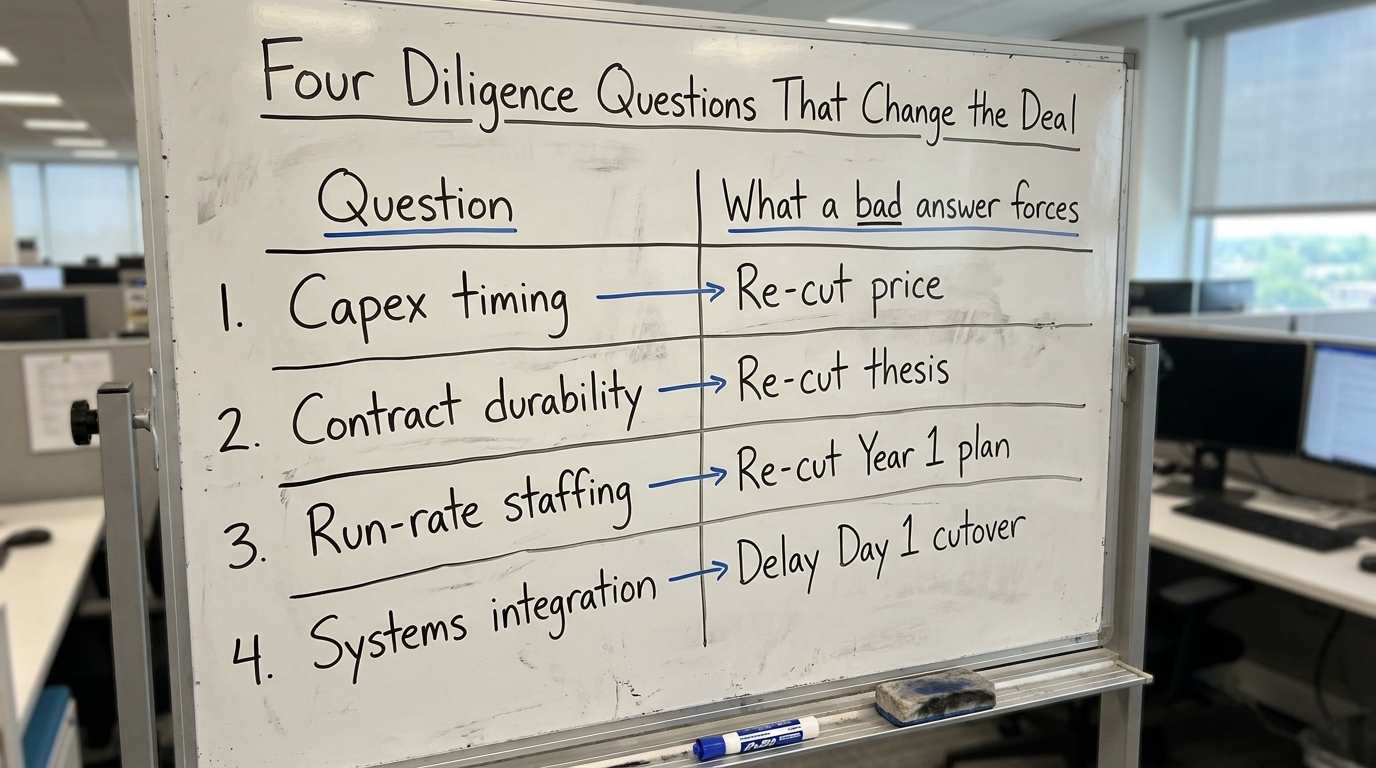
The common failure is treating diligence as a catalog of findings. A deal team does not need a list of everything that could be better. It needs to know which findings change the price, which change the plan, and which change the thesis. Before the first site visit, write the three or four questions whose answers would make you walk, re-cut the valuation, or restructure the first year of ownership.
Bain’s annual private equity report has tracked how value creation has shifted toward operational improvement rather than multiple expansion, which means the diligence that matters most is the kind that feeds a concrete operating plan (Bain & Company Global Private Equity Report). For infrastructure, that plan is dominated by capex timing, contract durability and the cost of running the asset at the seller’s current staffing.
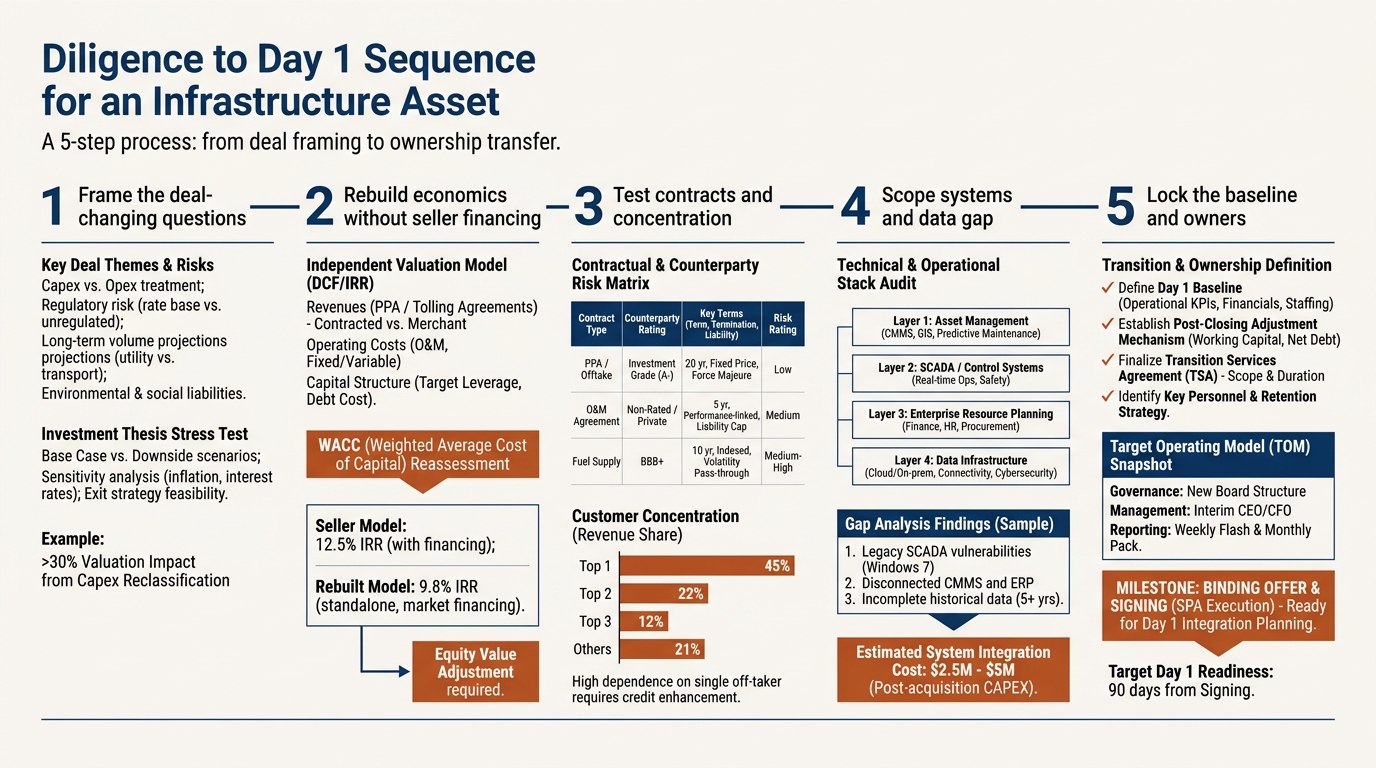
2. Separate the asset’s economics from the seller’s financing
Infrastructure assets are frequently dressed for sale. Maintenance is deferred, a major refurbishment is pushed past the signing date, and a tax-advantaged or rate-regulated structure flatters the cash flows. Your job in diligence is to rebuild the economics as the asset will actually run under your ownership and your cost of capital.
Ask for the full capex register. Reconcile what was spent against what the engineering team says the asset needed. A gap between the two is deferred liability you will inherit, and it belongs in the risk register with an owner and a rough number, even when the number is still a range.
3. Judge the contracts before you judge the engineering
The value of most infrastructure assets sits in long-dated contracts: offtake agreements, capacity reservations, concession terms, interconnection rights. A revenue systems leader may not draft those, but should insist on seeing the contracted versus uncontracted revenue split, the renewal dates clustered on a timeline, and the counterparty concentration.
If 40 percent of revenue renews within eighteen months of close and the counterparty has alternatives, that is a thesis risk. S&P Global Market Intelligence publishes sector data useful for sanity-checking whether a renewal assumption is market or wishful (S&P Global Market Intelligence). The same discipline that protects you when buying a services firm applies here, which is why the logic in buying a value creation consulting firm without overpaying for slideware carries over: pay for durable contracted cash flow, not for a story about it.
4. Treat the technology stack as an operating cost, not a line item
Infrastructure assets run on real systems: SCADA, asset management platforms, billing engines, field service software, and increasingly a layer of analytics bolted on top. These are often undercounted in diligence because they are not the headline asset. They become the Day 1 problem when the asset carves out of a parent that provided IT as a shared service.
A structured technology due diligence pass answers three things: what the asset owns versus what the parent provided, what the real run-rate cost of standing those systems up independently is, and which integration dependencies gate the first operating milestones. The same separation discipline shows up in IT carve-out advisory and the separation decisions the operating partner owns.
5. Build the baseline the forecast will be measured against
A forecast with no baseline is a hope. Before close, lock the actuals for the trailing twelve months at a granularity you can hold the management team to: output, availability, unit operating cost, headcount by function, and maintenance spend. This baseline becomes the yardstick for actual versus plan in every board pack that follows.
McKinsey’s private capital research has made the point repeatedly that the owners who create value instrument the business early and measure against a fixed baseline (McKinsey private capital research). If the data to build that baseline does not exist in confirmatory diligence, that absence is itself a finding, and it usually means the asset runs on spreadsheets rather than connected systems.
6. Price the data and visibility gap before you promise synergies
Most infrastructure platforms cannot see their own numbers in one place. Operations data sits in one system, maintenance in another, finance in Excel, and nobody has a current unified view of unit economics. Any synergy case that assumes real-time visibility has to fund the work to create it.
This is where a revenue systems leader earns the seat. The question for the deal team is concrete: how many weeks and how much cost to get read-only connections, a unified model and the first management dashboards, so the board is not flying on a lagging Excel file. That scoping belongs in diligence, not in month three when the first forecast misses and nobody can explain why.
7. Map the integration dependencies that gate Day 1
Carve-outs create a cliff. On the day the transaction closes, the transitional services agreement clock starts, and everything the parent used to provide becomes your responsibility on a deadline. The diligence deliverable is a dependency map: what breaks at close, what the TSA covers and for how long, and which workstreams must be staffed before the TSA expires.
The decisions a CTO or technology operating partner cannot hand off during that window are laid out in fractional CTO PMI and the five decisions an operating partner cannot delegate, and the revenue-system side of the same cutover is covered in post-merger integration for revenue systems. Read both before signing, not after.
8. Decide what cannot wait for the first 100 days
Some findings convert into pre-close conditions, some into Day 1 actions, and some into the value creation plan proper. Sort them now, because the cost of deferral is not symmetric. A deferred safety or compliance item carries regulatory exposure; a deferred reporting fix just delays visibility; a deferred capex item compounds.
The sequencing logic for the early period is covered in planning the first 100 days, and the decisions that genuinely cannot wait for Day 1 are set out in pre-close value creation planning. Infrastructure assets punish teams that treat the first quarter as a settling-in period.
9. Assign an owner and a decision right to every material finding
A finding with no owner is noise. Every item that survives into the risk register needs a named owner, a decision right (who can commit money or change scope), and a trigger that moves it from monitored to active. This is the difference between a diligence report that sits in a data room and one that drives the first board meeting.
How to build a plan that holds up when the board tests it is the subject of building a portfolio value creation strategy that survives the first board meeting. The Harvard Law School Forum on Corporate Governance regularly publishes practitioner guidance on diligence governance worth keeping current on (Harvard Law School Forum on Corporate Governance).
10. Judge the cost structure against a real reset, not the seller’s run-rate
Challenge the seller’s operating cost; do not inherit it as baseline. Overtime can mask understaffing, contractor rates may reflect negotiation under duress, and maintenance timing distorts the run-rate being shown. The disciplined version of this exercise is laid out in the 100 day cost reset and the four decisions that cannot wait, and the same four-decision frame applies to an infrastructure platform.
PitchBook and Preqin data on comparable deals can anchor whether your assumed cost base is in a defensible range before you commit to it in a model (PitchBook research and data).
11. A next-step checklist for the diligence window
Before the deal team asks for your read, make sure each of these has a documented answer and an owner:
- The three or four findings that would change price, plan or thesis, written down before the first site visit.
- Rebuilt economics with seller financing, deferred capex and favorable TSA pricing stripped out.
- A contract timeline showing contracted versus uncontracted revenue and counterparty concentration.
- A systems inventory separating owned from parent-provided, with a run-rate cost to stand each up.
- A locked trailing-twelve-month baseline at a granularity you can hold management to.
- A costed scope for read-only data connections and the first management dashboards.
- A Day 1 dependency map tied to TSA expiry dates and staffed workstreams.
- A risk register where every material finding has an owner, a decision right and a trigger.
The decisions in this guide sit inside a broader value creation program. How a buyer should judge the partner who owns that program is covered in what a value creation partner has to own and how to judge one before you sign, and what digital value creation consulting buys a private equity owner frames the systems and data side specifically.
If your team is approaching confirmatory diligence on an infrastructure asset and needs the systems, data and integration scoping turned into numbers the deal team can underwrite, review how DevriX works with private equity owners to scope that work for a specific deal.