Six months after close, a portfolio company reports flat pipeline against plan, and the CEO proposes a redesign of the marketing site as the fix. The operating partner has to decide in one board meeting whether that spend is a growth lever or a cosmetic project that will burn a quarter. Conversion rate optimization for portfolio companies gets framed as a design question when it is actually a revenue-systems question, and the difference decides whether the money returns anything. This guide is written for the person accountable for that call: the operating partner or portfolio company executive who owns the number, not the person running the A/B tests.
The stakes are concrete. A conversion program that moves qualified pipeline changes the revenue forecast the board is underwriting. A program that reshuffles button colors changes nothing and consumes a team for months.
1. Why conversion work rarely earns its budget
Most conversion programs fail the operating partner’s test because they optimize a metric that does not connect to booked revenue. A lift in form fills means nothing if those leads never reach a rep, or reach a rep who cannot work them because the routing is broken. Bain’s annual private equity report has tracked for years how value creation plans depend on operational levers that actually feed the P&L, and conversion belongs in that category only when it is wired into the revenue system.
The buyer here is not purchasing tests or heatmaps. The buyer is purchasing measurable movement in qualified pipeline and, downstream, in EBITDA. That distinction should govern how the work is scoped and how it is judged.
2. Decide what the program is allowed to touch
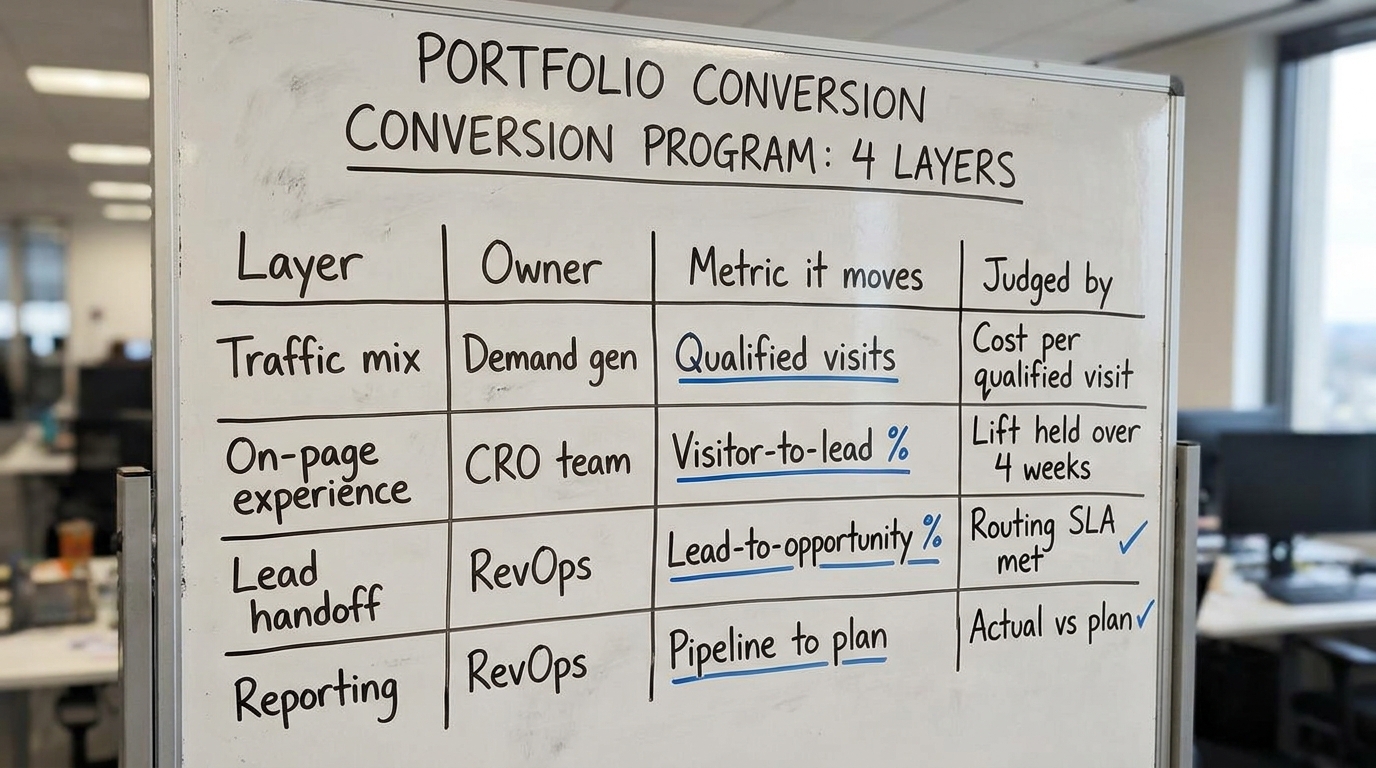
Before approving a dollar, define the boundary of the work. Conversion optimization in a portfolio company usually spans four layers: the traffic mix arriving at the site, the on-page experience, the lead-to-opportunity handoff, and the reporting that ties all three to revenue. A program scoped to only the second layer is a design project wearing a revenue label.
The operating partner’s decision is which layers the program owns and who holds the decision right on each. If the agency owns page design but no one owns routing, the lift leaks before it reaches a rep.
3. Establish the baseline before the first test
No conversion claim is credible without a baseline the deal team can audit. That means the current conversion rate at each stage, measured over a stable period, with the traffic source held constant. If the portfolio company cannot produce visitor-to-lead and lead-to-opportunity rates by channel, the first workstream is instrumentation, not testing.
This is the same discipline applied during technology due diligence, where an unmeasured funnel is a flagged risk rather than an asset. McKinsey’s work on digital and commercial performance has repeatedly made the point that data quality determines whether a growth lever is real or assumed. Treat the baseline as evidence, not as a formality.
4. Tie every test to a revenue hypothesis
A test that reads “will a shorter form increase submissions” is a vanity test. A test that reads “will qualifying two extra fields raise the rate of leads that convert to opportunities, even at lower total volume” is a revenue hypothesis. The second kind is the only kind worth an operating partner’s attention, because it accepts that a higher raw conversion rate can lower the quality of pipeline.
Insist that each test names the downstream metric it is trying to move and the plan number it maps to. Volume without qualification often makes the forecast worse.
5. Fix the handoff before optimizing the page
The most common leak in a portfolio company happens after the form submits. Leads sit unrouted, get assigned to the wrong segment, or reach reps with no context. Optimizing the page above a broken handoff raises the volume of leads that get wasted.
This is a RevOps problem before it is a CRO problem, and it usually lives in the CRM. The decisions around routing, scoring, and ownership are the same ones covered in Salesforce RevOps for PE portfolio companies. Fix the pipe, then increase what flows through it.
6. Match the traffic to the deal thesis
Conversion rate is a ratio, and the numerator is only as good as the traffic in the denominator. A portfolio company chasing enterprise accounts but buying broad, low-intent traffic will always show a weak conversion rate, and no page test will fix that. The fix is upstream, in who the company is trying to reach.
When the deal thesis names specific accounts or segments, the traffic strategy has to serve that list. The reasoning is the same one behind account-based programs, where the account list either matches the deal thesis or does not. Conversion work on the wrong audience produces efficient movement toward the wrong revenue.
7. Judge the team by decisions, not activity
An agency or in-house team that reports test counts, session recordings, and hours is reporting activity. The operating partner should ask a narrower set of questions: which tests reached significance, which ones changed a stage conversion rate, and which of those changes held up over a full month against the plan number.
Tests, tickets, and traffic are the register vendors default to because it is easy to produce and hard to argue with. The number that matters is qualified pipeline moved, classified honestly as realized, run-rate, or still forecast.
8. Sequence the work across the first 100 days
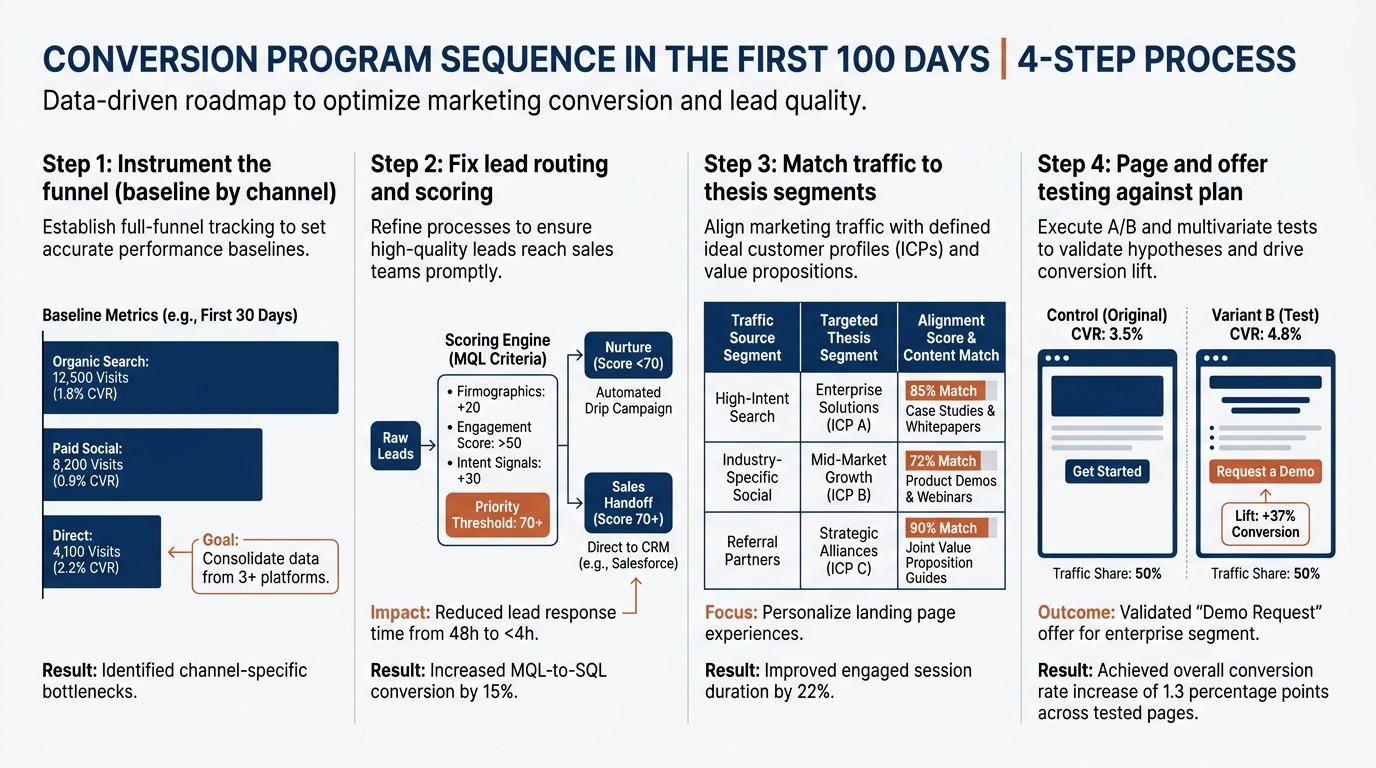
In a newly acquired company, conversion work competes with integration, system migration, and reporting cleanup for the same scarce team. The sequence that holds up is instrumentation first, then handoff, then page-level testing, because each stage depends on the one before it. Running page tests during a CRM migration wastes both.
This sequencing decision belongs in the first 100 days plan, tied to the same triggers as every other workstream: what has to be true before the next dependency can start. Conversion is rarely the Day 1 priority, and pretending otherwise crowds out work that has to happen first.
9. Decide build, retain, or hire
The staffing question sits with the operating partner. A one-time redesign is a project; ongoing conversion improvement is a retained capability that has to sit close to RevOps and reporting. Many portfolio companies lack the internal depth to run disciplined testing while also owning the CRM and the funnel data, which is where an outside retainer earns its place.
Whatever the model, the deliverable is a repeatable process that produces conversion changes tied to the forecast, with the reasoning and the evidence a board can review.
10. Know when this matters and when it does not
Conversion work pays off when traffic is reasonable, intent is right, and the leak is measurable, so the constraint is genuinely in the funnel. It does not pay off when the real problem is a product-market gap, a pricing issue, or a sales team that cannot close what it is given. Spending on conversion to cover a sales problem delays the diagnosis.
The trigger points where this earns a serious look are a flat pipeline forecast, an add-on that doubled the traffic without doubling the conversion discipline, or a first board meeting where the growth plan rests on demand generation with no funnel instrumentation behind it. BCG’s private equity research has consistently framed value creation as a sequencing problem, and conversion is one lever among several that has to be timed against the others.
11. A checklist before you approve the budget
- The program names which of the four layers it owns, with a decision-right owner on each.
- A baseline exists for visitor-to-lead and lead-to-opportunity rates by channel, auditable over a stable period.
- Each test states the downstream revenue metric it moves and the plan number it maps to.
- Lead routing, scoring, and ownership are fixed before page-level testing begins.
- The traffic strategy serves the accounts and segments named in the deal thesis.
- The team reports conversion changes that held over a month.
- The work is sequenced to complete before integration and migration begin.
- Impact is classified as realized, run-rate, or forecast, and the forecast is not presented as booked.
Run the same discipline here that a deal team applies to any private equity value creation lever: name the evidence, name the owner, and tie the claim to the number the board is underwriting.
12. The one decision that separates the two outcomes
The operating partner decision that determines the return is whether conversion work is wired into the revenue system or bolted onto the website. Wired in, it changes qualified pipeline and shows up in the forecast. Bolted on, it produces a prettier page and a flat number, and the quarter is gone. The scope question, the baseline, and the handoff all resolve to that single call.
If the goal is a conversion program judged by pipeline and forecast rather than by test counts, route the plan through the DevriX RevOps offer for portfolio companies and scope the work against the deal thesis before the next board meeting.