Most portfolio companies inherit a Salesforce instance that was configured by whoever happened to own the deal at the time. By the time an operating partner is looking at it, the pipeline number in the QBR does not match the number in the board deck, the sales team keeps two spreadsheets outside the CRM, and nobody can say what a stage-three opportunity actually means. That gap is not a reporting nuisance. It sits directly on forecast reliability, and forecast reliability is what the deal team, the CFO and the lender all price when they think about this asset.
If you are staffing the first 100 days or watching a revenue forecast miss plan, the question is not whether the company has Salesforce. It almost always does. The question is what to fix, in what order, and how to judge whether the spend is producing enterprise value or just producing activity. This guide covers how to decide and how to judge Salesforce RevOps for PE portfolio companies from the operator’s seat.
1. Start with the commercial consequence, not the platform
Salesforce is a general ledger for revenue, and like a financial ledger it is only as trustworthy as the discipline behind the entries. The reason to invest in it inside a portfolio company is narrow: a forecast the board can defend, a pipeline that converts predictably, and a data trail that survives confirmatory diligence at exit. Everything else is secondary.
Before approving a single hour of configuration work, write down which of these you are buying. Bain’s annual review of the industry has documented for years how much of the return now depends on operational improvement rather than multiple expansion, and a revenue system that produces a defensible forecast is one of the cheaper operational levers available. You can see that framing in Bain’s Global Private Equity Report.
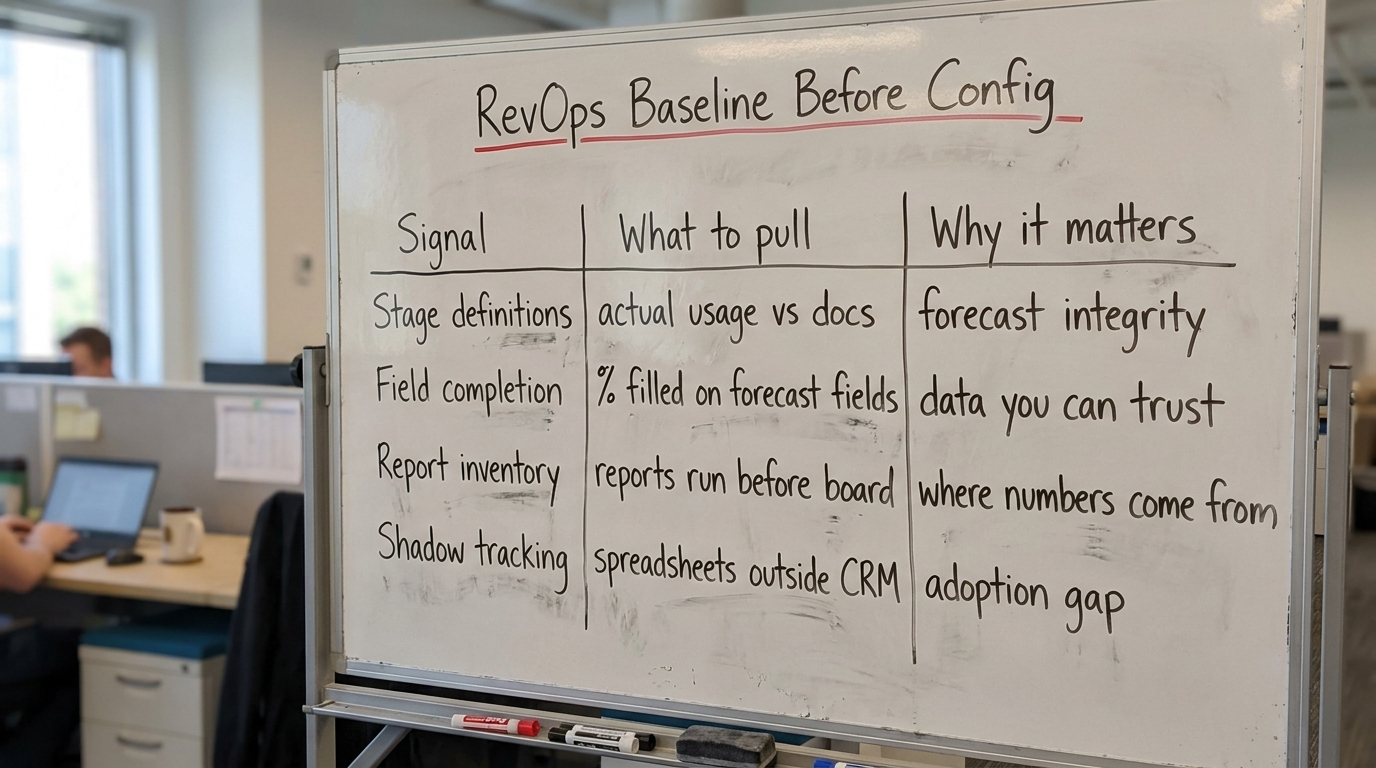
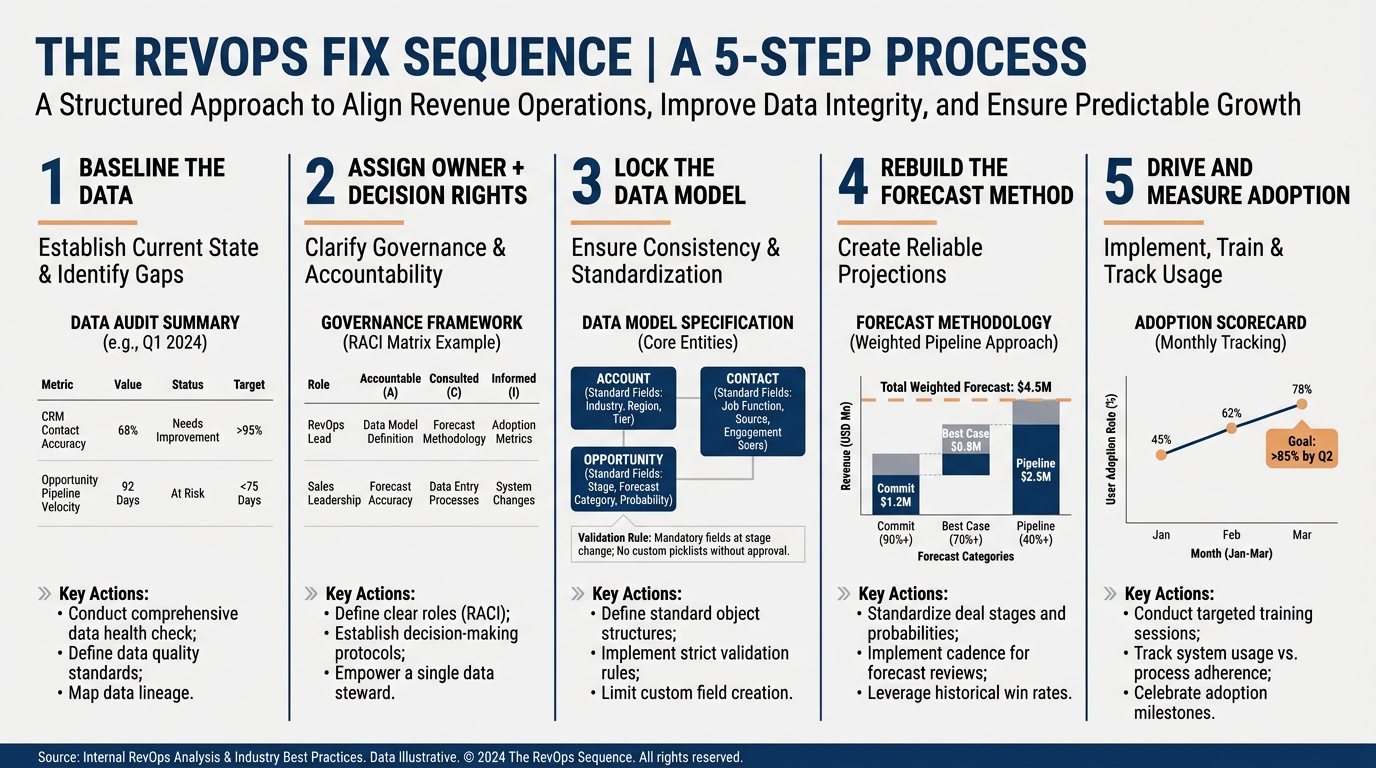
2. Establish the baseline before anyone touches the config
The first work requires measurement. Pull the last four quarters of closed-won and closed-lost, the stage definitions as they are actually used (not as documented), the field-completion rate on the fields the forecast depends on, and the list of reports the leadership team runs before a board meeting.
This is the same discipline a good technology due diligence exercise applies to the whole stack, narrowed to the revenue system. If the diligence work already flagged CRM data quality, that report is your starting baseline. If it did not, that is itself worth knowing before you rely on the numbers. It helps to read the underlying report critically, which is the subject of how to read a technical due diligence report before you sign off.
3. Decide the owner and the decision rights first
The most common failure in portfolio RevOps happens when nobody owns the system with authority to say no. Sales wants custom stages, marketing wants attribution fields, finance wants the forecast locked, and the admin quietly accommodates all three until the schema is unusable.
Name one owner for the revenue data model, ideally a RevOps lead who reports into the CFO or COO rather than into sales. Give that person the decision right over stage definitions, required fields and the forecast method. If the company is too small to justify a full-time hire, that is a case for a retained partner, but the decision right still has to live with someone accountable to the plan.
4. Fix the data model before the automation
Automation built on a broken data model scales the mess. The sequence that works is: agree the object model (accounts, contacts, opportunities, and how they relate), lock the stage definitions with exit criteria for each stage, then decide which fields are genuinely required to move an opportunity forward.
Keep required fields ruthlessly short. Every mandatory field a rep does not believe in becomes a garbage entry, and garbage entries are worse than blanks because they read as data. Only after the model is stable should anyone build validation rules, workflow automation, or the reporting layer on top of it.
5. Rebuild the forecast the board will actually use
A forecast is a claim about future cash, and the CFO has to be able to defend it in a board meeting and to a lender. Decide the forecast method explicitly: stage-weighted, commit-based, or a hybrid, and hold to one. Then reconcile the CRM forecast against the financial forecast every period until they stop diverging.
McKinsey’s private capital research has repeatedly tied value creation to management visibility and forecast discipline rather than to any single tool, and the point holds here. You can find that body of work through McKinsey’s research hub. The Salesforce forecast is only valuable to the extent the board trusts it more than the spreadsheet next to it.
6. Treat adoption as the real deliverable
A perfectly configured instance that reps route around delivers nothing. Adoption is measurable, so measure it: log-in frequency, opportunities updated within the current period, and the ratio of activity captured in Salesforce versus activity that exists only in inboxes and calendars.
Overservicing shows up here too. When a team maintains the CRM and a shadow tracker, someone is doing the work twice, and that duplicated effort is a cost the operating partner is paying without seeing it on any invoice. Kill the shadow system by making the CRM the only place the forecast comes from, then hold managers accountable for their team’s data hygiene as part of their number.
7. Judge the RevOps partner by evidence, not activity
If you are buying outside help, the register of features shipped, tickets closed and hours billed tells you almost nothing about whether enterprise value moved. Judge the work against the baseline from section two. Did forecast accuracy improve against actuals? Did the divergence between CRM and finance narrow? Did adoption rise on the metrics you set?
The same standard applies to any advisor working on the deal, and the discipline of choosing and judging one is covered in how to choose a technology due diligence advisor and judge the work. For the broader go-to-market side of this, choosing and judging a GTM strategy consultant uses the same evidence-first frame. Ask any partner to state their impact as realized, run-rate or forecast, and be skeptical of anyone who lets forecast improvement read as money already in the bank.
8. Sequence RevOps against the deal calendar
Timing changes what is worth doing. During the first 100 days, the priority is a trustworthy baseline and a forecast the first board meeting can rely on. Ahead of an add-on or a carve-out, the CRM has to be clean enough to merge or separate without corrupting the combined pipeline, which is why post-merger integration services and the CRM work need to be planned together rather than in sequence.
For carve-outs specifically, the transition service agreement often governs how long the seller’s Salesforce org stays available, and that clock sets the RevOps timeline. The tradeoffs there are covered in carve-out consulting and what operating partners actually need to decide.
9. Watch the licensing and integration cost
Salesforce cost is rarely just the seat count. Sandbox tiers, added clouds, connected apps and the integration middleware between Salesforce and finance systems all sit in the operating budget, and they compound as the company scales or acquires. Put the full run-rate cost, not the headline per-seat number, in front of the CFO before committing to an expansion.
The reporting and data standards that finance leaders expect from these systems are well documented by AICPA and CIMA, and holding the revenue system to those standards is what makes the forecast defensible at exit rather than a source of diligence friction.
10. The operating partner’s checklist
- State the commercial outcome you are buying: forecast reliability, faster conversion, or clean exit-ready data. Pick the primary one.
- Baseline the current instance before approving any configuration work, and reconcile it against the diligence report.
- Name one owner with the decision right over stages, required fields and the forecast method.
- Fix the data model and stage definitions before building any automation.
- Choose one forecast method and reconcile CRM against finance every period.
- Measure adoption directly and eliminate every shadow tracker.
- Judge any partner against the baseline, expressed as realized versus forecast impact, not against hours or features.
- Sequence the work against the deal calendar: baseline first in the first 100 days, clean data before any integration.
- Put the full run-rate licensing and integration cost in front of the CFO before expanding.
Run this sequence and the CRM stops being a reporting headache and starts being an asset the deal team can point to at exit. The connective tissue between a clean revenue system and enterprise value is the same logic that runs through the broader private equity operating agenda: measurable improvement, owned by someone accountable, judged against a baseline.
If you want the revenue system, the demand engine and the reporting layer treated as one workstream rather than three vendors, work with the DevriX Full-Funnel Demand and RevOps team on your portfolio company’s revenue operations.