An operating partner approving a portfolio company’s go-to-market plan for the year usually sees an ABM line item somewhere in the marketing budget, sitting next to demand gen and events, described in the language of campaigns and target account lists. That framing hides the actual question. Account based marketing for portfolio companies is a decision about where a limited sales and marketing budget concentrates over a hold period, and it commits the company to a named list of accounts that either does or does not map to the thesis the deal was underwritten on.
The commercial consequence is straightforward. If the target list is wrong, the company spends 12 to 18 months building pipeline in the wrong segment, and the revenue growth in the model does not arrive on schedule. This guide is written for the person who signs off on that spend, not for the person running the campaigns.
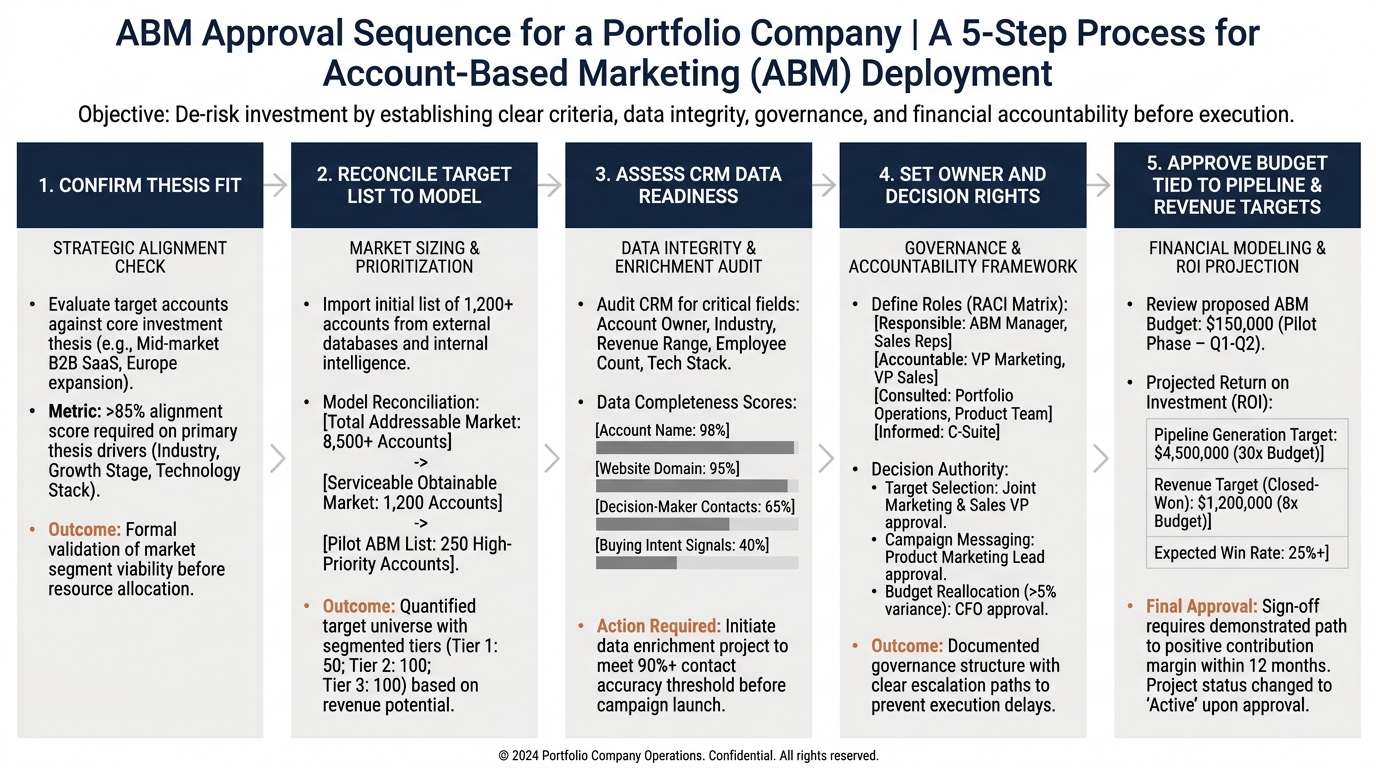
1. Decide whether ABM fits the thesis before you approve the budget
ABM concentrates spend on a small number of accounts with high contract value and long sales cycles. It suits a portfolio company selling six-figure deals to a definable set of buyers, and it works against a company whose growth comes from high-volume, low-touch transactions where broad demand generation is cheaper per dollar of revenue.
Before the budget is approved, someone needs to state, in writing, whether the growth thesis depends on winning more of a known account universe or on expanding a wide funnel. Bain’s annual private equity work has consistently tied disappointing hold-period returns to revenue plans that were never operationally specific, and this is one of the specific decisions that gets skipped. Read the value creation plan and check that the ABM spend serves the actual revenue mechanism, not a generic best-practice checklist.
2. Confirm the target account list maps to the underwriting
The single artifact that decides whether ABM works is the target account list, and in most portfolio companies it is assembled by the marketing team from whatever data is on hand rather than derived from the investment thesis. That is a defect worth catching early.
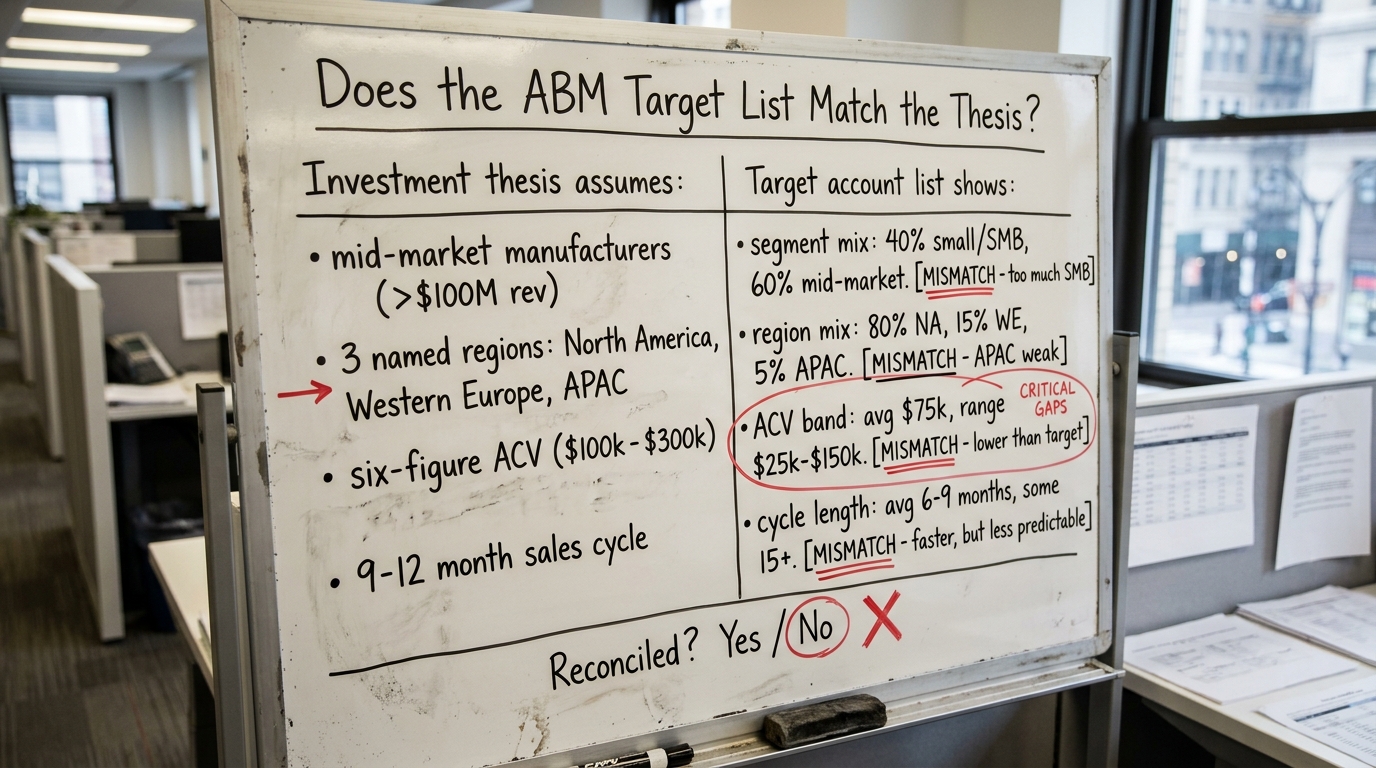
The list should be reconcilable to the model. If the thesis calls for growth in mid-market manufacturing in three regions, the account list should be dominated by mid-market manufacturers in those regions, with a documented count and a reasonable estimate of how many the company can realistically reach in a year. When the list and the model disagree, the model is usually right and the list needs rebuilding.
3. Judge the data and systems ABM will run on
ABM is only as good as the account and contact data underneath it, and portfolio companies routinely underestimate the state of their own CRM. A target list of 300 accounts is worthless if the CRM holds duplicate records, stale contacts and no reliable account hierarchy. This is the same class of problem that surfaces in technical due diligence for the mid-market, where the systems look functional in a demo and fail under real operating load.
Before committing spend, get an honest read on match rates, data completeness and whether marketing and sales share a single definition of an account. If the plumbing is broken, the first quarter of the ABM budget goes to fixing data, and the pipeline arrives later. State that clearly in the board meeting rather than discovering it in Q3.
4. Sequence the work against the hold period, not the calendar year
ABM produces pipeline slowly and revenue more slowly still, because the deals it targets have long cycles by definition. A company at the start of a five-year hold can absorb a two-quarter build before pipeline shows. A company 30 months into a hold with an exit in view cannot, and for that company the honest answer may be that ABM will not move the number in time.
Tie the sequencing to real triggers. If ABM is part of the first 100 days plan, the target list and CRM readiness need to be settled inside that window, because everything downstream depends on them. If it is a mid-hold acceleration move, judge it against the exit timeline, not against a marketing team’s annual planning cycle.
5. Set the owner and the decision rights
ABM fails quietly when marketing owns the list and sales ignores it. The two functions have to agree on the same accounts, the same definition of engagement, and the same handoff, and someone senior enough to overrule both needs the decision right when they disagree.
In a portfolio company that usually means the revenue leader, or the operating partner acting through them. Name that person before the money moves. McKinsey’s work on private capital value creation repeatedly points to unclear operating ownership as a reason plans stall, and ABM is a textbook case because it lives on the seam between two functions that report to different people.
6. Define the metrics that actually indicate progress
Impressions, clicks and list coverage are activity, and a board that accepts them as evidence will be surprised at exit. The metrics that matter are account engagement moving toward opportunities, pipeline created in target accounts, and eventually closed revenue that reconciles to the thesis segments.
Leading indicators worth tracking in the first two quarters
- Percentage of target accounts with any recorded engagement from a buying-committee contact.
- Number of target accounts that have converted to a qualified opportunity.
- Pipeline value inside the target list versus outside it.
Lagging indicators the board should hold the team to
- Closed revenue from target accounts against the plan figure for the segment.
- Average contract value in target accounts versus the rest of the book.
- Sales cycle length in target accounts, since a shortening cycle is a real sign the motion is working.
7. Decide build, buy or retain
Most portfolio companies cannot staff a credible ABM motion from the existing marketing team, because it needs data operations, campaign execution and sales alignment at the same time. The realistic options are hiring, engaging an agency for execution, or bringing in a RevOps partner to build the system and hand it back.
The choice depends on how repeatable the motion needs to be. If the platform intends to run the same play across several add-ons, building a repeatable system inside a RevOps engagement is usually cheaper over the hold than paying an agency to re-execute it each time. This is the same build-versus-buy logic operating partners apply in post-merger integration, and the discipline transfers directly.
8. Judge the vendor or hire on evidence, not deck quality
Whoever runs ABM should be able to show a target list reconciled to a revenue model, a data-readiness assessment of the actual CRM, and a reporting view that ties account engagement to pipeline. A vendor who leads with case studies and campaign creative, and cannot produce those three artifacts, is selling activity.
Apply the same scrutiny you would apply when you choose and judge a technology due diligence advisor: ask what they will hand you, how you will verify it, and what the company keeps when the engagement ends. The buyer who defines the deliverables gets a system; the buyer who buys a promise gets a monthly retainer with no asset at the end.
9. Connect the spend to enterprise value
A PE-backed buyer is funding measurable revenue and EBITDA improvement, and ABM has to be justified in those terms or not at all. The honest way to frame it is as forecast value with a stated path to realized: this spend is expected to produce this much pipeline in these segments, converting to this much revenue by this date, improving the multiple story at exit.
BCG’s private equity research has made the same point about value creation levers generally, that they need to be tied to a financial outcome and a timeline rather than presented as good practice. Hold the ABM budget to that standard before approval and at every board meeting after.
10. A short checklist before you sign off
- The growth thesis genuinely depends on winning a known account universe.
- The target account list reconciles to the segments and regions in the model.
- The CRM data has been assessed and any remediation is costed and scheduled.
- ABM is sequenced against the hold period and the exit timeline.
- A named revenue owner holds the decision right when sales and marketing disagree.
- The board reports on pipeline and revenue in target accounts.
- The build-versus-buy choice reflects how many times the motion will be repeated across the platform.
- The vendor or hire can produce a reconciled list, a data assessment, and pipeline reporting on request.
The same operator discipline that governs a GTM strategy engagement and a broader private equity value creation plan applies here, and the earlier a target list and CRM state are examined the fewer surprises land at exit. For companies where an add-on is coming, the ABM system should be built to absorb the acquired company’s accounts, which is a point best settled during technology due diligence rather than after close.
11. Next step
If you are deciding whether an ABM budget belongs in a portfolio company’s plan this cycle, and you want the target list reconciled to the thesis and the CRM assessed before the money commits, review the RevOps and revenue-system work in the DevriX private equity offer and bring the specific company and its hold timeline to the conversation.