When a corporate parent agrees to sell a division, the deal team inherits a business that has never run on its own. The seller’s IT, finance systems, CRM, marketing stack and data all live inside the parent’s environment, governed by a Transition Services Agreement (TSA) with a clock on it. The operating partner accountable for that asset has a narrow window, usually the length of that TSA, to stand up an independent revenue system before the meter runs out and service reverts to something the buyer no longer controls. That is the commercial problem carve out consulting exists to solve, and it is why judging the work badly is expensive: a slipped standup means paying the seller for extended TSA coverage, or worse, going dark on pipeline visibility during the exact quarter the thesis needs to hold.
This guide is written for the person who owns that outcome inside a portfolio company or on a deal team. It assumes budget authority and a working knowledge of how private equity operates. The question here is not what a carve-out is. The question is what to decide, in what order, and how to tell whether the consultant across the table can actually deliver a functioning revenue system before Day 1 becomes a liability.
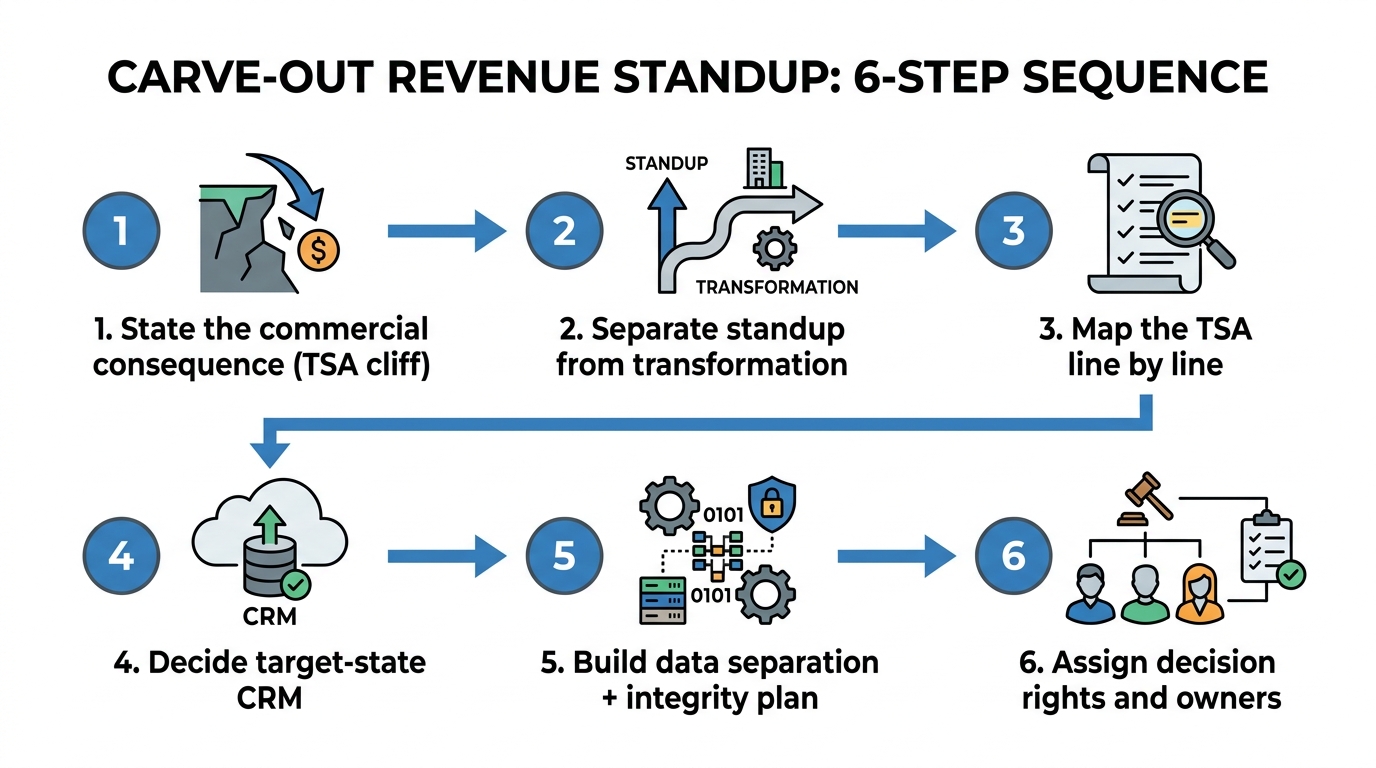
1. Name the commercial consequence before scoping anything
Carve-out complexity is not evenly distributed, and the parent’s separation cost tends to land disproportionately on the systems that touch revenue. Bain’s annual private equity report has tracked carve-outs as a persistent share of deal activity precisely because they are hard, not because they are easy money. The consequence a buyer cares about is specific: how many days of independent revenue operation stand between close and the TSA cliff, and what breaks if that gap is not closed.
Before any consultant scopes a workstream, the operating partner should be able to state the consequence in one sentence. Something like: “If CRM and marketing automation are not migrated off the parent’s instance by month four, we lose lead attribution and the sales team reverts to spreadsheets.” That sentence is the baseline everything else gets measured against.
2. Separate the standup from the transformation
The most common failure in carve out consulting is scope creep dressed as ambition. A consultant who arrives proposing a best-in-class revenue stack, a new CRM philosophy and a data warehouse rebuild is solving the wrong problem on the wrong clock. The first-100-days job is standup: replace what the TSA is providing with something the company owns and operates, at parity or better, before the deadline.
Transformation comes after. McKinsey’s private capital research has repeatedly made the point that value creation in the early ownership period rewards sequencing over simultaneity. Judge the consultant on whether they can draw a hard line between “what must exist by TSA exit” and “what we improve once we are independent.” If they cannot, they will burn the runway on the second while the first slips.
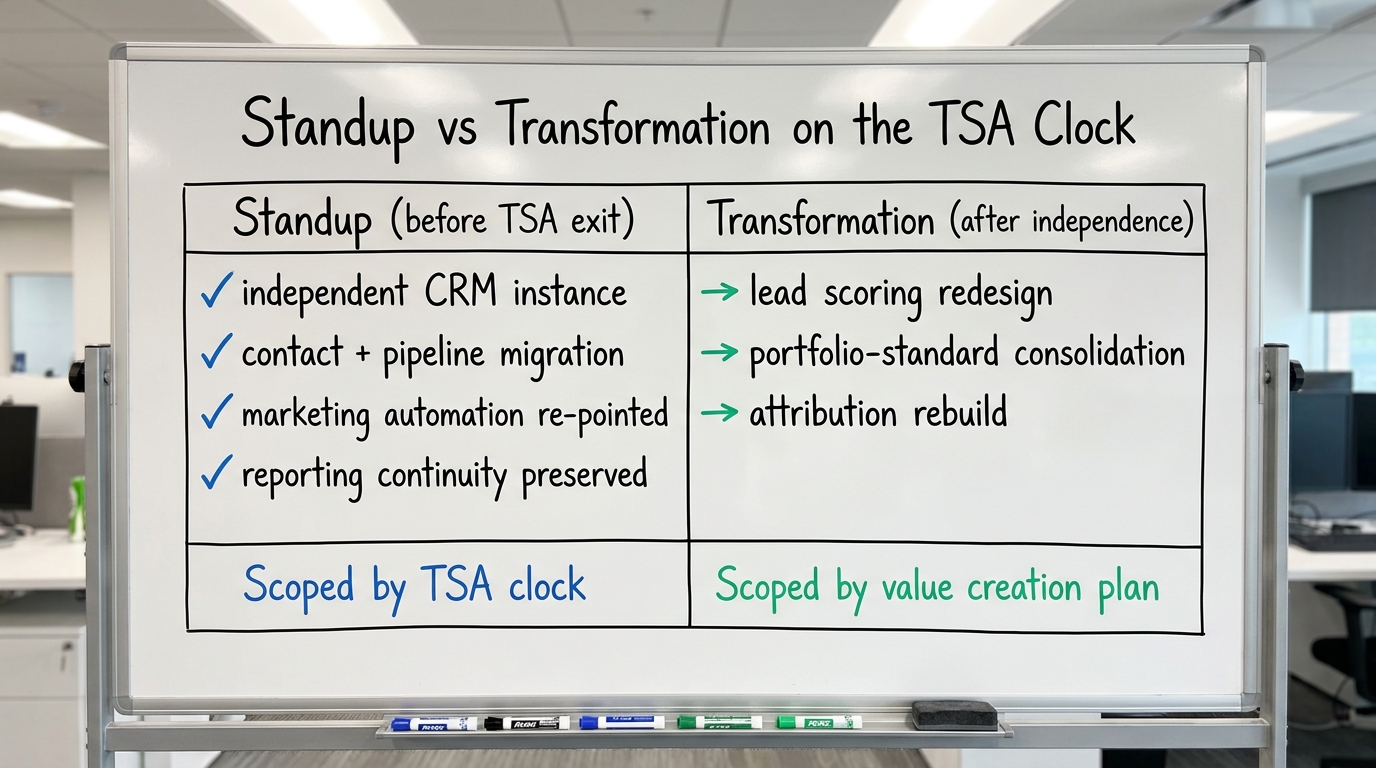
Standup versus transformation, in practice
- Standup: stand up an independent CRM instance, migrate contacts and pipeline, re-point marketing automation, preserve reporting continuity.
- Transformation: redesign lead scoring, consolidate onto a portfolio-standard platform, rebuild attribution modeling.
The first is scoped by the TSA clock. The second is scoped by the value creation plan. A good consultant refuses to blur them.
3. Read the TSA as the real project schedule
The TSA is not a legal footnote. It is the project schedule, the risk register and the budget constraint in one document. Every service the parent provides has an end date and a monthly cost. Carve out consulting that does not start from a line-by-line reading of the TSA is guessing.
The operating partner should require the consultant to map each TSA line to a replacement workstream, an owner, a target date and a dependency chain. Where a service has no clear replacement path, that is a flagged risk, not an assumption to be resolved later. The Harvard Law School Forum on Corporate Governance has published extensively on how separation agreements shape post-close execution, and the recurring lesson is that ambiguity in the TSA becomes cost overrun after close.
4. Decide the target-state CRM before touching data
Nothing in a revenue carve-out matters more than where the CRM lands, because it anchors pipeline, forecasting and every downstream report the board will ask about. Two questions decide it: does this asset get its own instance, or does it fold into a portfolio standard, and can the migration happen inside the TSA window either way.
This decision has enough weight to warrant its own analysis. The trade-offs between a clean standalone build and consolidating onto a shared platform are covered in depth in this RevOps decision guide on CRM standardization across portfolio companies, and the consolidation-specific version of the same call is laid out in the operator’s guide to CRM consolidation. For a carve-out specifically, the default should bias toward the fastest route to independence, standardization can follow once the asset is off the seller’s systems.
5. Insist on a data separation and integrity plan
Data is where carve-outs quietly fail. The parent’s CRM holds records belonging to businesses the buyer did not acquire, and untangling which contacts, accounts and opportunities transfer is real forensic work. A consultant should produce a data separation plan that names what moves, what stays, how ownership is proven, and how integrity is validated after migration.
Where conflicting CRM architectures are involved, the technical mechanics deserve their own roadmap. The approach in this post-merger integration guide on unifying conflicting CRM architectures applies directly, even when the situation is a separation rather than a merger. The operating partner’s job is to confirm the plan has a validation step, migrating data without reconciling it against a source of truth is how forecasts silently break.
6. Tie every workstream to a decision right and an owner
A carve-out generates dozens of parallel decisions across CRM, marketing automation, analytics, web properties and integrations. Without clear decision rights, the consultant becomes a bottleneck and the timeline slips waiting on approvals nobody was assigned to give.
Require a RACI-style map where each workstream has a named owner on the portfolio side, not just on the consultant’s side. The consultant executes, but the accountable owner sits inside the company. BCG’s work on principal investors and portfolio value creation consistently ties early-ownership success to clear governance, and a carve-out is the sharpest test of it.
7. Judge the consultant on evidence, not narrative
Commercial-intent buyers get pitched a lot of narrative. The discipline is to ask for evidence a claim is real. Good questions to put to a carve out consulting firm:
- Show a TSA-to-workstream map from prior work, redacted, with owners and dates.
- Name the actual-versus-plan tracking mechanism you will report against at the first board meeting.
- What is the rollback plan if a migration cutover fails on the scheduled date?
- How do you validate data integrity post-migration, and who signs off?
The framework for evaluating this class of advisor is worth reading alongside this guide. Both the piece on how to judge a revenue operations consultant for private equity and the companion on how to hire and judge a GTM strategy consultant apply the same evidence-first test used here.
8. Connect the standup to the value creation plan
A revenue standup is not an IT project, it is the foundation the value creation plan sits on. Pipeline visibility, forecast reliability and lead attribution are what let the board judge whether the thesis is tracking. If the carve-out delivers a technically independent system that produces worse revenue visibility than the parent had, the standup succeeded and the value plan lost.
This is where carve out consulting connects to go-to-market execution. The decisions covered in these guides on GTM value creation for portfolio companies and the RevOps decisions portfolio companies face are the same decisions the standup either enables or forecloses. The consultant should be able to say how their standup preserves or improves the metrics the value plan depends on.
9. Understand where the technical due diligence hands off
Much of what determines standup difficulty was, or should have been, surfaced during diligence. The state of the seller’s systems, the depth of integration into the parent, and the realism of the TSA timeline are all findings that belong in technology due diligence. When diligence was thin, the carve-out consultant inherits surprises that should have been risks on a register.
The operating partner should treat the handoff between diligence and the first 100 days as a formal transfer of a risk register, not a fresh start. Ask the consultant what diligence findings they are building the plan around, and what they are treating as unknown. PitchBook and S&P Global Market Intelligence both track how execution risk concentrates in the early ownership period, and carve-outs sit at the top of that distribution.
10. A next-step checklist for the accountable operator
Before engaging carve out consulting, the operating partner or portfolio executive should be able to confirm each of the following:
- The TSA has been read line by line and each service mapped to a replacement workstream, owner and date.
- The commercial consequence of missing the TSA cliff is stated in one sentence and agreed.
- Standup scope and transformation scope are documented separately, on separate clocks.
- The target-state CRM decision is made, with a migration path that fits the TSA window.
- A data separation and integrity plan exists, with a named validation and sign-off step.
- Every workstream has a named accountable owner inside the company, not only the consultant.
- The consultant reports actual versus plan against a mechanism agreed before Day 1.
- Diligence findings have been handed over as a live risk register, not discarded.
If any line cannot be confirmed, that is the next conversation to have before the engagement starts, not after the first cutover slips.
11. Where to take this next
A carve-out revenue standup is judged on one thing: whether an independent, board-legible revenue system exists before the TSA runs out, without losing the visibility the value plan depends on. Everything above is about protecting that outcome.
For operating partners and portfolio executives scoping a revenue carve-out against a live TSA clock, review the DevriX and GrowthShuttle Carve-Out Digital Standup offer to see how the standup workstreams, TSA mapping and Day 1 revenue continuity are structured for delivery inside the window.