An operating partner inherits a portfolio where every company runs a different CRM, or worse, three CRMs each and a spreadsheet the sales director actually trusts. Pipeline reported to the board does not reconcile with what the systems hold. Forecast reliability is thin, and no two companies define a “qualified opportunity” the same way. The question on the table is whether to force CRM standardization across portfolio companies, and if so, how far to push it, how fast, and how to know it worked. That decision moves real money: it affects forecast accuracy at the board level, integration speed on add-ons, and the quality of the revenue story a buyer will underwrite at exit.
This guide is written for the person accountable for revenue systems in a portfolio company, or the operating partner sitting above several of them. It skips the vocabulary lesson and gets to the decisions and the tests you should apply to them.
1. Decide whether standardization is the real objective
Standardizing the CRM platform is not a goal. Reliable revenue data, faster integration, and cleaner forecasting are goals. A single instance of one CRM across every company is one way to get there, and often not the fastest.
Before committing budget, name the outcome the sponsor actually wants:
- Forecast reliability the board and lender can trust each quarter.
- Faster add-on integration, so the next acquisition is producing clean pipeline data in weeks, not quarters.
- Cross-portfolio visibility, so the sponsor can compare companies on the same definitions.
- Exit readiness, so a quality-of-earnings review does not stall on unreconcilable revenue systems.
Each of these implies a different depth of standardization. Forecast reliability may only need shared stage definitions and reporting logic. Cross-portfolio benchmarking may need a common data model. A full platform migration is the most expensive option and rarely the one the thesis requires. Bain’s annual private equity report has consistently found value creation shifting toward operational improvement rather than financial engineering, which is exactly what disciplined revenue-system work supports. Read the current view in the Bain & Company Global Private Equity Report.
2. Separate the four layers of standardization
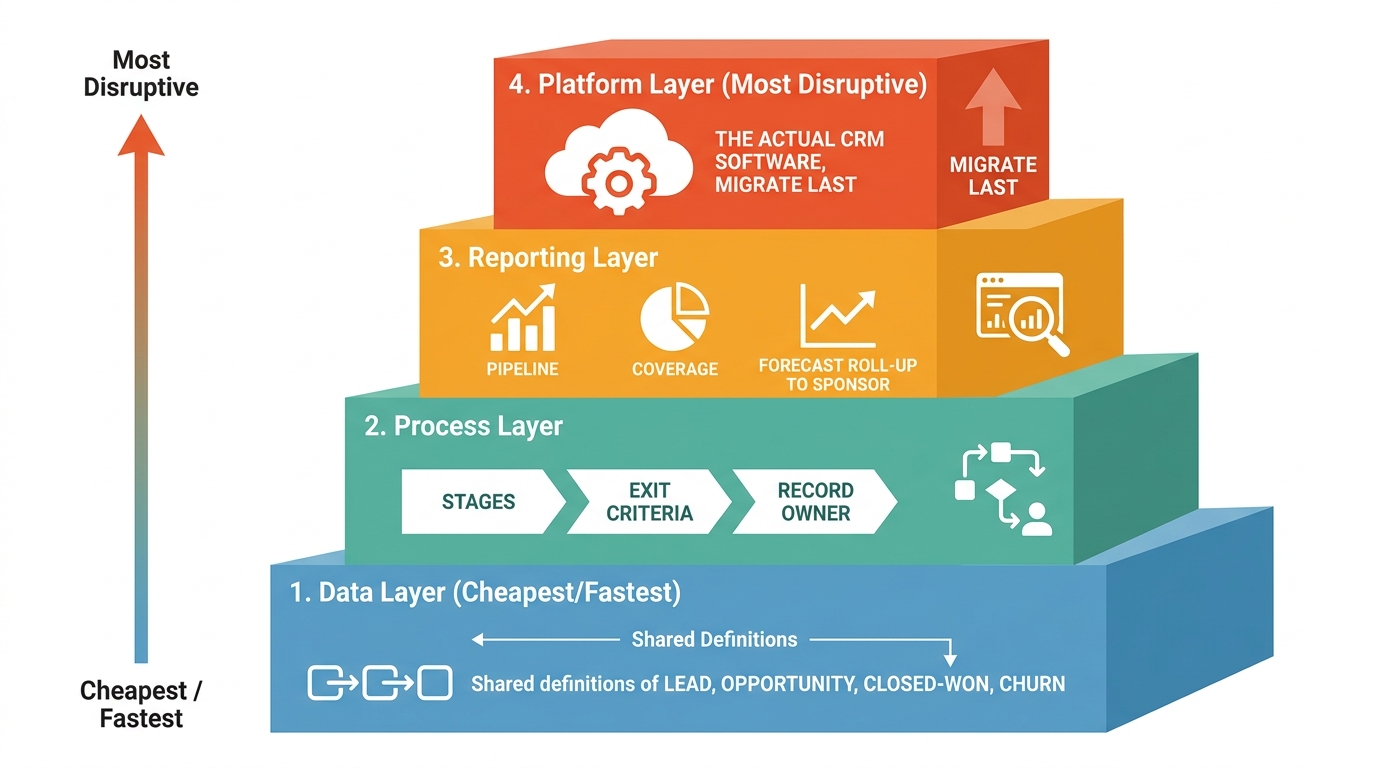
Most failed CRM programs treat “standardize the CRM” as one decision. It is four, and they can be sequenced independently.
The data layer
Common definitions: what counts as a lead, an opportunity, a closed-won deal, a churned account. This is where forecast reliability is won or lost, and it is the cheapest layer to fix first.
The process layer
The stages a deal moves through, the exit criteria for each, and who owns the record. Process alignment is what makes numbers comparable across companies.
The reporting layer
How pipeline, coverage, and forecast roll up to the sponsor. You can standardize reporting on top of different underlying platforms with a data warehouse long before you migrate anyone.
The platform layer
The actual CRM software. This is the most disruptive and least urgent layer. Migrate here only when the data, process, and reporting cases justify the cost and the change management.
3. Set the baseline before you touch anything
You cannot judge a standardization program without a documented starting point. Capture, per company: current CRM platform and version, seat count and actual active usage, integration dependencies, current stage definitions, and the last four quarters of forecast accuracy against actual. That baseline is your evidence. It also protects you when a company claims disruption; you have the before-state on record.
This work overlaps heavily with any technology due diligence performed at acquisition. If diligence was done well, much of the baseline already exists. If it was not, the first weeks of ownership are where you build it.
4. Choose a target model based on the thesis, not the loudest vendor
Three target models are common, and the right one depends on how tightly the portfolio is meant to operate together.
- Single shared instance. One CRM, one configuration, all companies inside it. Best when the portfolio is being built into a single operating platform. Highest disruption, highest visibility.
- Federated with a common standard. Each company keeps its own instance but conforms to shared definitions, stages, and reporting fields. Best when companies serve different markets but the sponsor needs comparable numbers.
- Reporting-layer only. Platforms stay as-is; a warehouse harmonizes the data for board reporting. Fastest to deliver, weakest at changing day-to-day sales behavior.
McKinsey’s work on private capital operating models makes the same point repeatedly: the operating design should follow the value-creation thesis, not a template. See the McKinsey private capital research hub for their perspective on portfolio operating value.
5. Sequence it against the first 100 days and the deal calendar
Timing is a decision, not a detail. Ripping out a CRM in the middle of a sales quarter destroys pipeline data and burns credibility with the very sales leaders whose adoption you need. Anchor the program to real triggers: the first 100 days after close for baseline and quick data-layer wins, a natural quarter boundary for process changes, and a low-season window for any platform migration.
When an add-on lands, the sequence tightens. This is where post-merger integration discipline matters, and where conflicting CRM architectures become a live workstream. The mechanics of reconciling two live systems are covered in this guide to unifying conflicting CRM architectures.
6. Assign decision rights before the project starts
The most common cause of stalled standardization is unclear authority. Name, in writing:
- Who owns the shared data standard across the portfolio.
- Which decisions a portfolio company CEO can override, and which they cannot.
- Who signs off on stage definitions and reporting logic.
- Who arbitrates when a company’s edge case conflicts with the standard.
Without this, every configuration choice becomes a negotiation, and the timeline triples. Governance quality is a recurring theme in the Harvard Law School Forum on Corporate Governance, and the same principle holds at the operating level: decision rights defined up front prevent value leaking into endless debate.
7. Judge the delivery partner on evidence, not slideware
Whether the work runs internally or through a RevOps partner, apply the same test you would to any operator. Ask for the before-state baseline, the specific migration method, the data-integrity checks, and how they will measure forecast accuracy after cutover. Vendors who lead with ticket counts and hours are selling activity, not outcomes. The framework for vetting this is laid out in how to judge a revenue operations consultant for private equity.
For the wider decision of what RevOps should own across a portfolio, this companion piece on RevOps for private equity portfolio companies maps the decisions and the tests.
8. Instrument the outcome, not the migration
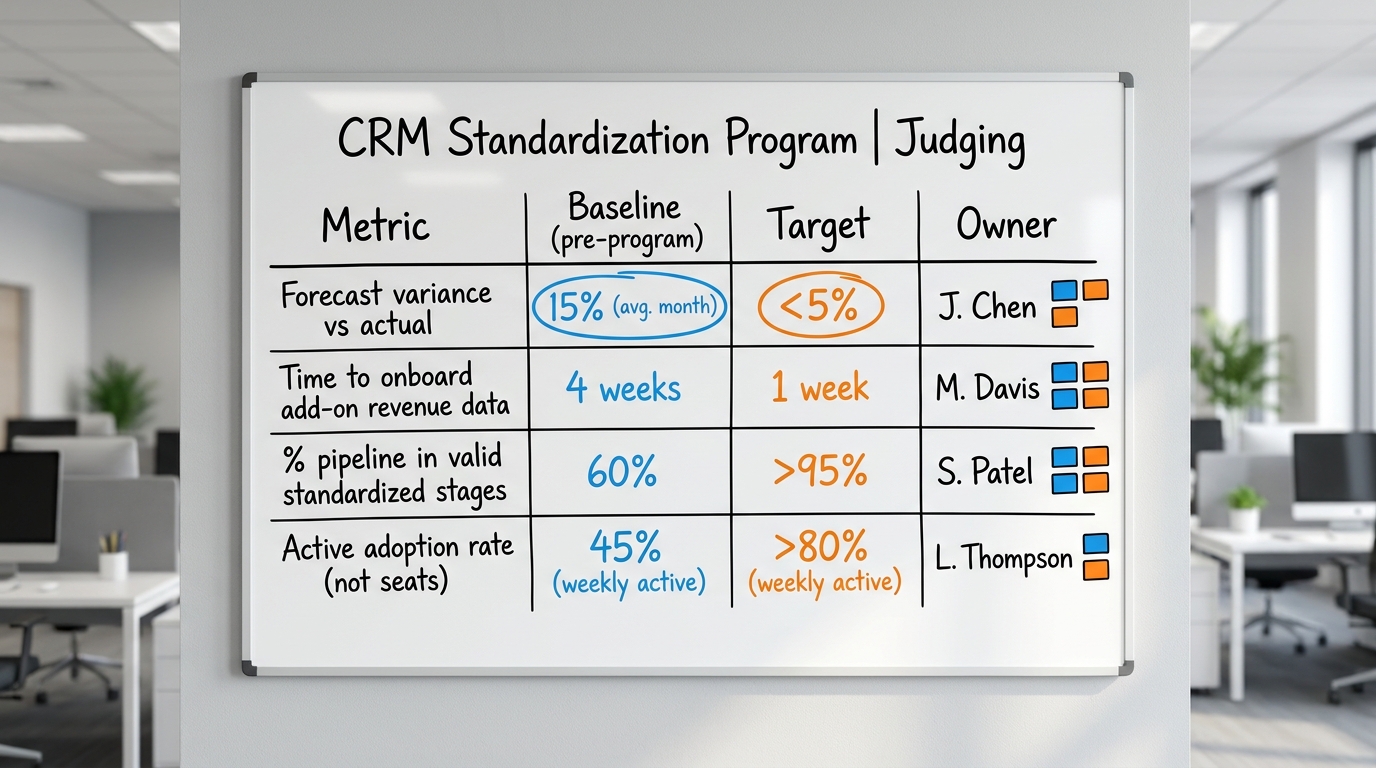
A CRM program that finishes “on time” but does not improve forecast accuracy has failed. Define success in commercial terms before you start:
- Forecast variance against actual, quarter over quarter.
- Time to onboard a new acquisition’s revenue data.
- Percentage of pipeline sitting in the standardized stages with valid data.
- Active adoption rate by the sales team, not license count.
Track these against the baseline from section 3. That is what makes the program defensible to the board and, later, to a buyer’s diligence team. PitchBook and S&P Global both publish data on how operational reporting quality affects deal execution; for context on market conditions, see PitchBook research and data and S&P Global Market Intelligence.
9. Watch for the predictable failure modes
Three patterns sink these programs. First, standardizing the platform while leaving definitions inconsistent, which produces one clean-looking system full of incomparable numbers. Second, migrating during a live sales push and losing the pipeline data everyone relied on. Third, treating adoption as automatic because the software is installed; without process ownership and training, sales teams route around the system and the data decays within a quarter.
10. The operator’s checklist
Before approving any CRM standardization budget across the portfolio, confirm each item:
- The commercial objective is named: forecast reliability, integration speed, cross-portfolio visibility, or exit readiness.
- The four layers are separated, and the program starts with the cheapest layer that delivers the objective.
- A per-company baseline exists, including four quarters of forecast accuracy.
- The target model matches the value-creation thesis, not a vendor default.
- Sequencing is anchored to close, quarter boundaries, and low-season windows.
- Decision rights and override authority are documented before work begins.
- The delivery partner is judged on baseline, method, and post-cutover measurement.
- Success is defined in forecast variance and adoption, not go-live dates.
Standardization done in this order improves management visibility and forecast reliability early, reduces integration risk on future add-ons, and produces a revenue system a buyer can underwrite without a discount for messy data. For the broader operating context, DevriX maintains a hub on private equity value creation that connects these RevOps decisions to the wider thesis.
11. Next step
If a CRM standardization program is on the near-term plan for one company or the whole portfolio, scope it against a documented baseline and a defined commercial objective before committing budget. Route the decision through the DevriX / GrowthShuttle PE RevOps offer to pressure-test the sequence, decision rights, and success metrics before work starts.