When a portfolio company misses its bookings plan two quarters in a row, the operating partner rarely gets a clean answer to why. The CRM says one thing, the finance model says another, and the sales leader has a third story. That gap is a revenue operations problem, and it costs money at exit because a buyer discounts a forecast it cannot trust. If you are an operating partner or a portfolio company executive holding the number, the decision in front of you is not whether to “do RevOps.” It is where to spend limited capital and management attention so that pipeline, conversion and forecast reliability actually move before the next board meeting.
This guide is written for the person accountable for the revenue system, not for someone learning the discipline. It covers what to decide, in what order, and how to judge whether the work is producing enterprise value or just activity.
1. Why RevOps sits on the value-creation plan, not the IT budget
RevOps for private equity portfolio companies earns its place on the value-creation plan when it changes one of a small set of outcomes: revenue growth, gross-margin retention, forecast reliability, or a faster path to a defensible exit story. Everything else is overhead dressed up as strategy.
Bain’s annual Global Private Equity Report has tracked for years how sponsors are relying more on operational improvement and less on multiple expansion to generate returns. That shift is the reason RevOps matters to a deal partner at all. A cleaner revenue engine is not a nice-to-have inside a hold period measured in a few years. It is the difference between a management team that can defend its pipeline in a sale process and one that cannot.
Judge every proposed initiative against a single test: does it move growth, margin, cash conversion, or forecast credibility? If it does not map cleanly to one, it is a lower priority than whatever does.
2. Establish the revenue baseline before you touch anything
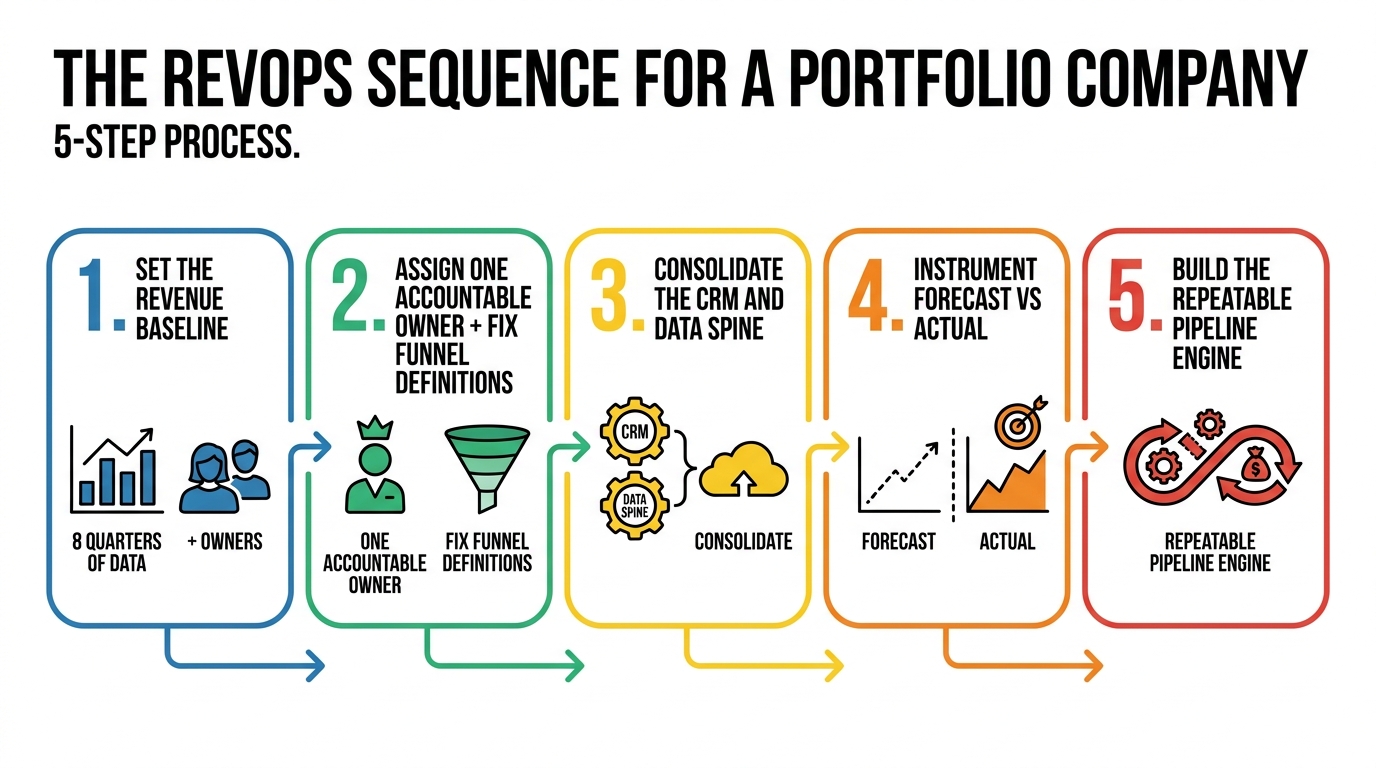
The first job is not tooling. It is evidence. You cannot claim improvement without a defensible baseline, and in most portfolio companies the baseline does not exist in usable form.
Pull the last eight quarters of pipeline, win rate by segment, sales-cycle length, average deal size, net revenue retention, and the historical gap between forecast and actual. Where the CRM data is too dirty to trust, say so in writing and treat data quality as its own workstream. This is the same discipline a buyer applies during technology due diligence: assertions without evidence get discounted.
The output of this step is one page: current-state metrics, the confidence level of each, and the owner of each number. If nobody owns net revenue retention, that is a finding.
3. Decide who owns the revenue system
The most common failure is not a missing tool. It is a missing decision right. Marketing owns the top of funnel, sales owns the middle, finance owns the reporting, and no single person owns the handoffs where deals leak.
Name a single accountable owner
Assign one executive accountable for the end-to-end revenue process, with authority over definitions (what counts as a qualified lead, when a deal is committed) and over the reporting that reaches the board. In a smaller portfolio company this may be the CRO or even the CEO. The title matters less than the fact that one person can be held to the number.
Fix the definitions before the dashboards
Conflicting stage definitions produce conflicting forecasts. Agree the funnel stages, the exit criteria for each, and the single source of truth for the number that goes to the board. Do this before buying reporting software, because a dashboard on top of bad definitions just makes the wrong number faster.
4. Consolidate the data spine, especially after add-ons
Roll-up theses live or die on integration. When a platform acquires an add-on, you inherit a second CRM, a second set of stage definitions, and a second version of the truth. Left alone, this permanently corrupts the consolidated forecast.
The technical work here is real and often underestimated. Consolidating two or more systems is a project with dependencies, not a weekend migration, and it is worth reading a detailed treatment such as this post-merger integration guide to unifying conflicting CRM architectures before scoping it. Decide early: one system of record, mapped fields, and a migration plan with a rollback. This work usually belongs in the first 100 days plan, because the longer two systems run in parallel, the more expensive the reconciliation becomes.
5. Instrument forecast versus actual as a standing report
A CFO cares about one thing above dashboards: whether the forecast can be believed. McKinsey’s private capital research and BCG’s work on principal investors both point to forecast reliability and operating rigor as recurring drivers of value in the current environment, where cheap leverage no longer carries returns on its own.
Build a standing report that shows forecast versus actual by segment, with variance explained. Over three or four quarters this report becomes the single most valuable artifact you own, because it is the thing a buyer’s diligence team will test. A management team that has predicted its own number for a year commands a better process than one that has not.
6. Build the pipeline engine, not just the pipeline
Once the data spine and definitions are sound, the growth question becomes tractable. The goal is a repeatable demand engine, not a heroic quarter.
Match channels to the actual buyer
For portfolio companies with a content and publishing motion, the leverage is often in the top of funnel. Depending on the model, that can mean disciplined omnichannel distribution across social, email and video, tighter content strategy, or lower-cost reach through micro-influencer partnerships. Pick the channels that fit the buyer and the margin structure, and instrument each one to cost per qualified opportunity, not vanity traffic.
Treat the engine as an asset with a run rate
Classify what you are building honestly. A campaign that closed this quarter is realized. A rebuilt lead-scoring model that has not run a full cycle is enabled value, not realized. Do not let a pipeline you hope for read to the board as a pipeline you have.
7. Judge the work like a diligence team would
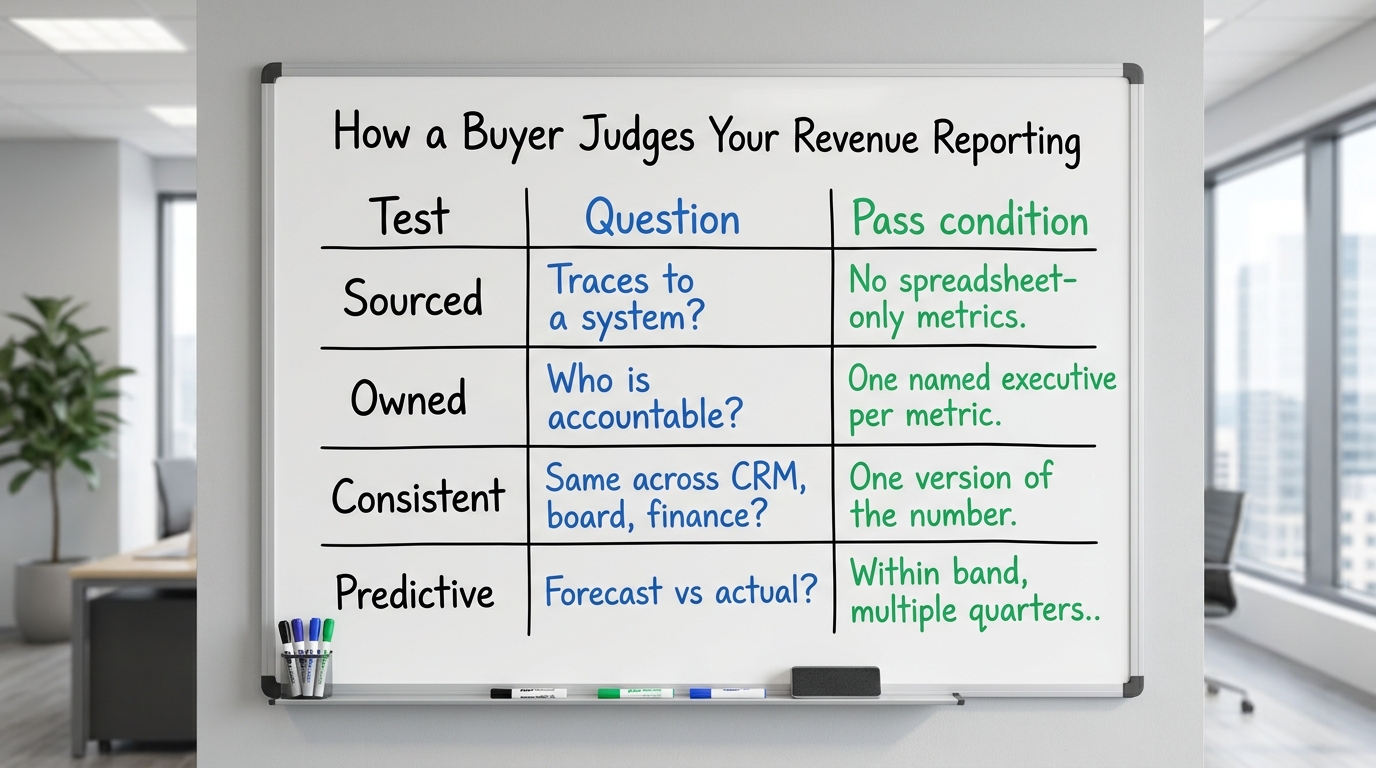
The test of good RevOps is whether it survives scrutiny. Apply the standard a buyer applies: is the number sourced, is it owned, and does the trend hold when you segment it?
- Sourced. Every board metric traces to a system, not a spreadsheet reconstructed by one person.
- Owned. Each metric has a named accountable executive.
- Consistent. The revenue number is the same in the CRM, the board deck and the finance model.
- Predictive. Forecasts have tracked actuals within a defensible band for multiple quarters.
PitchBook’s research and data and reporting outlets like Buyouts both document how much sharper diligence has become on the quality and durability of revenue. Reporting that fails these four tests will be discounted in a sale process, and that discount is real money against the multiple.
8. Sequence spend against real triggers, not the calendar
The events that should trigger RevOps investment are concrete: signing an LOI on an add-on, the first board meeting after close, a system migration, or a forecast that has broken twice. Tie each initiative to one of these, and resist funding work that is not attached to a decision someone actually has to make.
The reason this matters commercially is that operating partners have finite attention. Governance-focused readers can see the same logic play out in board practice on the Harvard Law School Forum on Corporate Governance, where forecast credibility and management reporting recur as themes. Spend where the trigger is live.
9. The decision checklist
Before approving a RevOps program or retainer, an operating partner or portfolio executive should be able to answer these:
- Is there a documented revenue baseline with owners and confidence levels?
- Is one executive accountable for the end-to-end revenue system and its definitions?
- Is there a single source of truth for the board number after any add-on integration?
- Does a forecast-versus-actual report exist as a standing artifact?
- Does every proposed initiative map to growth, margin, cash conversion or forecast credibility?
- Is each investment tied to a real trigger (LOI, Day 1, migration, missed plan)?
- Would this reporting survive a buyer’s diligence on the four tests above?
If the answer to any of these is no, that is the next place to spend, ahead of anything more sophisticated. For portfolio companies whose growth motion runs through content and community, adjacent decisions such as turning content into a membership community or adding interactive features to lift engagement only earn budget once the measurement spine underneath them is trustworthy.
10. Where this connects to the value-creation plan
RevOps done well produces one thing the whole ownership structure wants: a revenue number the board, the CFO and an eventual buyer all believe. That credibility compounds across the hold period and shows up directly in the quality of the exit process. Everything in this guide is in service of that, not of tooling for its own sake.
The next step is to make the sequence concrete for a specific portfolio company. To scope a baseline, ownership and reporting build against a live value-creation plan, review the DevriX and GrowthShuttle private equity operating offer and its full-funnel demand and RevOps engagement.