An operating partner inherits a portfolio company with three CRM instances, a marketing platform nobody trusts, and a revenue forecast the CFO builds by hand in a spreadsheet every Friday. That is the starting condition for most CRM consolidation for portfolio companies, and it is not a technology problem first. It is a decision problem. Someone has to decide which system survives, who owns the migration, what data gets carried forward, and what the board sees at the end of it. Get those decisions wrong and the consolidation eats a full year of RevOps capacity while pipeline visibility stays exactly as murky as it was on Day 1.
This guide is written for the person accountable for revenue systems inside a portfolio company, or the operating partner sponsoring the work. It assumes budget, authority, and a deadline. It skips the vendor demo theater and gets to the decisions that determine whether consolidation lifts enterprise value or just moves data between databases.
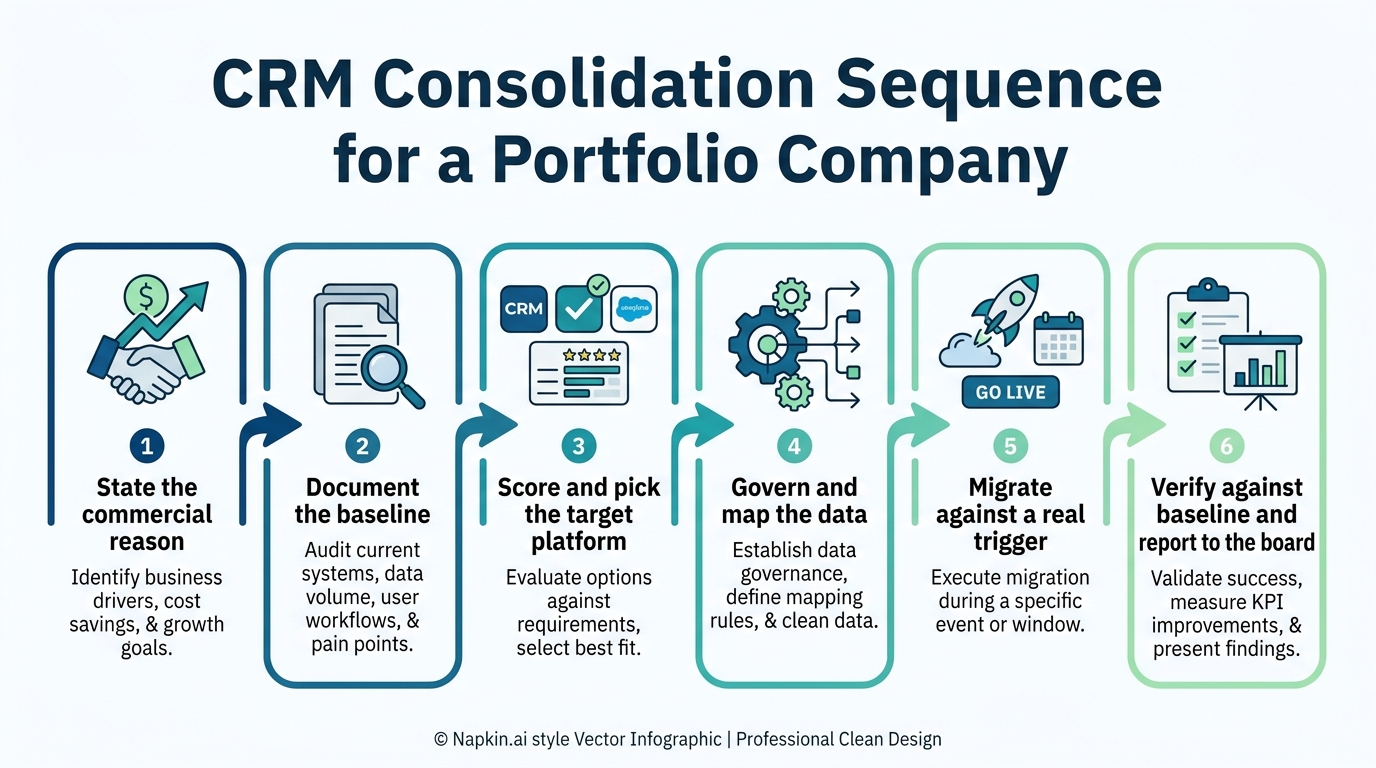
1. Name the commercial reason before touching a system
Consolidation is not the goal. Forecast reliability, cleaner attribution, lower per-seat license spend, faster onboarding of add-ons, and a management dashboard the board actually trusts are the goals. CRM consolidation is the mechanism.
Before any tooling conversation, the sponsor should write down the single financial consequence that justifies the spend. Bain’s annual Global Private Equity Report has tracked how much of PE returns now depend on operational improvement rather than multiple expansion, which means the systems that produce revenue visibility carry real weight in the value-creation plan. If the team cannot state the consequence in a sentence a CFO would accept, the project is not ready.
Three reasons that actually hold up
- Forecast reliability. One source of pipeline truth the board can price off.
- Integration speed. A single instance every future add-on lands into instead of a fourth silo.
- Cost and risk. Fewer licenses, fewer data-security surfaces, fewer manual reconciliations.
2. Establish the baseline you will be judged against
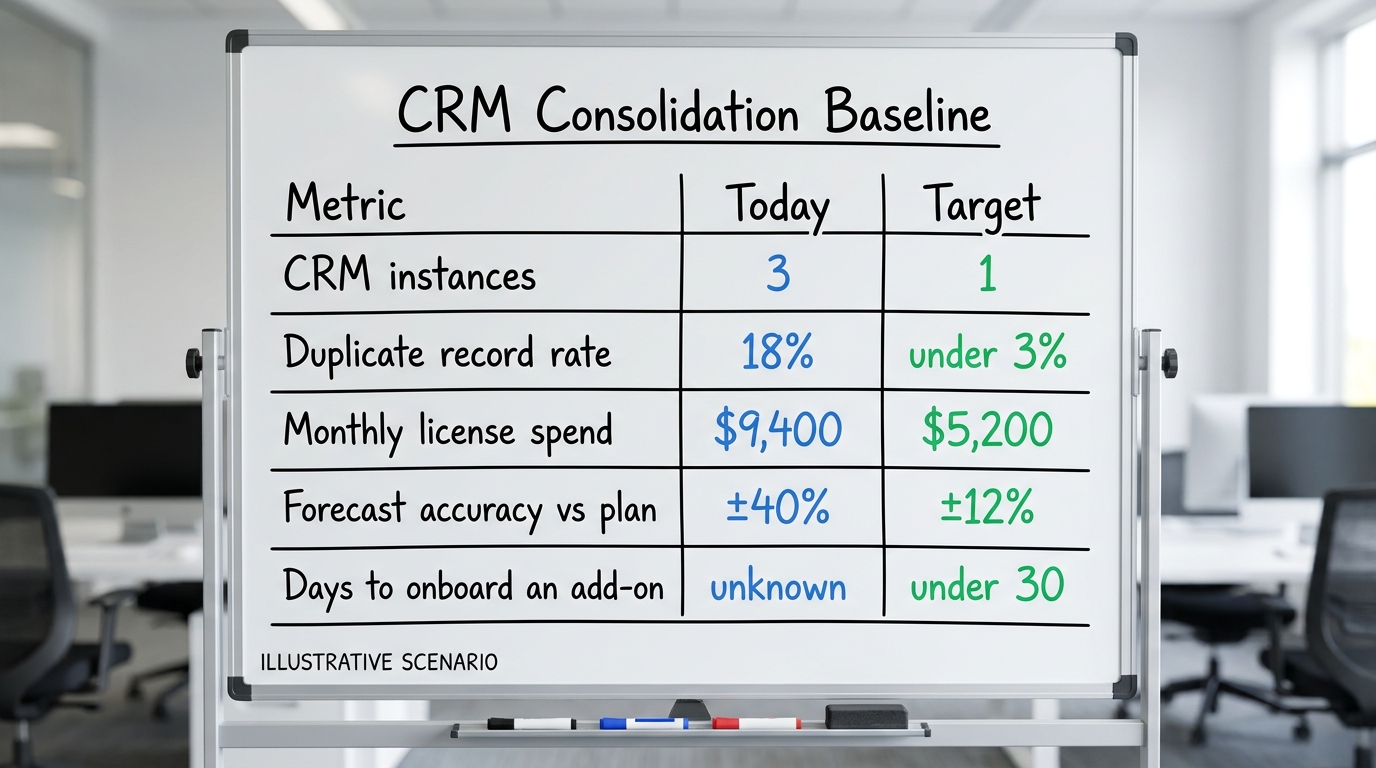
No consolidation should begin without a documented baseline. That means the current count of CRM instances, records per instance, duplicate rate, active seat count, monthly license cost, and the current forecast accuracy expressed as actual versus plan over the last four quarters. This is the evidence the board meeting will reference when it asks whether the money worked.
If the portfolio company came through a recent deal, much of this belongs in the technology due diligence file already. If it does not, that gap is itself a finding, and it tells the operating partner the revenue data was never trusted enough to underwrite.
2b. What that baseline table is doing
The numbers above are an illustrative scenario, not a benchmark. The point is the shape: every row is a metric a CFO or deal partner can price, and every target ties back to a commercial reason from section one. Fill the same table with the portfolio company’s real numbers and the consolidation stops being an IT project and starts being a value-creation workstream.
3. Decide the target system on economics, not preference
The instinct is to keep the CRM the largest business unit uses or the one the loudest sales leader prefers. Resist it. The target platform decision should be scored against integration cost, per-seat economics at the portfolio’s projected headcount, native reporting the CFO can use without a data engineer, and whether it can absorb future add-ons without another migration.
Score the candidates, then pick
Build a short scoring model with weights the sponsor sets: data model fit, total cost at scale, reporting depth, integration ecosystem, and migration effort. When the model disagrees with the popular choice, the model usually reflects the enterprise-value case and the preference reflects switching-cost anxiety. Name which one is driving the decision.
4. Own the data before you move it
Migration failures are rarely about the platform. They are about data nobody governed. Before a single record moves, assign a data owner, agree the field mapping across all source systems, and decide the deduplication and enrichment rules. Records with no owner, no close date, and no activity in twelve months are usually noise that should not survive the move.
When the consolidation follows an acquisition, the field-level conflicts get harder. Two systems that both call a field “Stage” but mean different things will corrupt every downstream report. The post-merger integration guide on unifying conflicting CRM architectures walks through the technical reconciliation in more depth than most teams plan for.
5. Sequence the migration against real triggers
Consolidation timing is not arbitrary. Anchor it to events the business already recognizes: the close of an add-on, the start of a new fiscal year, a system contract renewal, or the first board meeting where the sponsor committed to a cleaner forecast. Migrating mid-quarter into a live sales team’s workflow is how consolidations lose adoption.
The first 100 days after a deal are often the right window because the organization already expects change and has not yet hardened around bad workflows. McKinsey’s private capital research has consistently pointed to early operational moves as a driver of value-creation outcomes, and revenue-system cleanup fits that pattern well.
6. Assign decision rights before the project starts
Every consolidation stalls at the same points: which field wins a conflict, whether to sunset a legacy report a sales director loves, whether to delay Day 1 for cleaner data. If those decisions route to a committee, the project stalls. Assign each decision right to one named owner and let the operating partner hold the escalation path.
The four decision rights that matter most
- Target platform selection: the RevOps lead, signed off by the sponsor.
- Field mapping and data survival rules: the data owner.
- Go-live date: the RevOps lead against the trigger calendar.
- Scope trade-offs under time pressure: the operating partner.
7. Build the risk register the board will ask about
Treat consolidation like any other integration dependency and maintain a live risk register. The recurring risks are predictable: adoption failure by the sales team, data loss in migration, reporting continuity gaps during cutover, and license overlap while both systems run in parallel. Each risk needs an owner, a mitigation, and a status the sponsor can read in thirty seconds.
Guidance from the Harvard Law School Forum on Corporate Governance on operational risk oversight is a useful reference point for how boards expect these risks to be surfaced rather than discovered after the fact.
8. Protect revenue continuity during cutover
The most expensive consolidation mistake is a sales team that cannot see its pipeline for two weeks. Run the target system in parallel long enough to validate that reports reconcile, keep the legacy system read-only rather than deleting it on Day 1, and give reps a single-page reference for the new workflow. Adoption is a revenue metric, not a training footnote.
If the portfolio company runs content and demand-gen through its own channels, the consolidation should preserve the tracking that feeds attribution. Teams running omnichannel content across social, email, and video lose real reporting value if UTM and lead-source mapping breaks during the move.
9. Verify against the baseline and report it
The project is not finished at go-live. It is finished when the team re-measures the section-two baseline and reports the delta to the board. Duplicate rate down, license spend down, forecast accuracy up, add-on onboarding time down. Classify each result honestly: license savings are realized, forecast improvement is often run-rate until a full quarter closes, and faster future integration is enabled value rather than money in the bank.
PitchBook and its research and data, along with S&P Global Market Intelligence, are useful external references when the sponsor wants to frame the consolidation’s payoff against how the market values operational discipline in mid-market portfolios.
10. The decision checklist
Before the sponsor greenlights CRM consolidation for portfolio companies, confirm every line below has a name and an answer:
- The single commercial reason is written and CFO-acceptable.
- The baseline is documented with real numbers, not estimates.
- The target platform was scored, not chosen by preference.
- A data owner is named and survival rules are agreed.
- Go-live is anchored to a real trigger, not a calendar guess.
- The four core decision rights each have one owner.
- A live risk register exists and the board can read it.
- Revenue continuity during cutover is planned, not hoped for.
- A verification-against-baseline report is scheduled for a board meeting.
If more than two of those lines are blank, the consolidation is not ready to start. It is ready to be scoped.
11. Where this fits in the wider value-creation plan
CRM consolidation rarely stands alone. It usually sits inside a broader revenue-systems cleanup that touches demand generation, attribution, and the reporting stack. Operators thinking about how their platform choices age should also weigh where their content and marketing tooling is heading, since a look at the future of WordPress trends and updates shows how quickly the surrounding stack shifts around the CRM. The goal across all of it is the same one the private equity value-creation plan cares about: a revenue engine the board can see, trust, and price toward exit.
12. Next step
If the portfolio company is carrying multiple CRM instances into a value-creation plan and the forecast still gets rebuilt by hand every Friday, the fix is a scoped RevOps engagement that treats consolidation as an enterprise-value workstream rather than an IT ticket. Route the consolidation into the DevriX PE offer to get the baseline documented and the sequence built against your real trigger calendar.