An operating partner with a stalled forecast has a narrow window to decide whether the problem is the pipeline, the process, or the person running revenue. A portfolio company executive who just missed a quarter has the same question, minus the luxury of time. In both cases the temptation is to hire a revenue operations consultant for private equity because the deck looked sharp. That is the wrong test. The right test is whether the engagement moves a number the board already watches: net revenue retention, sales cycle length, CAC payback, or the gap between actual and plan.
This guide is written for the person who owns that decision. It skips the definitions and goes straight to what to specify, what to inspect, and how to tell competent execution from expensive activity.
1. Start with the enterprise-value question, not the tool question
A PE-backed buyer is not purchasing dashboards, a new CRM, or a marketing automation rebuild. It is purchasing measurable enterprise-value improvement. Before scoping any RevOps engagement, the operator should name which value lever is in play. Bain’s annual Global Private Equity Report has documented for years that returns increasingly depend on operational improvement rather than multiple expansion, which raises the bar on what a revenue function has to deliver.
Write the lever down first. Options usually reduce to: revenue growth, EBITDA expansion, faster integration of an add-on, or reduced forecast risk. A consultant who cannot connect their proposed work to one of those in the first meeting is selling the tool, not the outcome.
2. Define the decision the engagement informs
RevOps work at a portfolio company almost always sits behind a specific decision. Naming it early prevents scope drift.
- Confirmatory diligence: is the target’s reported pipeline real and repeatable, or front-loaded to close the deal?
- First 100 days: can the revenue engine be instrumented well enough to produce a forecast the board will trust by the first board meeting?
- Add-on integration: can two conflicting go-to-market systems be reconciled without stalling bookings?
- Underperformance: is the miss a demand problem, a conversion problem, or a data problem?
Each decision implies a different owner, a different baseline, and a different definition of done. A consultant scoped against “improve RevOps” is scoped against nothing.
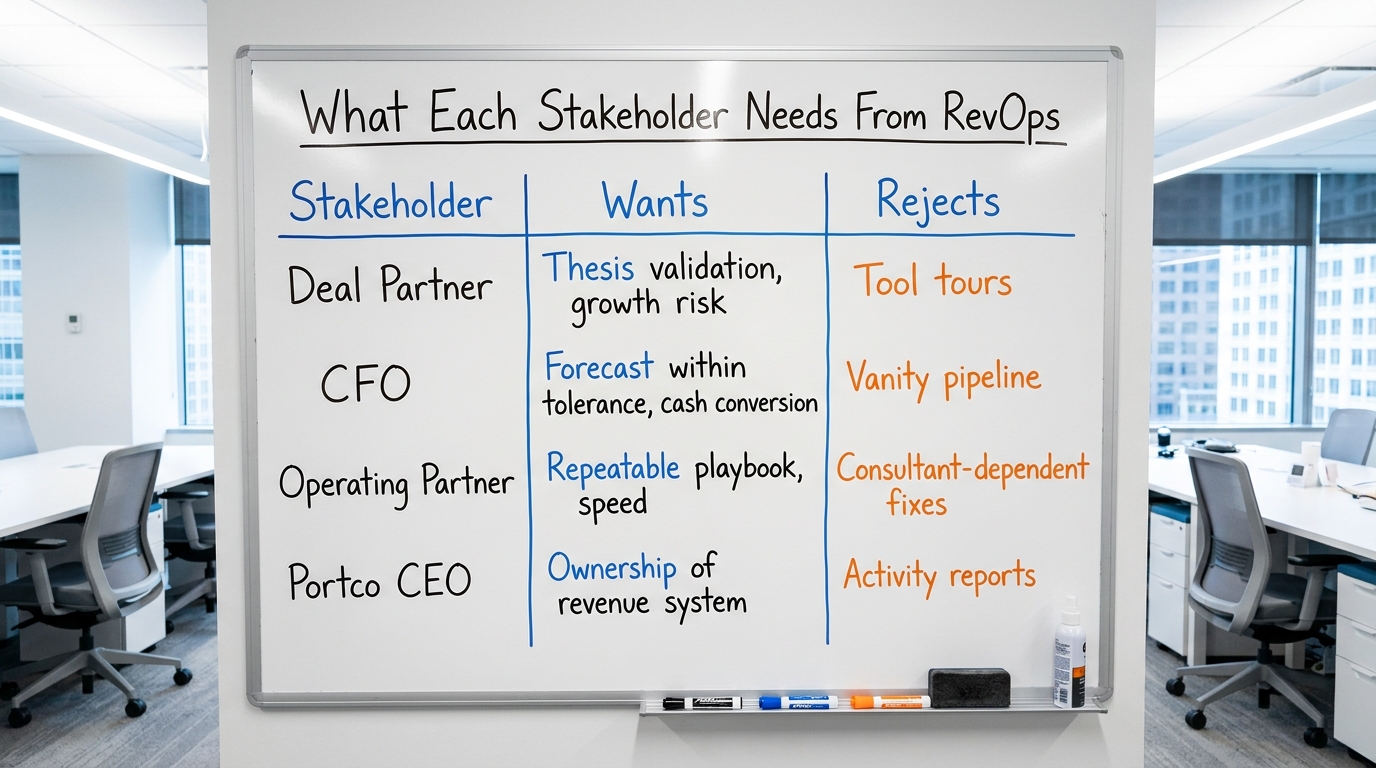
3. Separate the deal partner’s question from the CFO’s question
The people who read a RevOps assessment want different things, and a good consultant writes to each.
The deal partner
Wants thesis validation and risk. Is the growth assumption in the model supported by the actual pipeline and conversion behavior, or is it aspirational?
The CFO
Wants forecast reliability and cash. Can revenue be predicted within a tolerance that keeps the board and the lenders calm, and does the pipeline convert to cash on the timeline the covenants assume?
The operating partner
Wants speed and a repeatable playbook that survives the next add-on. A one-off fix that only the consultant understands is a liability, not an asset.
If a candidate gives all three stakeholders the same answer, they have not understood who they are talking to.
4. Judge the diligence work, not the diligence deck
When RevOps assessment happens inside technology due diligence, the output that matters is evidence, not narrative. A credible reviewer produces the baseline behind every claim: the raw CRM export, the definition of a qualified opportunity actually in use, the stage-conversion rates by cohort, the data hygiene score. McKinsey’s private capital research has repeatedly made the point that value creation planning built on unverified operating data tends to unravel in the hold period.
The operator’s job here is to ask for the workpapers. If the consultant can only show the summary slide, treat the finding as an opinion.
5. Insist on a baseline before any change
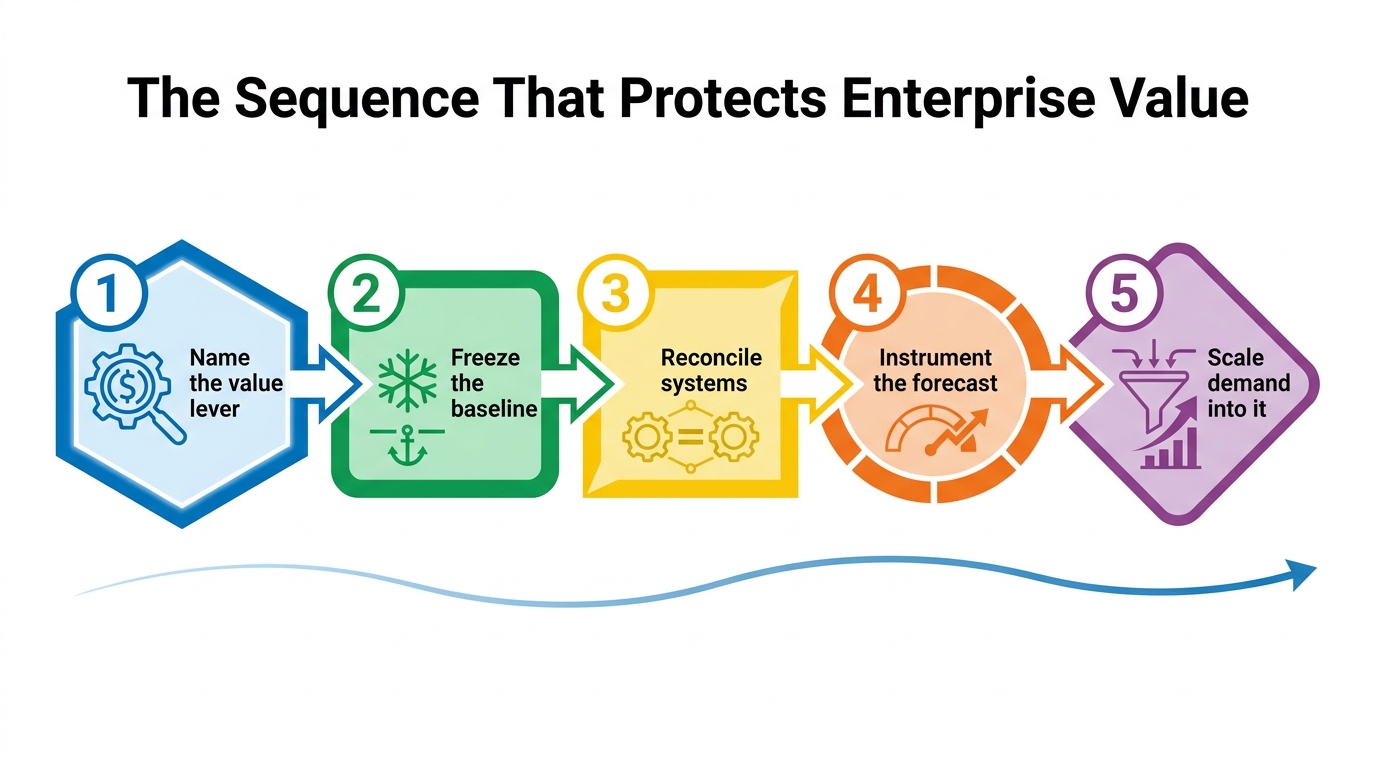
The single most common failure in portfolio RevOps is starting work before establishing what “before” looked like. Without a baseline, no one can prove the engagement moved anything, and the board is left with a story instead of a number.
A competent consultant will refuse to touch the system until the current-state metrics are frozen: pipeline coverage ratio, win rate by segment, average sales cycle, lead-to-close conversion, and the data completeness rate underneath all of them. That last one matters more than it looks. Most forecast problems in mid-market portfolio companies are data problems wearing a demand costume.
6. Watch for the activity trap
Hours logged, tickets closed, campaigns launched, and reports built are the vendor register, not the outcome. A revenue operations consultant for private equity who leads status updates with volume of activity is signaling that they cannot tie the work to a financial result. Ask a blunt question in every review: which number on the board’s page moved, in which direction, and by how much versus the baseline we froze?
The good ones welcome that question. The rest change the subject to how much they have shipped.
7. Reconcile the systems before scaling the demand
After an add-on, revenue systems rarely line up. Two CRMs with different stage definitions, two lead-scoring models, and two versions of “closed won” will corrupt any consolidated forecast. This is where a lot of value quietly leaks in the first 100 days. The sequence matters: reconcile the architecture first, then instrument it, then scale demand into it. Doing it in any other order pours pipeline into a broken container.
Blogger Hangout’s own post-merger integration guide for unifying conflicting CRM architectures walks through the technical roadmap for exactly this reconciliation, and it is worth handing to any consultant before they propose a rebuild.
8. Check whether they build a system or a dependency
An engagement that ends with the portfolio company able to run its own revenue operations is an asset. An engagement that ends with the company unable to produce a forecast without the consultant on retainer is a risk on the exit register. The Harvard Law School Forum on Corporate Governance has covered how governance and management self-sufficiency factor into exit readiness, and buyers in a sale process notice when a critical function is outsourced to one person’s head.
Ask directly: at the end of this, who owns the model, and can the internal team run it without you? The answer tells you whether you are buying capability or renting it.
9. Match the consultant’s demand engine to the actual channel mix
RevOps is not only pipeline plumbing. In content and publishing portfolio companies, revenue depends on demand mechanics the consultant has to understand in detail. A candidate who only speaks enterprise SaaS may miss how these businesses actually monetize.
- Distribution across owned channels, covered well in this guide to integrating social, email, and video strategies.
- Ad-based revenue models, where the mechanics differ sharply, as laid out in this programmatic ads toolkit.
- Recurring revenue through membership, which changes retention math entirely, explained in this guide to turning content into a membership community.
The point is not that the consultant must know every channel. It is that they must instrument the ones that produce this company’s revenue, not a generic funnel.
10. Verify their read on the platform and data risk
For publisher and content portfolio companies, the underlying platform is part of the revenue system, not a background detail. A consultant who ignores where the CMS is heading is ignoring a real integration dependency, and this overview of where WordPress is trending is a fair test of whether they understand the technical ground the revenue engine sits on.
11. Price the engagement against the value lever
Cost is only assessable against the lever named in section one. PitchBook and its research and data, along with S&P Global Market Intelligence, both track how operating spend correlates with realized value creation, and the honest reading is that RevOps spend is justified by forecast reliability and margin, not by the size of the workplan. If a consultant cannot state the run-rate improvement they expect to enable and label it as forecast rather than realized, the price has no anchor.
12. The decision checklist
Before signing, the operator should be able to answer yes to each of these:
- The engagement is tied to a named value lever the board already tracks.
- The specific decision it informs is written down, with an owner and a deadline.
- A current-state baseline will be frozen before any change is made.
- Reviews lead with the number that moved, not the activity that occurred.
- System reconciliation precedes demand scaling in any post-add-on scope.
- The internal team can run the model at the end without the consultant.
- Every diligence claim is backed by workpapers, not just a summary slide.
- The proposed price is anchored to a forecast improvement, labeled as forecast.
Any “no” is a scoping conversation to have before, not after, the contract.
When the mandate is scoped this way, and matched to a team that understands both revenue systems and the demand engine underneath them, the DevriX Full-Funnel Demand and RevOps work fits a private equity portfolio brief cleanly. Review the DevriX / GrowthShuttle PE offer and the async RevOps sprint at the DevriX private equity hub to see how the engagement is structured against the checklist above.