An operating partner who has just signed off on a growth thesis usually inherits the same problem in month two: the portfolio company can describe its product and its pipeline, but nobody can explain why revenue lands where it lands, or what would change if the go-to-market motion were fixed. That gap is where a GTM strategy consultant for portfolio companies earns or wastes the budget. Get the brief right and the engagement returns a repeatable revenue system that survives the hold period. Get it wrong and the deal team pays for a slide deck that nobody in the business ever operationalizes.
This guide is for the person accountable for the revenue number, the operating partner, the portfolio CEO, or the revenue leader who reports to both. It covers what to decide before you engage, how to scope the work, and how to judge whether the money produced enterprise value or activity.
1. Decide what problem the engagement actually solves
GTM work fails most often because the mandate is vague. “Improve go-to-market” is not a mandate. Before any consultant is briefed, name the commercial consequence you are trying to move: a stalling new-logo rate, a widening gap between forecast and actual, a CAC that no longer supports the LBO model, or two merged businesses selling into the same accounts with conflicting motions.
Each of those points at a different engagement. A CAC problem is a channel and conversion problem. A forecast-reliability problem is a pipeline hygiene and CRM problem. A post-merger overlap is a coverage and systems problem. Tie the brief to the value-creation plan the deal team underwrote, not to a generic desire to “grow faster.”
Map it to the thesis, not the org chart
The right owner is whoever holds the revenue number in the value-creation plan. If the thesis assumed cross-sell after an add-on, the GTM engagement has to prove or kill that assumption with evidence, not restate it. The broader context of a private equity operating model is that every workstream should reduce time to a defensible exit, and GTM is no exception.
2. Separate strategy from the system that runs it
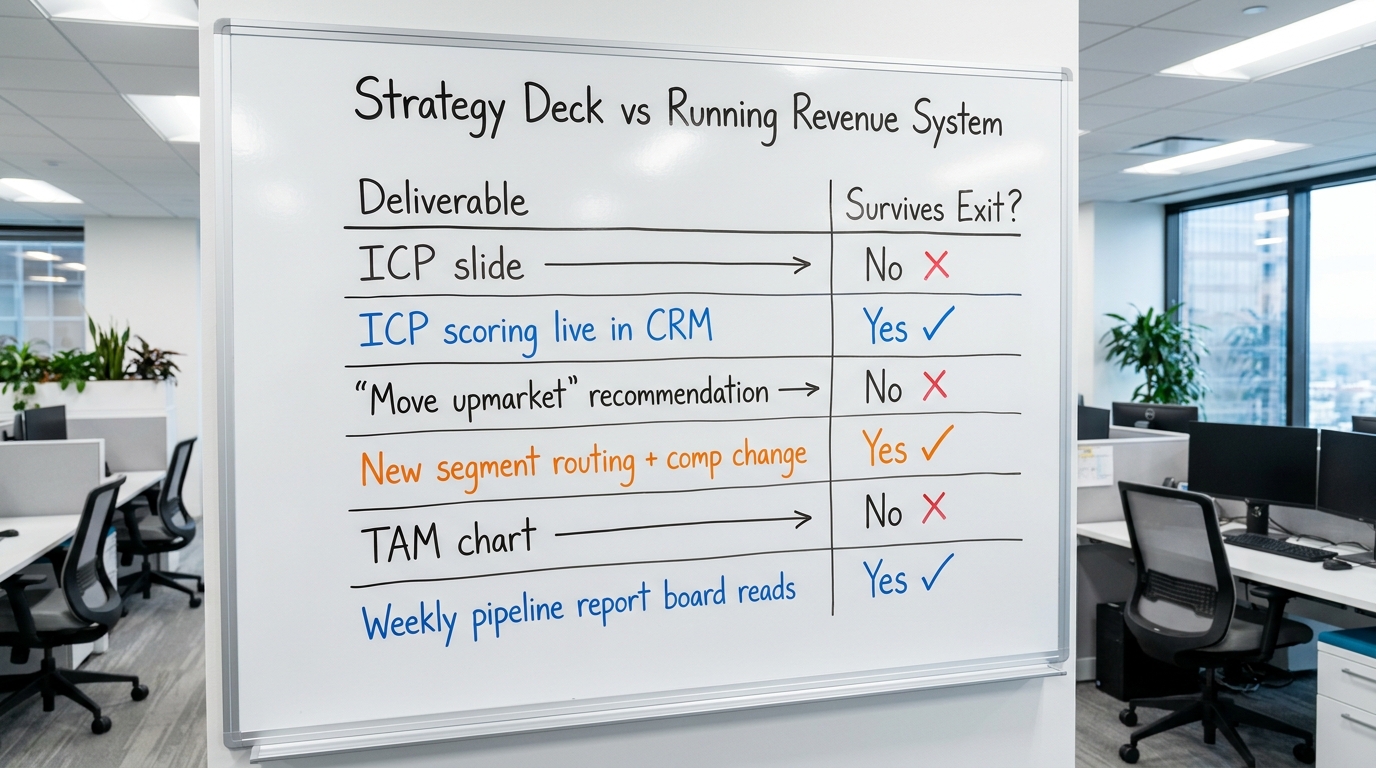
A slide that says “move upmarket” is cheap. The revenue system that makes it happen, segmentation, ICP scoring in the CRM, routing rules, comp aligned to the new motion, reporting the board can read, is the expensive and durable part. Judge a consultant on whether they can deliver the second thing, not just the first.
This is the practical line between a strategy firm and a RevOps operator. Strategy without instrumentation degrades the moment the consultant leaves. If the deliverable cannot be run by the portfolio company’s own team on day 91, it was theater.
3. Set the diligence baseline before the first workshop
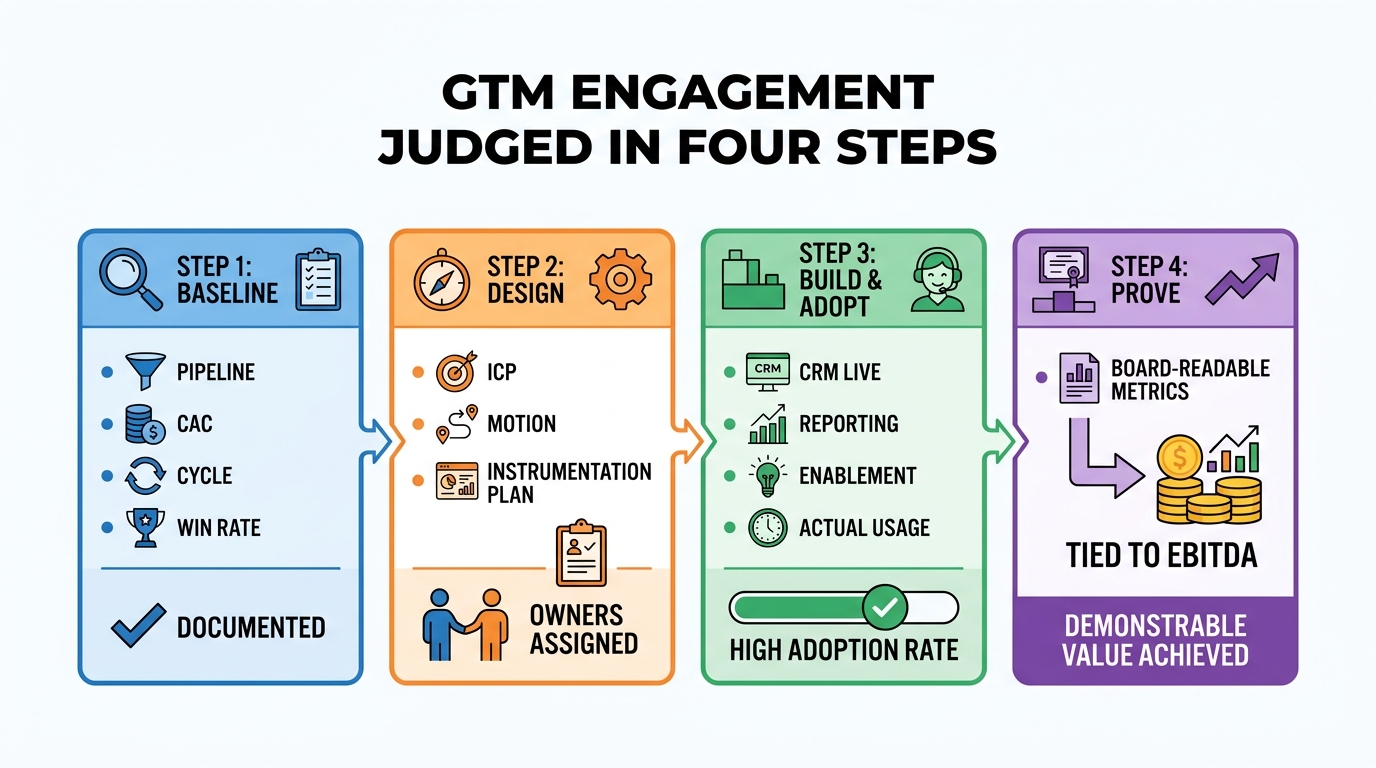
You cannot judge improvement without a baseline, and most portfolio companies do not have one that holds up. Before the consultant runs a single workshop, insist on a documented starting point: pipeline conversion by stage, CAC by channel, sales cycle length, win rate by segment, and the reliability of the forecast over the last four quarters.
If the CRM cannot produce those numbers cleanly, that is itself a finding, and it usually surfaces during technology due diligence. A GTM engagement that starts by fixing data hygiene is not a detour. It is the precondition for every claim that follows.
4. Scope the engagement to the first 100 days, then the run
The first 100 days set the tone for the whole hold. Structure the GTM engagement in two clearly separated phases so the budget maps to outcomes.
- Phase one, diagnosis and design (weeks 1 to 6): baseline, ICP, motion definition, instrumentation plan, and a prioritized backlog with owners and decision rights.
- Phase two, build and adopt (weeks 7 onward): CRM configuration, reporting, enablement, and the discipline to make the sales team actually use it.
Adoption is where most engagements die. A design nobody follows produces no EBITDA. The retainer that runs phase two is where the value converts from forecast to realized.
5. Judge the consultant on evidence, not credentials
Deal experience on a resume is not proof of GTM competence. Ask three things and weigh the answers.
Can they show the system, not just the strategy?
Ask for a redacted example of a revenue system they built, the actual CRM logic and reporting, not a positioning deck. If they only have decks, they are a strategy vendor and you should scope them as one.
Do they talk in commercial consequence or in activity?
A weak consultant reports hours, workshops delivered, and personas created. A strong one reports the expected movement in conversion rate, cycle time, or pipeline coverage, and names what has to be true for it to happen. Activity is not outcome, and the board will not credit it as one.
Will they name what they will not fix?
Scope honesty is a strong signal. Someone who says “your product gap is real and no GTM change fixes it” is more useful than someone who promises to fix everything with a new funnel.
6. Get the data and systems question right early
Most GTM strategy stalls on the same thing: the underlying systems cannot support the motion the strategy requires. This is acute after an acquisition, where two businesses arrive with incompatible CRMs and overlapping accounts. The mechanics of reconciling them are their own workstream, covered well in this guide to unifying conflicting CRM architectures, and a GTM consultant who ignores that layer is designing on sand.
For portfolio companies whose revenue depends on owned content and audience, the systems question extends to the publishing stack too. A revenue leader inheriting a content-driven business should understand where the platform is heading, which is why the trajectory covered in recent WordPress trends and updates belongs in the diagnosis, not as an afterthought.
7. Match the engagement to how the business actually makes money
A GTM strategy for a SaaS business and one for a publisher or community-driven business are not interchangeable. If the asset earns through audience, the motion sits closer to content, distribution, and monetization than to outbound sales.
For that profile, the consultant’s plan should account for real revenue levers on the site, such as the ones described in this programmatic ad toolkit and the recurring-revenue mechanics in turning content into a membership community. A distribution strategy that ignores omnichannel integration across social, email, and video is not a serious GTM plan for an audience business.
8. Insist on reporting the board can actually read
The output that matters at the first board meeting is not a strategy narrative. It is a small set of metrics the CFO trusts and the deal partner can tie back to the model: pipeline coverage against target, conversion by stage, CAC payback, and forecast accuracy. If the consultant’s reporting does not roll up to those, it will not survive contact with the board.
Preqin and Private Equity International both track how sharply value creation has shifted toward operational improvement rather than multiple expansion, which raises the bar on evidence for every operating workstream. Reporting that cannot connect a GTM change to EBITDA is a liability, not a deliverable.
9. Understand the market context you are buying into
The pressure on GTM performance is not incidental. Bain’s annual private equity report has documented longer hold periods and slower exit markets, which forces sponsors to generate returns from the operating line rather than from financial engineering. McKinsey’s private capital research and BCG’s work on principal investors point the same direction: the operational lever is doing more of the work.
PitchBook and S&P Global Market Intelligence both track deal and exit conditions that make a repeatable, evidence-backed revenue engine more valuable at exit than a one-time revenue spike. A buyer pays a higher multiple for a system, not for a good quarter.
10. Watch for the failure modes that quietly waste the budget
- Deck-only delivery. Strategy with no system attached leaves nothing behind.
- No adoption plan. A perfect design the sales team ignores produces zero enterprise value.
- Vanity reporting. Traffic, personas, and workshop counts that never connect to revenue or margin.
- Baseline skipped. Without a starting point, no improvement claim can be verified, and the board will not credit it.
- Systems ignored. A motion the CRM cannot support is a plan that stalls in week eight.
Engagement techniques that lift audience revenue, such as interactive features like polls and quizzes, only count if they map to a measured revenue outcome. Otherwise they are activity dressed as strategy.
11. The decision checklist before you sign
- The engagement is tied to a named commercial consequence in the value-creation plan, not to “grow faster.”
- A documented baseline exists, or fixing it is the explicit first deliverable.
- The scope separates strategy design from the running revenue system, and someone owns each.
- The consultant can show a system they built, not only decks.
- Reporting rolls up to metrics the CFO and board already trust.
- There is an adoption plan with owners and decision rights, not just a design.
- The systems and data layer is addressed, especially after any add-on or merger.
- Impact is labeled honestly as realized, run-rate, or forecast, and forecast is not sold as realized.
If most of those boxes cannot be checked, the engagement is a strategy purchase, not a value-creation one. Scope and price it accordingly, and hold the retainer that runs the system to a higher standard than the diagnosis that designed it.
12. Next step
If you are scoping GTM work for a portfolio company and need the strategy tied to a running revenue system with board-readable reporting, see how a RevOps sprint and retainer are structured for portfolio companies at the DevriX private equity operating hub.