A portfolio company executive signs off on a technology spend that runs $15,000 to $50,000 a month, and six months later the board asks what changed in the numbers. If the honest answer is “we replatformed the CMS and stood up a data warehouse,” the deal partner is looking at cost, not value creation. Choosing a digital transformation consultant private equity firms will actually credit at the next board meeting is a commercial decision about what moves in the model, who owns the outcome, and how you will know it worked. This guide is for the operating partner or portfolio executive holding that decision.
The work matters most at specific moments: the first 100 days after close, an add-on that forces two tech stacks together, or a forecast that has started missing plan because the revenue systems cannot report cleanly. Each of those is a different brief, and the wrong consultant will happily accept all three.
1. Start with the value-creation line, not the technology
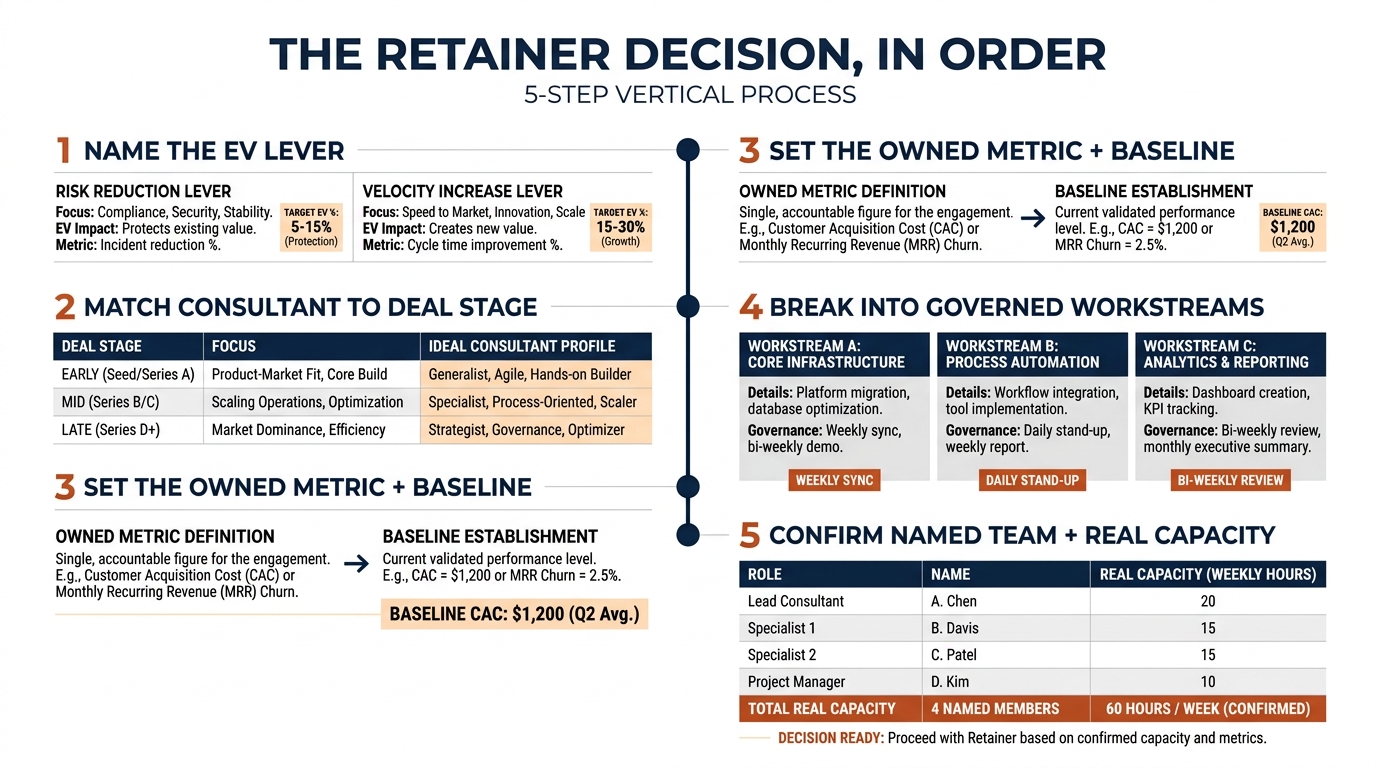
Before you scope anything, name the enterprise-value lever the work is supposed to move. There are only a handful that a deal partner recognizes: revenue growth, EBITDA expansion, cash-flow improvement, faster integration, reduced operating risk, better management visibility, or a shorter path to exit. Bain’s annual private equity report has tracked for years how the industry has shifted from multiple expansion toward operational improvement as the primary source of returns, which is exactly the ground a transformation program lives on. You can read that framing in Bain & Company’s Global Private Equity Report.
If a prospective consultant leads with tooling and architecture before asking which part of the model you are trying to change, that is a scoping problem you will pay for later. The technology is the mechanism. The lever is the point.
2. Match the consultant to the deal stage, not the buzzword
A transformation engagement means something different at each stage of the hold, and the skill set does not transfer cleanly across them.
Diligence
Pre-close, the brief is assessment, not building. This is technology due diligence: is the stack a liability, what will remediation cost, and does the roadmap the seller pitched survive contact with the code and the team. If you want the buyer’s version of how to select and judge that work, this site has a practical walkthrough on how to choose a technology due diligence advisor.
First 100 days
Post-close, the brief is speed and sequencing. The first 100 days set what gets measured, what gets fixed first, and which quick wins fund credibility for the harder work later.
Steady-state hold
Between the sprint and the exit, transformation becomes an operating discipline: revenue systems, reporting, and the adoption work that makes any of it stick. That is the phase most retainers actually serve.
3. Decide who owns the outcome
The single most expensive mistake is buying activity and calling it a program. Hours, tickets, features shipped, and traffic are how vendors describe themselves. None of them is an outcome. Before you sign, get the consultant to state, in writing, the metric they are accountable for and the baseline it starts from.
An illustrative version of a clean accountability line: “reduce quote-to-cash cycle time from 34 days to under 20 by end of Q2, measured in the CRM.” That is a claim a CFO can check. “Modernize the sales tech stack” is not, because nobody can fail it.
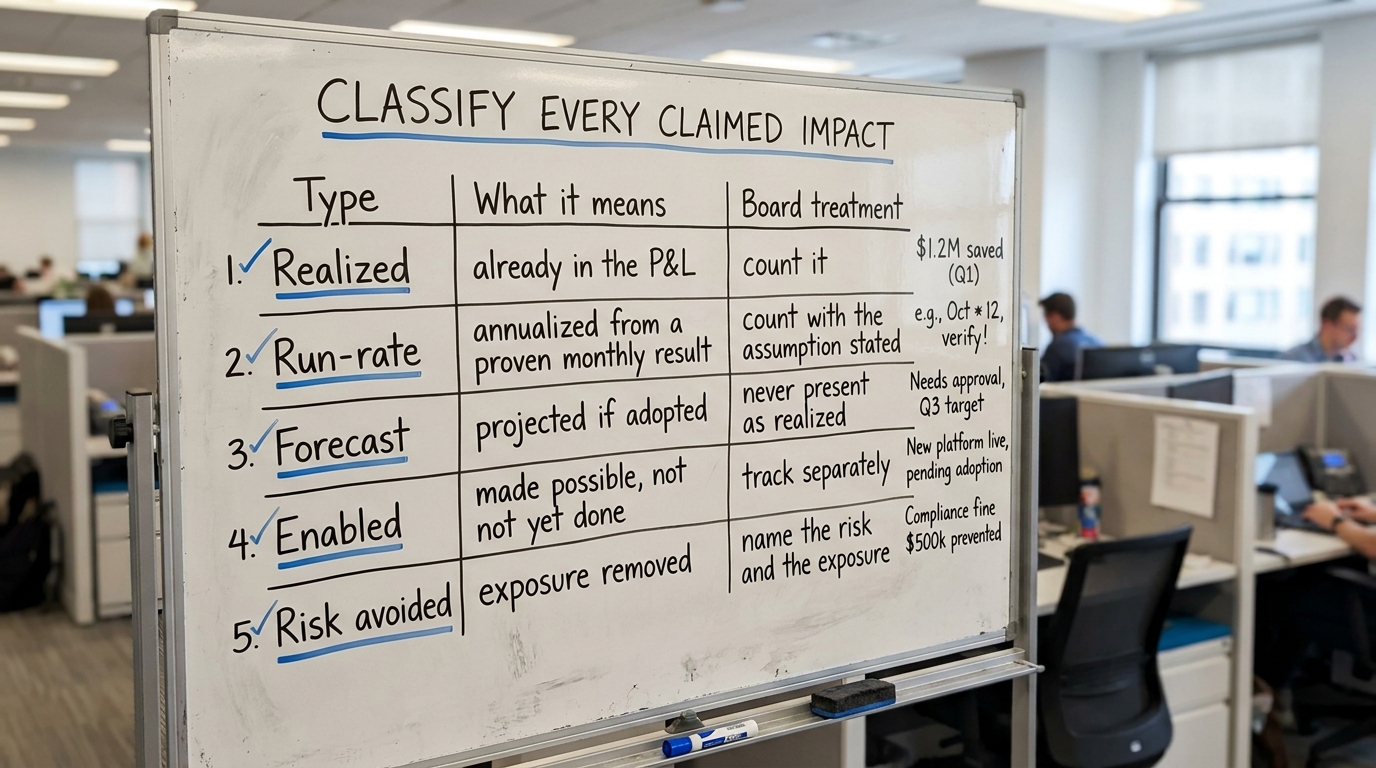
4. Force the classification of every claimed impact
Not all value is the same value, and treating forecast as realized is how a program loses the board’s trust. Insist that any impact the consultant projects gets labeled honestly as realized, run-rate, forecast, enabled, or risk avoided. A replatform that removes a security exposure is risk avoided. A funnel change that lifted conversion last quarter is realized. A pipeline model that “could” add revenue if adopted is forecast, and it should never appear in a board deck dressed as money already earned.
5. Read the transformation as a set of workstreams
A serious consultant breaks the program into named workstreams, each with an owner, a decision right, and a place on the risk register. Ask to see that structure in the proposal. If the pitch is a single undifferentiated “transformation,” you cannot govern it, and you cannot tell which part is late.
The workstreams that carry the most enterprise value in mid-market portfolio companies are usually revenue-facing: how leads convert, how the CRM reports, and how marketing spend maps to the deal thesis. For the revenue-system side of this, the practical decisions are laid out in Salesforce RevOps for PE portfolio companies and, on the demand side, in conversion rate optimization for portfolio companies.
6. Pressure-test the integration dependencies
Transformation programs fail on dependencies more than on any single build. If the data warehouse depends on the CRM migration, and the CRM migration depends on a sales-process redesign nobody has approved, the schedule is fiction. McKinsey’s research on digital and technology programs has consistently found that execution capability, not strategy, separates the programs that deliver from the ones that stall; their work is collected at McKinsey’s private capital and digital research.
In an add-on, the dependency map is the whole game. Two companies mean two stacks, two data models, and two definitions of a “customer,” and reconciling them is where the synergy either shows up or disappears. This is closer to post-merger integration than to a greenfield rebuild, and the consultant should treat it that way.
7. Judge the team you actually get
Ask who staffs the engagement after the pitch. A common failure is the senior partner who sells the work and the junior team that delivers it. For a retainer at this price, you are entitled to know the named people, their capacity in real hours per month, and how much of the senior person’s time is committed versus advisory.
Capacity is not a rounding detail. A consultant “committing” a lead architect who is actually spread across four accounts is committing a fraction of a person, and your timeline is built on the full one.
8. Set the reporting cadence before Day 1
Decide how the work reports into you and into the board, and lock it before the engagement starts. Actual versus plan, by workstream, monthly, with a short risk register update. If the first time you see a real status is the quarterly board meeting, you have already lost a quarter of correction time. BCG’s work on value creation in private equity portfolios makes the same point about early, disciplined tracking; see BCG’s principal investors and private equity research.
9. Know when this is really a carve-out or a demand problem
Two situations get mislabeled as “digital transformation” and need different specialists. A separation from a parent is carve-out work, with its own timeline pressure and transitional-service-agreement clock; the operator decisions there are covered in carve-out consulting for operating partners. And a company that is missing plan because it is chasing the wrong accounts has a targeting problem, not a platform problem, which is the argument in this piece on ABM and the deal thesis. Buying a transformation program to fix either is expensive misdirection.
10. The checklist before you sign
- The proposal names the enterprise-value lever and identifies the technology that delivers it.
- The consultant is matched to the actual deal stage (diligence, first 100 days, or hold).
- Every workstream has an owner, a decision right, and a spot on the risk register.
- The lead metric has a stated baseline and a date, and the consultant will be measured on it.
- Claimed impact is classified as realized, run-rate, forecast, enabled, or risk avoided, with forecast never shown as realized.
- Integration dependencies are mapped, and the critical path is honest.
- The named delivery team and their real monthly capacity are in the contract.
- Actual-versus-plan reporting cadence is agreed before Day 1.
If the engagement passes all eight, you have something you can govern and something the board can credit at exit. If it fails three or more, you are buying activity at a retainer price, and the next board meeting will show it.
11. Where the decision fits in the broader portfolio program
A transformation retainer is one instrument inside a value-creation plan that usually also touches diligence, integration, and revenue operations. Reading it in isolation is how portfolios end up with three overlapping vendors and no single accountable line. The broader private equity operating context, including how these pieces sequence across the hold, is worth mapping before you commit the spend.
When the diligence and the transformation are handled by teams that never talk to each other, the second team relitigates what the first one already found. Keeping the through-line from technology due diligence into the hold-period program is what makes the eventual work faster and cheaper.
If you want the transformation work scoped against a named enterprise-value lever, staffed with committed capacity, and reported as actual versus plan from Day 1, review the DevriX / GrowthShuttle private equity offer and bring it the specific deal stage you are in.