An operating partner signs off on a value creation plan, and somewhere in that plan sits a line for digital: web, demand generation, marketing operations, sales tooling, analytics. Six months into the hold, the board asks whether that spend is tracking to the thesis, and the honest answer is usually that nobody built a baseline anyone can defend. A digital value creation benchmark is the thing that answers the question before it gets asked, and its absence is why digital workstreams get cut in the first budget review even when they were producing.
This guide is for the person accountable for revenue systems in a portfolio company, the operating partner who owns the digital line, and the CFO who has to reconcile it against forecast. It walks through what the benchmark should actually contain, how to build it without a six-week consulting engagement, and how to tell a real benchmark from a vanity dashboard.
1. Why the digital line gets cut when it should not
Digital work in a portfolio company tends to arrive as activity: campaigns launched, pages rebuilt, a new CRM instance, an analytics stack. None of that is enterprise value on its own, and a deal partner reading a report full of hours and impressions has no way to connect it to revenue, EBITDA or exit multiple. When cash gets tight, the line with the weakest evidence loses, and digital usually has the weakest evidence because it was never baselined against a commercial outcome.
Bain’s annual private equity report has tracked how value creation has shifted from financial engineering toward operational improvement across the hold period, which raises the bar on proving that operational spend actually moved a number. You can read the arc of that shift in Bain’s Global Private Equity Report. A benchmark is how the digital line stops being the first thing sacrificed.
2. What a digital value creation benchmark actually is
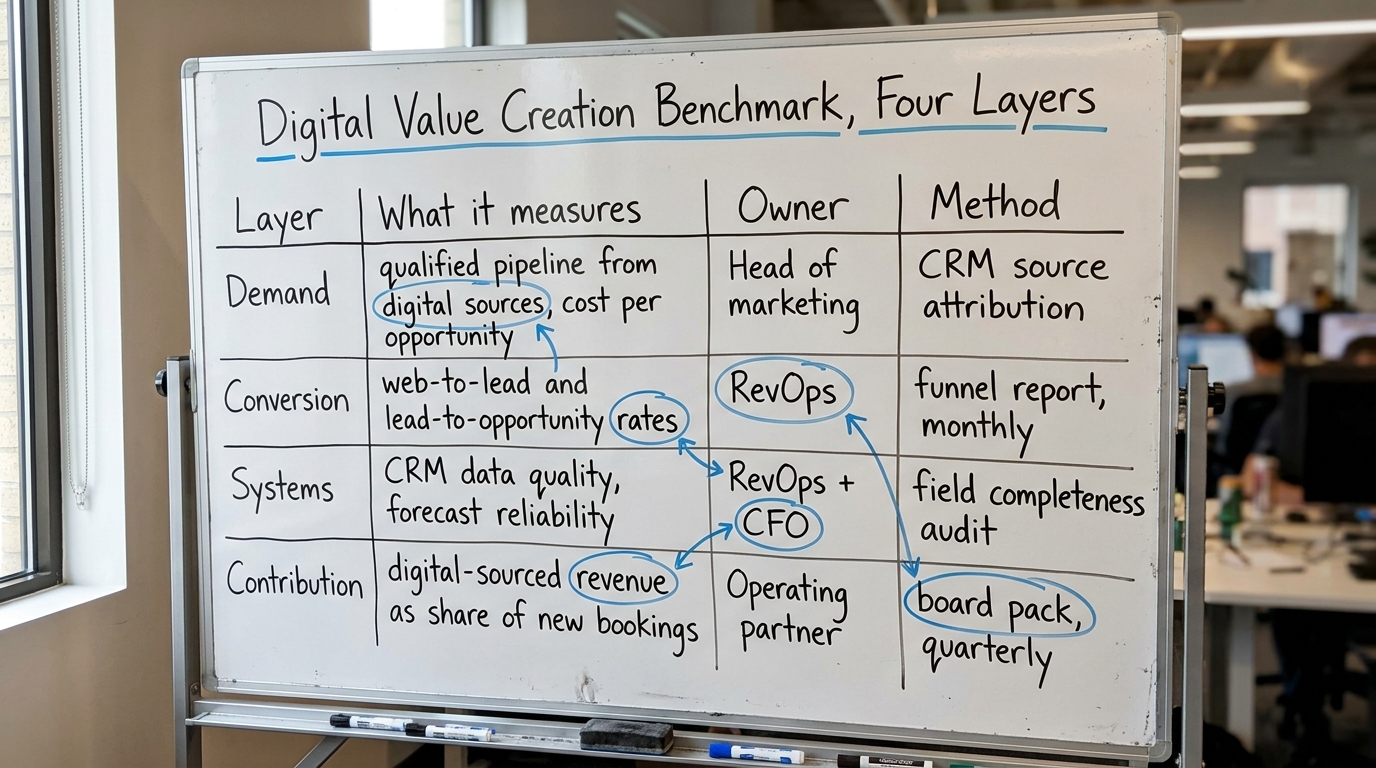
It is a documented starting position for the digital revenue system, tied to the metrics the deal thesis cares about, with an owner and a measurement method for each one. It is a statement of where things stood at a specific date, with numbers: the company generated this much pipeline from digital sources at this cost, converted at this rate, and here is how we measured it. Everything the digital workstream does afterward is read as movement against that line.
The distinction that matters to a buyer with budget is that a benchmark makes the digital line auditable. When the CFO builds the forecast and the operating partner reports to the board, both are working from the same baseline instead of two different stories.
3. Set the baseline before anyone touches the stack
The most common mistake is rebuilding the website or migrating the CRM and then trying to reconstruct where things stood beforehand. Once the system changes, the pre-change baseline is gone, and every later claim of improvement becomes an argument instead of a measurement. Capture the baseline in the first 100 days, before the first migration, and freeze it.
At minimum, record digital-sourced pipeline and closed revenue for the trailing twelve months, cost per opportunity by channel, the web-to-lead and lead-to-opportunity conversion rates, and a plain assessment of CRM data quality. If the CRM cannot produce clean source attribution, that fact is itself part of the baseline and usually the first workstream.
4. Tie each metric to a thesis number, not to a channel
A benchmark organized by channel (SEO, paid, email, events) tells the operating partner nothing about the thesis. Organize it by the commercial outcome the deal underwrote. If the thesis is faster organic growth, the benchmark leads with digital-sourced new bookings and cost per acquired customer. If the thesis is margin expansion, it leads with the cost of the demand engine per dollar of pipeline.
This is the same discipline that account-based programs demand when the target list has to match the deal thesis. A metric that does not roll up to a thesis number is measurement for its own sake, and it will not survive a budget review.
5. Decide what the benchmark does not include
Vanity metrics inflate a benchmark until it stops informing any decision. Sessions, impressions, follower counts and email open rates belong in an operating dashboard, not in the benchmark the board reads. The test is simple: if a number moving up or down would not change a resourcing decision, it does not belong in the benchmark.
The same applies to leading indicators dressed up as outcomes. Marketing qualified leads are useful internally, but a benchmark that reports MQL growth without the downstream conversion to opportunity and revenue is describing motion, not contribution.
6. Fix attribution before you trust any of it
Most portfolio-company CRMs cannot cleanly attribute revenue to digital sources on the day of acquisition. Fields are blank, source is overwritten at each stage, and duplicate records inflate the counts. A benchmark built on that data is worse than no benchmark because it produces confident numbers that are wrong.
Getting attribution to a defensible state is usually the first real project, and it overlaps heavily with the CRM work covered in Salesforce RevOps decisions the operating partner has to make. Until source attribution is reliable, treat the benchmark as provisional and label it that way in the board pack.
7. Assign an owner and a decision right to every line
A benchmark without a named owner is a report nobody maintains. Each metric needs one person accountable for its accuracy and a clear statement of who decides when it triggers action. The head of marketing may own cost per opportunity, but the operating partner holds the decision right on whether a rising cost gets more budget or a different playbook.
This is where a fractional RevOps arrangement earns its retainer, because a portfolio company at $15-50M in revenue rarely has a full-time RevOps leader who can maintain the benchmark and run the underlying systems at the same time.
8. Judge the benchmark against four questions
When someone hands the operating partner a digital value creation benchmark, whether built in-house or by an embedded partner, four questions separate a real one from a dashboard.
- Does every metric roll up to a thesis number? If it stops at channel performance, it is a marketing report.
- Is the baseline dated and frozen? A benchmark that keeps recalculating the starting point cannot show improvement.
- Is the attribution method stated and defensible? If nobody can explain how digital-sourced revenue is counted, the number is not usable in a board pack.
- Does each line have an owner and a decision right? Without that, the benchmark informs no decision and maintains itself into staleness.
9. Classify every claimed improvement
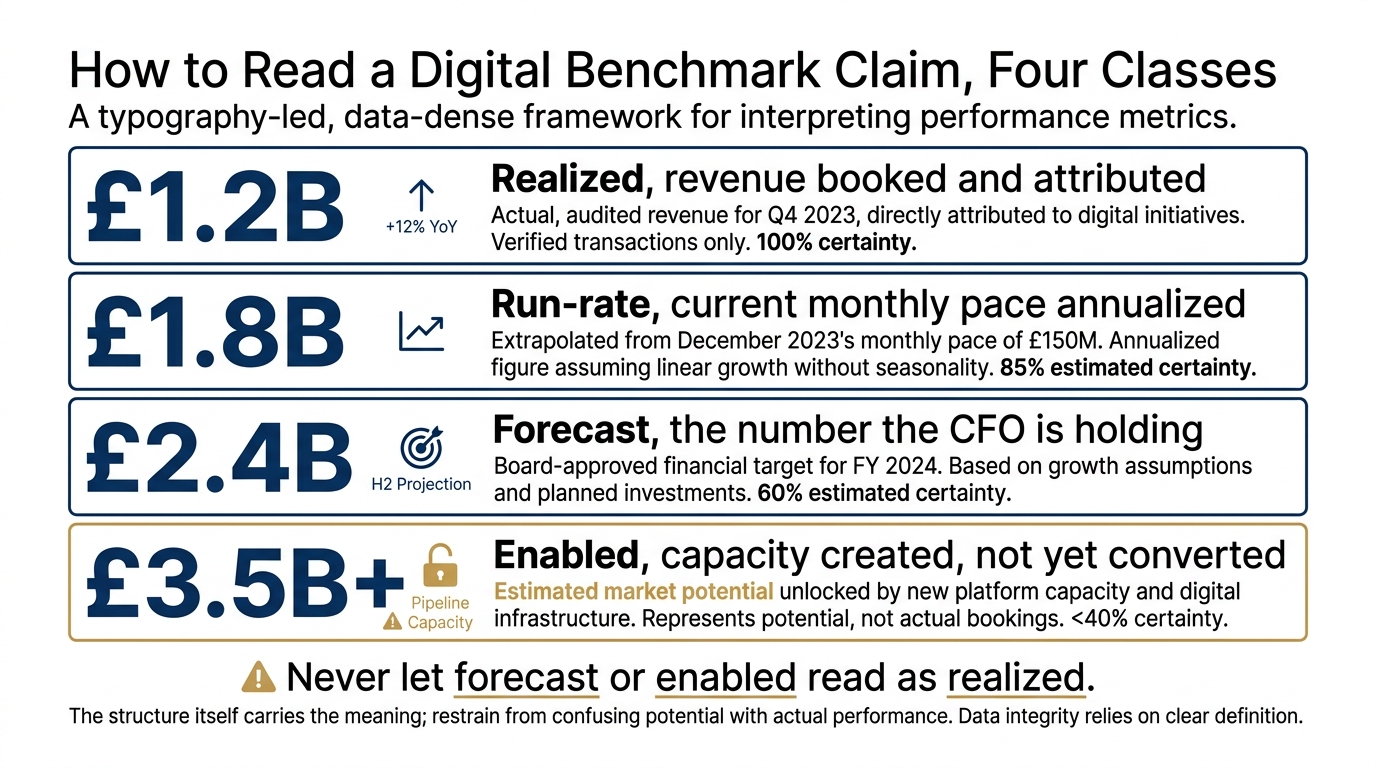
The strongest benchmarks separate what has actually happened from what is projected. Realized improvement is revenue already booked and attributable. Run-rate is the current monthly pace annualized. Forecast is the number the CFO is holding. Enabled value is capacity created that has not yet converted. Mixing these is how digital workstreams lose credibility, because a forecast reported as realized eventually gets caught.
McKinsey’s private capital research and BCG’s work on principal investors both point to disciplined value tracking as a differentiator between funds, and that discipline starts at the metric level. Their perspectives are worth reading at McKinsey and BCG.
10. Connect the benchmark back to diligence
The best digital benchmarks start during diligence, not after close. If the technology and revenue systems were assessed before signing, the baseline is half-built already. Weak CRM data, thin attribution and an underpowered demand engine should surface in technology due diligence, and the benchmark is where those findings become a measurable improvement plan.
For deal teams still deciding how deep to go, the mechanics of reading and commissioning that work are covered in how to read a technical due diligence report before you sign off. PitchBook’s deal data, available through PitchBook research, is useful for setting external context on comparable transactions.
11. Set the reporting cadence and stick to it
A benchmark reviewed only when the board asks is a benchmark that gets rebuilt under pressure with whatever data is handy. Fix a monthly internal review for the operating metrics and a quarterly board-level read for contribution. The quarterly view is what protects the digital line when the budget conversation starts, because it shows movement against a frozen baseline rather than a fresh set of numbers.
12. A next-step checklist
- Capture the trailing-twelve-month baseline before any system migration, and freeze the date.
- Map each digital metric to a specific thesis number, and drop anything that does not roll up.
- Audit CRM source attribution first, and label the benchmark provisional until it is defensible.
- Name an owner and a decision right for every line.
- Classify every claimed improvement as realized, run-rate, forecast or enabled.
- Set a monthly operating review and a quarterly board read.
- Tie the benchmark back to diligence findings so improvement is measurable against what was underwritten.
For operators standing up this work across a portfolio, the DevriX and GrowthShuttle PE team builds and maintains benchmarks like this as part of an embedded engagement. The team runs the digital value-creation workstream when the portfolio company needs the benchmark built and held. See how the DevriX PE offer works.