By the first board meeting, the operating partner already owns a number. The revenue plan the deal team underwrote is now a commitment, and the gap between that plan and what the portfolio company’s go-to-market engine can actually produce is the operating partner’s problem to close. GTM value creation for portfolio companies is not a marketing exercise. It is the mechanism that turns an underwritten thesis into realized revenue growth and defensible EBITDA expansion before exit.
The person accountable for revenue systems in a portfolio company faces a specific decision set: what to fund, what to fix, what to leave alone, and how to prove any of it moved a number. This guide is built for that person, someone with budget and a plan to defend, not someone learning the category. It sequences the decisions and gives concrete tests for judging whether a GTM investment is working.
GTM sits at the center of the value-creation plan because multiple expansion alone won’t carry the return
Multiple expansion is no longer the reliable engine it was in a low-rate era. Bain & Company’s annual global private equity report has tracked the shift toward operational value creation as the durable source of returns, and McKinsey’s private capital research points to the same reality: sponsors increasingly need real revenue and margin gains to hit target returns.
Go-to-market is where a large share of that gain either shows up or fails to. Pricing, pipeline coverage, sales productivity, retention, and marketing efficiency are the levers that move the top line and, through operating leverage, the bottom line. The operating partner’s job is to decide which of these levers has the shortest path to a measurable result and to hold the portfolio company accountable to it.
Start with the underwritten thesis, not the org chart
Before any GTM spend gets approved, the revenue owner needs the deal team’s thesis without the consultingspeak. Was this company underwritten on new-logo acquisition, on expansion within the base, on price, on entering an adjacent segment, or on consolidating add-ons? The answer dictates where GTM investment goes. A retention-led thesis funded as if it were a new-logo thesis burns cash and misses plan.
This connects directly to what the deal team learned during technology due diligence. Diligence findings about CRM state, attribution gaps, and data quality are not IT trivia. They are the constraints on how fast the GTM plan can execute. Treat the diligence risk register as the input to the GTM plan, not a separate document that gets shelved after close.
Establish a baseline before you spend
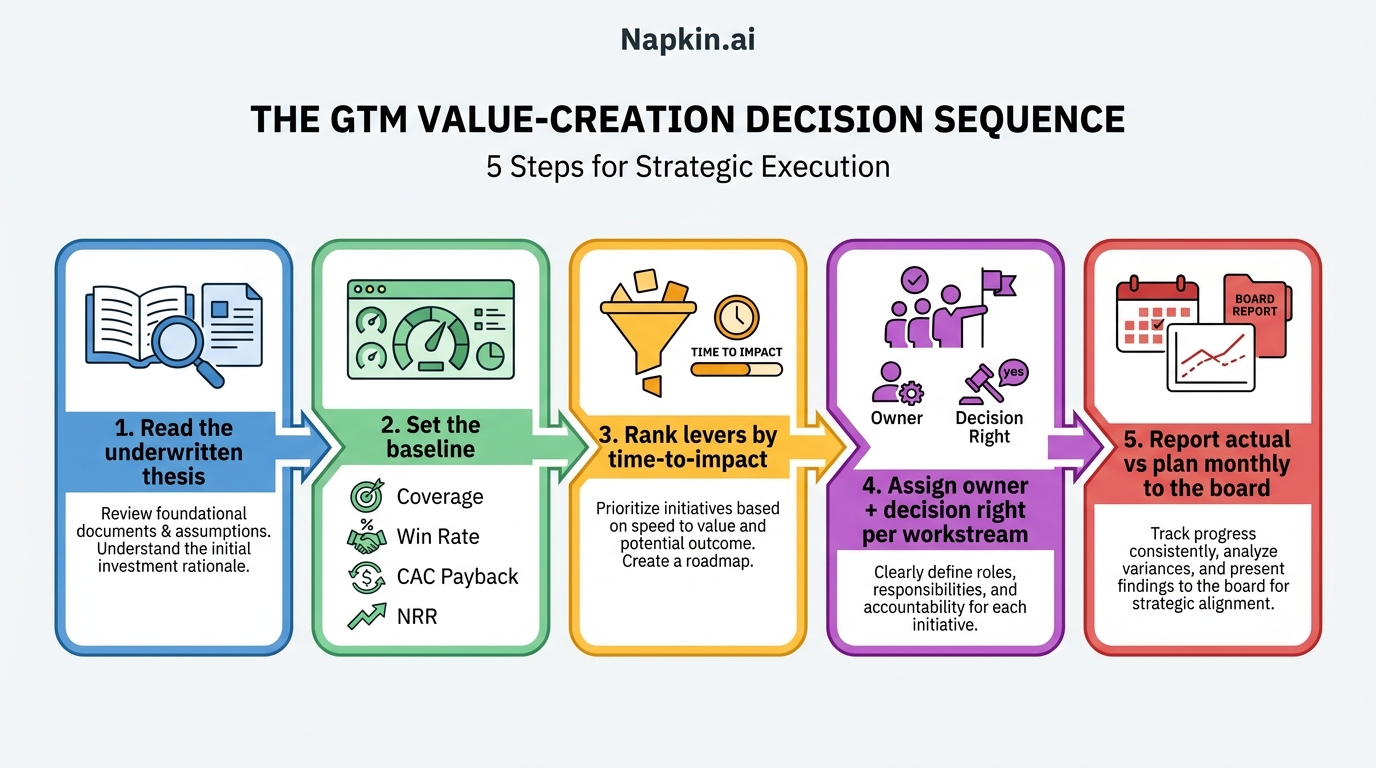
The most common failure in portfolio GTM work is spending against a plan without an honest baseline. If the revenue owner cannot state current pipeline coverage, win rate by segment, CAC payback, net revenue retention, and lead-to-close conversion, then no GTM investment can be judged. It can only be reported as activity.
Build the baseline in the first 100 days. Bain and BCG both frame the first 100 days as the window where an operating partner sets the measurement regime that governs the rest of the hold. A baseline captured late is a baseline argued over, because nobody can separate the effect of the intervention from the noise.
The test for a real baseline is simple: can two people pull the same number from the same system and agree it is right? If revenue and marketing report different pipeline figures, fix the data before funding the campaign.
Rank the levers by time to impact
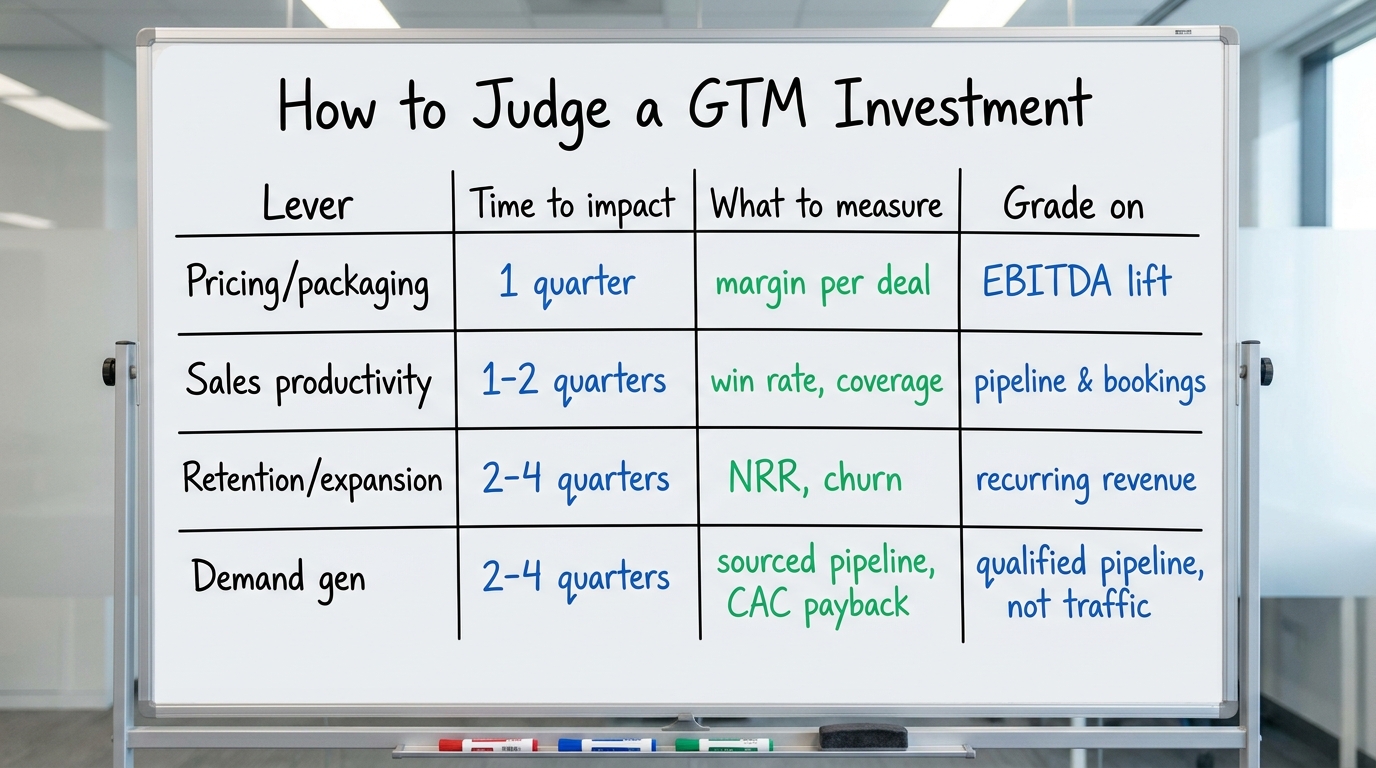
Not every GTM lever pays back on the same timeline, and the hold period does not forgive slow bets. A practical ranking the revenue owner can defend to a board:
- Pricing and packaging. Often the fastest EBITDA impact because it flows to margin with little incremental cost. Requires clean segmentation and the nerve to test.
- Sales productivity and pipeline hygiene. Territory design, stage discipline, and coverage math produce results inside a quarter or two.
- Retention and expansion. Slower to show, but the most durable and the most attractive to the next buyer.
- Demand generation and new-logo motion. Real, but it carries the longest lag and the most attribution ambiguity, so it needs the tightest measurement.
Rank these against the specific thesis and against the exit clock. A five-year hold funds retention infrastructure differently than a company being readied for sale in eighteen months.
Decide what the tech stack actually enables
GTM plans die in the systems layer. If attribution is broken, the demand-gen result cannot be proven. If the CRM cannot support the pricing model, the pricing change cannot ship. This is sharpest in a buy-and-build, where add-ons arrive with their own systems and processes.
Post-merger CRM conflict is a direct tax on GTM velocity, and it is worth treating with the same rigor as any integration workstream. The practical mechanics of reconciling incompatible systems are covered well in this post-merger CRM integration roadmap. The revenue owner’s job is to know which GTM moves are blocked by an integration dependency and to sequence around it rather than pretend the constraint does not exist.
Assign owners and decision rights before funding
Every GTM workstream needs a named owner and a clear decision right. Who signs off on a pricing change? Who can reallocate demand budget mid-quarter? Who owns the number for retention? When these are ambiguous, the plan slows to the speed of the slowest escalation.
The operating partner does not run the workstream. The operating partner sets the accountability structure and reviews actual against plan. The portfolio company executive runs it. Confusing those two roles produces either a passive board or a micromanaged team, and both waste the hold period.
Judge demand programs on pipeline, not traffic
Content, social, and channel programs generate activity that is easy to mistake for progress. Traffic, impressions, and follower counts are inputs, not outcomes. The revenue owner judges a demand program by sourced and influenced pipeline, by conversion, and by CAC payback, full stop.
That said, the input mechanics matter because they compound. Publishers running portfolio content operations get real leverage from disciplined digital content strategy and from omnichannel distribution across social, email, and video. Where relevant, micro-influencer distribution can extend reach at a lower cost than broad paid campaigns. The rule stays the same: fund the input, but grade it on the pipeline it produces.
Instrument the reporting the board will actually read
A GTM plan the board cannot see is a plan the board cannot support. The reporting should show a small set of leading indicators tied to the thesis, updated monthly, with actual against plan and a short note on variance. Overbuilt dashboards get ignored. The Harvard Law School Forum on Corporate Governance has published extensively on value creation and board oversight in private equity, and the consistent theme is that reporting discipline, not reporting volume, is what earns board confidence.
PitchBook’s research and data is useful here for benchmarking growth and multiple expectations by sector, which helps the revenue owner set targets the board will recognize as credible rather than arbitrary.
Protect and expand recurring revenue
The most exit-attractive revenue is retained and expanding revenue, because the next buyer pays for predictability. Retention work is unglamorous and slow to show, which is exactly why it gets underfunded. The revenue owner should protect its budget from being raided to chase a short-term new-logo number.
For portfolio companies with a media or content asset, recurring revenue can be built directly into the model. Approaches like converting content into a membership community and using live events to deepen community and retention create recurring, higher-multiple revenue lines that a buyer will pay for. These are illustrative moves, not a prescription; the right ones depend on the asset.
Avoid the value-destruction traps
Three traps recur across portfolio GTM programs:
- Funding activity as if it were outcome. Approving spend against volume metrics with no line to pipeline or margin.
- Ignoring the systems constraint. Launching a plan the CRM and attribution cannot support, then arguing about numbers nobody trusts.
- Mistiming the lever. Funding a long-lag demand motion in a short-hold asset, or starving retention in a long hold.
BCG’s principal investors and private equity research and S&P Global’s market intelligence both reinforce that the operational programs which hold up under scrutiny are the ones tied to a specific, measured commercial result. That is the standard to hold every GTM line item to.
The next-step checklist
- Write down the underwritten thesis in one sentence and confirm the GTM plan matches it.
- Establish a baseline both revenue and marketing agree on before approving spend.
- Rank the levers by time to impact against the hold period.
- Map every GTM move to its systems constraint and integration dependency.
- Assign one owner and one decision right per workstream.
- Grade demand programs on sourced pipeline and CAC payback, never on traffic.
- Build one monthly board view: leading indicators, actual vs plan, variance note.
- Protect the recurring-revenue budget from short-term raids.
Run this in sequence. Each step is a decision the revenue owner can defend, and together they convert a GTM plan from a spend line into a value-creation lever the board can watch move.
When a portfolio company needs a full-funnel demand and RevOps program built and measured against the value-creation plan, review the DevriX private equity operating offer and how it maps GTM execution to the thesis your deal team underwrote.