A roll-up that bought six brands in thirty months usually inherits six websites, six CMS stacks, six analytics setups and six vendors who each think they own the customer. The operating partner now carries a cost line nobody underwrote, a security surface nobody mapped, and a revenue story the board expects to improve. Multi brand website consolidation for portfolio companies is the work of turning that estate into something that costs less to run, converts better, and does not break during the next add-on. What to consolidate, in what order, and what evidence proves it paid are the decisions that follow.
This guide is written for the person accountable for revenue systems across the platform. It covers the decisions to make, how to sequence the work, and how to judge whether the spend earned its place in the value creation plan.
1. Why the web estate shows up as a value creation problem
In a private equity roll-up, each acquired brand arrives with its own digital footprint, and nobody chose the resulting mix on purpose. The platform ends up paying for parallel hosting, overlapping agencies, duplicated license seats, and content teams who rebuild the same page five ways. None of that converts a buyer.
Bain’s annual private equity report has tracked how holding periods and multiple expansion have tightened, which pushes more of the return onto operational improvement rather than entry-to-exit re-rating. You can read Bain’s current view in its Global Private Equity Report. When the return has to come from the business, a web estate that leaks cash and loses demand is a line you can act on inside a hold period.
2. Decide the consolidation model before you touch a single site
There are three honest models, and the choice drives everything downstream.
- Full merge. Every brand folds into one domain and one design system. Best when the brands serve the same buyer and the parent brand carries equity.
- Shared platform, separate brands. One CMS, one analytics layer, one hosting contract, but each brand keeps its domain and identity. Best for roll-ups where customers are loyal to the local or category brand.
- Federated, governed. Sites stay distinct but share standards, a security baseline and a measurement model. Best when brands are genuinely different businesses that happen to share an owner.
Most portfolio companies overreach toward full merge because it looks cheapest on a slide, then lose organic traffic from brands that customers searched by name. The model choice needs to match buyer behavior and the equity each brand carries.
3. Baseline the estate before anyone proposes a redesign
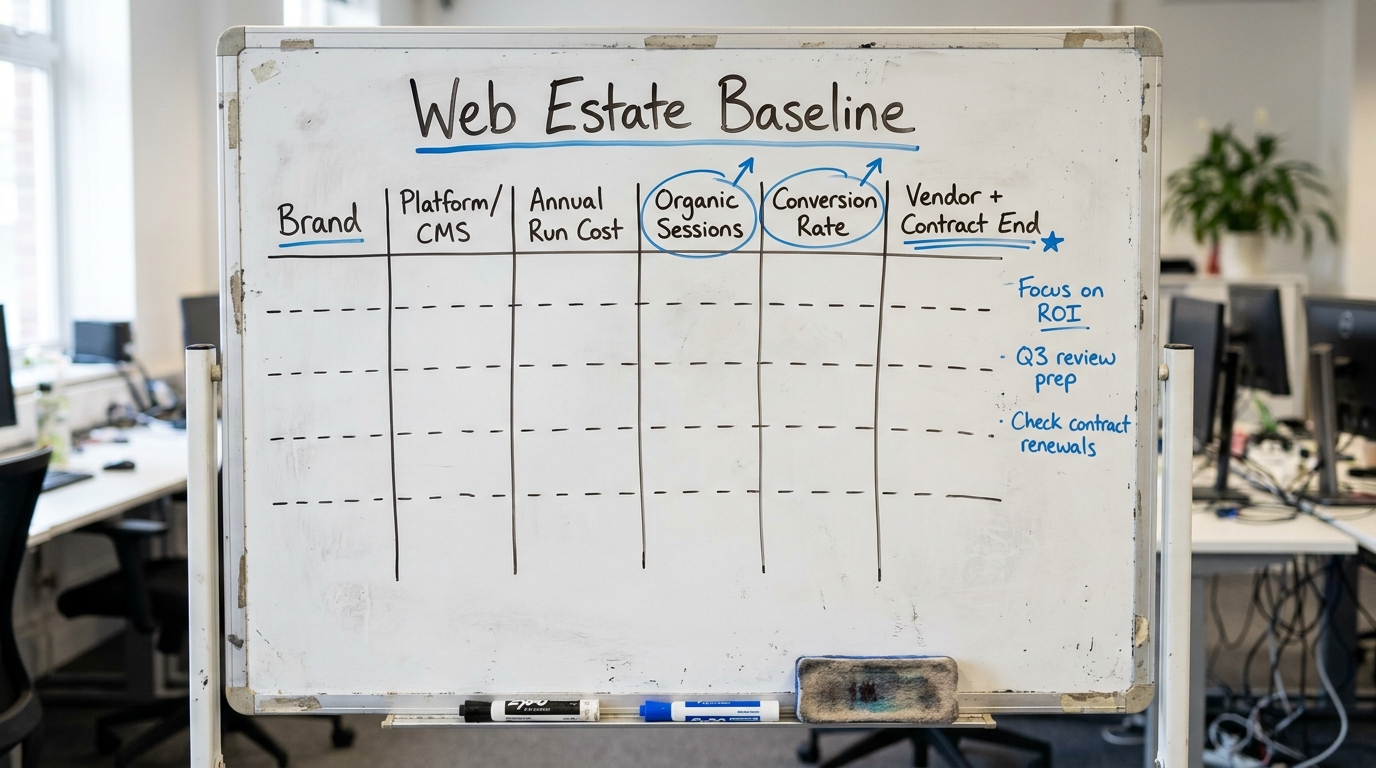
You cannot judge a consolidation you never measured. Before approving any build, require a baseline that lists every property, its platform, its annual run cost, its organic and paid traffic, its conversion rate, and its vendor and contract terms. This is the same discipline a buyer applies during technology due diligence, applied now to an estate you already own.
The baseline settles arguments. When a vendor claims a brand’s site cannot move, the contract end date and the traffic number tell you whether that is true or a renewal they want to protect.
4. Protect the organic demand you already paid for
The fastest way to destroy enterprise value in a consolidation is to break search visibility on a brand that was ranking. Redirects done badly, URL structures changed without mapping, and content dropped during migration all cost real demand that shows up as a revenue miss two quarters later.
Require a redirect map and an organic-traffic hold target as acceptance criteria for any migration. The team should commit to preserving ranking pages, not just launching a prettier site. The commercial logic here mirrors what operators weigh in M&A commercial due diligence: demand you already bought is cheaper to keep than to re-earn.
5. Consolidate the data layer, not just the pages
Separate sites almost always mean separate analytics, separate CRM connections and separate attribution logic, which is why the platform cannot see its own numbers across brands. A consolidation that unifies the front end but leaves six disconnected measurement setups has solved the visible problem and left the expensive one.
Insist that the project deliver one measurement model across brands, so the CFO and the board can read performance the same way for every property. McKinsey’s private capital research, published across its insights, has repeatedly tied value creation to management’s ability to see and act on operating data. A shared data layer is what makes the rest of the revenue engine improvable, which is the point raised in post-acquisition RevOps integration.
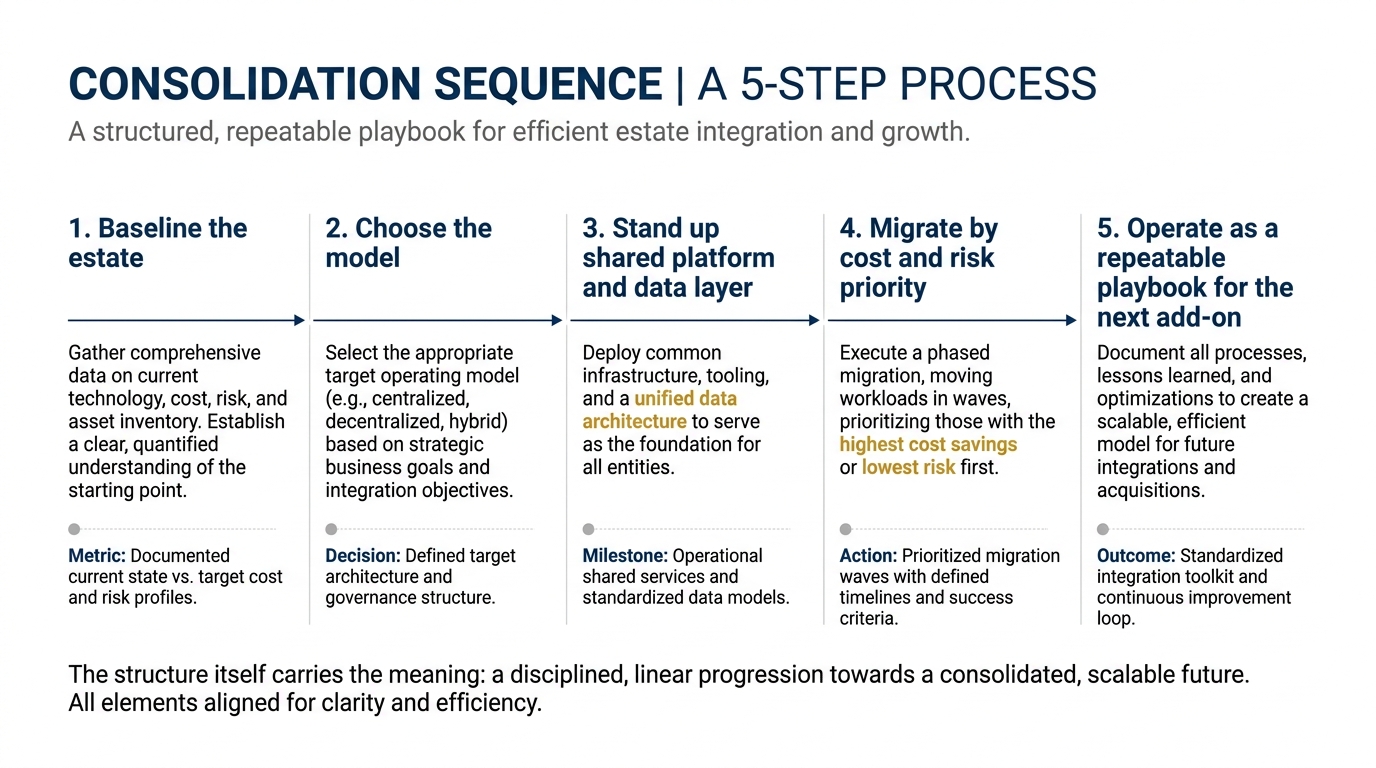
6. Sequence the work so the first add-on does not reset it
Roll-ups keep buying. A consolidation designed around the six brands you own today breaks when brand seven arrives on an unfamiliar stack. Sequence the work so the platform and the standards come first, and the brand migrations follow in priority order.
Prioritize by two factors: the cost each site drains, and the risk each site carries (unsupported CMS, no security patching, expiring contract). Migrate the highest-cost or highest-risk property first, prove the pattern, then run the rest as a repeatable playbook rather than six custom projects.
7. Put a real cost case on the table
The CFO will not approve a consolidation on design quality. The case has to show run-cost reduction (fewer hosting contracts, fewer license seats, fewer overlapping agencies), avoided risk (retiring unsupported platforms), and a revenue argument tied to conversion and preserved organic demand.
Classify each number honestly. Run-cost savings from canceling a contract are realized once the contract ends. Conversion lift is forecast until the data confirms it. If you are weighing the cost of the diagnostic that produces this case, the logic in what a value creation diagnostic costs applies directly to scoping the estate work.
8. Decide the vendor question deliberately
Six brands often means six agencies, and consolidation forces the question of who runs the combined estate. The choice is to standardize on one internal team, rent a single partner who owns the platform and the migrations, or keep a governed set of vendors against one standard.
Benchmark the quote against AI-era build costs. Entry consolidation work on a shared platform should cost tens of thousands and move in weeks, not a six-figure, multi-quarter rebuild. A partner who arrives already understanding a roll-up’s business model, rather than one who needs constant correction, is the one that holds the timeline. Avoid lock-in; the platform should remain portable as the estate grows.
9. Tie the project to the first 100 days, or to a clear trigger
Web consolidation competes for attention with every other integration workstream, so it needs a trigger that makes it urgent rather than eventual. The strongest triggers are a new platform acquisition, an expiring hosting or agency contract, an unsupported CMS flagged in diligence, or a measurement gap the board raised at the first meeting.
When the work lands inside the first 100 days, it benefits from the integration budget and the attention that fade later. The planning discipline here is the one described in pre-close value creation planning: decide the owner and the sequence before Day 1, not after the agencies have renewed.
10. Name the owner and the decision rights
A consolidation with no single owner stalls, because every brand lead defends their own site and no one can force a standard. Name one accountable owner for the estate, give them the decision right over platform, domain strategy and vendor selection, and make brand leads consulted rather than vetoing.
Put the baseline, the model decision, the sequence and the cost case into the risk register and the board pack, so the project has the same standing as any other value creation workstream rather than living as an IT ticket.
11. The checklist before you approve the spend
- A baseline table exists listing every property, its run cost, its traffic, its conversion and its vendor contract terms.
- The consolidation model (full merge, shared platform, or federated) is chosen against buyer behavior and written down.
- A redirect map and an organic-traffic hold target are acceptance criteria for the integration.
- The project delivers one measurement model across all brands.
- The sequence puts the shared platform and data layer first, then migrates by cost and risk.
- The cost case separates realized savings from forecast conversion lift.
- One owner holds the decision rights, and the work is tied to a real trigger.
Independent data from PitchBook and S&P Global Market Intelligence on deal activity and roll-up strategies is useful context when you size the estate against how fast the platform intends to keep acquiring. The faster the buy cadence, the more the repeatable-playbook model pays.
12. What good looks like at the next board meeting
A consolidation that worked shows a lower run cost on the estate line, organic demand held or grown through migration, one set of numbers the board can read across brands, and a documented pattern the next add-on can follow without a custom project. If the only evidence is a nicer-looking homepage, the spend has not yet earned its place in the plan.
If the estate is sprawling and the next acquisition is already in sight, the teams at DevriX and GrowthShuttle run this consolidation work against enterprise-value targets for portfolio companies. See how that engagement is scoped at the DevriX private equity hub.