By the time a deal reaches confirmatory diligence, the commercial case is usually already written into the model: the market is growing, the pipeline converts, the customer base is sticky, and the revenue plan compounds for five years. The operating partner’s job is to find the two or three assumptions that, if wrong, break the thesis, and to decide whether they can be tested before close or have to be managed after it. That is what m&a commercial due diligence is for, and it is why handing the entire exercise to an external firm and reading the deck at the end is the most expensive way to run it.
This guide is written for the person who will have to live with the answer, the operating partner or portfolio executive accountable for hitting the plan once the wire clears. It covers what to decide, who owns each call, and how to judge the work rather than how to define it.
1. Start from the decision, not the data room
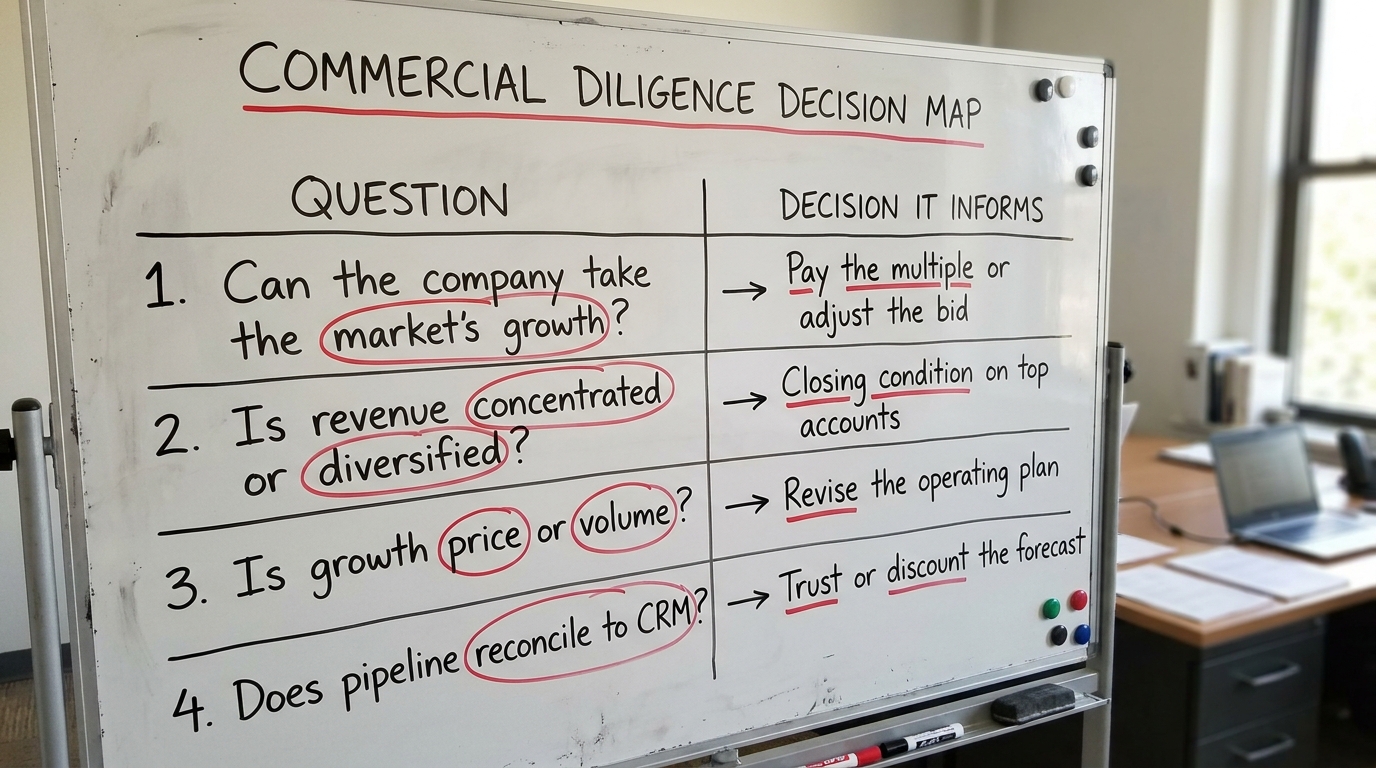
Commercial diligence produces a lot of material, and most of it is confirmatory. The useful fraction answers a decision the deal team actually faces: do we pay this multiple, do we adjust the plan, do we add a closing condition, or do we walk. Everything else is cost.
Before the first interview is booked, write down the three to five questions whose answers would change the bid or the plan. Bain’s annual Global Private Equity Report has documented for years how often returns now depend on operational improvement rather than multiple expansion, which means the diligence that matters is the diligence that tells you whether the operating plan is reachable, not just whether the market exists.
2. Separate the market story from the company’s actual position
A healthy market and a healthy business are different findings, and they get conflated constantly. Market sizing, growth rates and segment dynamics tell you whether there is room to grow. They say nothing about whether this specific company can take that room with its current product, salesforce and pricing.
Insist that the commercial work answer the second question explicitly. Where is the company winning, where is it losing, and why. If the output is a market-size chart and a competitor logo grid with no position statement, the firm has described the pond and skipped the fish.
3. Test the revenue quality, not just the revenue number
The top line in the model is an aggregate. What decides whether it holds is the composition underneath it: customer concentration, contract terms, renewal behavior, net revenue retention, and how much of last year’s growth came from price versus volume versus one-time events.
This is where commercial diligence and a quality-of-earnings review have to talk to each other rather than run in parallel. The AICPA and CIMA publish guidance on QoE engagements that the finance workstream should be anchored to, and the commercial read on customer behavior should reconcile with what the QoE finds in the ledger. When the two disagree, that gap is the finding.
The signals worth isolating
- Revenue concentration: how much of the base sits in the top ten accounts, and what their individual trajectories look like.
- Retention and churn by cohort, not blended, because a blended rate hides a declining core behind new logos.
- Price realization: whether the company holds price or discounts to close.
- Pipeline conversion that reconciles to the CRM, not to a spreadsheet built for the process.
That last point matters more than it reads. In many mid-market targets the commercial data that diligence relies on lives in disconnected systems and gets assembled in Excel for the sale. If the pipeline numbers cannot be traced back to the CRM, treat them as a claim, not evidence.
4. Walk the demand chain the way a buyer walks it
Customer interviews are the part that external firms do well and internal teams rarely have time for. Done properly, they tell you why customers chose this company, whether they would choose it again, and what would make them leave. Done poorly, they produce satisfaction scores that mean nothing.
Judge the interview program by its sampling and its questions. Were lost accounts and churned customers included, or only happy references the seller supplied. Were buyers asked about alternatives they considered, or only about their experience. A reference list curated by the target is marketing, not diligence.
5. Pressure-test the growth plan line by line
The model’s growth usually comes from a named set of levers: new logos, cross-sell, price increases, geographic expansion, new products. Each is a separate bet with a separate risk, and each should survive being questioned on its own.
Ask what has to be true for each lever to deliver, and what capacity the company would need to pull it. A cross-sell assumption that requires a salesforce the company does not have, and cannot hire fast, describes a scenario the company cannot execute, which makes it a forecast rather than a plan. This is the connective tissue between diligence and pre-close value creation planning: the levers you believe in during diligence become the workstreams you own on Day 1.
6. Read the commercial findings against the technology reality
A growth plan that depends on better data, faster quoting, or an integrated customer view is only as good as the systems that would have to deliver it. Commercial diligence that never looks at the revenue stack will credit the model with efficiency gains the infrastructure cannot support.
This is why the commercial and the technology due diligence workstreams should share findings before either writes its conclusions. When someone writes an operating plan that assumes the company can run GTM with fewer people through automation, someone else has to confirm the CRM is governed, the data is connected, and the reporting is real. Often it is not, and that is a cost line someone omitted rather than a reason to walk.
7. Classify every commercial upside before you bank it
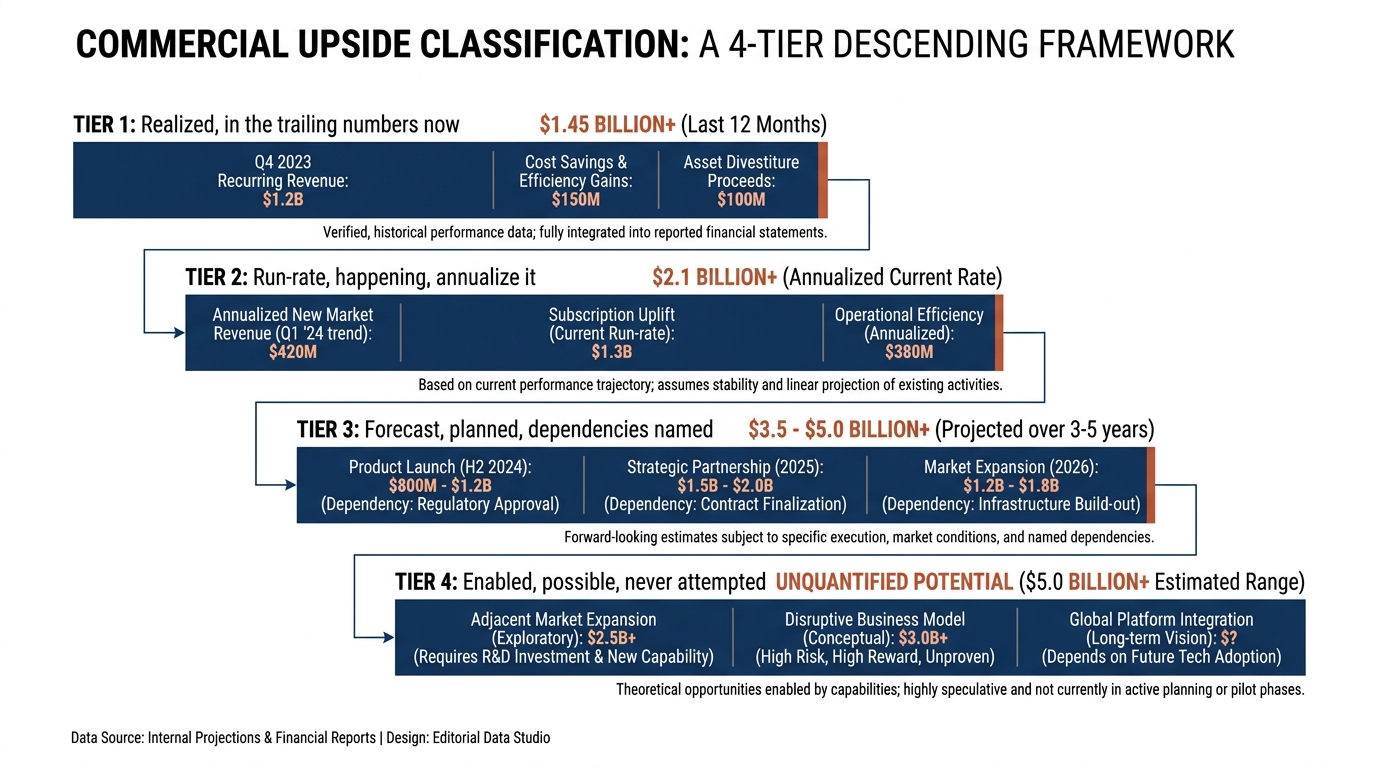
Not all upside is the same, and treating it as the same is how plans miss. A revenue improvement is realized, run-rate, forecast, or merely enabled, and the bid should treat them differently.
Price increases already in effect are closer to run-rate. A cross-sell program that has never been attempted is enabled at best. McKinsey’s work on value creation in private capital repeatedly makes the point that the gap between the deal thesis and realized value is where returns are won or lost, and most of that gap is upside that was banked at close but only enabled in reality.
8. Write the risk register before the price gets fixed
Every commercial finding that cannot be resolved before close belongs on a risk register with an owner, a cost to fix, and a decision on who carries it. Concentration risk might become a closing condition. A weak sales process becomes a first-100-days workstream. A missing systems foundation becomes a budgeted project.
The discipline is to carry each item somewhere rather than letting it dissolve into optimism. Harvard Law School’s Forum on Corporate Governance hosts practitioner writing on how diligence findings should flow into deal terms and post-close governance, and the principle holds: a finding with no owner is a finding someone chose to ignore.
9. Decide what you will fix in the first 100 days
The commercial issues that cannot be priced away become the opening agenda for ownership. The ones worth resolving early are usually foundational: CRM governance, consistent data capture, the reports leadership actually needs, and a pipeline that reconciles. None of it is advanced, and all of it has to exist before the clever growth levers work.
Sequencing this is the heart of the first 100 days, and it is easier when diligence handed you a ranked list of commercial fixes rather than a 200-page report. For revenue systems specifically, the handoff from diligence into execution is its own discipline, covered in more depth in this piece on post-merger integration for revenue systems.
10. Judge the diligence firm the way you judge any vendor
Commercial diligence is bought under time pressure, which is exactly when buyers overpay for volume and presentation. The signal to look for is whether the firm arrives having done outside-in work on the company’s actual business model, or whether it needs constant correction because it dropped a SaaS template onto a distributor or a clinic group.
Ask what decision each section informs. If a chapter answers no question on your list, it is there to fill pages. The same test applies to anyone you hire for the value creation side afterward, which is worth reading alongside this guide to judging a value creation partner before you sign and to buying advisory work without overpaying for slideware.
11. The checklist before you sign off on commercial diligence
- The three to five questions that could change the bid are written down, and the report answers them.
- Market attractiveness and company position are two separate findings that belong on separate axes.
- Revenue quality is read by cohort and concentration, and it reconciles with the QoE.
- Pipeline numbers trace back to the CRM, not to a spreadsheet built for the sale.
- Customer interviews include lost and churned accounts alongside seller references.
- Each growth lever has a named condition and the capacity needed to pull it.
- Commercial and technology findings were reconciled before either concluded.
- Every upside line is classified as realized, run-rate, forecast, or enabled.
- Unresolved findings sit on a risk register with an owner and a cost to fix.
- The foundational fixes are sequenced into the first-100-days plan.
Research shops that track deal outcomes, including PitchBook and S&P Global Market Intelligence, keep showing that entry price alone no longer carries returns the way it once did. The implication for commercial diligence is direct: the work has to tell you whether the plan is reachable, and hand you a ranked set of actions, not a verdict you file and forget.
If the commercial findings point to a revenue systems problem, disconnected data, a CRM nobody governs, a forecast that cannot be traced, that is the gap between the thesis and realized value, and it is fixable work with a known cost. To turn those findings into a sequenced plan and the team to run it, review the DevriX private equity offer and bring your diligence risk register to the conversation.