When the LOI is signed and confirmatory diligence is closing, the operating partner usually faces a staffing decision with real money attached: whether to hire post merger integration experts for the deal, what those people have to own, and how to tell a capable integrator from a slide factory before the engagement letter goes out. Get it wrong and the first 100 days burn on status decks while the systems that actually carry revenue, cash collection and management reporting stay broken. Get it right and the integration workstreams have named owners, a baseline, and a plan that survives the first board meeting.
This guide is written for the person accountable for revenue systems in a private equity portfolio company. It covers what to decide, in what order, and how to judge the people you are paying.
1. Decide what the integration actually has to deliver
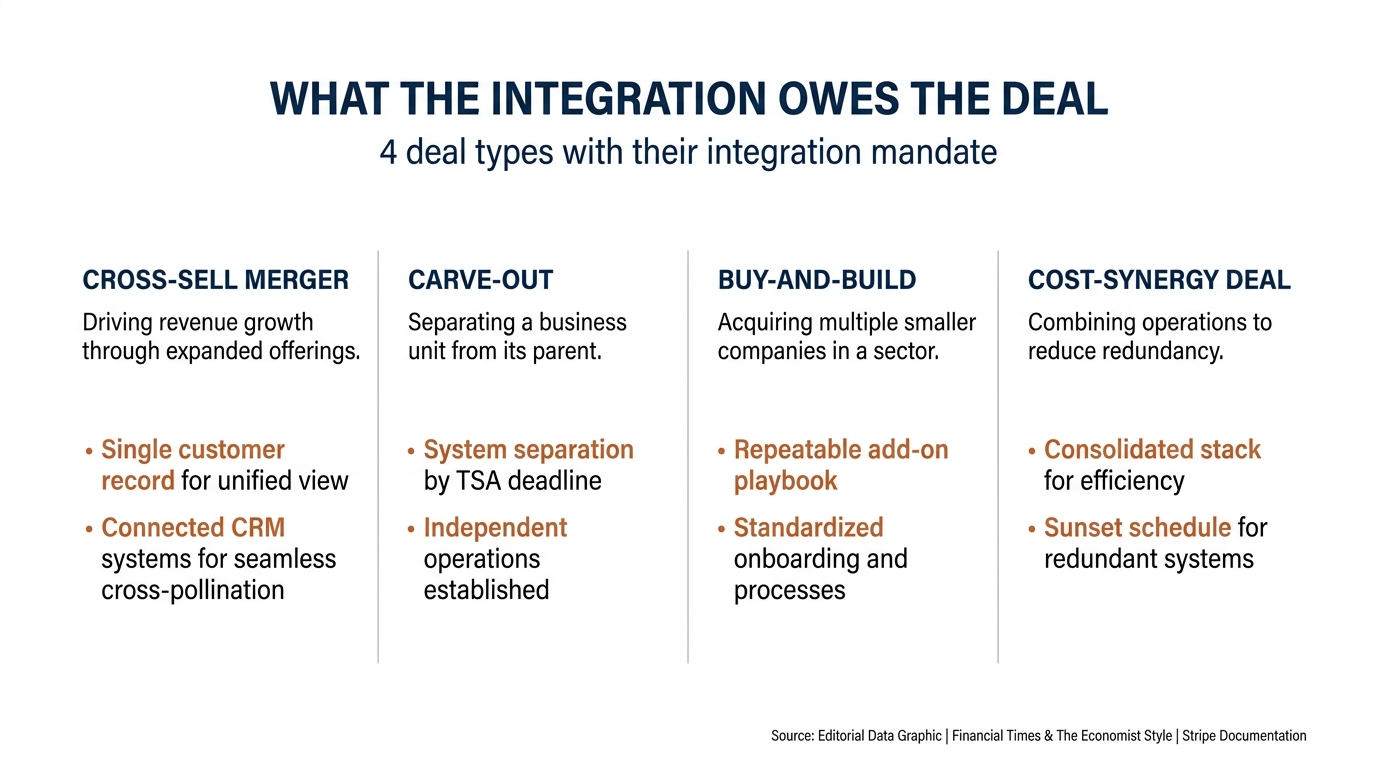
Before anyone is hired, write down the commercial result the integration owes the deal. A merger that was underwritten on cross-sell owes a connected CRM and a single customer record. A carve-out owes system separation from the parent by the transition services agreement deadline. A buy-and-build owes a repeatable playbook that the next add-on drops into without a six-month rebuild.
The result is not “integrate the two companies.” It is a specific change in revenue, EBITDA, cash conversion, or integration speed that the deal model assumed. If the people you interview cannot restate that result back to you in the first meeting, they are not ready to run it.
2. Separate the calls the operating partner keeps from the work to hire out
Some decisions do not transfer to a vendor. Which system becomes the system of record, which leader owns a merged function, what gets sunset and when, how customer data is consolidated: these are the operating partner’s to make, informed by evidence the integrators gather. The reason to hire post merger integration experts is to run the workstreams, surface the trade-offs with real numbers, and execute once the call is made.
We have written separately on the revenue-system calls the operating partner owns and on the five PMI decisions a fractional CTO cannot delegate. Read both before you scope the engagement, because what you keep determines what you buy.
3. Know why integration is where returns leak
The reason this hire matters is that integration is a documented failure point for deal returns. Bain’s annual private equity report has tracked for years how value creation now depends on operational improvement rather than multiple expansion, which puts execution in the first 100 days under direct scrutiny. Harvard Business Review’s M&A research has long held that most mergers underperform their thesis, and poor integration is a repeated cause.
You can read Bain’s view at the Global Private Equity Report and broader operational research from McKinsey. The money you spend on competent integration is underwriting the thesis.
4. Scope the engagement around workstreams, not headcount
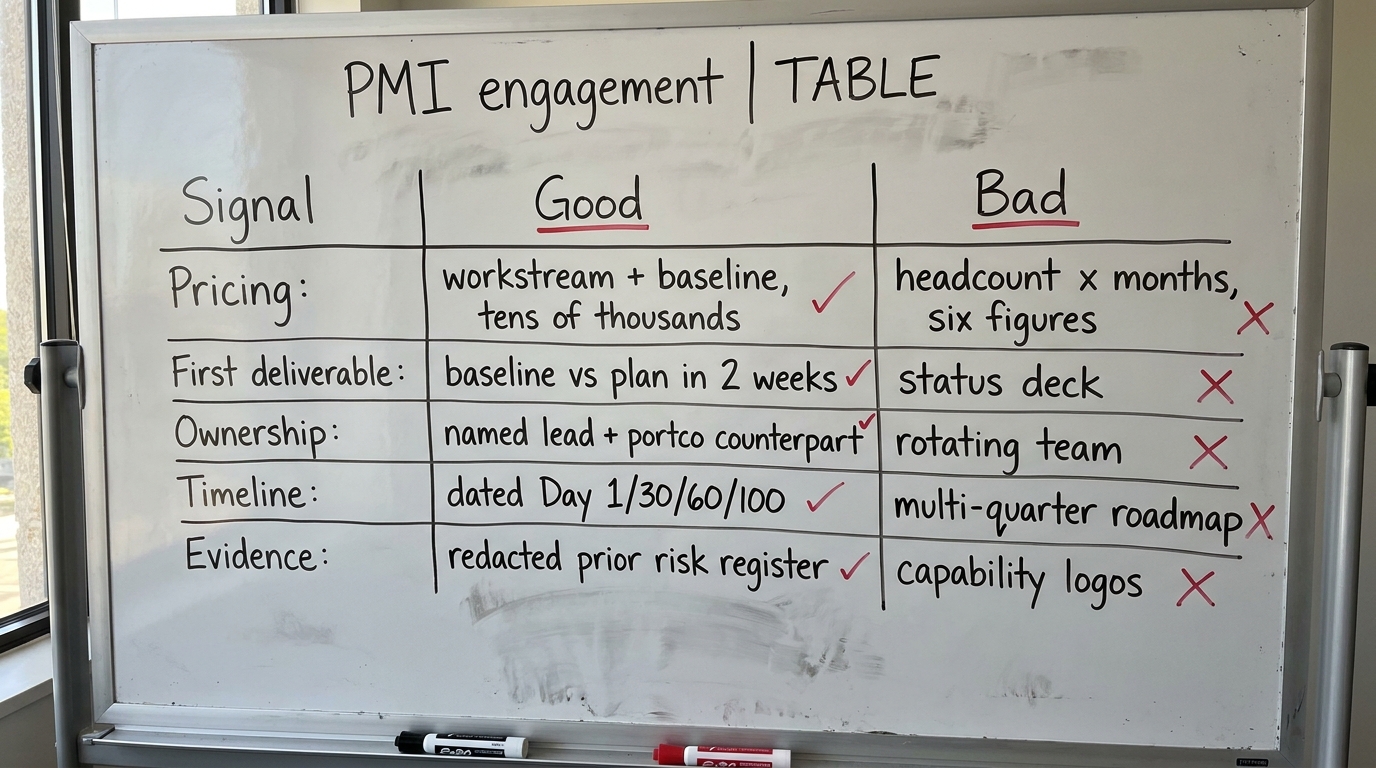
A proposal priced on bodies and months tells you the firm sells time. A proposal built around workstreams, each with an owner, a baseline, a decision date and a dependency map, tells you they have run this before. Ask for the second one.
The core workstreams for a revenue-systems integration usually include data consolidation, CRM and martech, finance and reporting, and the application rationalization that follows a technology due diligence finding. Each needs a named owner on the integrator’s side and a named counterpart in the portfolio company. If a workstream has no portco owner, it will not land, no matter who you hire.
5. Judge the people before you judge the firm
Logos on a capability deck do not run your integration. The lead who shows up does. Before you sign, meet the person who will own the engagement day to day and ask them to walk through a comparable integration they ran, including what went wrong and what they changed.
What a capable lead can do in the room
- Restate your deal thesis and name the two or three systems decisions that put it at risk.
- Describe how they establish a baseline in the first two weeks, with read-only access rather than a long data request.
- Explain their escalation path when a workstream slips, and who they call.
- Show a risk register from a prior deal, redacted, so you can see how they track and retire risk.
The standard for judging a value creation partner before you sign applies here directly. You are buying a person’s judgment under deadline, not a methodology slide.
6. Price it against what integration work costs now
Entry-level diligence and baseline work should cost tens of thousands and move in days, not a six-figure time-and-materials project that takes months to produce a first read. The build economics have changed, and a quote that ignores that is a quote from a firm that has not updated its model.
For a sense of how to judge the spend, our breakdown of what a value creation diagnostic costs sets out the ranges and the questions that keep a proposal honest. Benchmark any PMI quote against it and against market data from PitchBook on deal activity in your sector.
7. Insist on a baseline before a plan
A plan built on assumptions is a guess with a timeline. The first deliverable from anyone you hire should be a baseline: actual system inventory, actual data quality, actual reporting gaps, actual integration dependencies, measured against what the deal model assumed. The gap between actual and plan is the real scope, and it is almost never what the data room suggested.
This is also why a share of the serious work belongs before close. Our note on pre-close value creation planning lists the decisions that cannot wait for Day 1, and several of them determine who you need to hire in the first place.
8. Tie the engagement to the first 100 days
The clock that matters is the one that starts at close. The integration plan should map to the first 100 days with dated milestones, not a vague multi-quarter roadmap. For cost-side work, our walkthrough of the 100-day cost reset and the four decisions that cannot wait shows how tightly the early calendar has to be sequenced.
Ask any candidate to produce a Day 1, Day 30, Day 60 and Day 100 view with owners and a proof metric for each milestone. If they cannot, they are selling activity rather than the outcome the deal needs.
9. Watch for the carve-out trap
Carve-outs carry a deadline the merger does not: the transition services agreement with the former parent. Separation that runs past the TSA either costs money in extensions or strands the business on systems it no longer controls. If the deal is a carve-out, the people you hire need separation experience specifically, and our piece on IT carve-out advisory and the separation decisions the operating partner owns covers the calls you cannot hand off.
10. Avoid the slideware firm
Some firms are built to produce the governance deck for the board and nothing that survives contact with a real system migration. You can tell them apart by what they commit to. A slideware firm commits to meetings, workshops and a final report. An execution firm commits to a working artifact, a connected system, a migrated dataset, a dashboard the CFO can open.
Our guide to buying a value creation firm without overpaying for slideware applies the same filter to the firm-level decision. Hold the PMI hire to it.
11. Confirm the plan survives the board
Whatever you hire has to produce a plan the deal partner will defend at the first board meeting. That means the plan is tied to enterprise value, has owners, and classifies each expected impact honestly as realized, run-rate, forecast or risk avoided. The standard in our piece on building a portfolio value creation strategy that survives the first board meeting is the bar to hold. For governance expectations around integration, the Harvard Law School Forum on Corporate Governance is a useful reference.
12. A checklist before you sign
- The commercial result the integration owes is written down and the lead can restate it.
- You have separated the calls you keep from the workstreams you are buying.
- The proposal names an owner and a price for each workstream rather than billing by headcount and elapsed time.
- You have met the actual engagement lead and seen a redacted prior risk register.
- The first deliverable is a baseline measured against the deal model, inside two weeks.
- The plan maps to dated Day 1, 30, 60 and 100 milestones with one proof metric each.
- If it is a carve-out, the team has specific separation and TSA experience.
- The plan is tied to enterprise value and will hold at the first board meeting.
Also review the related framing in what a value creation advisor actually owns, and cross-check sector deal data through S&P Global Market Intelligence and BCG’s principal investors research as you scope the work.
If you want a team that runs the revenue-systems integration as dated 100-day execution rather than a governance deck, review the DevriX 100-Day Digital Execution offer for private equity and bring a live deal to scope against it.