By the first board meeting after close, the operating partner usually knows which part of the thesis is at risk. The revenue number in the model depends on a system that does not exist yet: a pipeline that converts, a pricing motion that holds, a reporting layer the CFO can forecast against. Choosing a value creation partner for private equity is the decision that determines whether that system gets built on the hold-period clock or slips two quarters. This guide is for the person who owns that call: what the partner has to own, what you decide before you sign, and how to tell a real operator from a vendor selling activity.
The stakes are commercial, not academic. A partner who delivers dashboards and campaign reports leaves you exactly where you started, except poorer and later. A partner who moves EBITDA, cash conversion or integration speed changes the exit math. The difference is visible in the first scope conversation if you know what to ask.
1. Start with the value creation plan, not the vendor
The mistake that costs the most is scoping a partner before the value creation plan is written down with owners and dollar figures attached. If the plan still lives in the deal partner’s head, any vendor can sound relevant, because nothing is falsifiable yet.
Write the plan first. For each lever, name the EBITDA or revenue it is supposed to produce, the baseline it moves from, the owner on the management team, and the quarter it lands. Bain’s annual Global Private Equity Report has tracked for years how much of the industry’s return now depends on operating improvement rather than multiple expansion or leverage, which is exactly why the plan has to be specific enough to hold a partner accountable to a number.
Only then does the question “who do we hire” have a correct answer. The partner exists to close a named gap in that plan, not to bring a general capability you might use someday.
2. Decide which gap you are actually buying against
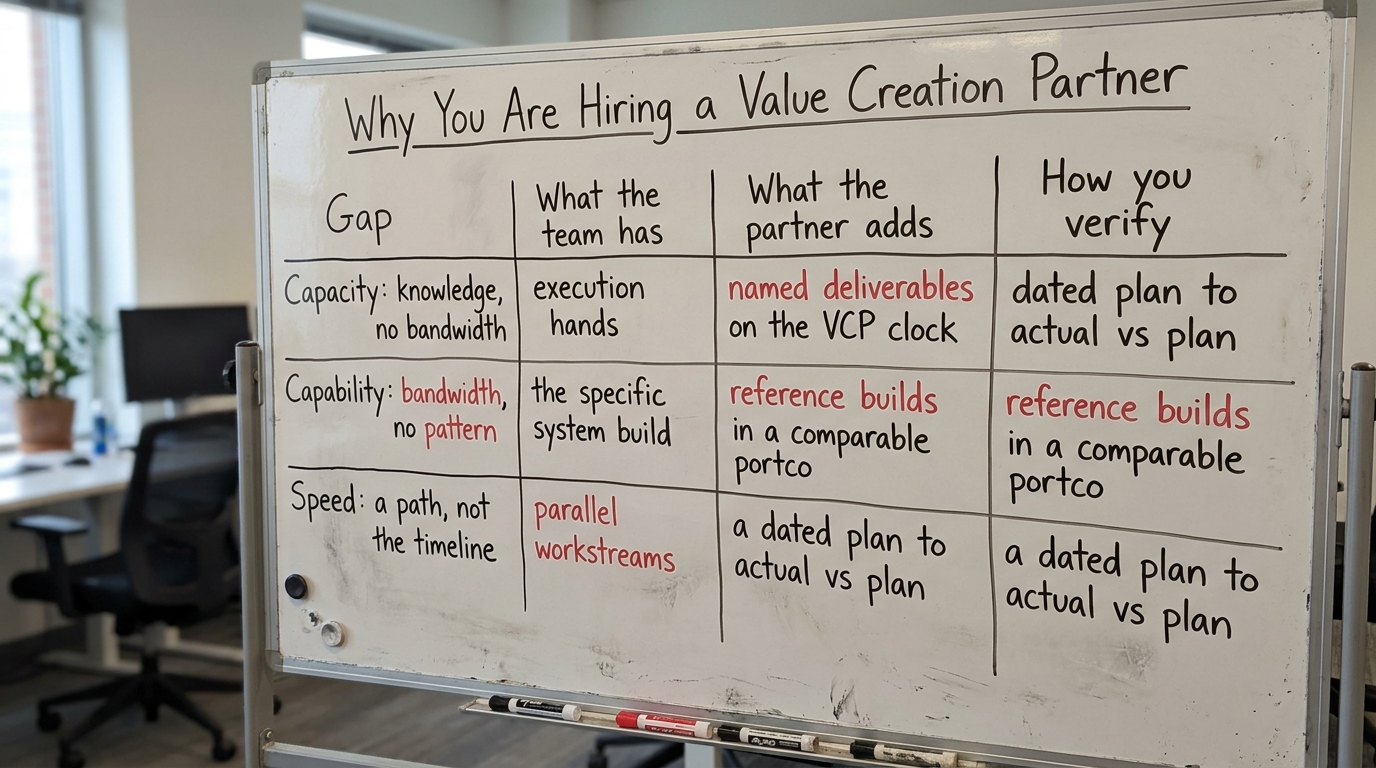
A value creation partner for private equity is worth the fee only when it closes a gap the management team cannot close on the hold-period clock. There are three honest reasons to bring one in.
- Capacity: the team knows what to do and has no bandwidth to do it inside the window.
- Capability: the team has bandwidth but has never built the specific system (a modern revenue stack, a carve-out separation, an ABM motion tied to the thesis).
- Speed: the team could get there in eighteen months and the plan needs it in six.
Name the one that applies before the first call. If you cannot, you are buying reassurance, and reassurance does not show up in the QoE at exit.
2b. The capacity-vs-capability call in one view
3. Separate strategy from execution before you scope
Firms sell three different things under the same label. Some write the diagnostic and hand you a deck. Some execute what someone else planned. A smaller group does both and stays on the hook for the number.
Decide which you need. If your management team can execute but cannot see the gap, buy the diagnostic and keep execution in-house. If they can see the gap and cannot build, buy execution and keep strategy where it is. The expensive error is paying a strategy fee for a plan your team could have written, then paying again for the build. The way digital value creation consulting is scoped for a PE owner tells you quickly which of the three you are talking to.
4. Judge the partner on evidence, not on the pitch
Commercial references from a comparable portfolio company matter more than methodology slides. Ask for a build they ran in a business of similar size, under PE ownership, where the number they claimed showed up in the P&L. McKinsey’s private capital research and BCG’s principal investors work both document how thin the line is between operating improvement that compounds and transformation theater that consumes the hold period, so the reference needs to survive follow-up questions.
Three questions separate operators from vendors:
- What did actual come in at against the plan you signed, and where did you miss?
- Who on the management team owned the result after you left, and does it still run?
- What did you refuse to scope because it would not move the number?
A vendor describes effort. An operator describes outcomes they can attribute to an account, a period and a baseline. The frameworks in how to judge a digital transformation partner for portfolio companies and how to judge a consultant before you sign the retainer go deeper on the reference calls worth making.
5. Require a baseline before anyone touches a system
No credible partner starts building before the current state is measured. If they propose a roadmap in week one without a baseline, they are selling a template. The baseline is what makes actual-vs-plan possible later, and without it you cannot tell improvement from noise at the board meeting.
For revenue systems specifically, the baseline covers pipeline conversion by stage, CAC and payback, data integrity in the CRM, and the reporting the CFO forecasts against. What belongs in that measurement is laid out in what belongs in a digital value creation benchmark. Treat a partner who skips it the way you would treat a technology due diligence provider who never opened the codebase.
6. Match the partner to the deal moment
The right partner at the first 100 days is not the right partner for an add-on two years later. The trigger dictates the scope.
At close and through the first 100 days
The work is stabilizing revenue systems, fixing reporting the CFO cannot trust, and standing up the levers the thesis depends on. Speed matters more than elegance.
During an add-on or carve-out
The work shifts to integration and separation. The calls an operating partner owns during a revenue-systems merge are covered in post-merger integration for revenue systems, and the separation side in IT carve-out advisory and the separation decisions the operating partner owns. A partner strong at greenfield build can be weak at untangling two overlapping stacks, and the reference calls should test for the one you need.
7. Get the decision rights on paper
Before signing, write down who owns the roadmap, who signs off on spend, who the partner reports to at the board, and what moves to the management team at handoff. Ambiguity about who decides is the most common failure, and it costs more than bad work does.
If the partner wants to own a decision the CEO should own, that is a flag. If they want to hand every decision back to you, you have bought capacity, not a partner, and you should price it that way. The Harvard Law School Forum on Corporate Governance publishes repeatedly on how unclear accountability inside portfolio companies erodes value, and the pattern holds for vendor relationships too.
8. Price against value at risk, not against hours
The fee should map to the EBITDA the lever is supposed to produce, not to headcount or ticket volume. A partner charging day rates with no tie to the plan’s dollars has told you how they think about the engagement.
Structure the entry small and conditional. A diagnostic that costs a few thousand dollars and produces a dated, owned plan de-risks the larger spend that follows. If the diagnostic is good, the execution scope writes itself. If it is thin, you have spent little to learn that. PitchBook’s research and data and S&P Global’s Market Intelligence both show operating-driven returns under more pressure as entry multiples stay elevated, which is the case for paying for proof before paying for scale.
9. Know which specific builds the partner is for
“Value creation” covers work that needs different operators. Be precise about the one you are buying.
- Standing up a revenue operations function: fractional RevOps for private equity covers what the operating partner actually gets.
- Fixing conversion on existing demand: conversion rate optimization for portfolio companies.
- Pointing demand at the thesis account list: ABM and the named account list.
- Building software the business needs to run: custom software development for portfolio companies.
A firm that claims all of these equally is worth a harder look at references. Breadth is cheap to assert and expensive to prove.
10. The checklist before you sign
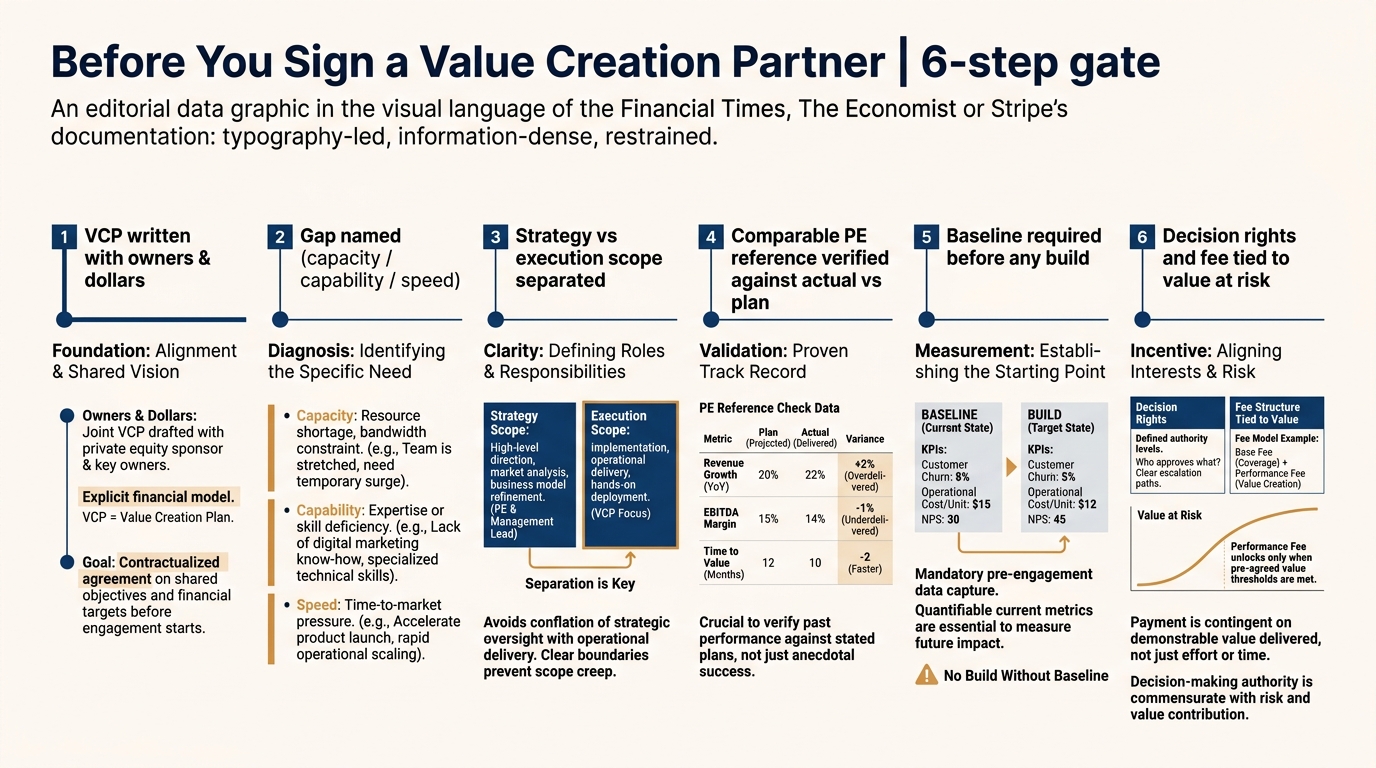
Run every candidate through the same gate:
- The value creation plan is written, with owners, baselines and dated dollar figures, before the partner is scoped.
- The gap you are buying against is named: capacity, capability or speed.
- Strategy and execution are scoped separately, and you are not paying a strategy fee for a plan your team could write.
- At least one commercial reference from a comparable PE-owned business survives follow-up on actual vs plan.
- A baseline is required before any build begins.
- Decision rights are on paper, and the fee maps to value at risk rather than hours.
A partner who clears all six is accountable to the exit math. One who stumbles on more than one is selling activity, and activity does not improve the enterprise value you underwrote. For broader context on how this work fits the operating model across a portfolio, DevriX’s private equity hub maps the engagements to the deal stages they belong to.
11. Where to start
The lowest-risk first move is a diagnostic that produces the owned, dated plan this whole decision depends on, then a defined 100-day scope only if the diagnostic earns it. If you are approaching close or already inside the first board cycle and the revenue-system lever in your thesis has no owner yet, start with the Value Creation Diagnostic and 100-Day plan through the DevriX PE practice and scope the build against the number it surfaces.