By the first board meeting after close, the operating partner is usually holding two numbers that do not agree. The deal model promised a margin bridge that depends on cost actions landing inside the first quarter, and the actual run-rate spend coming out of the target’s ledgers is higher and messier than diligence suggested. A 100 day cost reset in private equity is where those two numbers get reconciled, or where the forecast quietly starts slipping. The decision in front of the portfolio company executive is not whether to cut, but which costs to touch, in what order, and how to prove the savings are real rather than timing.
This is written for the person accountable for that reconciliation, the operating partner or the portfolio CFO. The framework below names the four decisions that have to be made and owned, and how a board should judge whether the reset worked.
1. Why the first 100 days is where cost credibility is won or lost
The window matters because management attention, lender patience, and employee tolerance for change are all at their highest right after a transaction. Bain’s annual private equity report has tracked for years how value creation has shifted toward operational improvement rather than multiple expansion and leverage, which means the cost side of the plan now carries weight it did not carry a decade ago. You can read Bain’s ongoing work on this in its Global Private Equity Report.
Waiting past the first quarter does not make the cuts easier. It makes them look reactive, because by then the board has a quarter of actuals showing the gap. The reset is most defensible when it runs in parallel with the broader first 100 days plan rather than as a separate austerity exercise bolted on after the honeymoon ends.
2. Name the framework before you name the numbers
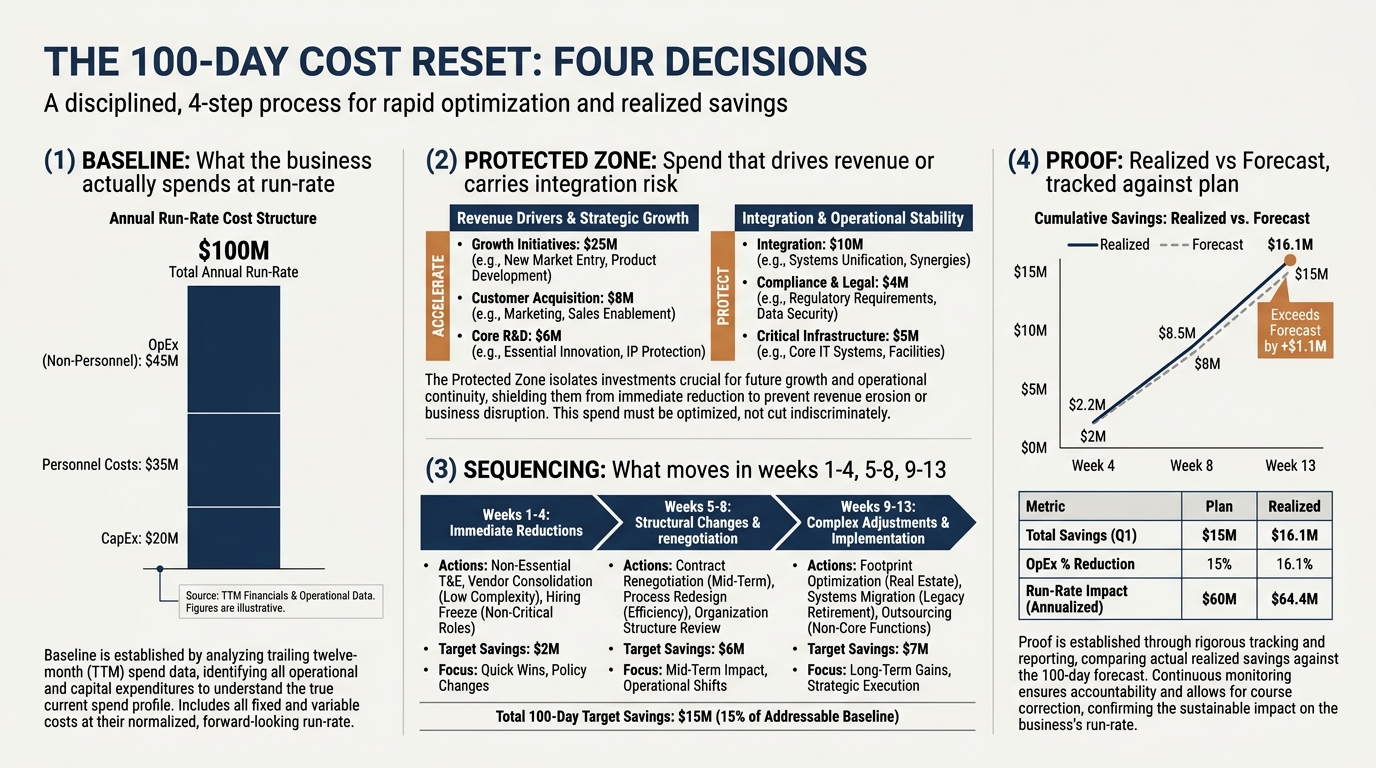
The reset breaks into four decisions, each with a named owner and a way to judge it. Treating them as one undifferentiated “cost takeout” line is how reviews turn into theater. The four are: the spend baseline, the protected zone, the sequencing of actions, and the proof mechanism. Everything a board should ask about the reset maps to one of these.
The point of naming them separately is that they fail separately. A baseline can be wrong while the sequencing is sound. The proof mechanism can be absent while the cuts themselves are correct. Diagnosing which part broke is only possible if they were held as distinct decisions from the start.
3. Decision one is the baseline, and it is usually wrong on day one
Nearly every reset starts from a cost figure that came out of the deal model, and the deal model used normalized or adjusted numbers for valuation purposes. Those are not the numbers you manage against in week two. The first decision the operating partner owns is forcing a true run-rate baseline out of the actual general ledger, by vendor, by contract, by headcount line.
This is where diligence quality shows. If the technology due diligence was thin, software and infrastructure spend is often the line hiding the most surprises, duplicate SaaS contracts, auto-renewing licenses nobody owns, and infrastructure provisioned for a traffic peak that no longer exists. The baseline is not finished until every cost line has a named owner inside the business who can confirm it.
How a board judges the baseline
Ask whether the reset’s starting number ties to the actual ledger and is built from vendor, contract, and headcount detail. If the starting point came out of the deal model, the baseline is not yet real and the savings claims resting on it are not either.
4. Decision two is the protected zone, drawn before any cut
The second decision is which spend does not get touched, and it has to be made explicitly and early. Cuts that hit revenue-generating capacity or create integration risk cost more than they save, and they tend to surface two quarters later when a pipeline dries up or a migration stalls. Drawing the protected zone first is what separates a cost reset from indiscriminate trimming.
In most portfolio companies the protected zone covers direct revenue systems, the people who run them, and anything load-bearing for an in-flight integration. The reasoning behind protecting revenue operations specifically is laid out in this piece on fractional RevOps for private equity and what the operating partner actually buys. Cutting the function that measures revenue to save a modest run-rate figure is the kind of saving that reverses itself.
5. Decision three is sequencing, because order changes the outcome
The same set of cuts produces different results depending on the order they land in. Contract renegotiations that need lead time have to start in week one even though they book savings later. Vendor consolidation that depends on a system decision cannot run before that decision is made. Headcount actions carry a different legal and morale cost and usually belong after the quick, reversible wins have built some credibility.
A workable sequence puts the low-risk, high-certainty items in weeks one to four, the actions with dependencies in weeks five to eight, and the structural moves in weeks nine to thirteen. The dependency most operators underestimate is the one running through revenue and billing systems, which is covered in detail in this analysis of post merger integration for revenue systems and the calls the operating partner owns.
The carve-out case changes the sequence
If the business is a carve-out, stranded cost and transition service agreement timing dominate the sequence, and the order is largely set by the separation schedule rather than by what is easiest. The separation decisions that constrain everything else are set out in this piece on IT carve-out advisory and the separation decisions the operating partner owns.
6. Decision four is proof, and it is where most resets quietly fail
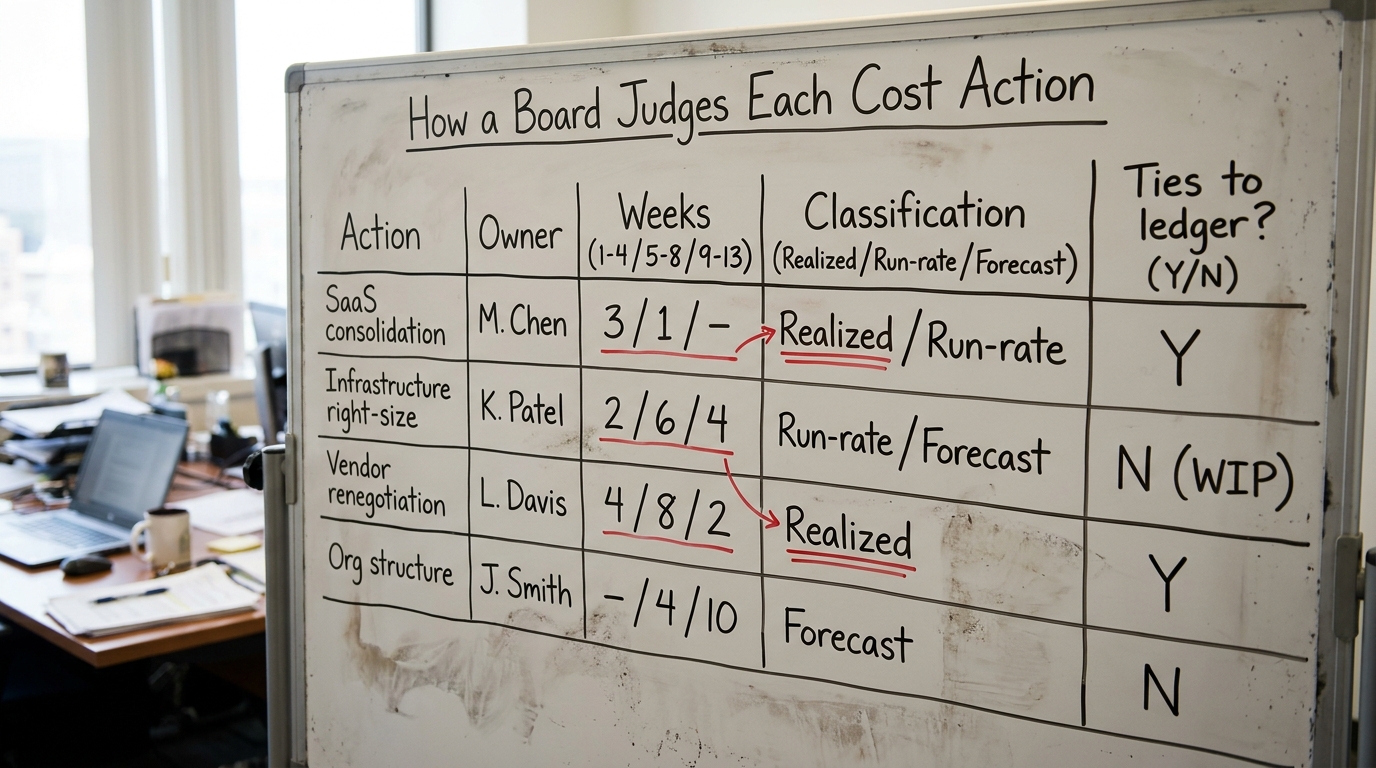
A savings number that cannot be traced to a line in the forecast or reconciled against the ledger cannot be defended. The fourth decision is how each action gets measured and classified: realized savings already in the actuals, run-rate savings that annualize from a change already made, or forecast savings that still depend on something happening. Letting forecast savings read as realized is the most common way a reset looks better in the board deck than in the cash position.
McKinsey’s private capital research has documented how operational value creation gets overstated when it is not held to a measurement discipline, and the broader literature on post-deal performance at the Harvard Law School Forum on Corporate Governance makes the same point about forecast reliability. The reset’s proof mechanism, tracking actual against plan line by line, is what keeps the next board meeting honest. McKinsey’s ongoing work on the subject sits on its research hub.
7. An illustrative walk-through of the four decisions
Consider an illustrative scenario, not a real deal. A newly acquired publisher shows €4.2M in annual operating spend in the model. Pulling the actual ledger (decision one) surfaces €380K in duplicate SaaS and over-provisioned hosting that the model had netted into a single line. The operating partner draws the protected zone (decision two) around the editorial and ad-ops teams and the analytics stack that proves revenue.
Sequencing (decision three) puts the SaaS and hosting cleanup in weeks one to four as low-risk wins, starts a vendor renegotiation that will not book until week ten, and defers any structural change to the back of the window. Proof (decision four) classifies the €380K as run-rate from the moment the contracts are cancelled, and only counts the renegotiation once the new terms are signed. The board sees a smaller, cleaner number than the model implied, and every euro of it ties to the ledger.
8. Where outside help earns its fee, and where it does not
The baseline and the proof mechanism are the two decisions a portfolio company can rarely build fast enough on its own inside a 100-day window, because they require instrumentation the business did not need before it was owned by a fund. A focused diagnostic that establishes the true run-rate baseline and stands up the measurement discipline is worth paying for. Open-ended “cost consulting” that produces a slide deck of savings ideas without an owner or a classification is not.
How to tell the two apart before you sign anything is the subject of this guide on how to judge a digital transformation consultant in private equity before you sign the retainer, and the value-creation framing sits in what digital value creation consulting buys a private equity owner.
9. The checklist a board should run before the reset is called done
- The baseline ties to the actual ledger, not the deal model, with a named owner on every cost line.
- The protected zone was drawn and documented before any cut, and covers revenue systems and in-flight integration dependencies.
- Every action has a sequence slot, a named owner, and a dependency check against system and separation decisions.
- Each saving is classified as realized, run-rate, or forecast, and the forecast items are not counted in the cash picture.
- The reset tracks actual against plan line by line and survives the next quarter of actuals without restatement.
Resets that pass all five are the ones that still look right at the second board meeting. The ones that fail usually failed at decision one, where a model number was mistaken for a managed number.
For the broader portfolio context around these decisions, the private equity operating work at DevriX sits alongside the diagnostic that produces the baseline and the measurement discipline. If the first quarter after close is where your margin bridge has to start landing, the place to begin is a 100-Day value creation diagnostic that establishes the run-rate baseline and the proof mechanism before the cuts begin.