An operating partner approving a diagnostic in the first weeks after close is making a budget decision with incomplete information. The deal thesis names where value sits, but the portfolio company’s own numbers often cannot confirm it, and the people who could confirm it are the same people running the business. The value creation diagnostic cost question gets asked in that window, usually by a CFO or operating partner who has been quoted anything from $5,000 for a scoped review to six figures for a months-long engagement, and who needs to know which number is defensible and what each one actually buys.
The spread is not random. It tracks what the diagnostic is scoped to do, who runs it, and whether its output feeds a plan anyone will execute. This piece names a framework for judging the spend, walks its tiers, and applies it to a worked scenario so the number on the quote stops being a mystery.
1. Why the price range is so wide
Bain’s annual private equity report has tracked how hold periods and entry multiples have pressured sponsors to show operational improvement rather than rely on leverage and multiple expansion, which has pushed diagnostic work earlier into the deal cycle (see the Bain & Company Global Private Equity Report). That demand has produced two very different products sold under the same label.
One is a fixed-scope review that reads the systems and the numbers already present, flags the gaps, and ranks them by value at stake. The other is a bespoke consulting engagement that rebuilds the data, runs management interviews across functions, and produces a full operating model. Both call themselves a value creation diagnostic. Only one of them costs $5,000, and confusing the two is how operating partners overpay or underscope.
2. The framework for judging the spend
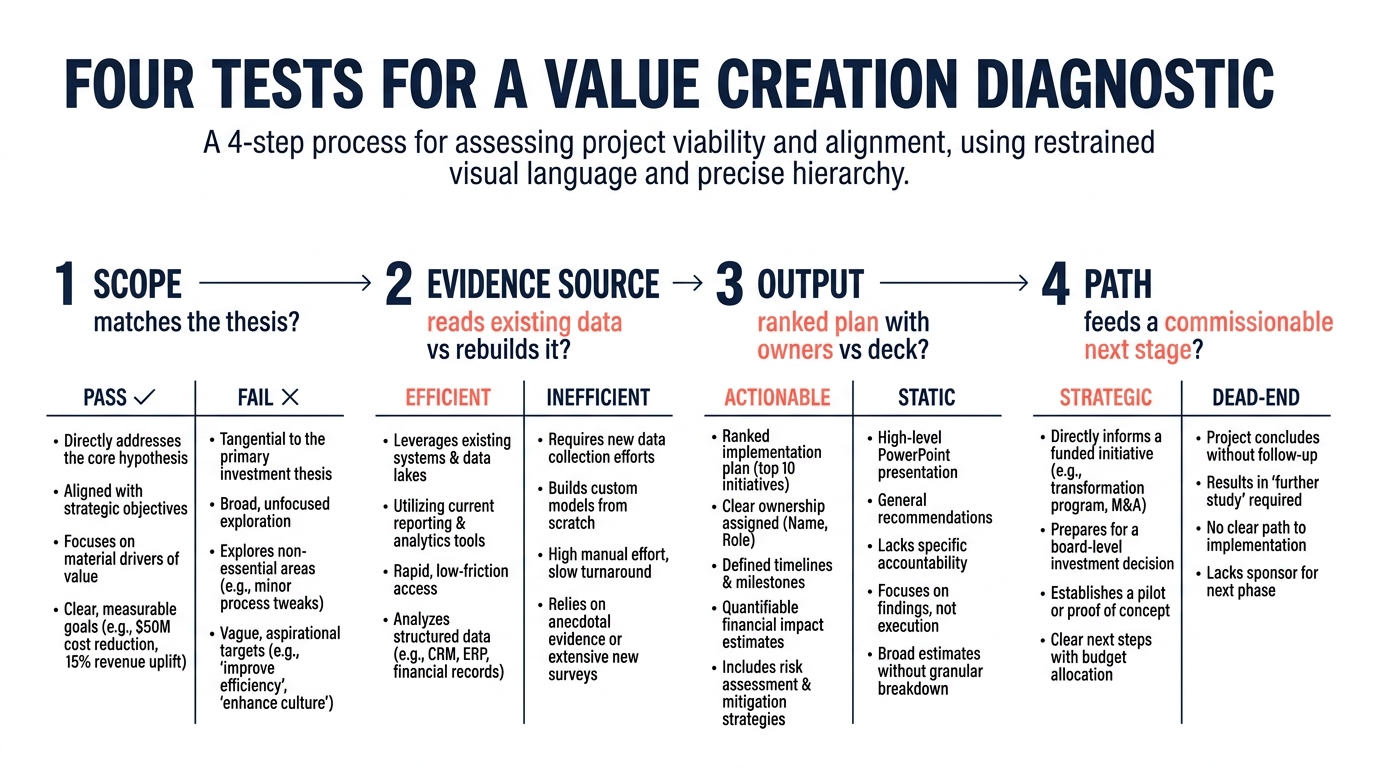
Price a diagnostic against four tests, in order. Each test is a reason to pay more or a reason not to. If a quote cannot answer the first two, the number is unanchored regardless of what it says.
- Scope: what the diagnostic promises to cover, and whether that matches the thesis.
- Evidence source: whether it reads existing data read-only or rebuilds it from scratch.
- Output: whether you receive a ranked plan with owners, or a slide deck.
- Path: whether the diagnostic feeds a defined next stage you can commission or walk away from.
3. The tiers you are actually choosing between
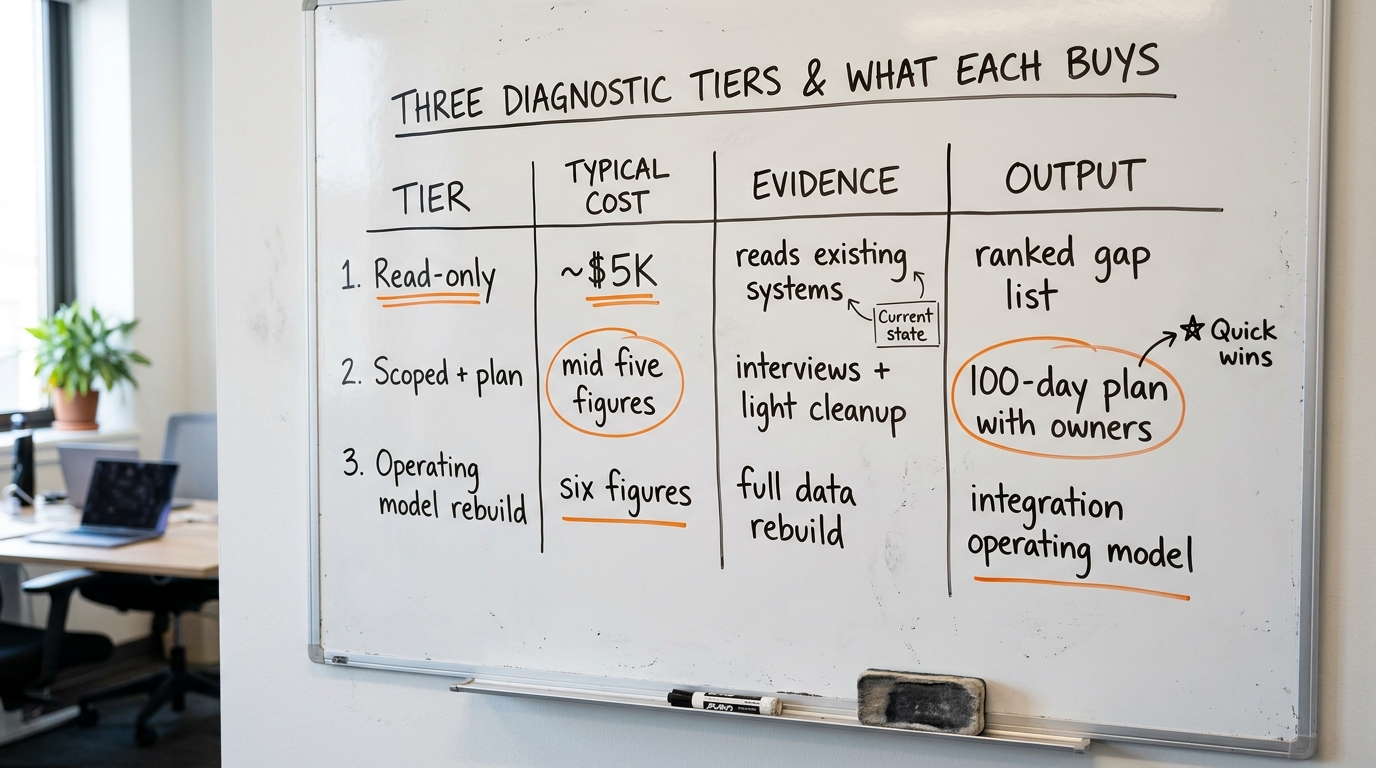
Quotes cluster into three tiers once you apply the scope and evidence tests. Naming them removes the ambiguity that lets a vendor charge tier-three prices for tier-one work.
Tier one: the read-only diagnostic
Typically in the low five figures, often around $5,000 for a focused review. The team connects to the systems that exist (CRM, ERP, martech) and reads what is there. No rebuild, no multi-week interview program. The output is a ranked list of gaps and value at stake, built on the company’s current data. This is the right first spend when the question is “where do we actually stand” and the thesis names a specific area to confirm.
Tier two: the scoped diagnostic with a plan
Mid five figures. It adds structured interviews with the functional owners, light data cleanup to make the numbers trustworthy, and a first 100 days plan with owners and sequencing. This is where most portfolio companies get real value, because the output is something the management team can run against.
Tier three: the full operating model rebuild
Six figures and multiple months. Justified when the data is so disconnected that nothing can be trusted, or when the deal is a platform with add-ons and you are building the integration logic for several businesses at once. Paying tier-three prices for a single business with usable systems is the most common overspend.
4. Scope is the first thing to price against
A diagnostic scoped to the whole business when the thesis rests on one lever is paying to confirm things nobody will act on. If the thesis is pricing discipline and salesforce productivity, the diagnostic should be scoped to revenue systems, not to a full technology and operations sweep. Match the scope to the two or three value drivers the deal was underwritten on, and treat anything wider as optional.
This is also where the diagnostic connects to the broader value creation plan. The reviews worth paying for feed directly into the decisions covered in the 100-day cost reset and the four decisions that cannot wait, rather than producing a standalone document.
5. Where the evidence comes from drives most of the cost
The single largest cost difference between tiers is whether the team rebuilds the data or reads it. Rebuilding is expensive because it is labor across weeks. Reading is cheap because the data already exists and the skill is in interpreting it. McKinsey’s private capital research has documented how much of a portfolio company’s operating picture already lives in disconnected systems rather than being genuinely absent (see McKinsey), which means the first question is whether the numbers exist and are disconnected, or do not exist at all.
If the systems hold the data and it is simply scattered across Excel and three tools, a read-only diagnostic can answer most of the thesis questions in days. Pay for a rebuild only when the data genuinely is not there.
6. The output determines whether you spent well
A diagnostic that ends in a presentation has produced analysis. A diagnostic that ends in a ranked plan with named owners, sequencing and value at stake has produced something the management team can execute. The difference is whether the work names who does what by when.
When judging a vendor on this, the standards are the same ones that apply to the people who run the plan afterward. The criteria in what a value creation partner has to own before you sign apply equally to the diagnostic: if the output cannot be executed, the review was priced as advice and delivered as decoration.
7. The diagnostic has to feed a next stage
A good diagnostic is the cheap front end of a staged commitment. The right structure is a low-cost read-only review that either confirms the thesis and justifies a larger plan, or surfaces something that changes the plan before more money is committed. That staging is what makes the low entry price defensible: the operating partner buys confirmation first and scope second.
This is also how the diagnostic connects to technology due diligence. A diagnostic run just after close inherits the questions diligence could not fully answer, and a vendor who can speak to both is pricing against a coherent path rather than a single invoice.
8. An applied example
The following is an illustrative scenario, not a client account. A sponsor acquires a project-delivery firm. The thesis is margin expansion through better resource utilization and cleaner billing. The CFO is quoted three numbers: $5,000 for a review, $45,000 for a scoped plan, and $150,000 for a full rebuild.
Applying the framework: the firm’s systems already hold time-tracking and billing data, scattered but present, so a rebuild is not warranted. The thesis is narrow, utilization and billing, so a full-business sweep is overscope. The right first spend is the $5,000 read-only review to confirm where utilization actually sits and whether the billing leakage is real. If it confirms the thesis, the $45,000 scoped plan becomes the obvious next commitment, with a revenue-systems integration plan as its spine. The $150,000 rebuild only enters the conversation if the data turns out to be unreadable, which the $5,000 review will reveal before the larger check is written.
9. Red flags in a diagnostic quote
- A six-figure number for a single business whose systems already hold usable data.
- A scope that covers the whole operation when the thesis rests on two or three drivers.
- An output described as a report or a readout, with no named owners or sequencing.
- No defined next stage, so the diagnostic is a terminal purchase rather than the front end of a plan.
- A quote benchmarked against legacy consulting rates rather than what the work costs to do now.
PitchBook’s research and deal data has tracked the compression in advisory economics as sponsors push for faster, cheaper operational work (see PitchBook), which is why a diagnostic priced like a 2015 consulting engagement should prompt questions rather than acceptance.
10. How this fits the wider value creation decision
The diagnostic is one input into a sequence of judgments the operating partner cannot delegate. The capability question, whether to hire, contract or rent the people who run the plan, sits downstream of it, and the reasoning in what a value creation advisor actually owns covers who should hold those decisions once the diagnostic has ranked them. Buying the diagnostic well is what keeps those later decisions grounded in evidence rather than in the seller’s enthusiasm.
11. The checklist before you approve the spend
- Name the two or three value drivers from the thesis the diagnostic must confirm, and scope to them.
- Confirm whether the data exists and is disconnected, or genuinely absent, before accepting a rebuild price.
- Require the output to name owners, sequencing and value at stake, not just findings.
- Start with the read-only tier unless the data is unusable, and treat the larger plan as a second decision.
- Check that the diagnostic feeds a defined next stage you can commission or decline on its own merits.
Run the four tests before the number on the quote, and the value creation diagnostic cost becomes a scoping decision rather than a leap of faith. To scope a staged diagnostic that starts read-only and feeds a 100-day plan, review the private equity value creation offer from DevriX and GrowthShuttle.