When two companies close and the deal thesis assumes cross-sell, the revenue systems become the first place the plan either holds or slips. A portfolio company executive running post merger integration for revenue systems is deciding whether the combined pipeline, the quota coverage, and the forecast the board saw at close will actually reconcile inside 100 days. Get this wrong and the first post-close board meeting opens with two sales teams reporting on two systems, no shared definition of a qualified opportunity, and a forecast nobody can defend.
This guide is for the operating partner or portfolio company leader who owns that outcome. It walks the sequence of decisions, who holds each one, and how to judge whether the work is on track.
1. Name the commercial consequence before the system question
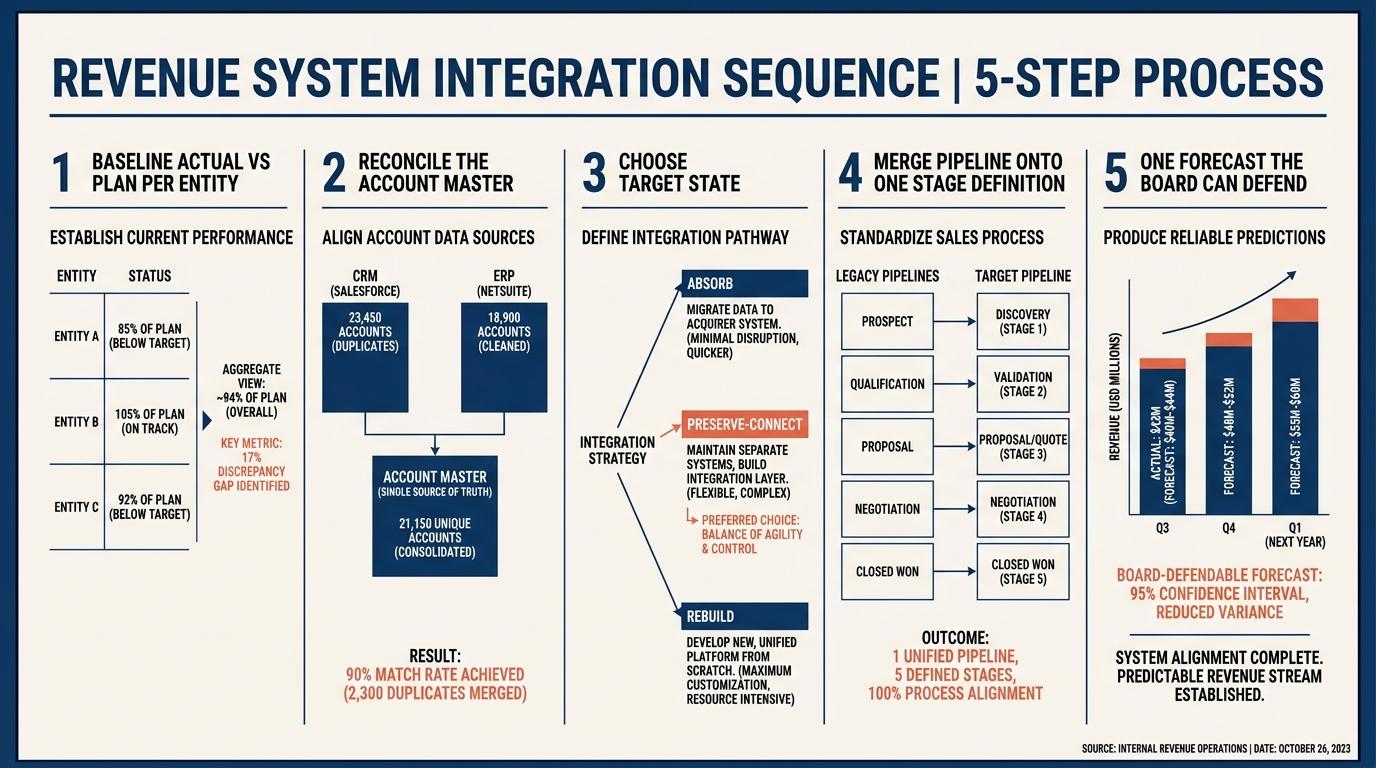
The revenue system is downstream of the thesis. If the deal was underwritten on cross-sell into the acquirer’s base, integration has to produce one account list, one owner per account, and one pipeline view fast enough that reps can sell across both books in the first two quarters. If the thesis was cost synergy, the integration goal is different: consolidate tooling, remove duplicate licenses, and keep the existing revenue motion intact while you strip cost.
Bain’s annual global private equity report has tracked how often value-creation plans lean on commercial synergies that never materialize because the operating detail was never sequenced. The revenue-system decision is where that detail lives.
2. Establish the baseline before anyone touches a config
The first workstream is establishing the actual-versus-plan baseline for each entity: pipeline by stage, win rates, average deal size, sales cycle length, and how each side defines a stage in the first place. Two companies almost never mean the same thing by “qualified.” You need that baseline before anyone migrates a record or changes a field definition.
This is the same discipline a serious technology due diligence exercise applies pre-close, extended into the operating period. If diligence flagged that the target’s CRM was a spreadsheet with a Salesforce logo on it, that finding is now your Day 1 risk register item with a mitigation plan attached.
3. Decide the target-state architecture and who owns it
There are three honest options, and the choice is commercial before it is technical.
- Absorb. The acquired entity moves onto the acquirer’s stack. Fastest to a single forecast, hardest on the acquired team’s productivity during cutover.
- Preserve and connect. Both systems stay, joined by reporting and a shared account master. Lowest disruption, but you carry duplicate tooling cost and a reconciliation tax on every board pack.
- Rebuild. A new target state neither side runs today. Rarely justified inside a hold period unless both systems were already failing.
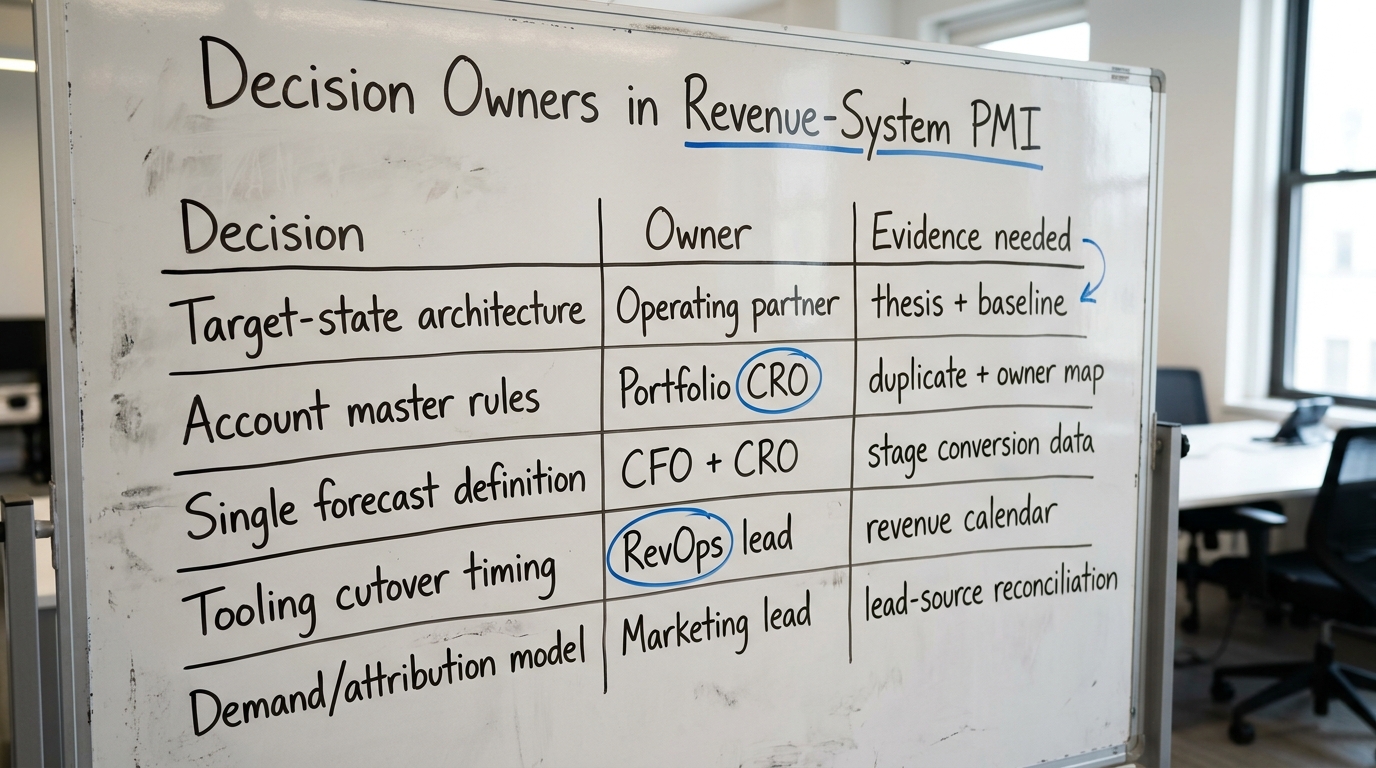
The operating partner holds the decision right on which path the thesis funds. The portfolio CRO or CFO holds delivery. Write that split down before the first standup, because ambiguity here is where integrations stall.
4. Fix the account master before the pipeline
The dependency that breaks most revenue integrations is the account record. If the two companies share customers, you have duplicate accounts, conflicting owners, and overlapping quota claims the day you close. Reconcile the account master first, then map opportunities to it. Doing it in the other order produces a merged pipeline that double-counts revenue and a comp dispute in the same week.
This is deliberate, owned work, not a data-hygiene afterthought. If you are staffing it with fractional capacity, the piece on fractional RevOps for private equity covers what that role actually delivers against this kind of mandate.
5. Reconcile the two forecasts into one the board can defend
A single forecast is the deliverable the board is actually waiting for. That means one pipeline definition, one set of stage-conversion assumptions, and one currency for how each stage is weighted. Until both sides forecast the same way, the combined number is an average of two methods and it will miss.
McKinsey’s private capital research and HBR’s coverage of mergers and acquisitions both return to the same operating point: integrations that report on a shared metric early recover synergy value faster than those that let each side keep its own scorecard.
The judgment call for the operating partner is when to force the single definition. Too early and you break the acquired team’s ability to sell during cutover. Too late and the first two board meetings run on numbers nobody trusts.
6. Sequence the tooling consolidation against the selling calendar
License consolidation is real EBITDA, and it is also the easiest way to knock a quarter of selling off the acquired team if you time the cutover into the middle of their pipeline push. Sequence tool changes around the revenue calendar, not the integration Gantt chart. Move reporting and the account master first, because those are invisible to reps. Move the CRM they log calls in last, and never during a close-heavy month.
If part of the target state requires something neither vendor sells off the shelf, treat it as a scoped build decision with an owner, a spec, and a go/no-go threshold. The guide on build decisions an operating partner owns walks through how to frame that call.
7. Protect the demand engine during the cutover
Marketing and demand systems break in quieter ways than sales systems, so they get neglected. Two marketing automation platforms mean two lead-scoring models, two definitions of a marketing-qualified lead, and two sets of attribution that will not agree when finance asks how a deal sourced. If the thesis funds an account-based motion, the named account list has to survive the merge intact, which the piece on ABM and the deal thesis works through in detail.
Conversion paths on the combined web properties also need an owner, because a redirected site with broken forms silently drops inbound pipeline. The article on conversion optimization for portfolio companies covers what to watch there.
8. Staff it with people who have done a cutover, not a demo
The integration will surface a Salesforce-versus-HubSpot decision, an owner-assignment rule, and a comp-plan reconciliation in the same week, and the person running it needs to have shipped a live cutover before. If you are bringing in outside help, judge them on the outcomes they will commit to in writing, the same way you would judge any transformation vendor. The piece on judging a digital transformation consultant and the deeper Salesforce RevOps decisions an operating partner owns are both worth reading before you sign anything.
9. Judge the work against evidence, not activity
Hours logged, tickets closed, and fields migrated are the vendor register, and none of them tell you whether the integration is on track. The evidence that matters is narrow: one reconciled account master, one pipeline both teams report into, one forecast method, and a variance to plan you can explain. Tie each of those to a trigger. The account master should be reconciled before Day 1, the single pipeline view before the first board meeting, and the tooling consolidation before the next renewal cycle.
PitchBook’s research and data and S&P Global’s market intelligence are useful for benchmarking how long comparable integrations take, but the operating test is local: can the CFO defend the combined forecast to the board with a straight face.
10. The next-step checklist
- Written baseline of pipeline, win rate, and stage definitions for each entity, actual versus plan.
- A named owner and a decision right for the target-state architecture, agreed before the first standup.
- Account master reconciled, with one owner per account and duplicates resolved, before Day 1.
- One pipeline definition and one forecast method in place before the first board meeting.
- Tooling consolidation was sequenced against the revenue calendar (quarter-end close, comp-plan cycles, board reporting) because a failed migration during a forecast lock costs more than the delay.
- Demand-side systems merged with one lead definition and one attribution model.
- An integration owner who has run a live cutover, judged on committed outcomes.
Most of this belongs inside a disciplined first 100 days plan rather than a standalone integration project, because the same clock governs both. For the broader operating context, DevriX covers how these decisions sit within a private equity value-creation plan.
11. Where to take it next
If you are approaching close or already inside the first 100 days and the combined revenue systems have to produce one defensible forecast, DevriX and GrowthShuttle run 100-Day Digital Execution for exactly this work. See the DevriX private equity execution offer to scope the integration against your deal thesis.