Two weeks after close, the operating partner has a value creation plan that reads well and a portfolio company that is not moving. The management team is polite, the diagnostic slides are thorough, and the EBITDA bridge still assumes a revenue lift that nobody at the company has committed to deliver. That gap is where a value creation advisor in private equity either earns the fee or quietly becomes another line of consulting spend that the next quarterly board meeting cannot trace to a number.
This guide is for the person accountable for revenue systems inside a portfolio company, or the operating partner who signs the retainer. It names what the advisor owns, what decision rights come with that, and how to tell within 90 days whether the engagement is producing enterprise-value movement or motion.
1. What the advisor is actually being hired to change
A value creation advisor is bought to move one of a short list of outcomes: revenue growth, EBITDA margin, cash conversion, integration speed, or a reduction in the operating risk that drags on the exit multiple. Everything else in the engagement is instrumental to one of those. If an advisor cannot name which one they own on this deal, and show the baseline they inherited, the engagement has no scoreboard.
Bain’s annual private equity report has tracked for years how much of fund returns now depends on operational improvement rather than multiple expansion or leverage. You can read the current edition through Bain’s Global Private Equity Report hub. The practical consequence for the operator is that the advisor’s work has to show up in the model as a line someone can point to.
2. Decide the mandate before the scope
Most retainers fail at the mandate stage. A scope lists activities; a mandate names the decision the advisor is allowed to make and the number they are accountable for. Before signing, the operating partner should be able to finish this sentence: the advisor owns [outcome], measured by [metric], against [baseline], with the authority to [decision right].
If the advisor only has the authority to recommend, the portfolio company executive still owns delivery, and the advisor is a research function. That can be the right buy, but price it and judge it as research, not as value creation.
3. Separate the diagnostic from the plan from the delivery
These are three different purchases and they carry three different risks. The diagnostic establishes the baseline and names the gaps. The plan sequences the work and assigns owners. Delivery produces the number. A common failure is paying full value-creation fees for what is really a diagnostic, then discovering at the first board meeting that nobody was retained to execute.
A tight diagnostic should cost a fraction of a delivery engagement and should produce a document the deal team can act on. The guidance on what belongs in a digital value creation benchmark is a useful standard to hold any diagnostic against before you approve the next phase.
4. Tie the engagement to a deal trigger
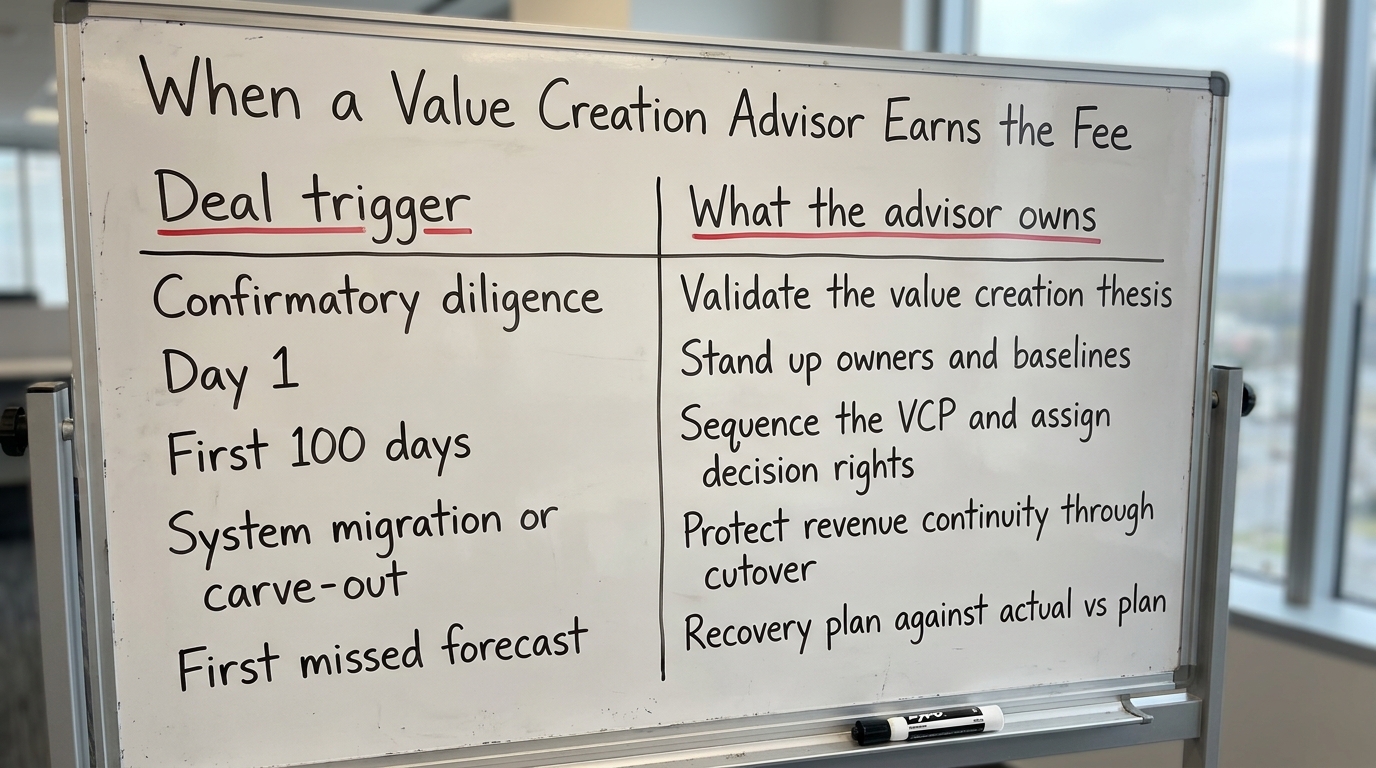
The value of an advisor depends heavily on when they arrive. Confirmatory diligence, Day 1, the first 100 days, a system migration, an add-on, and the first missed forecast each call for a different scope. An advisor brought in during the first 100 days is sequencing and standing up owners. The same advisor brought in against a failing forecast is doing recovery, which is a different discipline with a different success definition.
Name the trigger in the engagement letter. It sets the clock everyone will be judged against, and it stops the retainer from drifting into open-ended advice.
5. Judge the baseline before you judge the plan
A plan built on a shaky baseline will produce a confident forecast and no accountability, because when the number moves nobody can tell whether the work caused it. Inspect the evidence behind the starting point first: actual pipeline, actual conversion rates, actual churn, actual system data pulled from the source rather than from a management deck. The advisor’s recommendations matter less than whether the baseline is real.
This is the same discipline that applies on the technical side. Weak underlying data is a diligence risk, which is why serious technology due diligence digs into the systems of record before anyone trusts a dashboard built on top of them.
6. Decide what is strategy and what is capacity
An advisor who hands over a plan and leaves has sold strategy. An advisor who stands up the people and systems to run it has sold capacity. The portfolio company usually needs both, and the operating partner has to decide which one is scarce.
If the management team can execute a good plan, buy the plan. If the gap is that nobody on the team can actually run revenue operations, a plan on its own will sit unread. The analysis in fractional RevOps for private equity walks through what embedded capacity looks like against a pure advisory retainer, and which gap each one closes.
7. Separate realized value from forecast value in the reporting
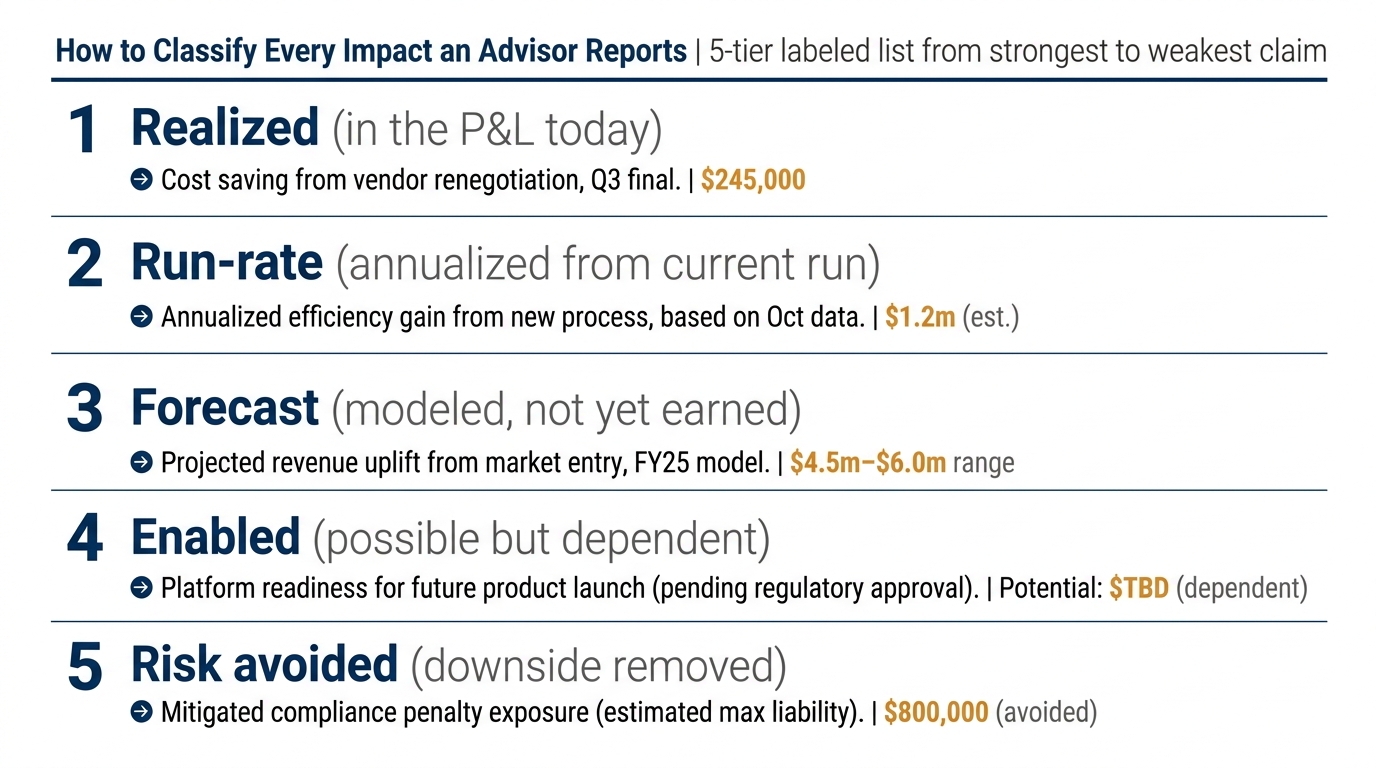
The fastest way an advisor loses credibility at the board is by letting forecast value read as realized value. A disciplined report classifies every claimed impact: realized (already in the P&L), run-rate (annualized from current performance), forecast (modeled, not yet earned), enabled (made possible but dependent on other work), or risk avoided.
Insist on that classification from the first monthly report. McKinsey and BCG both publish extensively on operational value creation in private capital, and you can reach their research through McKinsey and BCG’s private equity practice. The through-line in that work is that attribution discipline, not ambition, is what separates a credible value creation program from a hopeful one.
8. Match the advisor to the stakeholder who has the problem
A deal partner wants thesis, risk, and exit. An operating partner wants speed, adoption, and a repeatable playbook. A CFO wants forecast reliability, cash, and covenant headroom. An advisor who pitches engineering activity to a deal partner, or exit strategy to a CFO who needs this quarter’s cash, has misread the room.
Before the engagement starts, confirm which stakeholder’s problem the advisor is solving and that the reporting cadence speaks that stakeholder’s language. A value creation advisor in private equity who can translate operating work into the CFO’s forecast and the deal partner’s exit case is worth considerably more than one who only speaks in workstreams.
9. Decide the build-versus-standardize question early
Value creation work often collides with a technology decision: standardize on an existing platform, or build something specific to the thesis. Getting this wrong is expensive in both directions. Over-building burns the hold period on custom work that a configured product would have covered. Over-standardizing strips out the differentiation the deal was priced on.
The operating partner owns this call, not the advisor and not the vendor. The breakdown in custom software development for portfolio companies lays out which build decisions stay with the operating partner. The same ownership logic applies when the work is a separation, covered in IT carve-out advisory and the separation decisions the operating partner owns.
10. Set the exit conditions at the start
A good engagement has a defined end. Decide upfront what has to be true for the advisor to hand off: owners in place, systems live, a metric moving against plan, a playbook the team can run without the advisor in the room. Without exit conditions, the retainer renews on relationship rather than results, and the value creation line on the fee schedule grows every quarter with nothing to attribute it to.
11. A checklist before you sign the retainer
Run the engagement against these before approving spend:
- The advisor names which EBITDA-relevant outcome they own and the baseline they inherited.
- The mandate states a decision right and the authority to act on it.
- Diagnostic, plan, and delivery are priced and judged separately.
- The engagement is tied to a named deal trigger with a clock.
- Build the baseline from source-system data rather than from management decks.
- Reporting classifies every impact as realized, run-rate, forecast, enabled, or risk avoided.
- The reporting speaks the language of the stakeholder who actually has the problem.
- Exit conditions are written down before the first invoice.
For the broader standard on vetting an advisor before signing, the walkthrough on how to judge a digital transformation consultant before you sign the retainer covers the diligence questions that apply to any value creation engagement.
12. How this maps to the portfolio’s wider operating program
A value creation advisor rarely works in isolation. The same operating partner is usually making calls on conversion, account targeting, and the CRM that reports on all of it. The decisions in conversion rate optimization for portfolio companies and Salesforce RevOps for PE portfolio companies sit downstream of the value creation plan. They should inherit its baseline and its owners rather than inventing their own.
When the advisor’s plan and the operating systems share one baseline and one owner map, the board meeting gets shorter and the attribution gets cleaner. That is the practical test of whether the engagement is integrated or just adjacent.
13. Next steps
Start with the cheapest decision first. A focused diagnostic against a real baseline tells you whether you have a strategy gap or a capacity gap before you commit to a full delivery engagement, and it costs a fraction of getting that call wrong. From there the sequencing of the 100-day plan follows the triggers above.
If you are scoping a value creation diagnostic or a 100-day plan for a portfolio company, review the structure and the baseline-first approach in the DevriX private equity practice and map it against the engagement you are about to sign.