By the time a hold thesis reaches “grow the top line,” someone in the portfolio company owns a revenue number that outpaces headcount, and no clear map of how the go-to-market engine will produce it. That gap is where most GTM value creation for portfolio companies quietly stalls. The forecast assumes pipeline that the current motion cannot generate, the operating partner assumes the CRO has a plan, and the CRO assumes the marketing spend already booked will convert at rates nobody has actually measured.
This guide is written for the person accountable for that revenue system, the operating partner steering the account or the portfolio company executive who has to defend the plan at the next board meeting. It covers what you have to decide, in what order, and how to judge whether the work is producing enterprise value or just activity.
1. Name the decision before you fund the motion
GTM value creation is not a campaign budget. It is a sequence of decisions about where revenue comes from, at what cost, and how reliably. Before anyone approves spend, the accountable executive should be able to answer three questions in one page: which segment produces the next dollar of profitable revenue, what the current cost to acquire it is, and which part of the funnel is actually broken.
Bain’s annual private equity report has repeatedly tracked how value creation has shifted away from multiple expansion and financial leverage toward operational improvement. That shift makes the GTM decision a board-level one, not a marketing one. If you cannot state the decision, you are funding motion, not outcome. The Bain & Company Global Private Equity Report is a useful anchor for how sponsors now frame that expectation.
2. Separate the four value levers so you can price them
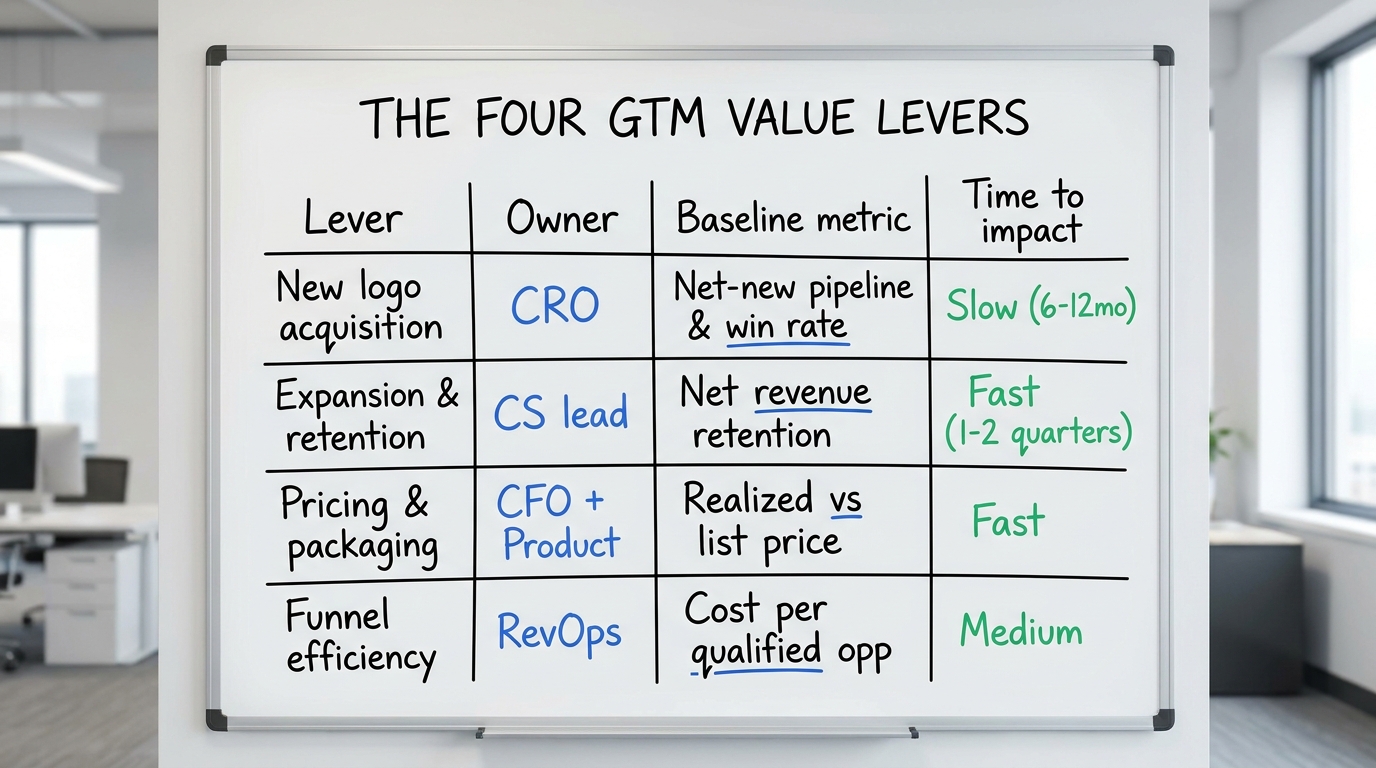
GTM value in a portfolio company comes from a short list of levers, and treating them as one blob is the most common budgeting error. Keep them distinct so each one has an owner, a baseline, and a way to be judged.
- New logo acquisition. Net-new pipeline and win rate. Slowest to move, most expensive to fund.
- Expansion and retention. Net revenue retention inside the installed base. Usually the fastest EBITDA lever in a mature asset.
- Pricing and packaging. Realized price versus list, discount discipline, and monetization of features already shipped.
- Funnel efficiency. Cost per qualified opportunity and the conversion rate at each stage.
McKinsey’s private capital research consistently points to commercial excellence, pricing and sales productivity as the levers with the shortest path to margin. Before you approve a demand-generation line, decide which of these four you are actually buying. A pricing fix and a new-logo push do not compete for the same budget or the same timeline.
3. Get the baseline before you touch the forecast
You cannot judge value creation without a baseline, and in most lower-mid-market portfolio companies the baseline does not exist in a form anyone trusts. The CRM is half-populated, attribution is guesswork, and the reported win rate mixes deal types that behave nothing alike.
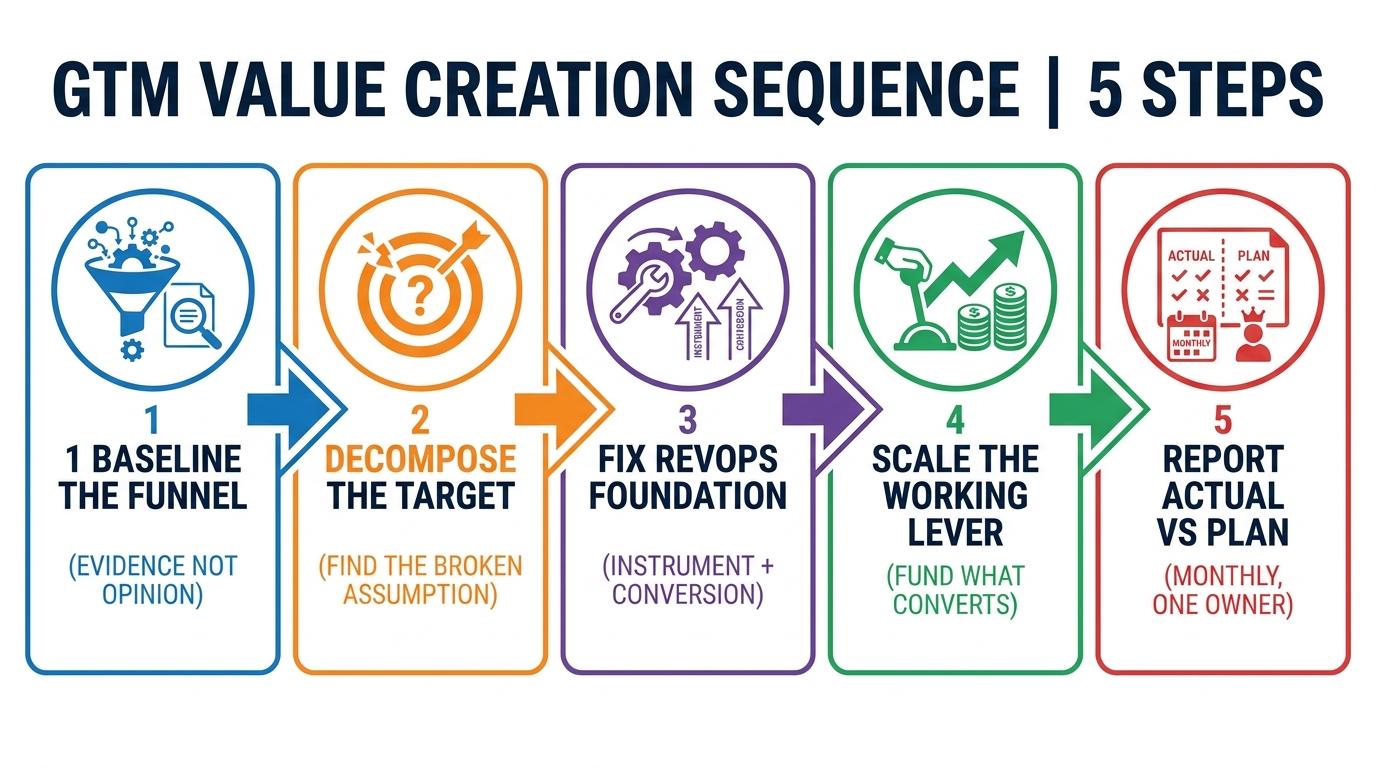
Establish the baseline as evidence, not opinion: current cost to acquire, current conversion by stage, current net revenue retention, and current sales-cycle length by segment. This is the same discipline that shows up in RevOps for private equity portfolio companies, and it is the precondition for everything downstream. If the numbers are unstable, that instability is itself a finding, and it usually surfaces during technology due diligence as a data-quality risk that will distort the first forecast you present to the board.
4. Decide what the system must produce, then work backward
Start from the revenue target the hold thesis requires, then decompose it. If the plan needs an incremental figure in year two, back out the pipeline coverage, the win rate, and the average deal size that produce it. When the arithmetic requires a win rate the business has never hit, you have found the real problem: the plan, not the team.
This backward pass exposes the difference between forecast value and realized value. A number the funnel could produce if conversion improves is enabled value, not money in the bank. Label it that way in every board deck so nobody mistakes a modeled improvement for a booked one.
5. Fix the system before you scale the spend
Pouring demand into a leaky funnel produces cost, not revenue. Sequence the work: instrument, then fix conversion, then scale acquisition. The RevOps foundation, clean CRM data, defined stages, reliable reporting, has to come first, because every acquisition dollar you spend before it is wasted twice, once on the spend and once on the inability to learn from it.
In roll-ups this becomes acute. When two acquired companies run conflicting systems, the reporting is fiction until they are reconciled. The mechanics of that reconciliation are covered in this post-merger CRM integration guide, and it is the kind of dependency that belongs on the integration risk register from day one.
6. Match the GTM plan to the first 100 days
The GTM plan and the integration plan are not separate documents. The first 100 days set the ceiling on what the revenue team can execute in year one, because you cannot ask a sales org to hit a new number while its systems, comp plan and territories are still being rewired.
Decide early which GTM moves happen inside the first 100 days (data cleanup, quick pricing wins, retention triage) and which wait until the platform is stable (new-segment expansion, channel builds). Sequencing this wrong is how a good thesis produces a missed first-year plan.
7. Choose the channel mix by margin, not by fashion
Channel decisions should follow the economics, not the trend cycle. For many B2B portfolio companies, content and owned media compound where paid acquisition only rents attention. Depending on the model, that can mean an omnichannel content strategy across email, social and video, a micro-influencer program to widen reach, or for ad-supported publishers a disciplined look at programmatic ad revenue. The test is the same for all of them: does this channel lower blended cost to acquire or raise retention, measured against the baseline you built in section three?
8. Assign decision rights and one owner per lever
Value leaks where accountability is shared. Each of the four levers needs a single named owner with the decision right to act on it, and the operating partner needs a monthly view of actual versus plan by lever. BCG’s work on principal investors and portfolio value creation stresses that governance clarity, who decides and who is measured, correlates with which plans actually land. Their principal investors and private equity research is worth referencing when you set that operating cadence.
What the operating partner should see each month
- Actual versus plan for each of the four levers, with variance explained.
- Pipeline coverage against the forward quarter, not the trailing one.
- Cost to acquire and net revenue retention, trended, not snapshotted.
- The one leading indicator that predicts next quarter’s bookings.
9. Judge the work by enterprise value, not activity
Tickets closed, campaigns launched and traffic gained are inputs. The portfolio company executive is accountable for outputs: profitable revenue growth, margin, and a multiple the next buyer will pay. Judge every GTM investment against one of those, and be honest about which category the impact falls into, realized, run-rate, or forecast.
Harvard Business Review’s coverage of mergers and acquisitions repeatedly documents how integration and commercial execution, not the deal terms, decide the outcome. Their M&A research is a sober counterweight to any plan that leans on activity metrics. If a workstream cannot be tied to revenue, margin or exit readiness, it is a cost center wearing a GTM label.
10. Build the case for the next buyer, not just this board
Every GTM improvement should also make the asset easier to underwrite at exit. A predictable pipeline, documented conversion economics, and a repeatable acquisition motion are what a diligence team pays a premium for. Owned audience assets, a membership community or a durable content channel, show up as a moat rather than a line item. Build the reporting now that the next buyer’s diligence will ask for, so the value you created is legible to the people writing the check.
11. The decision checklist
Before the next board meeting, the accountable executive should be able to answer:
- Which of the four levers is funded, and who owns each one?
- What is the baseline for cost to acquire, conversion and net revenue retention, and is it evidence or opinion?
- Does the plan require a win rate or deal size the business has ever produced?
- Is the RevOps foundation clean enough to trust the reporting before spend scales?
- Which GTM moves sit inside the first 100 days and which wait for platform stability?
- For every workstream, is the impact realized, run-rate or forecast, and is it labeled that way?
- Would the reporting survive the next buyer’s diligence?
If any answer is missing, that is the next thing to fix, ahead of any new spend. The broader operating context, from private equity operating playbooks to the specific governance decisions above, exists to keep the plan tied to enterprise value rather than to activity.
When the baseline is set, the levers have owners, and the sequence is agreed, the work becomes an execution problem with a schedule. To turn this decision framework into a running demand and RevOps engine for the asset, route the plan into the DevriX and GrowthShuttle PE offer and put a delivery cadence behind it.