An operating partner inherits five portfolio companies running five different CRMs, three of them customized past recognition, and a board deck that promises cross-sell synergies nobody can measure. The problem is not the software. The problem is that revenue data cannot be compared across the portfolio, forecast reliability is a guess, and any add-on acquisition adds a sixth data model to reconcile. When the value creation plan depends on GTM efficiency, CRM fragmentation is a direct drag on enterprise value, and it usually surfaces at the worst possible moment: the first board meeting where someone asks why pipeline coverage numbers do not reconcile.
This guide is for the person accountable for revenue systems inside a portfolio company or across a platform. It covers what actually needs to be decided about CRM standardization across portfolio companies, in what order, and how to judge whether the work is paying off. It assumes a budget and a mandate, not a beginner.
1. Why CRM standardization across portfolio companies is a value-creation lever, not IT hygiene
Standardization is worth doing only when it moves a number the deal thesis cares about. Bain’s annual private equity report has tracked the shift toward operational value creation as multiple expansion has become harder to rely on, which puts revenue-system discipline squarely inside the investment case. See Bain & Company’s Global Private Equity Report for the trend context.
Concretely, a standardized CRM layer improves management visibility (one definition of pipeline, one revenue recognition trigger), speeds integration of add-ons, and reduces the operating risk of forecasts nobody trusts. Those map to EBITDA quality and a cleaner exit narrative. If the platform is a roll-up with several add-ons planned, standardization compounds: every acquisition after the standard is set is cheaper to onboard.
What it does not do on its own is grow revenue. Standardization is an enabler. Treat the value as enabled and risk-avoided until adoption is proven and the reporting is actually used to run the business.
2. Decide the operating model before you touch a single instance
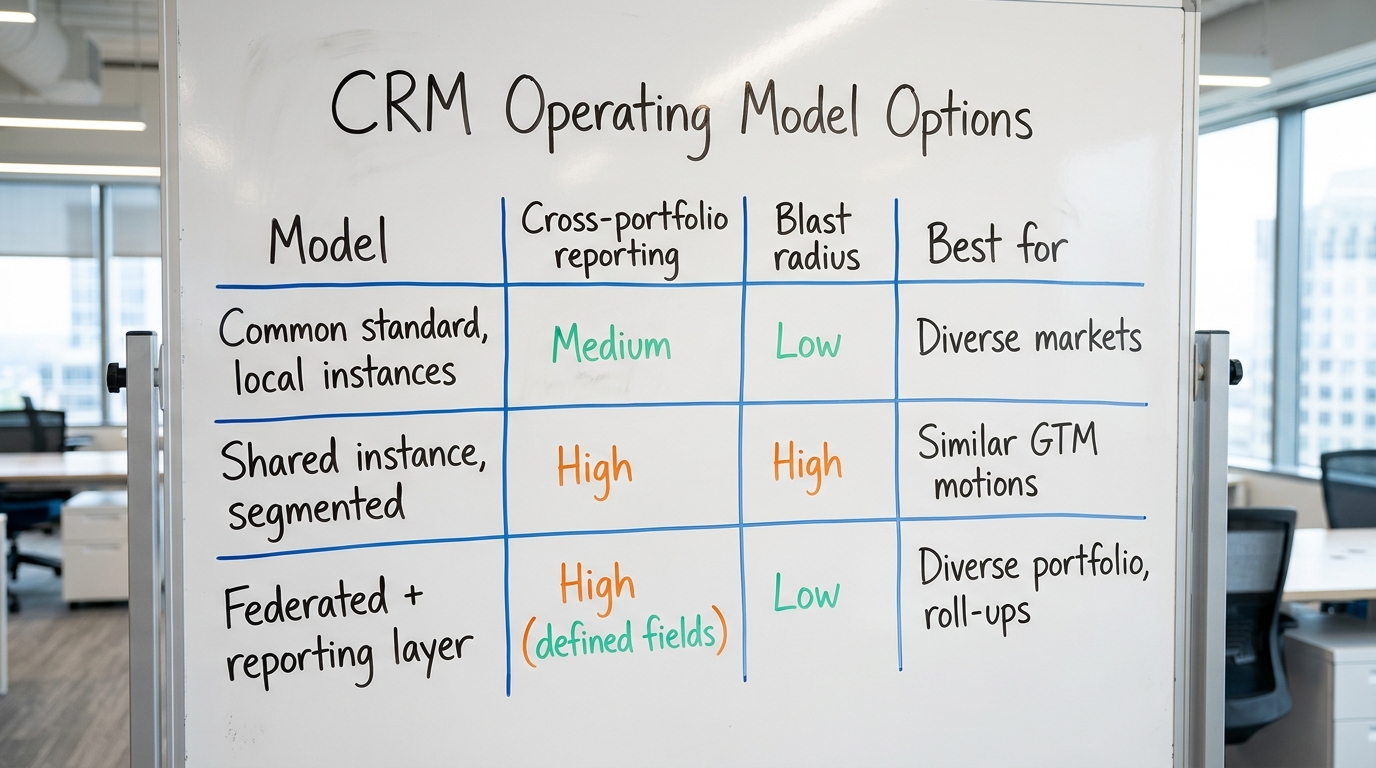
The first real decision is not which CRM. It is how much you intend to centralize. There are three defensible models, and the choice constrains everything after it.
Common standard, local instances
Every company runs the same CRM platform and the same core object model (accounts, opportunities, stages), but each keeps its own instance and local configuration. Lowest friction, weakest cross-portfolio reporting. Sensible when companies serve genuinely different markets.
Shared instance, segmented
One CRM tenant, business units partitioned inside it. Strong reporting, higher blast radius when something breaks, harder to divest a single company cleanly later.
Federated with a reporting layer
Companies keep their own CRMs but push a mandated set of fields into a portfolio data warehouse or reporting layer. This is often the pragmatic answer for a diverse portfolio where forcing a single CRM would destroy more value than it creates.
The decision right here belongs to the operating partner in consultation with each company’s revenue leader. Document who owns it. This choice is where most standardization programs quietly go wrong, because someone picks the tool before picking the model.
3. Establish the baseline before you standardize anything
You cannot judge the program without a baseline. For each company, capture the current CRM platform and version, the object model, forecast accuracy over the last four quarters (actual vs plan), data completeness on the fields that matter, and who administers the system. This is the same discipline that belongs in technology due diligence before close, and if it was skipped there, do it now.
The baseline is what turns “we cleaned up the CRM” into a defensible claim of improvement. Without it, every later result is an assertion.
4. Define the minimum common data model
Standardization does not mean identical configuration. It means an agreed core that every company must carry, and freedom below that. Define the non-negotiable set:
- Account and contact structure that reconciles across companies
- A single opportunity stage definition tied to a shared exit-of-stage criterion
- One revenue and bookings definition, aligned to how finance recognizes it
- Mandatory fields for anything that feeds board reporting
Keep this list short. The failure mode is a governance committee that mandates forty fields, kills adoption, and produces cleaner-looking data that sales teams route around. AICPA and CIMA guidance on data governance is a useful sanity check on where the line between finance-critical and nice-to-have sits; see AICPA & CIMA.
5. Sequence the rollout against the deal calendar, not a vendor timeline
Standardization work competes with everything else in the value creation plan, so it has to be sequenced against real triggers. The first 100 days is the window to set the standard and get the platform company onto it, because that is when change is expected and organizational resistance is lowest.
Do not attempt a portfolio-wide cutover in one quarter. Prove the model on the platform company or the healthiest single business, capture the migration runbook, then apply it to the next. Each subsequent migration should be faster and better documented. That reusable runbook is itself an asset that shortens integration on future add-ons.
6. Treat every add-on as a CRM integration problem before Day 1
For a roll-up, the CRM question is not “should we standardize” but “how quickly can we absorb the next acquisition.” Every add-on arrives with its own CRM, its own stage definitions, and its own data debt. The work of reconciling conflicting architectures is technical and specific, and it is worth studying the mechanics in advance; this post-merger integration guide for unifying conflicting CRM architectures lays out the technical roadmap.
The decision to make before Day 1 is whether the target migrates onto the standard immediately or runs parallel with a reporting bridge for a defined period. Migrating too early breaks the acquired team’s motion; waiting too long lets bad data calcify. McKinsey’s work on integration cadence, available through McKinsey’s private capital research, reinforces that the expensive integration decisions are the ones deferred past the point of easy change.
7. Assign ownership and decision rights explicitly
Standardization dies without clear ownership. Name three roles in writing:
- Standard owner (usually the operating partner or a platform RevOps lead) who controls the common data model and approves changes to it.
- Local admin in each company accountable for configuration below the standard and for data quality.
- Escalation path for disputes, because a revenue leader will eventually argue their business is the exception.
Governance research collected on the Harvard Law School Forum on Corporate Governance consistently ties execution failure to unclear decision rights rather than strategy. CRM standardization is a small, testable version of that pattern.
8. Judge the program on adoption and forecast reliability, not the migration
The migration going live is not success. Success is whether the standardized system is used to run the business and whether it makes the numbers more trustworthy. Watch three things:
Adoption
Are deals actually being worked in the standard, or is the real forecast still living in a spreadsheet? Low adoption means you bought data-model theater.
Forecast reliability
Compare actual vs plan accuracy against the pre-standardization baseline. This is the number the CFO and the board care about, and it is the honest test of whether the work created value.
Time to onboard an add-on
For roll-ups, measure how many days from close to the new company reporting on the standard. That number should fall with each acquisition.
PitchBook and S&P Global both publish portfolio-level operating data that can benchmark reasonable expectations here; see PitchBook research and data and S&P Global Market Intelligence. Do not attach anyone else’s benchmark to your own program without matching definitions first.
9. Connect the CRM to the rest of the revenue stack
A standardized CRM is only as useful as the systems feeding and reading it. Marketing attribution, content operations, and channel reporting all depend on clean CRM data. Portfolio companies that publish and monetize content directly, for example, need CRM standards that reconcile with how they measure programmatic and audience revenue; the mechanics of that revenue side are covered in this look at maximizing revenue with programmatic ads and in this guide to integrating social, email, and video across channels. If the CRM standard ignores those inputs, the reporting layer will be clean and incomplete.
10. Build the reusable case for the exit narrative
The last decision is documentation for the exit. A buyer paying for a portfolio wants to see that revenue is measured consistently, that forecasts hold, and that the next acquisition can be absorbed on a known runbook. Harvard Business Review’s coverage of mergers and acquisitions repeatedly makes the point that clean, comparable operating data is what lets a buyer underwrite growth rather than discount for uncertainty. Standardization, done and documented, is part of the story you sell.
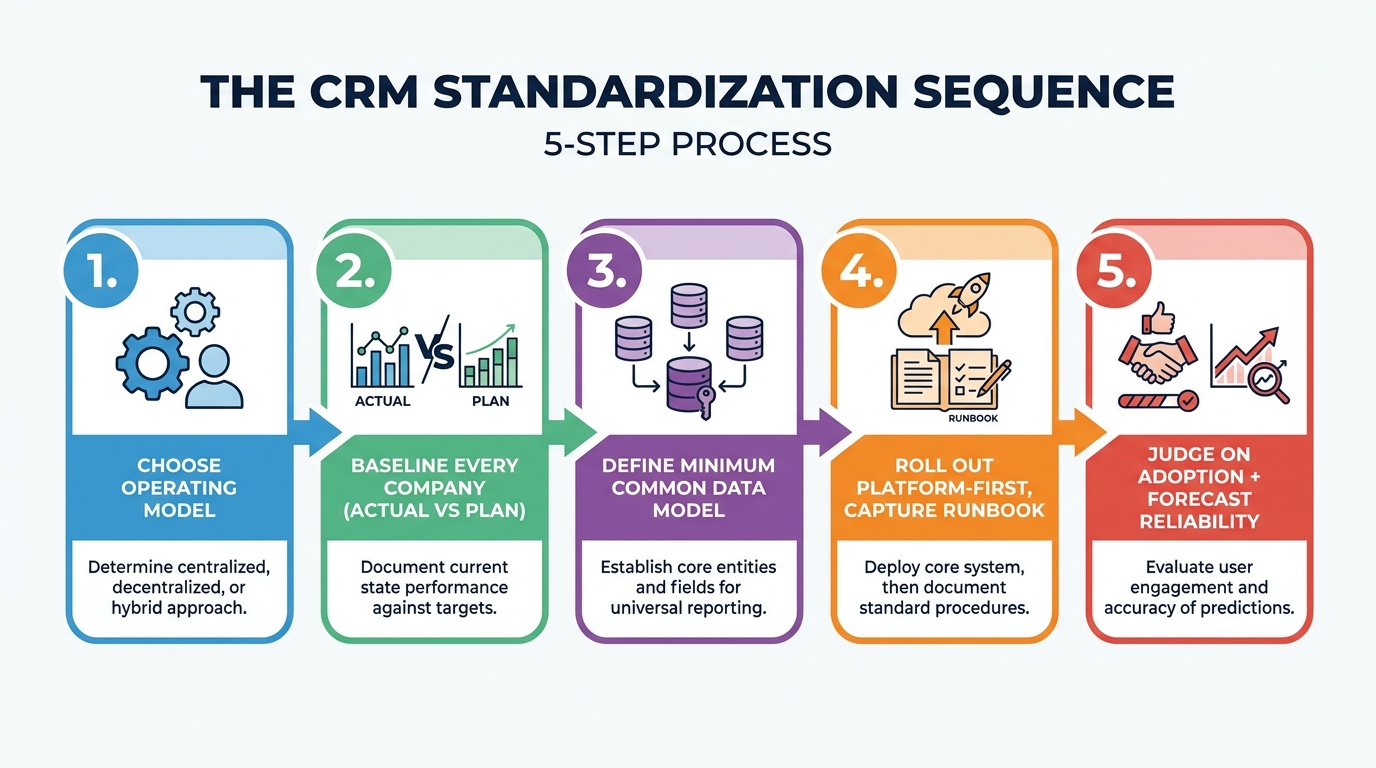
11. The decision checklist
- Operating model chosen (common standard, shared instance, or federated) and owner named
- Baseline captured per company: platform, object model, four quarters of forecast accuracy, data completeness
- Minimum common data model defined and kept deliberately short
- Rollout sequenced against the deal calendar, platform company first
- Add-on absorption decision (immediate migrate vs parallel bridge) made pre Day 1
- Standard owner, local admins, and escalation path documented
- Success measured on adoption, forecast reliability vs baseline, and time-to-onboard
- Documentation packaged for the exit narrative
Work this list in order. The most common mistake is jumping to tool selection at step one, which locks in an operating model by accident and forces expensive rework later.
12. Where outside execution earns its keep
The design decisions above belong to the operating partner and the portfolio’s revenue leaders. The build, migration, and governance instrumentation are where a dedicated RevOps team removes months of internal thrash, especially across multiple companies at once. That is the specific work DevriX runs for private equity portfolios: standardizing revenue systems so the numbers reconcile and the next add-on onboards on a runbook, not a scramble.
To scope a CRM standardization program against your value creation plan, review the DevriX RevOps offer for private equity portfolios and bring your current-state baseline to the first conversation.