An operating partner sponsoring a growth thesis usually inherits a revenue system that cannot tell the deal team what is real. Pipeline coverage is a guess, forecast accuracy swings by 30 points quarter to quarter, and the CRM holds three versions of the same account. When the first board meeting arrives, the sponsor needs to know whether the numbers the plan depends on can be trusted. Fractional RevOps for private equity exists to close that gap without hiring a full RevOps org the portfolio company cannot yet justify. This guide is for the person who has to decide whether to buy it, what to buy, and how to judge the work once it starts.
1. The problem a fractional model is meant to solve
Most lower-middle-market targets do not have a RevOps function. They have a sales leader, a marketing manager, a CRM admin who also runs support, and a set of spreadsheets that reconcile none of them. That arrangement survives founder-led growth because the founder holds the whole picture in their head.
Once a sponsor owns the business and expects a repeatable plan, the informal system stops working. Bain’s annual Global Private Equity Report has documented for years how much of the return now depends on operational improvement rather than multiple expansion, and revenue predictability is the part of operations the deal team feels first.
2. When fractional makes sense and when it does not
A fractional RevOps engagement fits a company that needs senior judgment on the revenue system but cannot support a full-time hire at the seniority the problem requires. That describes a large share of businesses between roughly 5 and 40 million in revenue.
It stops making sense in two directions. Below a certain scale, the fixes are basic hygiene a good CRM admin can handle. Above it, the volume of change management, integrations, and headcount justifies a permanent RevOps leader. The operating partner’s job is to place the specific company on that line, not to assume the fractional label is either cheap or a shortcut.
3. What the operating partner is actually buying
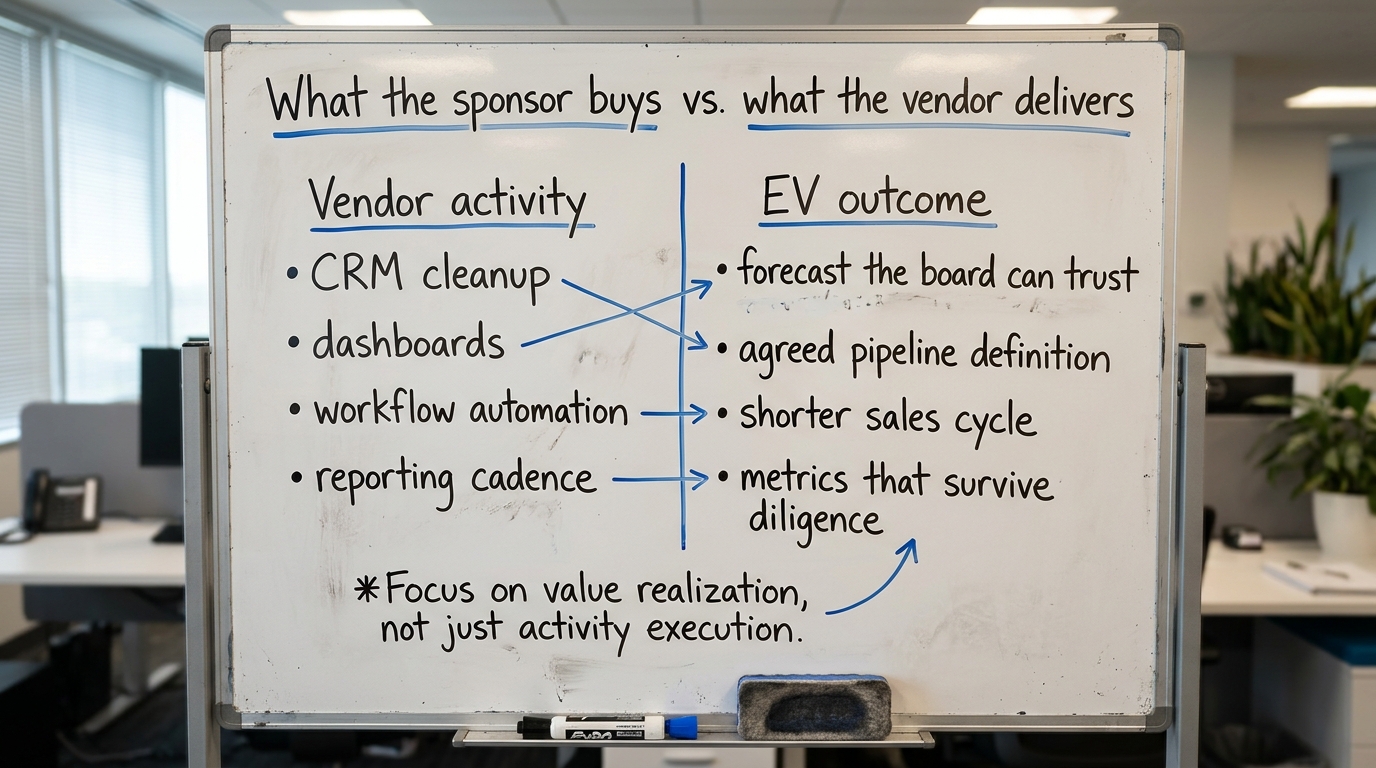
The sponsor is not buying hours, dashboards, or CRM configuration. Those are inputs. The output that matters to the investment case is a revenue system that produces a forecast the board can hold management to, a pipeline definition every function agrees on, and a set of metrics that survive the next round of diligence.
Judge any proposal against enterprise value. Better forecast reliability lowers the risk premium on the plan. A cleaner funnel shortens sales cycles and lifts conversion, which shows up in revenue and eventually EBITDA. If a scope of work cannot connect its activity to one of those, it is describing vendor deliverables without naming the financial outcome.
4. Start with a baseline before anyone builds anything
The first deliverable should be a written baseline of the current revenue system. Without it, there is no way to prove the engagement moved anything, and no way to tell the board what the starting point was.
A usable baseline names the owner of each revenue metric, states current forecast accuracy against actuals for the last four quarters, documents how the pipeline is defined today, and lists the systems of record and where they disagree. This is the same discipline a good technology due diligence exercise applies, brought inside the company after close. If diligence already produced a data-and-systems finding, the fractional team should start from it rather than re-running it.
5. Tie the scope to the deal thesis, not to a generic playbook
A buy-and-build thesis requires a revenue system that can onboard acquired companies without rebuilding pipeline processes each time, because serial acquirers cannot afford to re-teach sales methodology at every close. A margin-expansion thesis requires tighter conversion rates and reduced revenue leakage in the current sales motion, measured as the percentage of qualified pipeline that reaches close and the discount rate at signature. A new-logo growth thesis requires instrumented top-of-funnel tracking (source, cost per lead, velocity to qualified opportunity) and a named target account list that reflects the segments and geographies the deal team has modeled for growth.
That last point is where a lot of GTM spend goes wrong. As covered in this breakdown of how ABM commits the portfolio company to a named account list, an account-based motion is only useful if the list reflects the thesis. A fractional RevOps lead who does not ask which thesis they are serving is building against a default, and the default rarely matches the plan.
6. Decide the system of record before touching the tooling
Most revenue disputes in a portfolio company are really disputes about which system is right. Sales trusts the CRM, finance trusts the billing system, marketing trusts the automation platform, and none of them reconcile.
The operating partner should force one decision early: which system is authoritative for pipeline, for closed revenue, and for customer records. This is often a Salesforce decision, and the trade-offs there are specific enough that this walkthrough of Salesforce RevOps for PE portfolio companies is worth reading before the platform conversation starts. Get the system of record wrong and every dashboard built on top of it inherits the error.
7. Set the forecast cadence the board will actually use
The forecast is the artifact the sponsor cares about most, because it is what the board holds management to. A fractional engagement should produce a forecast process with a fixed cadence, a named owner, a defined method, and a monthly comparison of forecast against actual.
The number that tells you the system is working is forecast accuracy trending toward a tight band over two or three quarters. McKinsey’s work on private capital and value creation repeatedly points to management visibility as a driver of both performance and eventual multiple, and a reliable forecast is the most concrete form that visibility takes.
8. Assign decision rights and internal ownership from day one
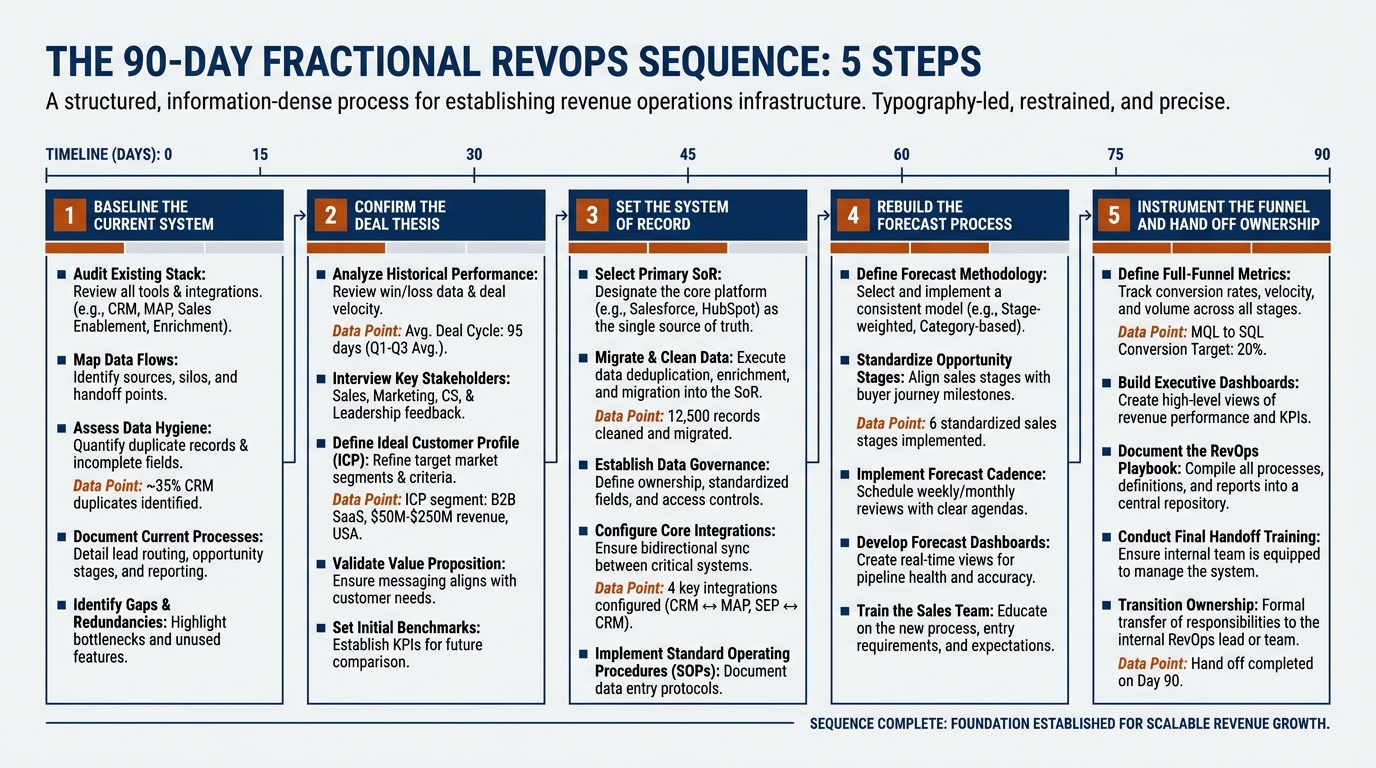
A fractional team that owns every decision creates a dependency that ends the day the retainer ends. The engagement should name which decisions the fractional lead makes, which the CFO or head of sales makes, and how the fractional lead hands ownership of the running system back to the company.
This is the difference between capacity and capability. The sponsor is paying to leave the portfolio company with a revenue function it can run, not with a vendor it cannot stop paying. Build the handoff plan into the statement of work before the first invoice, not after.
9. Judge the work by leading indicators, not deliverable counts
A monthly report that lists tickets closed and dashboards shipped tells the board nothing about whether the revenue system improved. Judge the work by a short set of leading indicators the fractional lead agreed to at the start.
- Forecast accuracy against actuals, trending over consecutive quarters.
- Pipeline coverage ratio, measured against a definition every function signed off on.
- Sales cycle length and stage conversion, before and after.
- Data completeness on the fields the forecast depends on.
- Number of contested numbers in the monthly review, which should fall.
If the fractional partner resists being measured on a baseline they helped set, that is a signal about the engagement, not about the metrics.
10. Where fractional RevOps meets integration and carve-out work
In a buy-and-build, the revenue system has to survive add-ons, and that overlaps with integration work. A fractional lead who understands what happens during post-merger integration will design a pipeline definition and a CRM structure that an acquired company can be folded into, rather than one that breaks on the first deal.
Carve-outs raise the same problem in reverse. When a business is separated from its parent, its revenue systems often live inside the seller’s stack, and the considerations there are covered in this piece on carve-out consulting. In either case, the RevOps scope should be sequenced against the first 100 days plan, not run as a parallel track that ignores it.
11. Price it against the risk it removes
The right way to size a fractional budget is against the cost of the problem. A forecast that misses by 20 percent forces the sponsor to hold capital in reserve and erodes confidence in every subsequent management number. The engagement that fixes it is priced against that consequence.
Industry data from firms like PitchBook shows how much scrutiny value-creation plans now receive across the hold period, which is another way of saying the board will keep asking whether the revenue numbers are real. A fractional model that answers that question earns its fee.
12. A short checklist before you sign
- The scope names a baseline as its first deliverable, with owners and current forecast accuracy.
- The work is tied to the specific deal thesis.
- The system of record is decided before tooling changes.
- The forecast process has a cadence, an owner, a method, and a monthly actual comparison.
- Decision rights and a handoff plan are written into the statement of work.
- Success is measured by leading indicators against a baseline.
- The RevOps sequence is aligned to the 100-day plan and to any integration or carve-out timeline.
Run any proposal against that list. If a fractional partner cannot meet most of it, the engagement will produce activity the board cannot connect to the plan, which is the outcome the model was supposed to prevent.
If you are scoping fractional RevOps against a specific thesis and want a partner who works to the standard above, review the DevriX private equity practice and start the conversation there.