The signatures on the merger are the easy part. What follows decides whether the deal thesis survives contact with two operating models, two CRMs, two sales motions and two sets of quota-carrying people who now report through a reorganized chart. If revenue leaks in the first 90 days, no one remembers the elegance of the LOI. They remember that pipeline stalled, that reps left, and that the combined forecast missed its first board update.
This guide is for the operating partner or portfolio company executive who owns that outcome and now has to decide whether to buy post merger integration services, what scope to buy, and how to judge whether the provider is protecting enterprise value or just billing hours. It assumes budget and accountability, not curiosity. The point is to make integration spend defensible to an investment committee and legible on a value-creation plan.
1. Start from the value at risk, not the org chart
Most integration conversations open with reporting lines and system logos. That is backwards. The first decision is which revenue and cost synergies the deal underwrote, and which of them run through systems, data or go-to-market execution. Everything you buy should trace back to a number that was promised in the model.
Bain’s annual private equity work has repeatedly flagged that value creation, not financial engineering, now drives most PE returns, which means integration is not a back-office cleanup. It is where a meaningful share of the thesis is won or lost. Before scoping any service, write down the two or three synergy lines most exposed to integration risk: cross-sell that depends on a unified customer record, cost takeout that depends on retiring a duplicate platform, or retention that depends on not disrupting the acquired book of business.
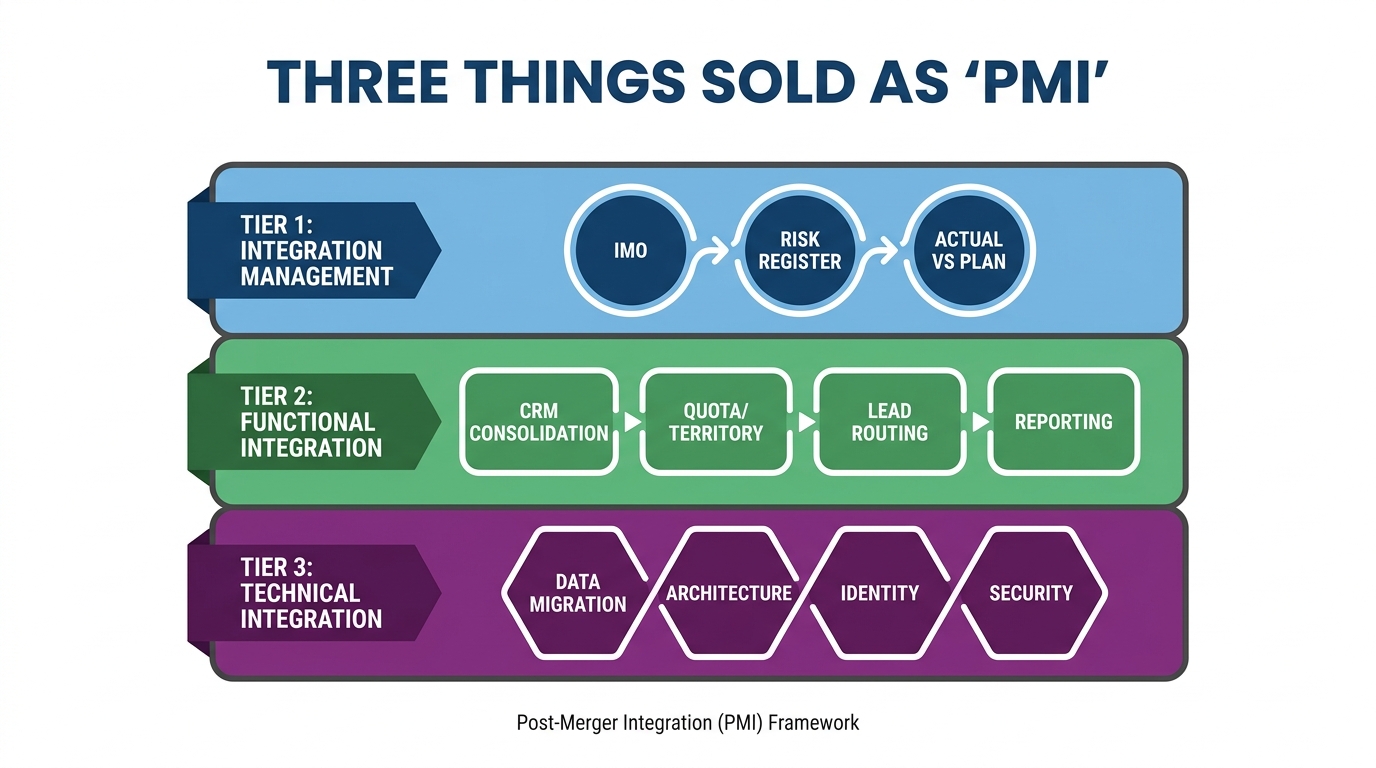
2. Separate the three things vendors call “PMI”
The label covers at least three different products, and buyers overpay by conflating them.
Integration management
Program governance: the IMO, the workstream owners, the risk register, the tracking of actual versus plan against synergy targets. This is management overhead, and it is worth it when the deal is large or the timeline is compressed.
Functional integration
The actual work inside a function. For a RevOps buyer this is CRM consolidation, marketing stack rationalization, lead routing, quota and territory redesign, and reporting. This is where revenue leaks or holds.
Technical integration
Data migration, systems architecture, identity, security and the plumbing that lets two companies operate as one. Weakness here surfaces during a real technology due diligence review and again the moment you attempt to merge two customer databases.
A provider strong at governance decks can be useless at CRM plumbing. Buy against the workstream that carries your value at risk, not against the firm with the most polished methodology slide.
3. Decide the target operating model before Day 1
The single most expensive mistake in integration is starting the work before deciding the end state. Are you fully absorbing the acquired company onto one platform, running a best-of-breed hybrid, or keeping it separate under a shared holding layer? Each answer produces a completely different service scope and a completely different bill.
This decision belongs to the operating partner and the portfolio CEO, not the vendor. The provider’s job is to price and execute the chosen model, and to tell you honestly where your chosen model creates hidden cost. If a firm tries to make this decision for you without pressure-testing it against the synergy math, treat that as a warning sign.
4. Get the revenue systems decision right first
For most mid-market deals, the highest-risk workstream is the revenue stack. Two CRMs holding two versions of the customer, two definitions of a “qualified” lead, and two forecasting methods do not merge themselves. The team accountable for revenue systems should treat CRM as the load-bearing decision.
The mechanics matter more than the vendor logo. Our technical roadmap for unifying conflicting CRM architectures walks the migration sequence in detail, and the broader CRM consolidation decision guide covers when to consolidate versus standardize across a portfolio. When you buy PMI services, insist the provider can speak to both, because a bad CRM cutover can freeze pipeline visibility during the exact window you need it most.
5. Judge the provider on evidence, not the pitch
Commercial integration providers all claim speed and rigor. Force the claims into evidence.
- Ask for the baseline method. How will they establish current-state revenue, pipeline and system health before touching anything? No baseline means no way to prove impact later.
- Ask who owns each decision. A credible plan names the decision right for every workstream: what the vendor decides, what the portfolio exec decides, what goes to the operating partner.
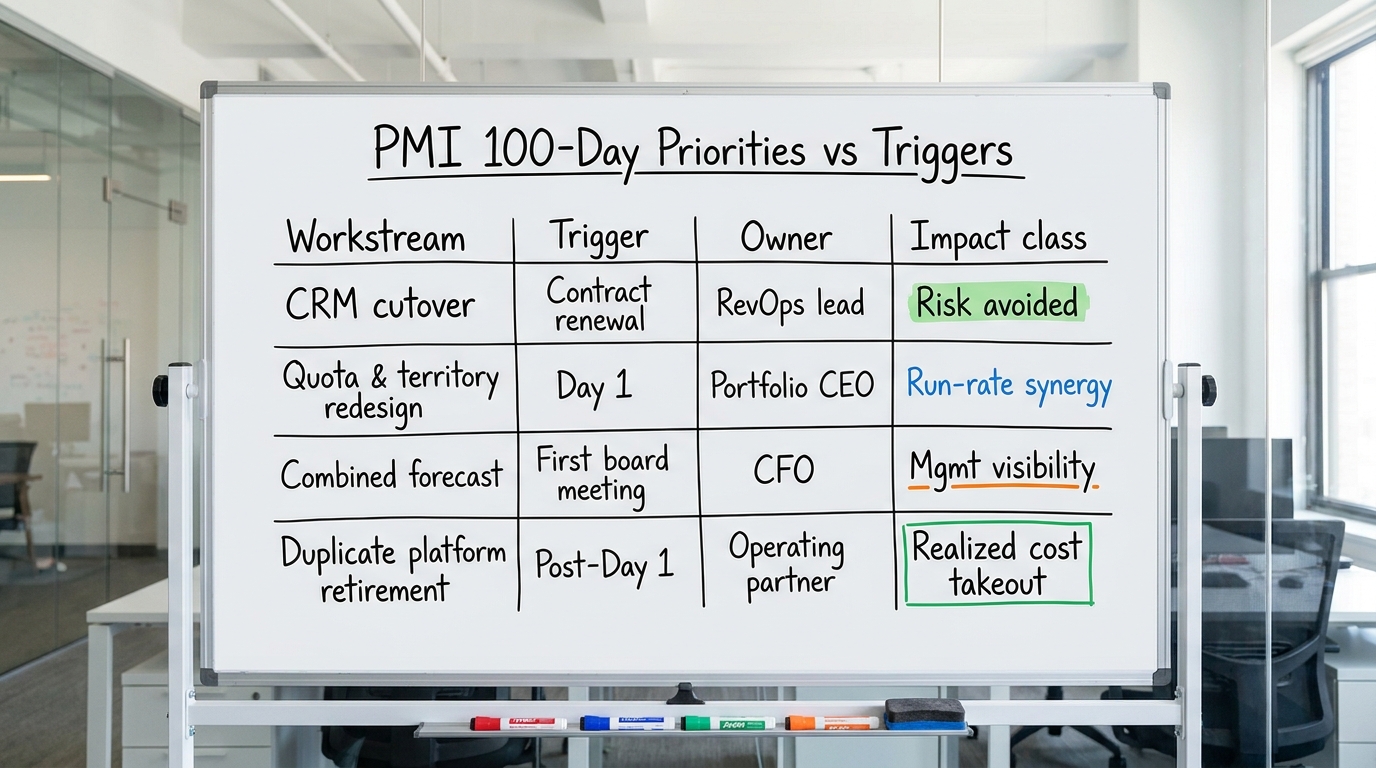
- Ask how they classify impact. Realized cost takeout, run-rate synergy, forecast upside and risk avoided are different things. A serious firm will not present forecast value as if it were banked.
- Ask for the risk register. If they cannot show you how they track integration dependencies and what happens when one slips, they are selling activity, not outcomes.
The discipline here mirrors what you would apply when hiring any revenue advisor. Our guide on judging a revenue operations consultant for private equity lays out the same evidence-first test, and it applies cleanly to PMI scope.
6. Set the 100-day plan against real triggers
Integration work should be sequenced against dates that already exist: legal Day 1, the first combined payroll run, the first board meeting where a combined forecast is expected, and any system contract renewal that forces a platform decision. Tie each workstream milestone to one of those triggers so the plan survives contact with the calendar.
The first 100 days playbook is the natural home for this. The goal in that window is not to finish integration. It is to stabilize revenue operations, protect the customer record, and produce a forecast the board can trust. Anything that does not serve one of those three is a candidate to defer.
7. Protect go-to-market during the disruption
Integration is internally focused by nature, and that is exactly when revenue slips out the side door. Reps get confused about accounts, marketing pauses campaigns during the migration, and the acquired company’s best sellers start taking recruiter calls. Build a GTM protection track into the scope from the start.
Two prior pieces on this site cover the decisions that keep growth intact: GTM value creation for portfolio companies and, if you are bringing in outside help for the motion, how to hire and judge a GTM strategy consultant. Read them alongside your PMI scope so revenue growth is a named workstream, not an afterthought.
8. Price the work against the synergy, not the day rate
A day rate tells you almost nothing about whether integration spend is defensible. The right frame is the ratio between what the work costs and the value it protects or unlocks. Retiring a duplicate platform that saves a defined run-rate cost each year justifies a very different budget than a cosmetic reporting cleanup.
McKinsey’s private capital research and BCG’s principal investors work both make the same underlying point across their published analysis: integration discipline correlates with deal outcomes, and under-resourcing it is a false economy. Scope to the value at risk, then hold the provider to it.
9. Watch for the activity trap
The most common failure mode is a provider who reports hours, tickets and meetings as if they were progress. Traffic to a migrated site, features shipped, and workstreams “in flight” are inputs. The board cares about pipeline held, cost taken out, forecast reliability restored, and integration risk closed. Insist that status reporting leads with the financial consequence and treats activity as supporting detail. If every update is a list of what was done rather than what changed in the numbers, the engagement has drifted.
10. A short checklist before you sign
- The two or three synergy lines most exposed to integration risk are written down and tied to model numbers.
- The target operating model (absorb, hybrid, or hold-separate) is decided and owned internally.
- The provider can speak credibly to functional and technical CRM integration, not just governance decks.
- Every workstream has a named owner, a decision right, and a milestone tied to a real trigger.
- Impact is classified as realized, run-rate, forecast or risk avoided, and none of it is inflated.
- A GTM protection track exists so revenue does not leak during the disruption.
- Status reporting leads with financial consequence, not activity.
- Spend is justified against value at risk, not against a day rate.
For the wider context on how these decisions sit inside a value-creation plan, the S&P Global Market Intelligence and PitchBook research hubs track deal and integration trends worth referencing when you build the investment committee case, and Bain’s global PE report remains the standard reference on where returns now come from.
11. Where this connects to the value-creation plan
Post merger integration is not a standalone project. It is the execution layer of the thesis, and it either compounds the other private equity value-creation workstreams or it drags on them. The portfolio companies that come out of integration clean are the ones where someone owned the revenue systems decision, protected go-to-market, and held the provider to numbers. If you also run CRM decisions across multiple assets, the CRM standardization playbook for operating partners extends the same logic across the portfolio.
If your next 100 days will be judged on a stabilized forecast and a protected revenue base, that is precisely the window where scoped execution earns its keep. See how 100-Day Digital Execution from the DevriX and GrowthShuttle PE practice maps integration workstreams to enterprise-value outcomes, and use it to pressure-test the plan before you commit budget.