When a carve-out signs, the clock on the transition services agreement starts, and the IT separation usually becomes the thing that decides whether the first 100 days go to plan or go sideways. The operating partner inherits a business that still runs on the seller’s email, seller’s ERP instance, seller’s network and seller’s licenses, and every one of those dependencies carries a cost and an exit date. An IT carve-out audit exists to tell you what you actually bought, what you are renting from the seller, and how long you have to replace it before the meter runs out or the access is cut.
This is written for the person accountable for revenue and operating systems in the new standalone entity, not for someone learning the terms. The question is not whether to run the audit. It is how to scope it, who owns the output, and how to judge whether what came back is good enough to fund a workstream against.
1. What the audit has to decide, before anyone opens a tool
A carve-out audit that produces a 90-page inventory and no decisions is a cost. Scope it backward from the calls the deal team and the operating partner have to make. Those calls are concrete: which TSA lines to exit first, which systems get rebuilt versus migrated, where the standalone cost base lands, and what breaks on Day 1 if nothing moves.
Bain’s annual Global Private Equity Report has tracked for years how much of the return thesis in carve-outs rests on separation moving faster than the seller’s incentives allow. The audit is the evidence base for that speed. If it does not shorten a decision, it does not belong in scope.
2. Separate what you own from what you are renting
The first split in any it carve-out audit is ownership. For every system, the audit should state one of three things: the entity owns it outright, it runs on a TSA from the seller with a stated end date, or it sits in a shared environment that has to be untangled before either side can move.
This matters because the three categories carry different risk and different cost. An owned system needs a migration plan. A TSA line needs an exit date and a replacement. A shared environment, usually identity, networking or a commingled ERP, needs separation work before a date can even be set. Treat the shared category as the one that quietly eats the timeline, because it is.
Read the TSA against the inventory, line by line
The TSA is a commercial document the deal team negotiated, and the IT audit has to reconcile it against reality. Every service the seller agreed to provide should map to a system in the inventory, and every system the new entity depends on should map to either ownership or a TSA line. A dependency with no TSA line and no owned asset is an unfunded gap, and those are the ones that surface at the worst time.
3. Build a dependency register the deal team can read
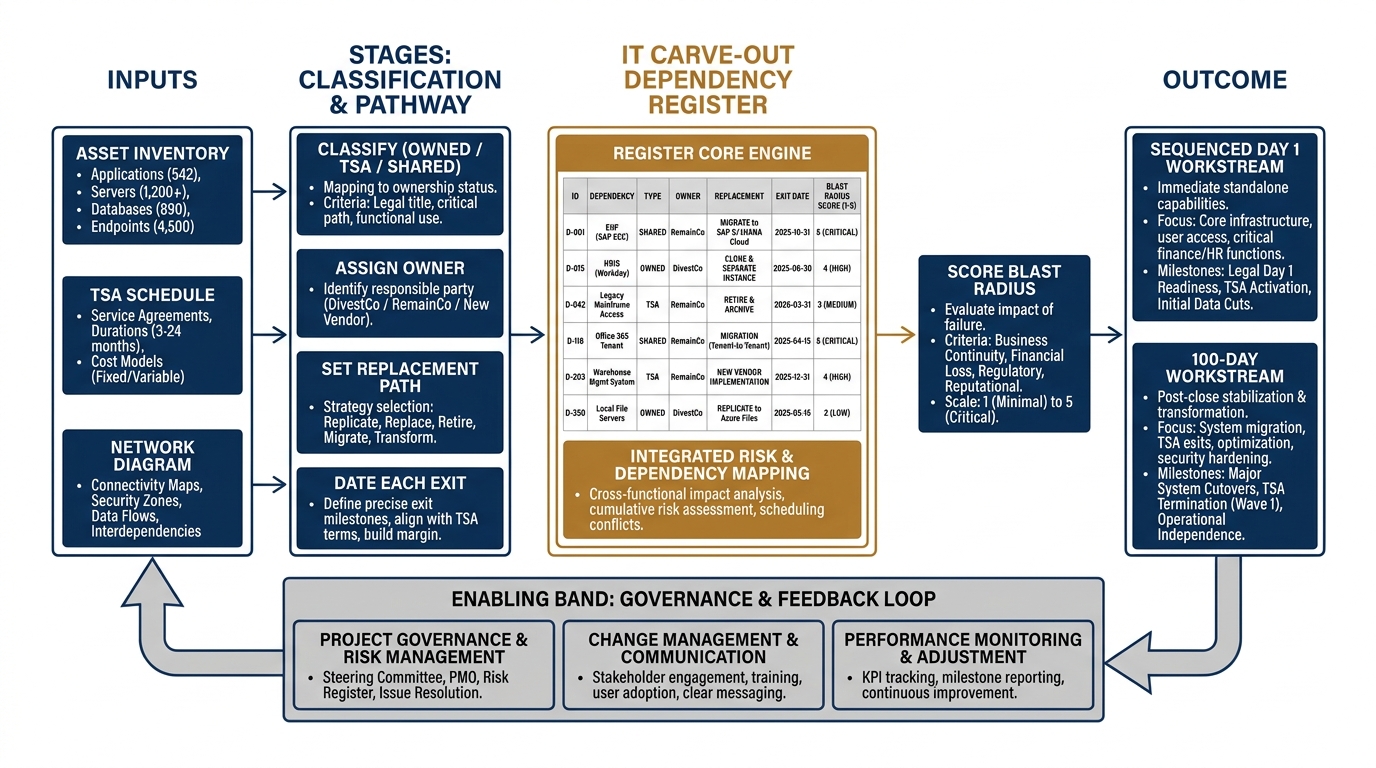
The register should list dependencies, each with an owner, a replacement path, a cost, a target date, and what fails if the date slips. Harvard Law School’s Forum on Corporate Governance has published extensively on how separation risk gets underestimated in diligence precisely because dependencies are catalogued as assets rather than as obligations with deadlines.
A register the deal team can read in ten minutes is worth more than an inventory nobody opens. Sort it by exit date and by blast radius, so the operating partner can see the three things that have to move in week one versus the twenty that can wait a quarter.
4. Price the standalone cost base, not just the migration
A carve-out that was priced on the seller’s IT cost will be run on a standalone cost base, and those two numbers are rarely close. The seller’s spend was spread across a larger estate with volume licensing and shared infrastructure. The standalone entity re-buys at its own scale, often at a worse unit price, and the audit should put that delta in front of the CFO before the first board meeting rather than after.
McKinsey’s private capital research has documented how standalone cost overruns are among the more common ways a carve-out thesis slips in year one. The audit does not fix that, but it makes the number visible early enough to fund a reserve or reset the forecast while there is still room to.
5. Judge the audit on evidence, not on page count
A weak audit lists systems. A strong one shows how it knows. For every material dependency, ask what the finding is based on: a config export, an admin console screenshot, a license agreement, or a conversation with the seller’s IT lead. This is the same discipline that applies to technology due diligence before close, carried into the post-signing phase where the stakes are now operational rather than hypothetical.
If the audit cannot say where a finding came from, treat it as a hypothesis. Hypotheses are fine in week one. They become a problem when you use them to commit to a TSA exit date with the seller.
6. Pin every line to a named owner
A register without owners is a wish list. Each dependency needs one person accountable for its replacement, and that person needs the decision right to spend against it. In a standalone carve-out the IT function is often thin, sometimes a single hire who has not landed yet, so the audit has to flag which lines have no owner at all.
That gap is a staffing decision for the operating partner. The 100-day plan an operating partner should be able to defend lives or dies on whether the people named against the hardest lines actually exist and have the authority to act.
7. Sequence by TSA exit date and by what breaks on Day 1
Two forces set the order of work. The first is the TSA clock, because some seller services are time-boxed or priced to escalate, and letting them run is a controllable cost the audit should quantify. The second is operational risk, because some dependencies break the business if they fail on Day 1 regardless of what the TSA says.
Email, identity and the systems the revenue team touches daily are Day 1 dependencies. A commingled ERP or a shared data warehouse belongs in the quarter-one bucket, large and slow, but not something that halts invoicing on the first morning. The audit should propose this sequence, and the operating partner should be able to defend it at the first board meeting.
8. Do not let the revenue stack hide inside the IT inventory
CRM, marketing automation, analytics and the data that feeds the forecast often get catalogued as ordinary IT line items, and that is where visibility gets lost. For the person accountable for revenue systems, the carve-out is the moment to decide whether the revenue stack comes across intact, gets rebuilt, or gets rationalized while everything is already moving.
A carve-out that inherits disconnected CRM and analytics running on the seller’s instance will spend its first two quarters unable to see its own pipeline cleanly. The audit should call that out as a revenue-visibility risk, with the line number and the size. When the question becomes whether to consolidate web and brand properties at the same time, the same discipline applies: decide it deliberately, with the costs and the dependency chain visible.
9. Decide the data separation before you schedule the system migration
The hardest line in most carve-outs is the one where the new entity’s data lives inside the seller’s environment, mixed with records that are not yours to keep. Separating the data is a prerequisite to migrating the system, and it is slower and more sensitive than the hardware or license work around it.
The audit should treat data separation as its own workstream with its own owner and its own date, not as a sub-task of a migration. BCG’s work on carve-outs and separations has repeatedly flagged commingled data as the dependency that most often resets a separation timeline, because it touches legal, security and operations at once.
10. What a buyer with budget should actually check
Before funding a separation workstream off the back of an audit, the operating partner should be able to answer each of these from the document itself:
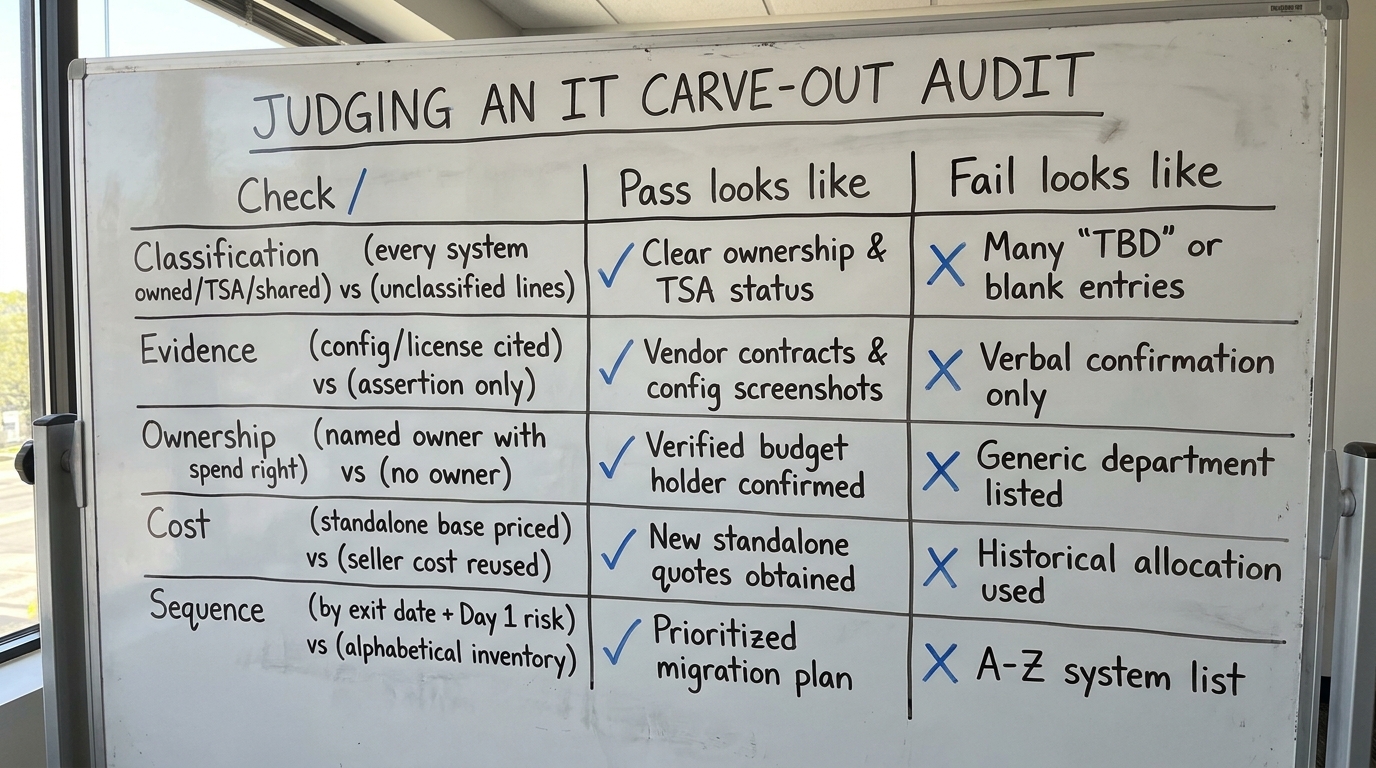
- Is every system classified as owned, TSA, or shared, with no unclassified lines?
- Does every TSA line have a replacement path, a cost, and a target exit date?
- Does every material dependency cite the evidence it rests on?
- Is every line pinned to a named owner who has the authority to spend?
- Is the standalone cost base priced, with the delta against the seller’s cost shown?
- Is the revenue stack broken out separately, with visibility risk flagged?
- Data separation should be scoped as its own workstream. Folding it into a migration hides the dependency and usually doubles the elapsed time.
- Is the whole register sequenced by exit date and by Day 1 blast radius?
If the audit cannot answer those, send it back before you build a plan on it. A thin audit costs the TSA line that escalates because nobody dated it, and the forecast that misses because nobody priced the standalone stack.
11. Where the audit connects to the rest of the integration
The IT carve-out audit is one input into a wider separation, and it should hand off cleanly to the people running the first 100 days. The dependency register becomes the IT section of the integration plan, the standalone cost base feeds the CFO’s forecast, and the owners named in the audit are the same people who show up on the workstream tracker.
How that work gets staffed is its own decision. The trade-offs between an internal build and an outside partner are covered well in this site’s take on whether to hire a PMI consultant or staff it internally, and the related piece on hiring PMI without buying a plan the team cannot run. The audit tells you what has to be done. Those decisions tell you who does it.
This kind of separation discipline, deciding before close and sequencing after it, is the same logic behind exit readiness starting with pre-close decisions. Carve-outs reward the teams that treat the IT audit as a decision document and punish the ones that treat it as an inventory. PitchBook’s research and data on deal activity shows carve-outs remain a significant share of sponsor dealflow, which means more operating partners inherit this exact problem every quarter.
12. Next steps and the standup that turns the register into progress
Run the audit against the eleven checks above, reject anything that answers fewer than all of them, and sort the resulting register by exit date and Day 1 risk before the first board meeting. Name an owner against every line, price the standalone cost base, and carve out data separation as its own workstream with its own date. That is the work that keeps a carve-out from spending its TSA window firefighting instead of separating.
For teams that want the register turned into a sequenced, owned, and costed separation plan quickly, the Carve-Out Digital Standup from the DevriX private equity practice takes the audit output and stands up the revenue and digital systems the standalone entity needs to run on its own.