An operating partner looking at top interim CTOs for post-merger integration is usually making the call under pressure. The deal closed, the target runs on systems nobody on the new side has mapped, and the integration plan assumes a technology owner who does not yet exist. The decision in front of the operating partner is who can hold release velocity, data migration and vendor risk through the first 100 days without stalling the revenue the model underwrote.
The cost of getting it wrong shows up fast. A weak interim pick lets the two CRM systems drift for a quarter, and by the first board meeting the pipeline numbers from each side still cannot be reconciled. This piece lays out what to decide, in order, and how to judge each candidate against the work that matters.
1. Decide what the interim CTO actually owns before you read a single CV
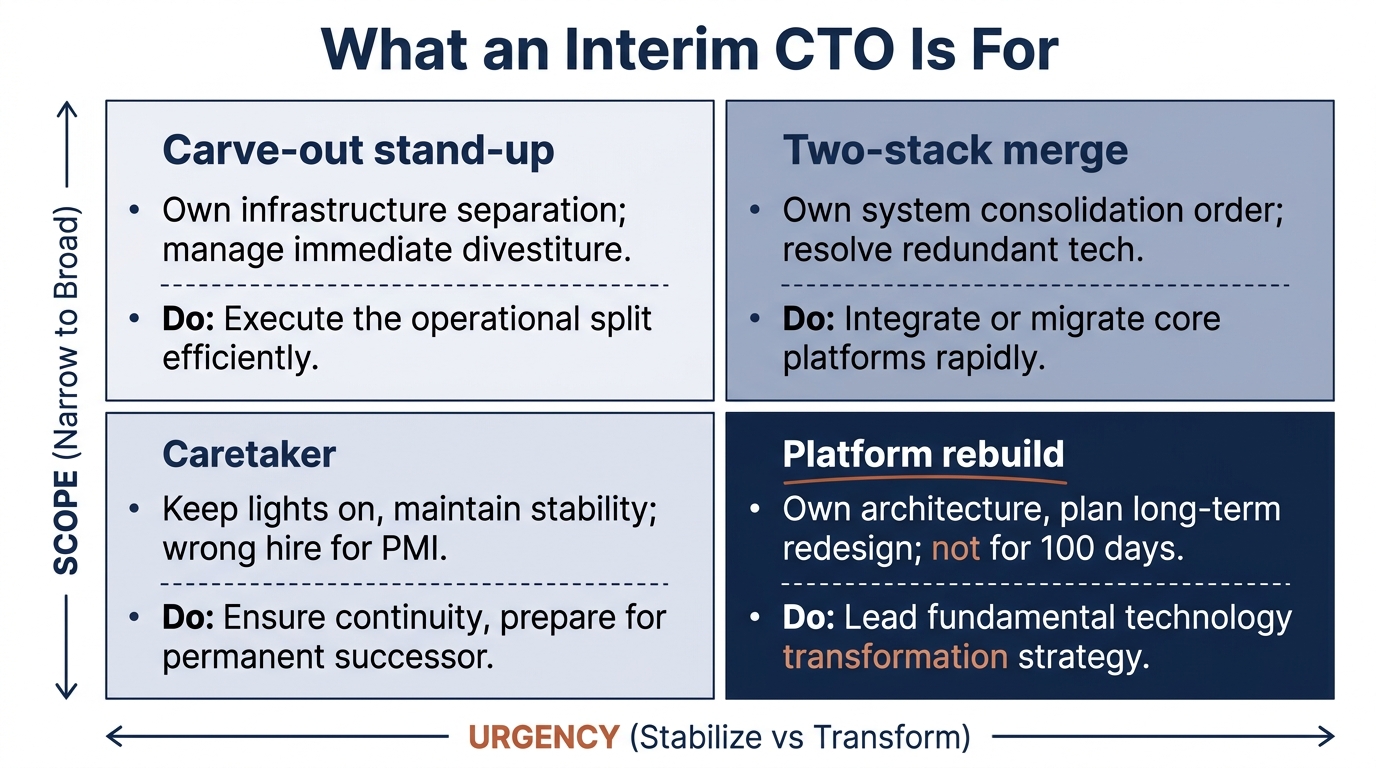
The most common error is hiring a title instead of a mandate. An interim CTO for a carve-out that is standing up its own infrastructure is a different person from one sewing two mid-market stacks together. Write the mandate first, in one page: the systems in scope, the decisions the role carries (platform selection, data model, vendor renewals), and the ones it does not.
If you cannot name the decision rights, you are not ready to hire. The work on hiring PMI without buying a plan the team cannot run makes the same point about integration leads generally, and it holds for the technology seat.
2. Judge them on integration dependencies, not on their resume stack
A candidate who has run large platform builds is not automatically the right person to merge two companies. Post-merger work is about dependencies: which system has to migrate before billing can consolidate, which data has to reconcile before finance closes the first combined month. Ask a candidate to walk through the dependency order on your actual deal, from a short brief you give them in the interview.
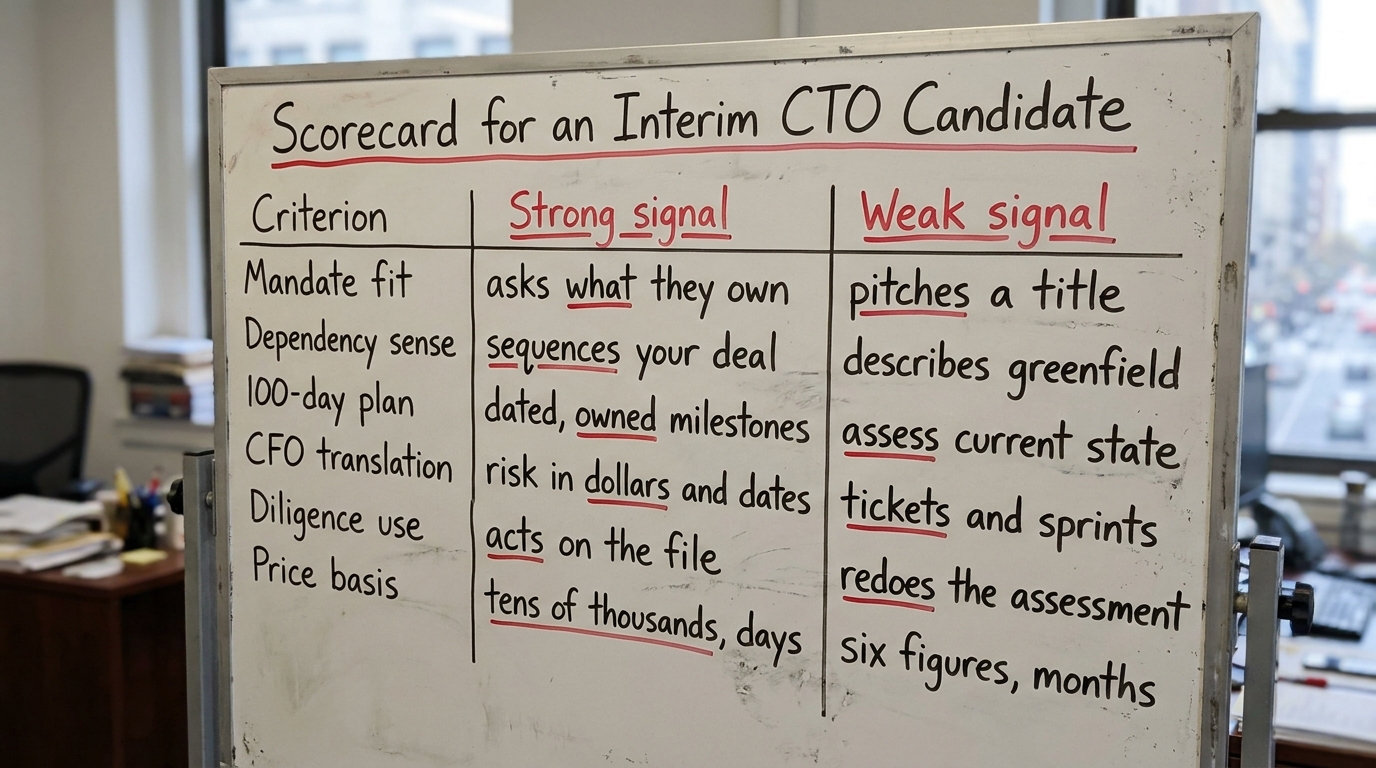
The strong ones ask about the sequence and the owners. The weak ones describe their last greenfield project. Bain’s annual private equity report has tracked how value creation has shifted toward operational execution over multiple expansion, and integration sequencing is where that execution either holds or slips. You can read that framing in Bain’s global private equity research.
3. Make them show the first 100 days, not the strategy deck
Anyone can produce an operating model slide. What distinguishes a usable interim CTO is a dated plan for the first 100 days that names which workstream moves in week one, who owns it, and what evidence proves it is done. The plan should show actual versus intended, not aspiration.
Push on specifics. If their week-two milestone is “assess current state,” that is a candidate who will spend your quarter observing. A defensible plan starts executing early, and the structure of a 100-day plan an operating partner can defend sets the bar for what good looks like here.
4. Test whether they can run a risk register a CFO will trust
The CFO wants forecast reliability and a clean first close. An interim CTO who cannot translate technical risk into financial consequence will lose the finance team in week two. Ask how they would flag a migration risk so the CFO can price it: the downside in dollars, the trigger date, the owner, the mitigation.
This is the connective tissue between technology and the numbers the board watches. Candidates who only speak in tickets and sprints are describing activity, not the EBITDA and diligence risk the finance side needs translated for them.
5. Confirm they can read a technology diligence file and act on it
If the deal ran proper technology due diligence, the interim CTO inherits a documented view of the stack, the technical debt and the key-person risk. A good one opens the diligence file on day one and turns its findings into the integration sequence. A weak one re-does the assessment because they did not trust or did not read it.
Ask directly: given this diligence summary, what are the first three things you act on. The answer shows whether they can move from evidence to execution without restarting the clock.
6. Separate the ones who merge systems from the ones who merge org charts
Consolidating two companies touches both the technology and the reporting lines. An interim CTO should own the systems and the data, and should stay clear of the people reorganization unless that is explicitly in the mandate. When those two blur, the technical migration slips because the candidate spent the quarter on staffing politics.
Where the two companies run separate websites and brand properties, the sequencing of that consolidation is its own workstream, covered in detail in multi-brand website consolidation for portfolio companies. An interim CTO should be able to tell you where that work sits in their dependency order.
7. Price the engagement against AI-era build costs, not legacy consulting rates
The market for integration work has moved. Entry-stage execution that once started at six figures and ran for months can now be scoped in tens of thousands and move in days, because the tooling and the available talent have changed. An interim CTO quoting a long discovery phase at a legacy rate is benchmarking against the wrong baseline.
McKinsey’s private capital research has documented the pressure on holding periods and the premium on faster value realization, which is the same pressure that compresses what you should pay for an interim technology seat. That context sits in McKinsey’s work on private capital.
8. Decide now whether the interim becomes permanent or hands off
Two exit paths exist for the role, and choosing late is expensive. Either the interim CTO stabilizes and hands a clean operating model to a permanent hire, or the interim becomes the permanent CTO. Decide the intent before you sign, because it changes who you pick. A caretaker who is great at stabilizing may not be who you want running the platform for three years.
The broader build-versus-rent question, including when to contract the capability rather than hire it, is worked through in whether to hire a PMI consultant or staff it internally.
9. Watch for the vendor who sells their own stack
Some interim CTOs arrive attached to a platform they want to install. That is a conflict worth surfacing in the first conversation. The role should recommend the right systems for the combined business, including keeping what already works, not steer every decision toward a tool the candidate resells.
The Harvard Law School Forum on Corporate Governance has published extensively on conflicts and governance in sponsor-backed deals, which is the same discipline you apply here. That material is at the Harvard Law School Forum on Corporate Governance.
10. Make the handover artifact a condition of payment
An interim engagement that ends with knowledge in one person’s head has failed, regardless of how smooth the quarter felt. Require a documented operating model, a system map, the vendor contracts and renewal dates, and a risk register the permanent team can run. Tie the final portion of the fee to delivering those artifacts, not to the calendar.
This is the same discipline that protects you on a website migration for a roll-up. The migration launches when the technical cutover completes. The team that stays can run what was built when the handover artifacts exist.
11. Tie the interim CTO’s work to exit from day one
The technology decisions made in the first quarter either support a clean exit or create diligence problems the next buyer will discount for. An interim CTO who understands this builds toward a documented, reconcilable, low-key-person-risk stack. One who does not leaves fragile integrations the exit diligence will flag.
The link between early integration choices and exit readiness is direct, and the brief for it is laid out in exit readiness and post-merger integration starting before close.
What to decide before your next interview
- Write the one-page mandate: systems in scope, decision rights, exclusions.
- Prepare a short brief on your actual deal and ask candidates to sequence it live.
- Require a dated 100-day plan with named owners and evidence of done.
- Ask how they would flag a migration risk to the CFO in dollars and dates.
- Confirm they will act on the existing diligence file and will not restart the work.
- Decide the exit path (handover or permanent) before you sign.
- Make the handover artifacts a condition of final payment.
Getting an interim technology leader right is one of the clearest levers an operating partner holds on how fast an acquisition contributes to the combined entity. The firms that treat it as a mandate problem rather than a resume search tend to lose fewer quarters to drift, a pattern consistent with the operational-execution focus BCG tracks in its principal investors and private equity research.
If you need a technology owner who executes against a dated plan through the first 100 days of an integration, review the digital execution offer built for that window at DevriX’s private equity practice.