An operating partner signing off on integration support in the weeks after close is making a resourcing decision under a running clock. The commercial consequence is direct: the synergy case underwriting the deal assumes certain cost and revenue moves land on a schedule, and the people doing the work either hit that schedule or they do not. When an operating partner or portfolio company executive decides to hire PMI for portfolio companies, they need to know what to buy, who owns the result, and how to tell early whether the engagement is producing decisions or producing status updates.
This guide walks through the calls that matter before you sign, during the first weeks, and at the point where you decide to renew or cut. It assumes you have budget and a thesis, not that you need the category explained.
1. Start from the decision the engagement has to inform, not the capability
Most PMI proposals open with a capability list: workstream leads, a program office, a reporting cadence. Before you read a single proposal, write down the two or three decisions the engagement exists to inform. For a carve-out, that is usually the TSA exit sequence and the standalone cost base. For a platform building toward an add-on, it is the integration playbook you will reuse.
Bain’s annual review of the industry has documented for years how much value creation now depends on operational improvement rather than multiple expansion, and you can track that shift through the Bain Global Private Equity Report. If value creation sits in operations, then the PMI engagement has to move operating decisions rather than describe them.
2. Decide what you are actually buying before you price it
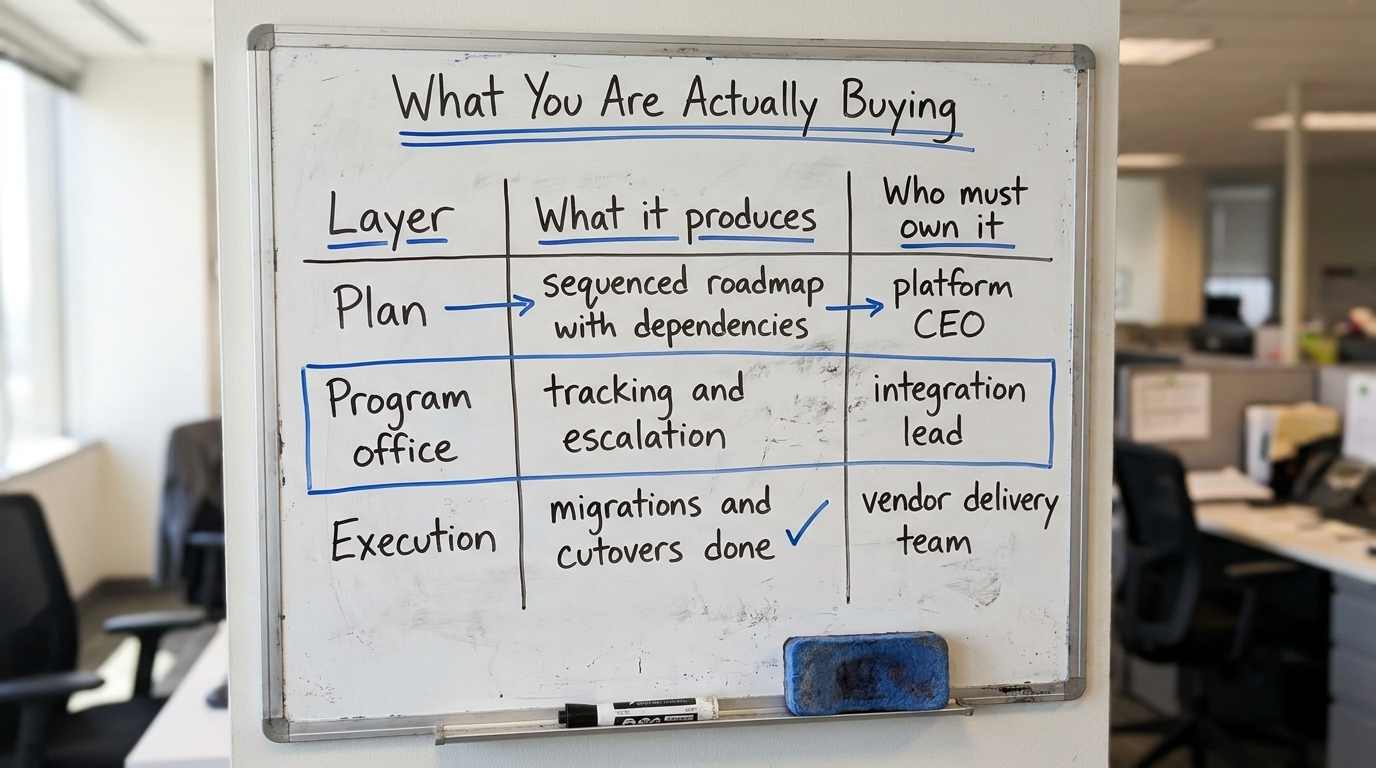
There are three distinct things that get sold under the same label, and conflating them is how operating partners end up with a binder nobody can run. The first is a plan: a sequenced integration roadmap with owners and dependencies. The second is a program office: coordination, tracking, escalation across workstreams. The third is execution: people who do the migrations, the consolidations, the system cutovers.
A plan alone leaves you holding a document and no one to run it. We wrote about that failure pattern in detail in the piece on hiring post-merger integration without buying a plan nobody can run. Price each layer separately so you can see what you are paying for.
3. Name the owner with the decision right
Someone inside the portfolio company has to own the integration result. A PMI firm can run the office and do the work, but the decision right on what gets integrated, what gets retired, and what gets left alone belongs to a named executive, usually the CEO or COO of the platform. If no one at the company owns it, the engagement drifts toward reporting because reporting is the only output that does not require a decision from the client.
The question of whether to hold that ownership internally or bring it in runs through the whole category, and the trade-offs are laid out in the comparison of whether to hire a PMI consultant or staff it internally.
4. Tie the scope to the deal clock, not a generic timeline
The useful boundary for most engagements is the first 100 days, because that window is where the synergy case is either confirmed or quietly abandoned. Scope the PMI engagement against your real triggers: LOI assumptions, the TSA exit dates, Day 1 cutover requirements, the first board meeting where you will defend progress. DevriX frames this execution window around the first 100 days for exactly this reason.
If the proposal has a timeline that would read the same for any deal in any sector, it was not built for your situation. A version of the plan you should be able to defend to the board is covered in the breakdown of the 100-day plan an operating partner should be able to defend.
5. Separate the digital and data workstreams from the rest
In most mid-market integrations, the parts that slip are the ones involving systems and customer-facing properties: website consolidation, CRM and ERP merges, martech, reporting. These have hard dependencies and they are easy to underestimate because they look like IT tickets rather than commercial risk. They are commercial risk, because a botched website migration during a roll-up costs organic traffic and lead flow that the revenue forecast assumed.
Two of those calls deserve their own owner and their own review. The sequencing of a website migration in a roll-up and the approach to multi-brand website consolidation both carry revenue consequences that are hard to reverse once the cutover happens.
6. Judge the firm on business-model fluency, not slide quality
The fastest filter in a first meeting is whether the firm understood the business before it arrived. A PMI firm that applies a SaaS integration template to a distributor, a project-delivery business, or a clinic group will need constant correction, and every correction is time your team spends teaching a vendor instead of integrating a company.
McKinsey’s private capital research and BCG’s work on principal investors both document how much integration value depends on the specifics of the operating model rather than generic program management; their hubs are worth checking at McKinsey and BCG. Ask the firm to describe your revenue engine back to you. If they cannot, they are not ready to integrate it.
7. Insist on a low-risk proof before the full engagement
You do not have to commit to a six-figure multi-month program to find out whether a firm can deliver. The better firms will take read-only access, an NDA, and a short diagnostic, and come back with a finding about your actual situation. That gives you something a champion can carry to the deal team without exposure. The pattern for avoiding the opposite outcome is covered in the guide to hiring PMI experts without buying a deck you cannot execute.
8. Connect the engagement to a value lever, not an activity count
Hours, tickets, and workstream status are the vendor register, and they tell you a team is busy, not that enterprise value moved. Every PMI engagement should map to one of a short list of outcomes: faster TSA exit, a lower standalone cost base, protected or recovered revenue, reduced operating risk, or better management visibility for the board. Classify what you expect as realized, run-rate, or forecast so that nobody at a later board meeting mistakes a projection for money in the bank.
The decisions that make this possible usually start before close, which is the argument in the piece on how exit readiness and PMI start with decisions you make before close.
9. Make the diligence findings the starting input
The integration plan should inherit directly from what diligence found. If the technology due diligence flagged a fragile ERP, a data model held together in spreadsheets, or a CRM with no governance, those become the first workstreams. The same holds for commercial findings, which is the throughline in the discussion of M&A commercial due diligence and the decisions an operating partner has to own.
A PMI firm that ignores the diligence pack and runs its own discovery is charging you twice for the same information. HBR’s archive on mergers and acquisitions, available through its M&A topic hub, has long tied integration failure to exactly this disconnect between what was found and what was acted on.
10. Own the spend calls yourself
When the engagement touches marketing and revenue systems, the budget decisions belong to the operating partner. A firm that sells its own tooling will steer the stack toward what it resells. The spend calls that cannot be delegated are set out in the piece on marketing for private equity and the spend calls an operating partner has to own. Keep the recommendation and the execution honest by keeping the budget authority in-house.
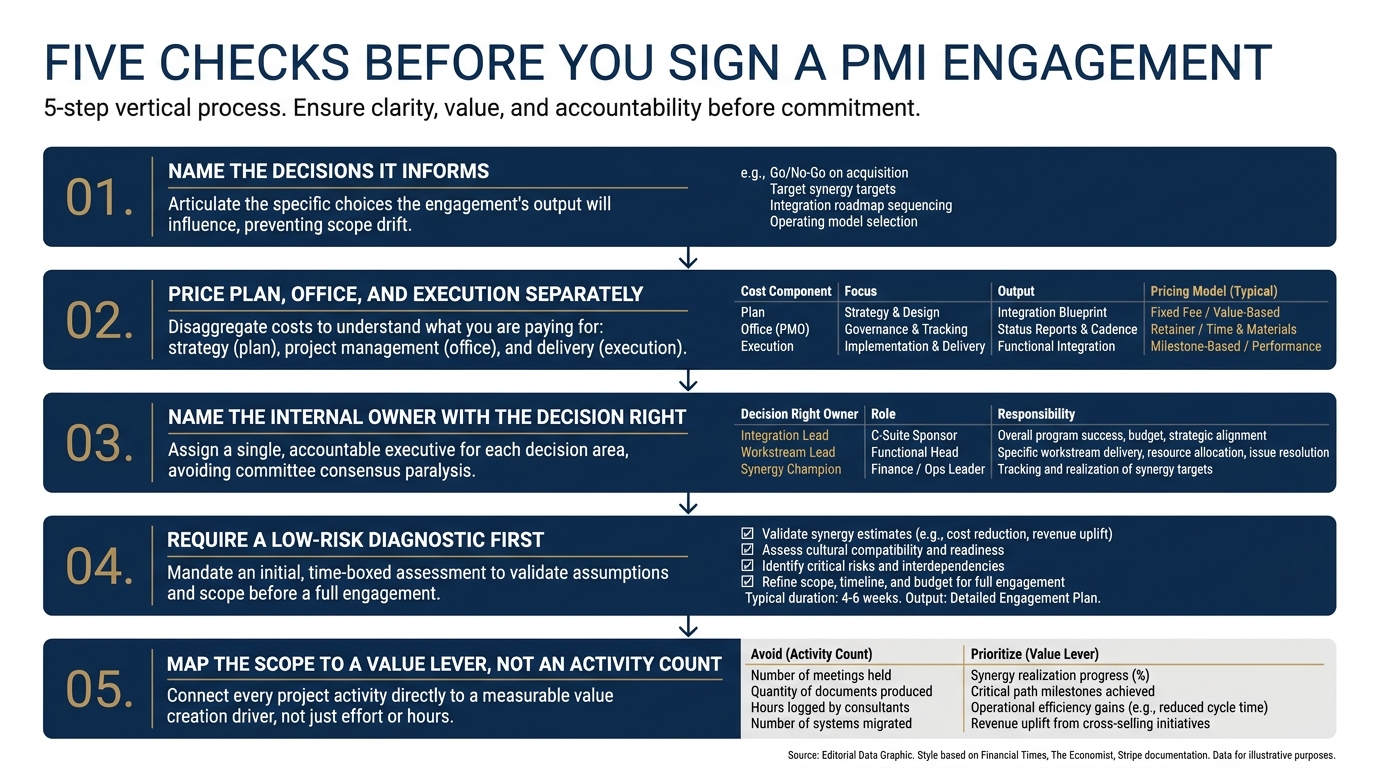
11. A pre-signature checklist
- The two or three decisions the engagement exists to inform are written down.
- Plan, program office, and execution are priced as separate layers.
- A named platform executive holds the decision right.
- Scope is anchored to real triggers: TSA dates, Day 1, the first board meeting.
- Digital, data, and website workstreams have their own owner and review.
- The firm described your business model back to you without correction.
- A low-risk diagnostic precedes the full commitment.
- Every workstream maps to a value lever, classified as realized, run-rate, or forecast.
- The plan inherits from the diligence findings rather than restarting discovery.
- Budget authority on stack and spend stays with the operating partner.
Industry data that supports this discipline is worth reviewing periodically through PitchBook and Preqin, both of which track how holding periods and value-creation sources have shifted. The pattern across that research is consistent: integrations that produce decisions on a schedule protect the deal thesis, and those that produce reporting erode it.
12. Where DevriX fits
The reason this matters now is the clock. Whether you are approaching close, inside the first 100 days, or watching a forecast slip because the systems work stalled, the choice of who runs the integration decides whether the synergy case holds. DevriX works with private equity operating teams on the digital and data execution inside the 100-day window, the part that slips quietest and costs the most when it does.
If you are scoping PMI support for a portfolio company and want the execution to produce decisions rather than decks, review the DevriX 100-Day Digital Execution offer and bring the specific integration you are facing.