The question of whether to hire a PMI consultant after an acquisition usually lands on an operating partner’s desk two weeks before Day 1, when the deal team has moved on and nobody owns the integration beyond a shared slide deck. By then you need to know whether the portfolio company has the people, the decision rights and the data to run integration itself, and if not, what specific gaps an outside team should fill before the value-creation plan starts slipping against actual.
This guide is for the person accountable for revenue systems and operating cadence in that portfolio company, not for someone deciding whether PMI is a real discipline. It walks through how to frame the decision, how to scope it, and how to judge a consultant so you buy execution rather than a plan nobody can run.
1. Start with the decision the hire is supposed to inform
Bringing in outside help is justified when an internal gap has a commercial consequence you can name. A combined company that cannot report revenue on one basis for the first 90 days delays the first board meeting’s view of the deal model. A CRM migration that stalls holds up quota setting, which holds up the GTM plan the thesis was underwritten on.
Write down the three or four decisions integration must support in the first 100 days: how customers are billed, how pipeline is reported, which system is the source of truth, who owns the combined forecast. If you cannot name the decisions, you are not ready to scope a consultant, and you will buy generic PMI hours that produce a workstream map instead of a billing cutover.
2. Decide whether this is a capacity gap or a capability gap
These need different answers. A capacity gap means your controller and your RevOps lead know exactly what to do but are already running the base business and cannot absorb an integration on top of it. A capability gap means nobody on the team has merged two billing systems or consolidated two CRMs before, and learning on the live deal is the expensive way to find out.
For a capacity gap, contract embedded hands against a defined scope and keep your people as owners. For a capability gap, you want someone who has run the specific cutover several times and will leave behind a playbook. Confusing the two is how portfolio companies end up paying consultant rates for junior project coordination.
3. Separate the work PMI consultants actually do
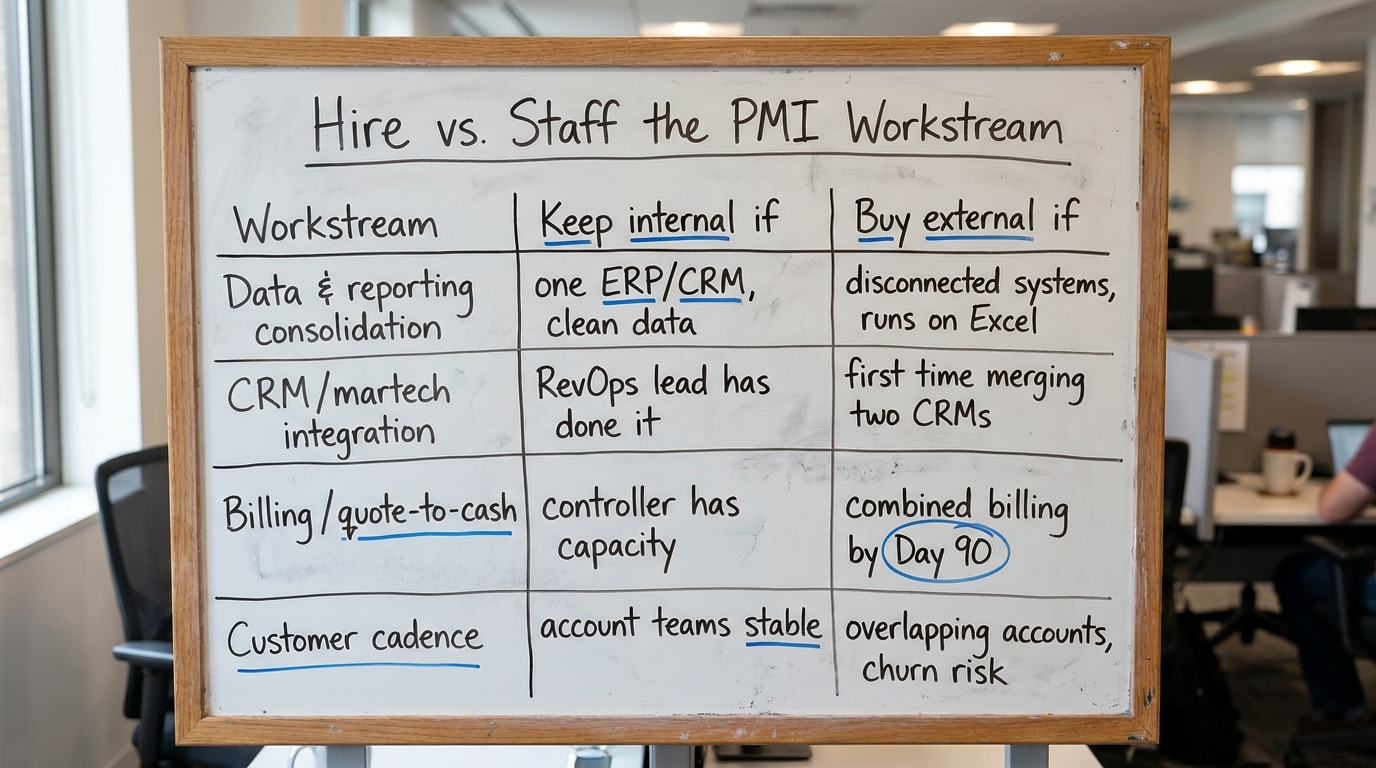
“PMI” covers a wide range, and most of the value sits in a few concrete workstreams rather than in overall program management. For a revenue-systems operator, the ones that matter are usually data and reporting consolidation, CRM and martech integration, billing and quote-to-cash, and the customer-facing cadence that keeps churn from spiking during the transition.
Bain’s annual private equity report has tracked for years how much of expected deal value depends on integration executing on schedule rather than on the thesis being right. Scope the hire around the two or three workstreams that carry the model. You can read the structure of that work in more depth in this breakdown of post-acquisition RevOps integration and the calls that decide whether the deal model holds.
4. Check what close already decided for you
Much of the integration difficulty was set before you got the keys. The quality of the diligence done on systems determines how much discovery your consultant has to repeat on the clock. If the deal ran proper technology due diligence, you already have an inventory of systems, data quality notes and the real cost of integration, and your consultant starts from evidence. If it did not, the first four weeks of any engagement will be diligence you are now paying a premium for.
The broader point is that integration and exit readiness both start with decisions made before close, a theme covered in exit readiness and post-merger integration starting with decisions you make before close. Read your diligence file before you write the scope.
5. Scope the engagement around a plan you can defend
The test of a good PMI scope is whether you could defend it at the first board meeting without the consultant in the room. That means named workstreams, named owners on your side, dated milestones tied to real triggers like the billing cutover or the CRM freeze, and a risk register that someone updates weekly.
A plan that is only a Gantt chart and a steering-committee cadence is the failure mode. For a reference on what a defensible version looks like, see the post-merger integration 100 day plan an operating partner should be able to defend, and align the consultant’s deliverables to your own first 100 days plan rather than letting them bring a template.
6. Judge the consultant on evidence, not on the deck
Commercial diligence on your own vendor is fair. Harvard Business Review’s body of work on mergers and acquisitions has long argued that integration failures trace to execution and people, not to the strategic logic of the deal, which is why you want someone who talks about cutovers and owners rather than synergy frameworks.
Ask a prospective firm to walk through a billing or CRM consolidation they ran, including what broke and how they caught it. Ask who, specifically, will be on the account, because the partner who pitches is rarely the person doing the migration. The failure pattern to avoid is covered directly in how to hire post merger integration experts without buying a deck you cannot execute.
7. Price it against what AI-era build costs actually are
A data and reporting consolidation that gives you a unified revenue model and the first dashboards should be measured in weeks and tens of thousands of dollars, not in a six-figure time-and-materials program that runs for two quarters before it produces a number. PitchBook and S&P Global both publish deal and holding-period data that make the cost of a slow integration legible against the hold, and that math usually argues for a fast, scoped sprint over an open-ended retainer.
If a quote starts at six figures for discovery, the firm is optimizing for margin rather than for your deal clock.
8. Decide the sequence before you buy automation
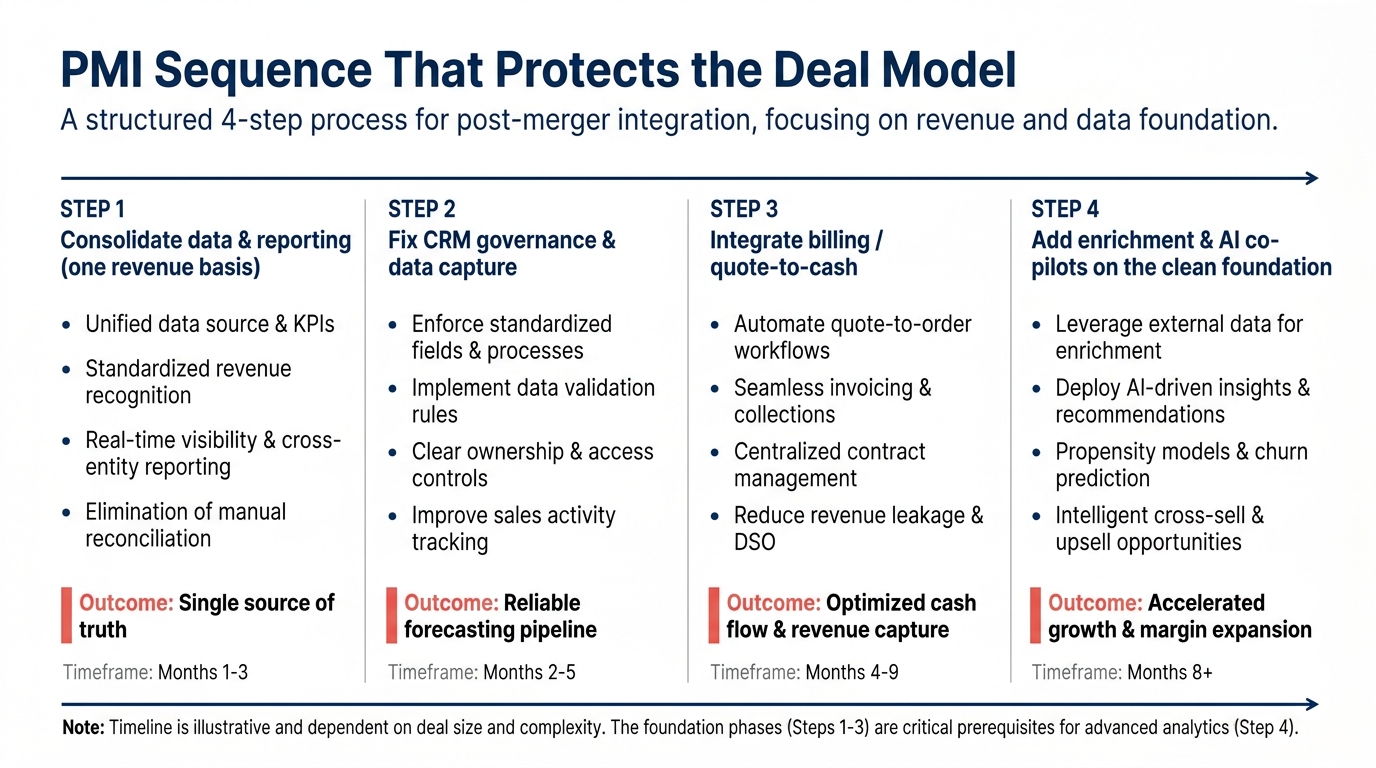
The order matters more than the tooling. Fix the data and reporting foundation first, then CRM governance and consistent capture, and only then the enrichment and co-pilots that let a lean team do more. Buying advanced automation before the two systems reconcile produces dashboards nobody trusts.
If the integration also involves consolidating brands or sites, the sequencing gets more specific, and the calls are laid out in this guide to multi-brand website consolidation for portfolio companies and in the companion piece on website migration for a roll-up.
9. Keep decision rights inside the company
The consultant runs the workstream. The portfolio company keeps the decision rights: which system wins, which fields are mandatory, which accounts get reassigned. When those decisions drift to the vendor, you have bought dependency and the next phase costs the same as the first.
This is the same discipline operating partners apply to marketing spend, where owning the calls matters more than owning the execution, as laid out in marketing for private equity and the spend calls an operating partner has to own.
10. The checklist before you sign
- Named the three or four integration decisions the first 100 days must support, each tied to a real trigger.
- Classified the problem as capacity or capability, and matched the engagement type to it.
- Scoped around two or three workstreams that carry the deal model.
- Read the diligence file so the consultant starts from evidence.
- Confirmed named owners on your side for every workstream, with weekly risk-register updates.
- Asked the firm to walk through a real cutover and named the people who will do the work.
- Benchmarked the price against a weeks-long scoped build.
- Kept system-of-truth and governance decisions inside the company.
If most of those boxes are checked, you probably need scoped execution for two or three workstreams, which is a different and cheaper purchase than a general PMI retainer. If few are checked, the honest first step is a short diligence-style scoping exercise before any larger commitment, a point reinforced in the broader guidance on how to hire post-merger integration for private equity without buying a plan nobody can run. The same framing applies upstream in M&A commercial due diligence and the decisions an operating partner has to own.
11. When this decision is worth paying for outside help
The trigger is usually a platform acquisition or the gap before a key hire lands, where prevention is cheaper than the firefight that follows a missed billing cutover. McKinsey’s private capital research has documented how the value-creation gap between top and bottom quartile owners widens during the integration window. That is the window where a scoped sprint earns its cost. If the first board meeting is weeks away and nobody owns the combined revenue number, that is the trigger to act.
For deal teams standing up a repeatable integration approach across several portfolio companies, the case for scoped help compounds. That is the operating model behind DevriX’s work in private equity.
If you are weeks from Day 1 and need two or three integration workstreams run against a dated plan rather than a full retainer, review the scoped PMI and initiative sprint options built for portfolio companies at the DevriX private equity practice and bring your diligence file to the first scoping call.