An operating partner rarely brings in a GTM strategy consultant because things are going well. The call usually comes when a portfolio company is missing its revenue plan, the pipeline math no longer ties to the model, or an add-on has left the combined business selling into the same accounts with two incompatible motions. The decision in front of the executive is not academic. It is who gets budget and decision rights over the revenue engine for the next two or three quarters, and whether that person can move the number that shows up in the next board pack.
Getting this wrong is expensive. A GTM engagement that produces frameworks instead of booked revenue burns a quarter you cannot get back inside a five-year hold. This guide is for the operator accountable for that revenue system, and it lays out what to decide before hiring a GTM strategy consultant for portfolio companies, and how to judge whether the one in front of you will actually move enterprise value.
1. Name the commercial problem before you scope the engagement
Most bad GTM engagements start with a vague brief: “help us grow faster.” That invites a deck. Instead, force the problem into one of a few concrete shapes, because the shape determines who you need and how you will measure them.
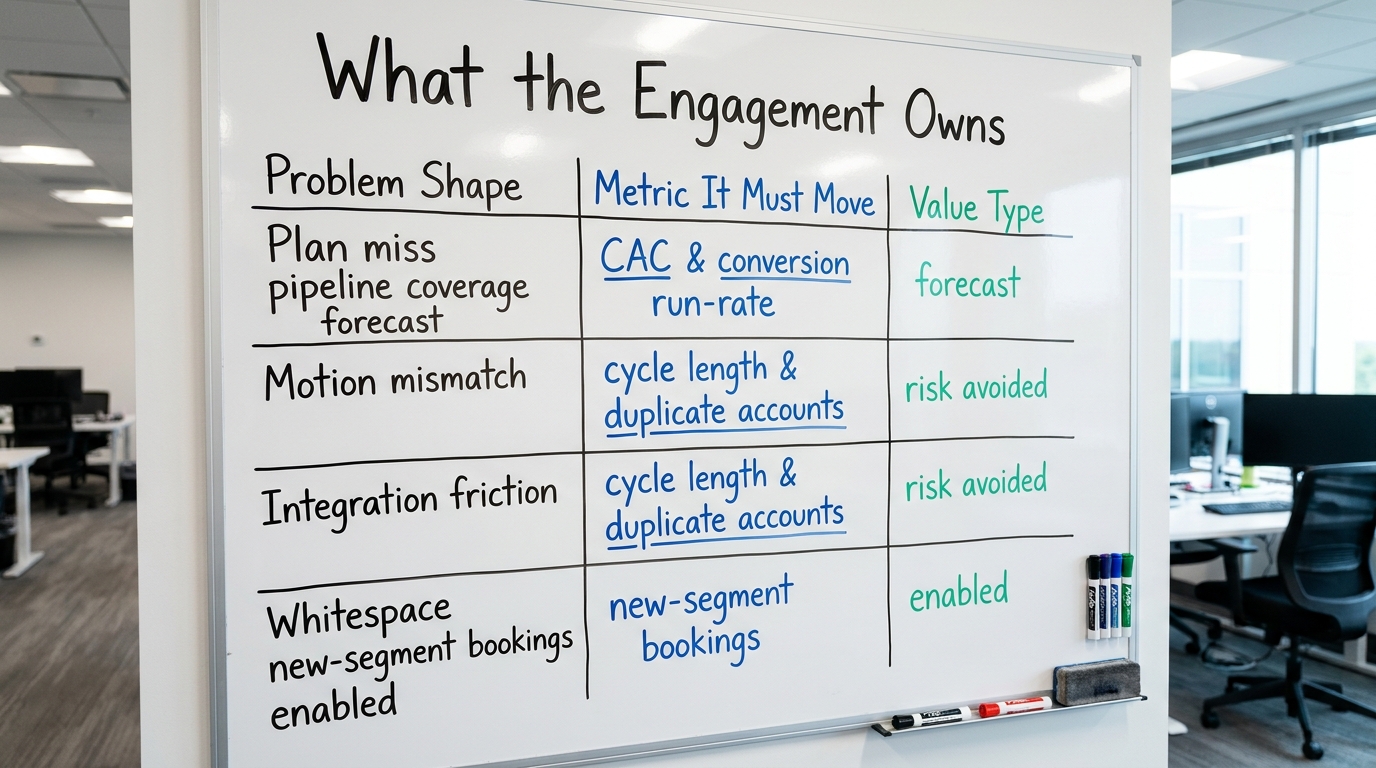
- Plan miss: the forecast is slipping and no one can explain the gap between actual and plan by segment, motion, or rep.
- Motion mismatch: the company is selling the way it did at half its current size, and the cost of acquisition no longer supports the growth thesis.
- Integration friction: two merged sales orgs are colliding on territory, pricing, and CRM. This is a distinct problem, and the post-merger CRM integration roadmap covers the technical half of it.
- Whitespace: the thesis assumed a new segment or channel that the team has not been able to open.
Bain’s annual private equity reporting has documented for years that value creation increasingly rests on commercial and operational improvement rather than multiple expansion or leverage. You can review that argument in the Bain Global Private Equity Report. Naming the problem in these terms is what lets you tell a strategy engagement apart from a booked-revenue engagement.
2. Decide what outcome the engagement owns
There is a real difference between a consultant who owns a plan and one who owns a number. A GTM strategy consultant working inside a portfolio company should be accountable for a movement in pipeline coverage, conversion rate, sales-cycle length, or net revenue retention, not for the delivery of a strategy document.
Before you sign anything, write the sentence: “This engagement succeeds if ______ moves from ______ to ______ by ______.” If the consultant cannot help you fill that in with a baseline and a target, they are selling you deliverables. Classify the value they are promising honestly. A repricing that lands next quarter is forecast value. A rebuilt lead-routing rule that recovers leads already being lost is closer to realized value. Do not let a slide of projected upside get logged as if it were money in the bank.
3. Separate the strategist from the operator you actually need
Portfolio companies rarely fail for lack of a strategy. They fail on execution: the CRM does not reflect the motion, attribution is broken, handoffs leak, and the forecast is built on stage definitions no one respects. A pure strategy consultant hands you a plan and leaves the plumbing to a team that does not exist.
For most mid-market portfolio companies, the person you need is closer to a revenue operations operator who can also set direction, not a strategist who arrives, presents, and disappears. The guidance in what to decide and how to judge RevOps for portfolio companies is worth reading alongside this, because the two roles are frequently conflated in a scope of work and priced as if they were the same thing.
4. Judge the diagnostic, not the pitch
Any competent GTM strategy consultant should insist on a diagnostic before recommending anything. The quality of that diagnostic is the single best predictor of the engagement. Watch for whether they:
- Pull the actual CRM data rather than accepting the management summary.
- Rebuild the funnel from raw records and reconcile it to the reported forecast.
- Segment win rate and cycle length by motion, source, and segment rather than reporting blended averages.
- Name a baseline for every metric they intend to move.
The judging criteria overlap heavily with hiring for RevOps, and the detailed rubric in how to judge a revenue operations consultant for private equity transfers directly. If a consultant proposes a strategy without touching the underlying data, the strategy is a guess dressed up as a plan.
5. Insist the technology reality be part of the scope
GTM strategy that ignores the tooling underneath it is fiction. The routing rules, the CRM schema, the marketing automation, and the reporting layer either support the recommended motion or quietly defeat it. This is why the commercial diagnostic and the technology due diligence view have to sit next to each other. A consultant who cannot read the systems cannot tell you whether the plan is executable or aspirational.
This matters most at the platform level. If the portfolio company runs on WordPress and a marketing stack bolted onto it, the person setting GTM direction needs to understand where that stack constrains data capture and lead flow. The direction WordPress is heading affects what is realistic to build on top of it.
6. Match the engagement to where the deal is in its life
Timing changes what good looks like. The same consultant should behave differently depending on the trigger.
During confirmatory diligence
The job is to validate the growth thesis and flag revenue risk that belongs on the risk register. Speed and honesty beat polish here.
In the first 100 days
The job is to establish a reliable baseline, fix the forecast, and land one or two visible wins that build management credibility. The first 100 days playbook is where a GTM engagement either earns board trust or loses it. McKinsey’s private capital research has repeatedly tied early operating discipline to eventual return outcomes; see their private capital work for the broader argument.
At an add-on or system migration
The job shifts to integration: unifying pipelines, deduplicating accounts, and reconciling two forecasts into one the board can trust.
7. Set decision rights before day one
Ambiguity over authority is where GTM engagements die. Decide in writing who owns the CRM configuration, who signs off on territory and comp changes, and who the consultant reports to. An operating partner who leaves a strategy consultant to “align” the existing sales leadership without a decision right has funded a negotiation, not an execution.
Governance of portfolio-level operating changes is a recurring theme in the Harvard Law School Forum on Corporate Governance, and the same principle applies at the company level: authority has to be explicit and time-bound, or the work stalls on consensus.
8. Price the engagement against the number, not the calendar
A day rate tells you nothing about whether the work moves enterprise value. Anchor the commercial terms to the outcome you defined in section two. That does not require exotic contingent structures. It requires a scope that names the baseline, the target, the owner, and the date, so that at the next board meeting you can say what moved and by how much.
Reporting research from PitchBook and Private Equity International both point to how much commercial diligence and post-close revenue work now drive underwriting expectations. If the plan set that expectation, the engagement should be measured against it.
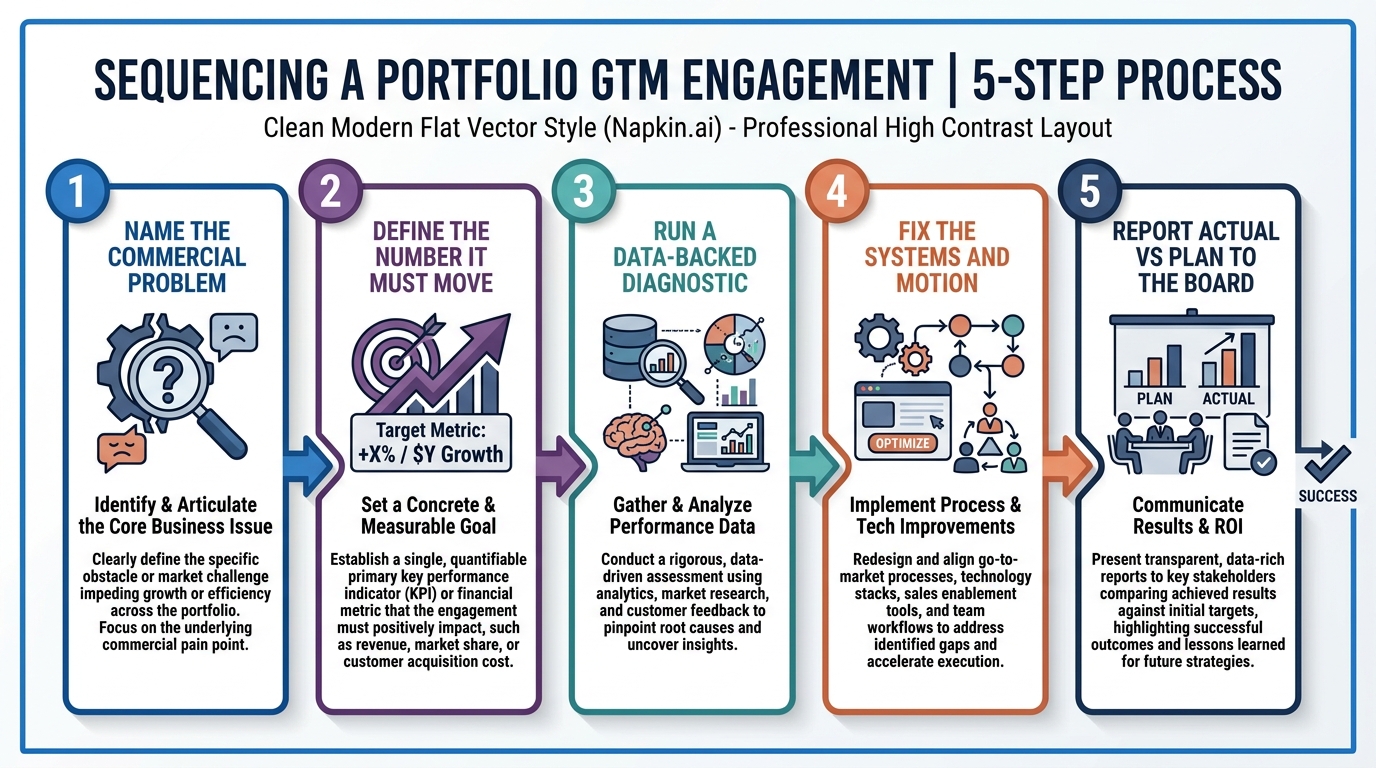
9. Watch for the activity trap
The most common failure mode is a consultant who reports activity as if it were outcome: workshops run, personas built, campaigns launched, traffic up. None of that is revenue. Some of it is worth doing. Refreshing acquisition channels through micro-influencer distribution or an omnichannel content approach can genuinely feed a portfolio company’s funnel. But those are inputs. Demand that every input trace to a metric on the scorecard, and treat any report that leads with volume rather than conversion or booked revenue as a warning.
10. A checklist before you sign
- The commercial problem is named as one shape, not “grow faster.”
- The engagement owns a metric with a baseline, target, and date.
- The diagnostic uses raw CRM data, not the management summary.
- Systems and tooling are inside the scope, not assumed away.
- Decision rights over CRM, territory, and comp are assigned in writing.
- Value is classified as realized, run-rate, forecast, or enabled, and not inflated.
- Reporting leads with actual versus plan, not activity volume.
- The engagement fits the deal trigger: diligence, first 100 days, or add-on.
If the consultant in front of you clears that list, you are buying execution. If they hedge on decision rights or cannot name a baseline, you are buying a document, and a portfolio company under a hold clock cannot afford that.
When you are ready to put a revenue system behind the plan rather than a slide deck, review the RevOps Sprint and retainer built for portfolio companies on the DevriX private equity hub.