When a carve-out closes, the newly independent company often keeps running on the seller’s systems for months. Email, CRM, ERP, analytics, the marketing stack, the data warehouse, the identity provider. The instrument that governs this is the transition services agreement. If the operating partner or portfolio executive treats the carve out digital standup transition services agreement as a legal formality rather than an operating plan, the cost lands later: stranded data, a TSA that overruns its exit dates, and a revenue system that cannot report actuals against plan in the first quarter of ownership.
This guide is for the person accountable for revenue and technology systems in the new company. It covers what to decide before signing, how to price and scope the digital services, how to judge whether the standup is actually happening, and how to exit the TSA on time. The stakes are direct: every month on the seller’s stack is a month of dependency, uncontrolled cost, and blind spots in management reporting.
1. Why the digital portion of the TSA is where carve-outs stall
Finance and HR services inside a TSA are usually clean to price and short to run. Digital is not. The seller’s CRM instance holds the new company’s pipeline mixed with the parent’s. Analytics dashboards pull from a warehouse the buyer does not own. Marketing automation, the CDP, and single sign-on are all wired to the seller’s identity. Bain’s annual private equity report has consistently flagged that value creation now depends on operational execution rather than financial engineering, and in a carve-out the digital standup is that execution. See Bain’s Global Private Equity Report for the broader shift.
The practical consequence: a TSA that is generous on time and vague on separation milestones lets the digital dependency drift. The buyer pays a monthly fee, the seller’s IT team deprioritizes the exit work, and the standup that was supposed to take six months takes fourteen.
2. What the buyer is actually deciding before signing
Three decisions matter more than the fee schedule.
Scope of what stays on the seller’s systems
Every system the new company continues to consume under the TSA is a system it must eventually stand up on its own. The buyer decides which systems it will rebuild fresh, which it will migrate as-is, and which it will retire. That decision drives cost, timeline, and the exit dates written into each service line.
Duration and the right to extend
Short TSAs force discipline but risk a hard cutover before the new stack is ready. Long TSAs reduce that risk but keep the company dependent and paying. The buyer wants clear per-service exit dates, a right to exit early without penalty, and a capped right to extend for defined services only.
Who owns the standup work
The TSA keeps the lights on. It does not build the new company’s systems. A separate workstream, owned by the buyer, does that. Confusing the two is the most common reason a digital standup slips. Grounding that workstream in disciplined technology due diligence before close is what makes the TSA scope defensible.
3. How to scope the digital service lines correctly
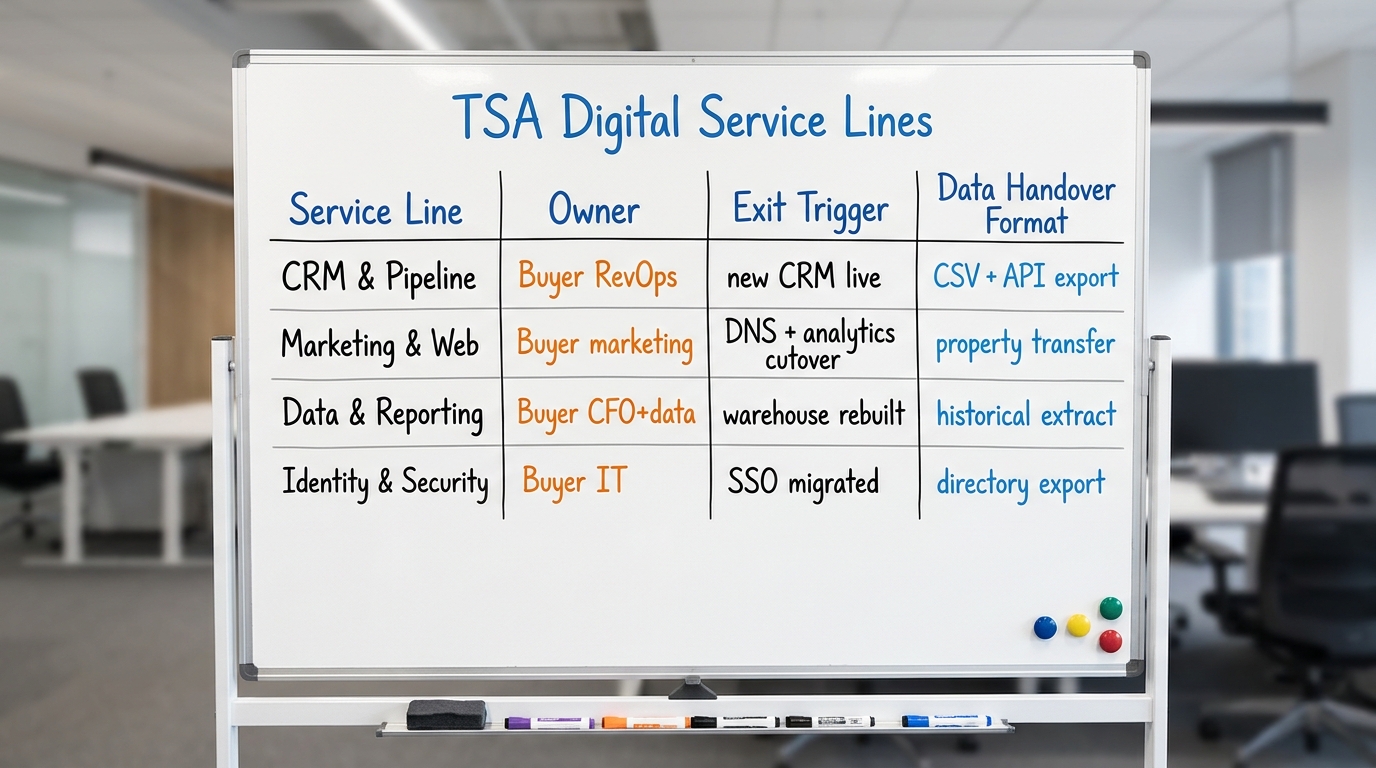
Scope each digital service as a discrete line with its own owner, exit date, and acceptance criteria. Vague bundling (“IT and digital support”) is how buyers lose control. A usable scope names the system, the level of service, the data involved, and the condition under which the buyer exits it.
- CRM and pipeline data: who administers it, who can extract it, and in what format the buyer receives its own records at exit.
- Marketing and web: the domains, analytics properties, marketing automation, and the CMS, plus the cutover plan for each.
- Data and reporting: the warehouse, the pipelines, and the dashboards the new CFO needs to report actuals against plan.
- Identity and security: single sign-on, email, and access, which usually must move first because everything else depends on it.
4. How to price it so incentives point the right way
TSA pricing is meant to cover the seller’s cost of providing the service, not to generate profit and not to subsidize the buyer. Two structures cause trouble. A flat monthly fee with no step-down gives the seller no reason to help the buyer exit early. A fee that is too low gives the seller’s IT team no reason to prioritize the work at all.
The buyer wants a fee that steps down as service lines are retired, so cost falls as the standup progresses, plus an escalation clause that raises the fee if the buyer extends past the agreed exit date. That single mechanism turns the seller from a passive provider into a partner who wants the buyer off the stack. McKinsey’s private capital research, available through McKinsey, has repeatedly tied carve-out value to disciplined separation execution rather than to the deal price alone.
5. The data handover clause most buyers underwrite too late
The single clause that protects enterprise value is the one governing data extraction. The new company’s customer records, pipeline history, financial transactions, and analytics history often sit inside the seller’s systems. If the TSA does not specify the format, the completeness, and the deadline for handing that data back, the buyer risks starting its independent life with a partial history.
Specify what data the buyer receives, in what machine-readable format, with what completeness guarantee, and by what date relative to each service exit. Tie the seller’s final TSA payment to acceptance of the data handover, not to the calendar. Harvard Law School’s Forum on Corporate Governance publishes useful analysis of carve-out and separation risk allocation at its M&A coverage.
6. How the standup workstream runs alongside the TSA
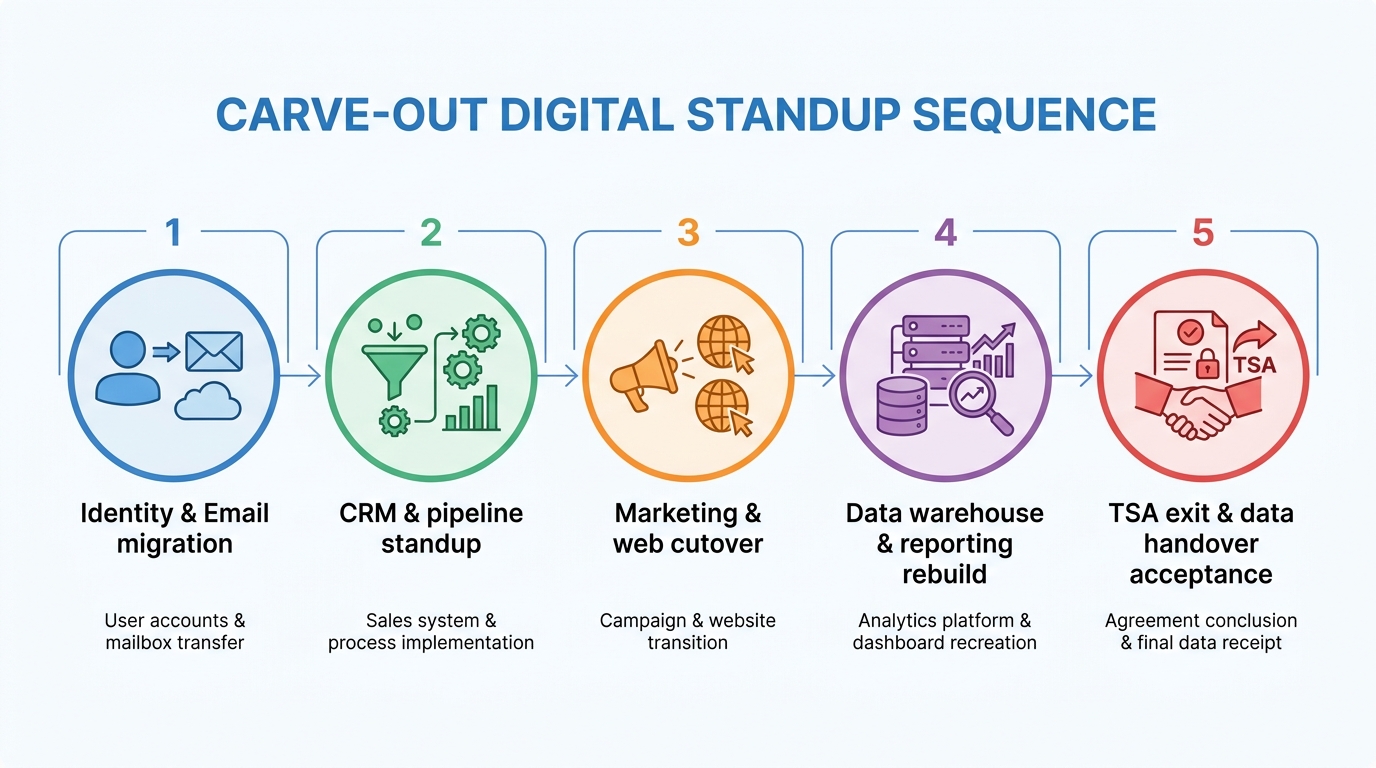
The TSA buys time. The standup uses it. The two run in parallel and the buyer owns the second one. The first 100 days set the pace, and the practices in a disciplined first 100 days plan apply directly: name owners, set a baseline, sequence dependencies, and track actual against plan.
Sequence matters. Identity and email usually come first because CRM, marketing, and analytics all authenticate against them. The revenue system, where standardization decisions live, comes next. Operators making those CRM calls should read this RevOps decision guide on CRM standardization before committing to a target architecture, and where the carve-out involves merging systems, the technical roadmap for unifying conflicting CRM architectures is directly relevant.
7. How to judge whether the standup is on track
The operating partner should not judge progress by hours billed or tickets closed. Those are activity, not outcome. Judge it by service lines actually retired, exit dates hit, and the new CFO’s ability to report reliable actuals from systems the company owns.
- Service lines exited to date versus the number planned by this point.
- Reporting independence: can management produce its numbers without the seller’s dashboards.
- Data handover completeness: what percentage of the company’s own history is now in its own systems.
- Cost trajectory: is the monthly TSA fee stepping down on schedule.
PitchBook’s research and data, at PitchBook, is a useful external reference point for how long separations typically run in comparable deals, which helps the buyer sanity-check its own timeline.
8. Judging the partner who runs the standup
Most portfolio companies do not have the internal bandwidth to run a digital standup and their day-to-day operations at once. When bringing in outside help, judge the partner the same way an operator judges any revenue systems vendor: on outcomes, owners, and exit criteria, not on activity. The framework in this guide on how to judge a revenue operations consultant for private equity applies directly, and the broader RevOps decision guide for portfolio companies covers what good looks like across the value creation window.
A capable partner commits to the exit dates in the TSA, owns the data handover acceptance, and hands the company a system it can run without them.
9. The most common failure modes
- TSA scope bundled instead of itemized, so no single service can be judged or exited independently.
- No step-down pricing, so the seller has no incentive to help the buyer leave.
- Data handover treated as a legal afterthought, discovered only near the exit date.
- Standup confused with the TSA, so nobody owns the build and the dependency drifts.
- Progress measured by activity, so slippage is invisible until an exit date is missed.
10. The pre-signing and execution checklist
Before signing the carve out digital standup transition services agreement, confirm the following:
- Every digital service is itemized with an owner, exit date, and acceptance criteria.
- Pricing steps down as service lines retire and escalates if the buyer overruns.
- The data handover clause specifies format, completeness, and deadline, and gates final payment.
- The buyer has an early-exit right without penalty and a capped, defined right to extend.
- A separate, buyer-owned standup workstream exists with a sequenced plan and named owners.
- Progress is tracked by service lines exited and reporting independence, not by activity.
Getting the same rigor into the surrounding go-to-market work matters too, and the guide on GTM value creation for portfolio companies covers how the revenue engine should look once the standup completes.
11. Where this fits in the value creation plan
A carve-out that exits its TSA on time, with its data in its own systems and its management able to report clean actuals, is a company positioned to grow rather than one still tethered to its former parent. That independence is what makes the rest of the private equity value creation plan executable, from revenue systems to reporting to eventual exit.
If the digital standup is the workstream that most affects the new company’s ability to operate and report independently, route it to a partner who builds portfolio revenue and technology systems for exactly this situation. See how the DevriX and GrowthShuttle private equity practice runs carve-out digital standups and structures them to exit the TSA on time.