By the time a SaaS target reaches confirmatory diligence, the operating partner already believes the revenue story. The question is whether the technology underneath it can carry the thesis without a surprise capital call in year two. Technical due diligence for a SaaS acquisition exists to answer one commercial question: does the code, architecture, team and data support the price you are about to pay, or does it hide a liability that will show up as slipped integration timelines, churn, or a rebuild the model never funded?
This guide is for the buyer with budget and a signed or imminent LOI, not for someone learning the field. It lays out what to commission, in what sequence, and how to judge the output so a technical finding turns into a price adjustment, a closing condition, or a first-hundred-days workstream. The consequence of skipping it is well documented across the deal literature: Bain’s annual private equity work has repeatedly tracked value creation shifting from financial engineering to operational improvement, which means the operating reality of the asset now drives returns more than the entry multiple did a decade ago. Read Bain’s coverage at the Bain & Company Global Private Equity Report.
1. Decide what the diligence has to prove before you scope it
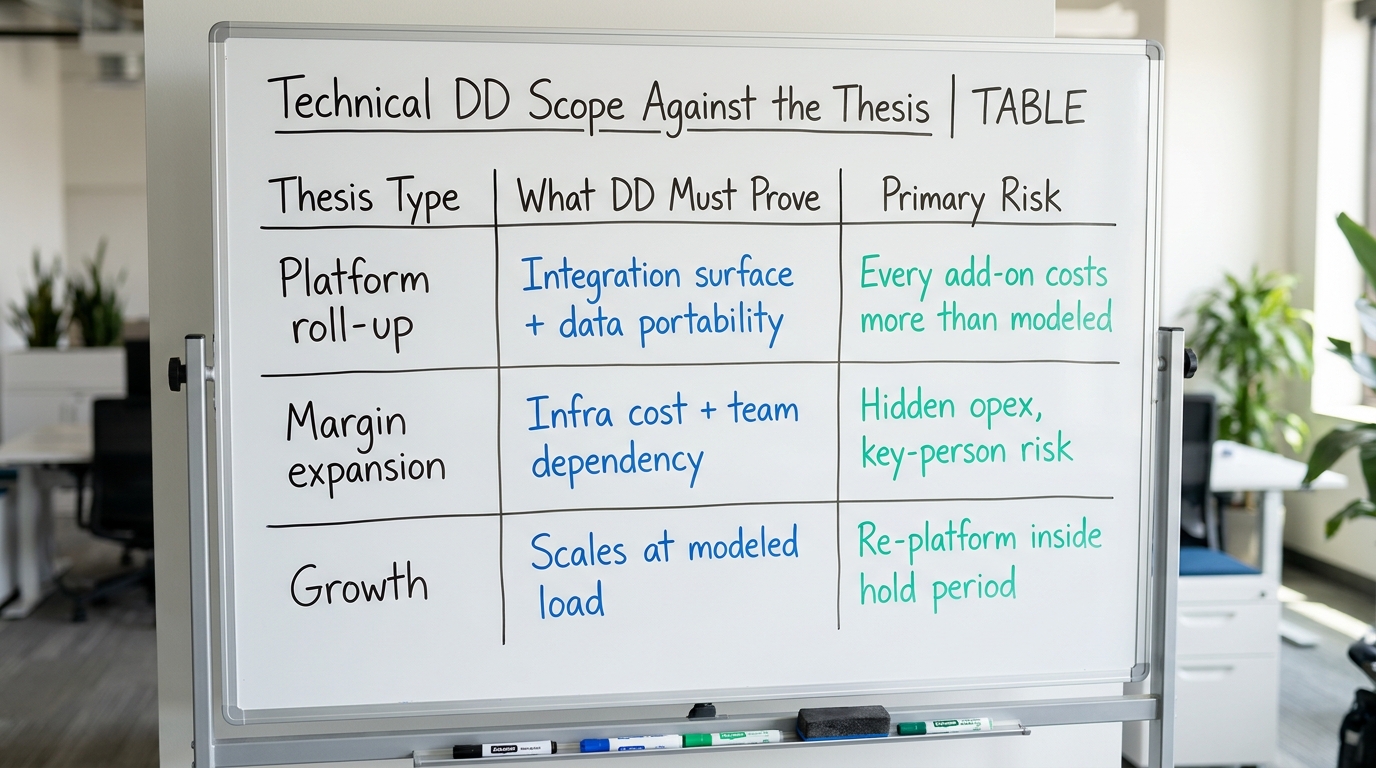
Technical due diligence is not a generic audit. It is scoped against the investment thesis. A platform play that intends to bolt on three acquisitions needs a hard read on integration surface area and data model portability. A margin-expansion thesis needs a read on infrastructure cost, licensing waste and team dependency. A growth thesis needs to know whether the architecture scales at the sales trajectory in the model, or whether the next 3x in load triggers a re-platform.
Write the thesis at the top of the diligence brief and force every finding to map back to it. If a finding does not change price, a closing condition, or a post-close plan, it is noise. The point of the exercise is decision support, not a catalog of technical debt.
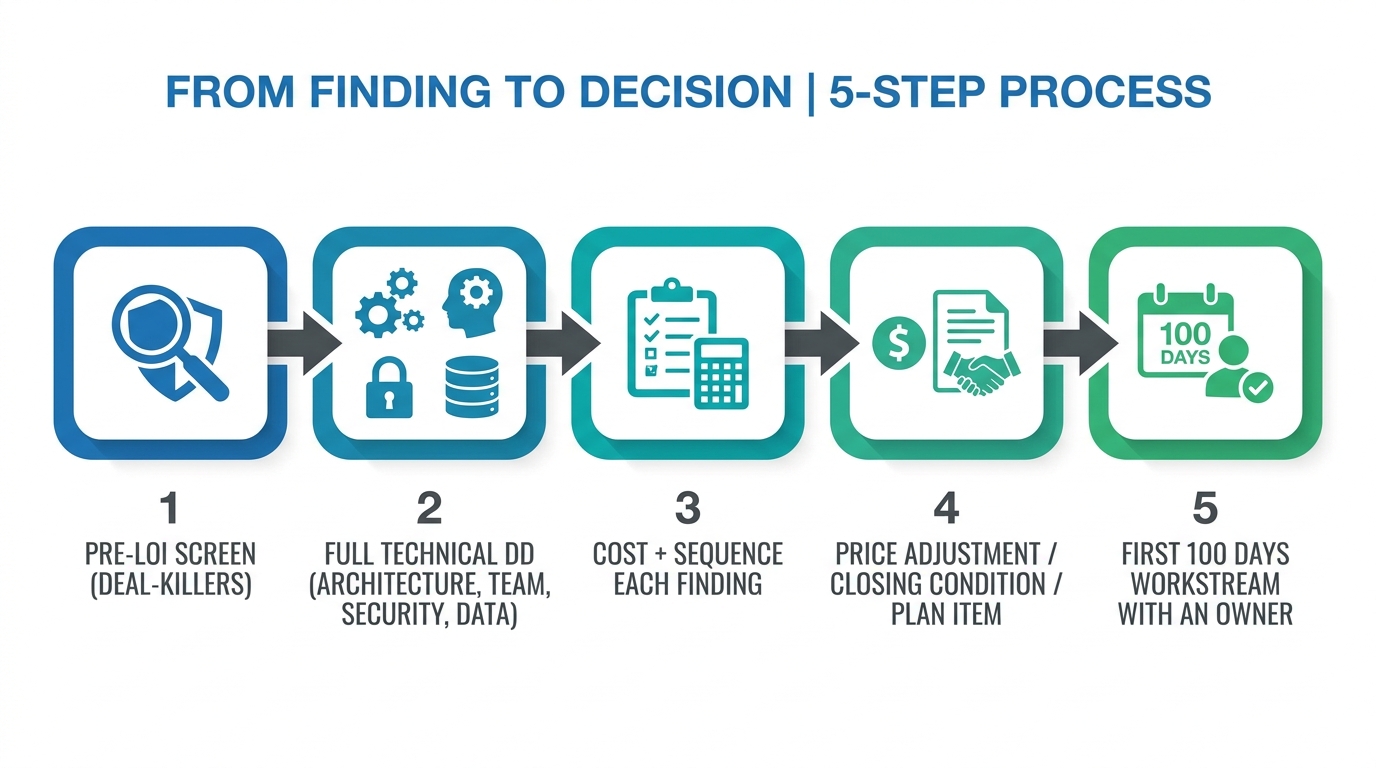
2. Sequence a light pre-LOI screen before the full engagement
Not every target deserves a full technical workup on day one. A short pre-LOI screen, typically a few days of expert review, tells you whether the deal is worth confirmatory spend at all. It surfaces the deal-killers early: a single-founder codebase with no documentation, a data architecture that cannot support the roll-up, a security posture that would fail a customer’s vendor review, or a hosting bill growing faster than revenue.
A pre-LOI screen is cheap insurance against burning weeks of legal and financial diligence on an asset the technology cannot support. If the screen is clean, you widen scope with confidence. If it is not, you renegotiate or walk before the sunk cost gets loud.
3. Read the architecture against the growth and integration plan
Architecture review is where the thesis meets the codebase. The operating question is not “is this good engineering,” it is “does this architecture support what we are about to ask of it.” Three lenses matter.
Scalability against the model
Map the current load, the modeled load at exit, and the point at which the architecture needs meaningful rework. If the re-platform lands inside your hold period, it belongs in the model as capital and as risk, not as a footnote.
Integration surface for add-ons
For a platform thesis, the target’s data model and API design determine how expensive every future bolt-on will be. This connects directly to the technology due diligence workstream and, later, to integration execution. The teams that get this right treat it as one continuous thread from diligence into the standup.
Single points of failure
Identify the components, vendors and individuals the whole product depends on. A brilliant system that runs on one engineer’s undocumented knowledge is a liability priced as an asset.
4. Judge the engineering team as a retention and continuity risk
In SaaS, the team is part of the asset. Diligence should establish who actually built and maintains the system, how concentrated that knowledge is, and how likely the key people are to stay through and past close. Key-person risk in a lean engineering org is a real closing consideration, sometimes handled through retention packages, sometimes through an escrow tied to continuity.
Assess delivery cadence too. A team shipping predictably against a roadmap is a different risk profile than one firefighting production every week. The second one will not deliver the integration work in your first-hundred-days plan on schedule, which cascades into every downstream revenue commitment.
5. Price the technical debt instead of just noting it
Every codebase has debt. The mistake buyers make is treating debt as a binary pass or fail. The operator’s job is to convert it into a number and a timeline. Which debt blocks the thesis and must be paid before the growth plan runs? Which debt is cosmetic and can wait past exit? Which debt is actively accruing risk, such as unpatched dependencies or an end-of-life framework?
The output you want is a remediation register with each item costed and sequenced, so remediation either lands in the model, becomes a price adjustment, or gets structured into the plan. McKinsey’s private capital research has consistently framed post-close value creation as an execution discipline rather than a spreadsheet exercise, and technical debt is one of the clearest places that plays out. See McKinsey private capital research.
6. Treat security and compliance as a revenue gate, not a checkbox
For a SaaS business selling into mid-market and enterprise, security posture is a revenue enabler. A missing SOC 2, a weak access model, or unresolved findings in a penetration test will show up as lost deals and stalled enterprise expansion, the exact revenue the growth thesis depends on. Diligence should establish current certifications, the gap to the certifications the sales motion needs, and the cost and timeline to close that gap.
Data handling and privacy exposure belong here as well. The corporate governance and disclosure literature covers the board-level weight of these obligations well; the Harvard Law School Forum on Corporate Governance is a reliable reference for how these risks are framed at the fiduciary level. This is a commercial and operating read, not legal advice, so pair the technical finding with your counsel.
7. Interrogate the data before you trust the metrics
The revenue story rests on data the target produced. Technical diligence should verify that the systems generating the metrics are trustworthy. Can churn, usage and cohort figures be reconstructed from source systems, or do they live in a founder’s spreadsheet? Is the data model clean enough to migrate into a portfolio-standard stack, or will consolidation cost more than budgeted?
This links directly to how revenue systems get standardized after close. If the target’s data foundation is weak, the work described in how to judge a revenue operations consultant for private equity starts on a longer runway, and the RevOps roadmap in this RevOps decision guide for portfolio companies takes longer to deliver reporting the board will trust.
8. Map the vendor and licensing stack for hidden cost
SaaS companies run on other SaaS companies. Diligence should produce a full inventory of third-party services, their contract terms, renewal timing, and any usage-based pricing that scales with growth. A cloud bill or a data-vendor contract that grows faster than revenue is a margin problem the model may not reflect. Open-source licensing exposure belongs in this review too, since certain licenses create obligations that matter in a resale.
9. Connect findings to the first hundred days, not a filed report
A technical diligence report that sits in a data room after close has failed. The findings should flow directly into the post-close plan. Remediation items become workstreams with owners. Key-person risks become retention actions. Integration surface findings become the sequencing for add-ons. This is the handoff into the first 100 days, and the deals that execute well treat diligence and the standup as one continuous motion.
For carve-outs, this handoff is sharper still, because the technology has to be separated and stood up on its own. The mechanics of that are covered in the carve-out digital standup and transition services agreement, and the broader integration sequencing in this guide to post-merger integration consulting.
10. How to judge the diligence output itself
The report is only useful if it supports decisions. Judge it against a short standard:
- Every finding maps to the thesis. No thesis link, no reason to read it.
- Risks are costed and sequenced, not just listed as concerns.
- Findings are classified as deal-killer, price adjustment, closing condition, or post-close workstream.
- There is a named owner path from each finding into the first-hundred-days plan.
- The provider knows SaaS operations, not just code review, so recommendations survive contact with the revenue plan.
A provider who can only tell you the code is “mostly fine” has not done the job. You are paying for decisions you can act on at close.
11. The buyer’s checklist before you sign the engagement
- Thesis written at the top of the diligence brief, with every finding required to map back to it.
- Pre-LOI screen commissioned first if the deal is early or the technology is unknown.
- Architecture read against modeled load, integration surface, and single points of failure.
- Engineering team assessed for key-person risk and delivery cadence.
- Technical debt costed, sequenced, and classified against the thesis.
- Security and compliance measured against the certifications the sales motion needs.
- Data integrity verified so the revenue metrics are trustworthy and migratable.
- Vendor, cloud and licensing costs inventoried for growth-scaling exposure.
- A named handoff from findings into the post-close plan.
Run this against any target and the diligence stops being a formality and starts protecting the price. For how technical diligence connects to the wider value-creation work in a portfolio, the private equity operating hub sets out how these workstreams fit together, and PitchBook’s deal and operations data at PitchBook research is a useful external benchmark for how buyers are pricing operational risk in the current market.
12. Where this fits in the deal calendar
Commission the pre-LOI screen when a target looks serious but unproven. Run full technical due diligence for the SaaS acquisition during confirmatory diligence, tightly coordinated with financial and legal workstreams so findings can still move price. Hand the output to the integration lead before Day 1 so remediation and standardization start on schedule, not after the first board meeting asks why the numbers are late.
If a technical read on a live SaaS target needs to turn into a costed, decision-ready diligence output, route the engagement through the DevriX and GrowthShuttle private equity offer and scope it against your thesis and deal timeline.