An operating partner inherits a portfolio company where the deal thesis assumed a working revenue engine and confirmatory diligence found something closer to a spreadsheet held together by two people who know where the data lives. The commercial consequence is direct: the first board meeting will ask for actual versus plan on pipeline and retention, and the systems cannot produce it. Choosing a digital transformation partner for portfolio companies is the decision that either closes that gap inside the hold period or lets it compound into a missed forecast. This guide is for the person accountable for that decision, not for someone learning what the terms mean.
1. Name the problem before you shop for a partner
The mistake is buying capability before defining the outcome. A portfolio company rarely needs “transformation” in the abstract. It needs a specific commercial result: a forecast the CFO can defend, a sales-to-marketing handoff that stops leaking, a data model that lets the board see cohort retention without a manual pull.
Start by writing the one or two enterprise-value outcomes the work has to move. Bain’s annual private equity report has tracked for years how value creation has shifted from multiple expansion and leverage toward operational improvement, which puts more weight on execution inside the hold. If you cannot name the EBITDA or cash-flow line the project touches, you are not ready to brief a partner.
2. Decide what “partner” actually means for this asset
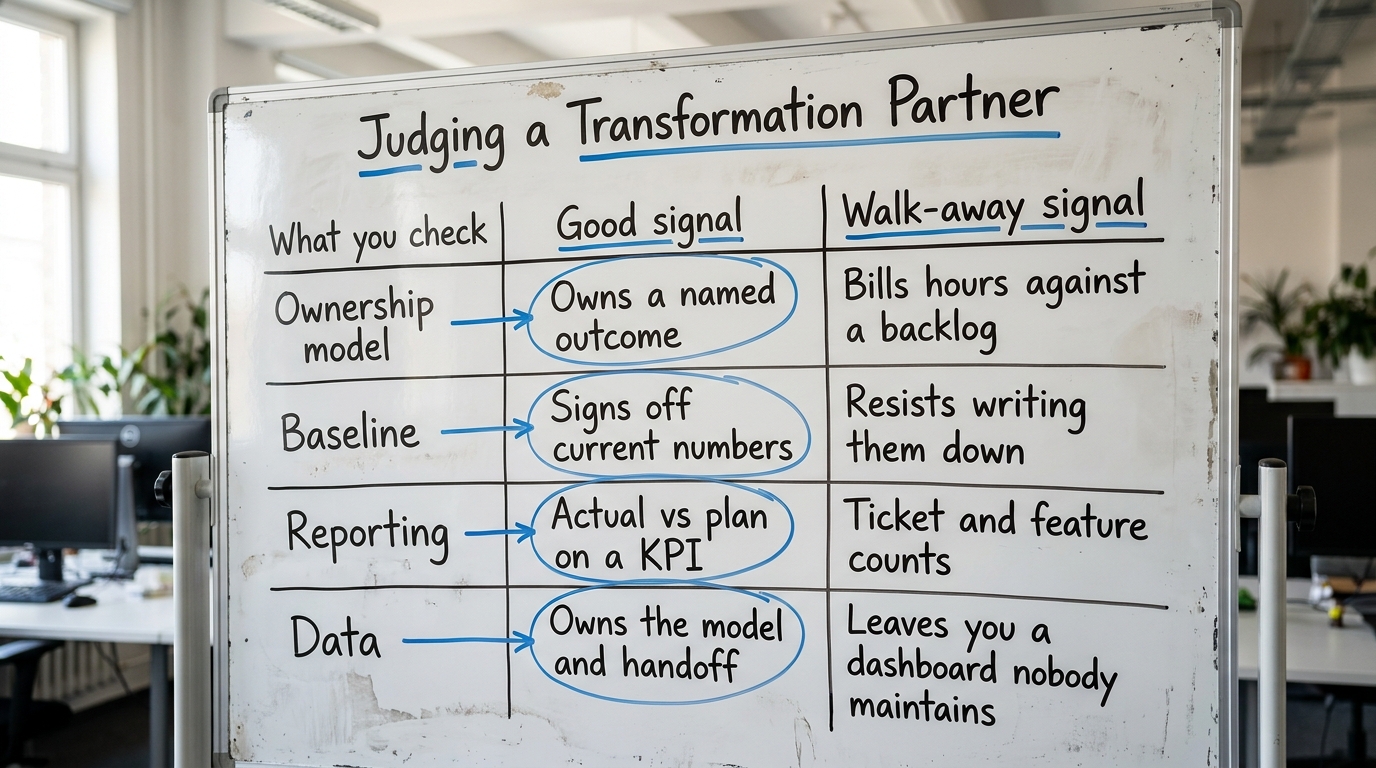
There are three distinct things buyers call a transformation partner, and they are not interchangeable. One is a strategy shop that produces a roadmap and leaves. One is a staffing arrangement that supplies engineers against your backlog. The third is an embedded team that owns delivery against a named outcome and reports the commercial result in the KPIs the board tracks.
For most mid-market portfolio companies the third model is the fit, because the internal team is too thin to absorb a roadmap and too busy to manage contractors. The decision you are making is who owns the outcome, and whether that ownership survives the first missed sprint.
3. Anchor the scope to the value-creation plan, not a wish list
The value-creation plan already names the levers: cross-sell, pricing, retention, new logo acquisition, cost-to-serve. A credible partner maps every workstream back to one of those levers and drops the rest. Work that does not trace to a plan lever is discretionary spend during a hold period, and it competes with debt service.
This is where a fractional RevOps arrangement often earns its place ahead of a full rebuild. If the constraint is pipeline visibility and lead routing, you may not need a platform migration at all. Diagnose the constraint before you scope the fix.
4. Establish the baseline the partner will be measured against
No baseline, no accountability. Before any build starts, the partner and your team should agree on the current numbers for the metrics the work is meant to move: conversion by stage, MQL-to-SQL rate, CAC payback, churn by cohort, forecast accuracy over the last four quarters. McKinsey’s private capital research repeatedly returns to the point that improvement claims are only credible against a measured starting position.
Insist that the baseline is documented and signed off. A partner who resists writing down the starting numbers is protecting themselves against being measured, which tells you how the engagement will end.
5. Judge the diligence-grade thinking, even post-close
A transformation partner worth retaining thinks like a diligence advisor about your own stack. They will ask where the data actually lives, which systems are load-bearing, and what breaks on a migration before they propose one. If you are pre-close or in an add-on, the same discipline belongs in technology due diligence, and the partner’s read should match what a diligence report already flagged.
If you have that report, hold the partner’s plan against it. The guidance on reading a technical due diligence report before you sign off applies here too: the risks named in diligence should show up as line items in the transformation plan, or the partner has not read the file.
6. Test whether they can operate inside the first 100 days
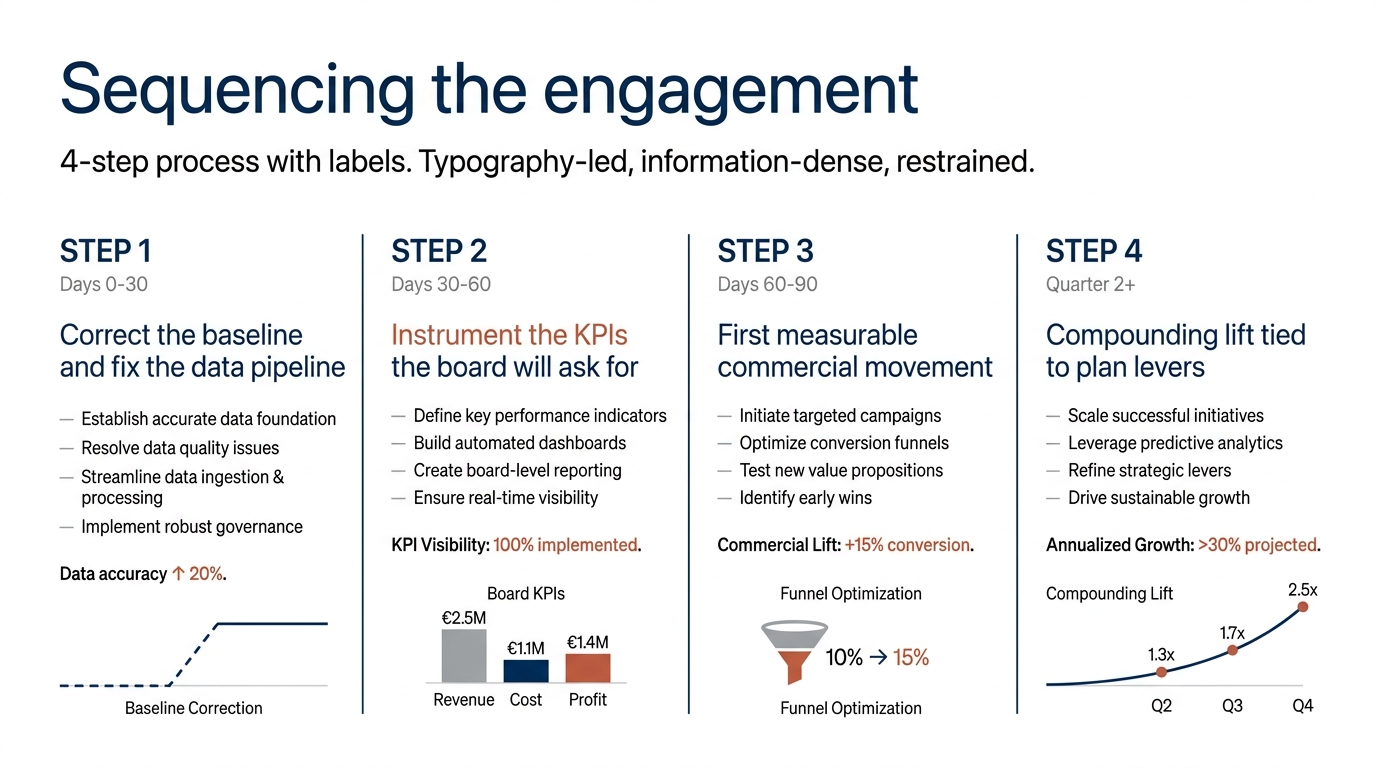
The first 100 days set the tone for the board’s confidence in the plan. A partner who needs a full quarter to “discover” before delivering anything is a poor fit for an asset on a five-year clock. Ask for the specific deliverables they commit to inside the first 30, 60 and 90 days, and whether any of those deliverables is a measurable movement on a KPI rather than a document.
The honest answer at 30 days is usually a corrected baseline and a fixed data pipeline, with the first commercial movement showing up around day 60 to 90. Be suspicious of a partner who promises revenue lift in week two, and equally of one who promises nothing measurable for six months.
7. Separate the platform decision from the operating decision
Buyers conflate the tooling question with the ownership question. Whether the portfolio company runs on Salesforce, HubSpot or something inherited, the platform is a smaller decision than who runs the process on top of it. A Salesforce RevOps engagement can be excellent or wasted depending entirely on whether someone owns adoption and data hygiene after go-live.
Decide the operating model first. If the partner’s answer to every problem is a new platform, they are selling capability rather than accountability for the outcome.
8. Check that the demand work matches the thesis
If the growth thesis is enterprise expansion, the demand engine has to target the accounts the thesis names. That is why an ABM program is a commitment to a named account list that either matches the deal thesis or does not. A transformation partner should be able to show how the top-of-funnel work maps to the segments the value-creation plan is built on.
The same test applies to conversion. Fixing conversion rate for portfolio companies is worth little if the traffic is the wrong traffic. Make the partner connect the funnel to the thesis, not to a generic best-practice checklist.
9. Price it against the value at stake, not the day rate
Embedded transformation work in the mid-market typically runs as a monthly retainer rather than a fixed project, because the scope evolves as the baseline gets corrected. The relevant question is not the rate but the ratio: what enterprise-value movement does the spend underwrite, and over what period. PitchBook’s research and data on hold periods and value creation is a useful frame for setting that ratio against the deal’s own timeline.
A partner who cannot articulate the value at stake in your terms is pricing their time. A partner who can is pricing your outcome, and that is the one you want negotiating scope with you.
10. Confirm the exit condition before you sign
The best embedded engagements are designed to hand back a working system, not to become a permanent dependency. Ask what “done” looks like and what the internal team owns when the partner steps back. If the answer is a dashboard nobody on staff can maintain, the transformation did not transfer. Harvard Business Review’s work on mergers and acquisitions is consistent on the point that integration and capability transfer, not the initial build, determine whether the value holds.
11. A checklist for the decision
- The one or two enterprise-value outcomes the work must move are written down.
- The partner owns a named outcome and reports actual versus plan with the baseline documented and the KPIs defined.
- The baseline numbers are documented and signed off before any build starts.
- Every workstream traces to a value-creation-plan lever.
- The risks named in diligence appear as line items in the transformation plan.
- There are measurable deliverables committed inside the first 30, 60 and 90 days.
- The operating model is decided before the platform, not after.
- Demand and conversion work maps to the thesis’s named segments.
- Pricing is framed against value at stake and the hold period, not a day rate.
- There is a defined exit condition and a capability handback to the internal team.
For pre-close and add-on work, pair this with the wider view on private equity value creation and, where the target is software, the specifics of technical due diligence for a SaaS acquisition. The transformation partner you choose after close should be reading from the same file.
12. The next step
If you are scoping this for a specific asset, start with a diagnostic that produces the baseline and the workstream map before you commit to a build. Review the DevriX embedded value-creation offer and diagnostic at the DevriX private equity practice and bring your value-creation plan to the first conversation, so the scope maps to your levers rather than a generic template.