An operating partner sponsoring a digital workstream in a portfolio company is spending real budget against a hold-period thesis, and the board will ask what moved. Digital value creation consulting private equity engagements fail most often not because the work is bad, but because nobody defined the enterprise-value line the work was supposed to move before the first invoice went out. This guide is for the person who owns that number: the operating partner, the portfolio company CEO, or the CFO running the forecast that now has a digital line item in it.
The commercial question is which decisions belong to the owner, which belong to the vendor, and how the owner judges the engagement against plan before month twelve, when the story is harder to change.
1. Start with the value-creation line the work has to move
Before you scope any digital engagement, name the enterprise-value driver it serves. Revenue growth from a specific channel, gross margin recovery through pricing and retention, faster integration of an add-on’s revenue systems, or reduced operating risk that a lender or a future buyer will price. If the engagement cannot be tied to one of those, it belongs in the marketing budget.
Bain’s annual private equity report has tracked for several years how much of sponsor returns now depends on operational improvement rather than multiple expansion or leverage, which is exactly why digital work moved from a nice-to-have into the value-creation plan (see the Bain & Company Global Private Equity Report). The consequence for you is that a digital consultant is now underwriting part of the thesis, and should be held to that standard.
2. Separate digital value creation from agency work
An agency sells activity: campaigns, pages, content volume, engineering hours. A value-creation engagement sells a change in a financial metric and accepts a baseline against which it is measured. The two look similar in a proposal and behave very differently by the third board meeting.
The practical test is whether the consultant will commit to a baseline. Ask what the current conversion rate, pipeline coverage, or content-to-revenue attribution is today, and what it should be by a stated date. A partner who leads with deliverables and cannot state a baseline is quoting activity, and you will be the one explaining the gap to the deal team later.
3. Decide which decisions stay with the owner
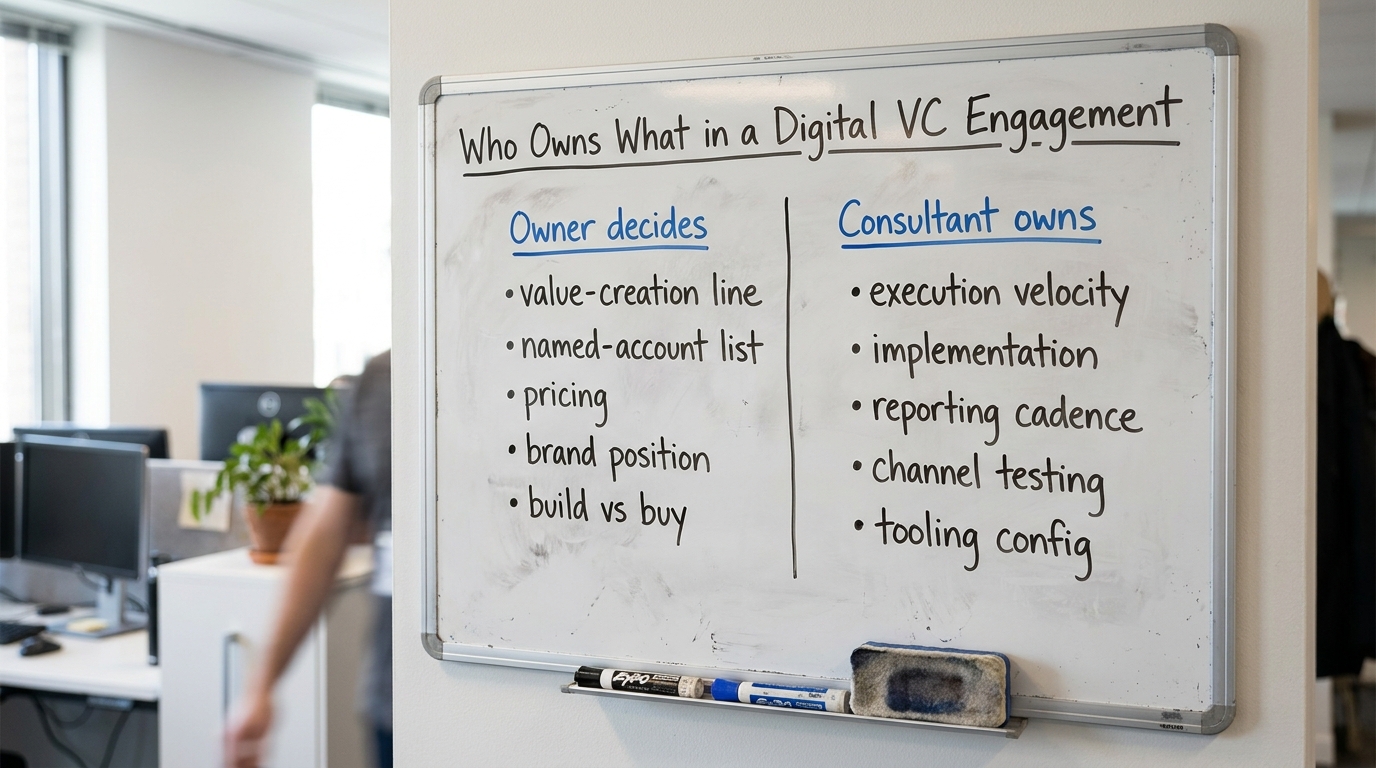
Some decisions cannot be delegated to a vendor because they encode the thesis. The named-account list in an account-based program either matches the deal thesis or it does not, and that is an owner decision, as the argument in this piece on ABM and the deal thesis lays out. The same holds for pricing changes, brand repositioning, and any build-versus-buy call on core systems.
The consultant should own execution velocity, technical implementation, and the operating cadence. The owner keeps the decisions that change what the company is worth. Getting this boundary wrong is how a portfolio company ends up with a beautiful demand engine pointed at the wrong customers.
4. Understand the timing triggers that make this urgent
Digital value creation is cheapest to get right at a few specific moments. During confirmatory technology due diligence, when you can still price a broken revenue stack into the deal rather than inheriting it. In the first 100 days, when a data baseline is achievable before the organization reorganizes around it. And ahead of each add-on, when the acquired company’s revenue systems have to fold into the platform without breaking reporting.
If the engagement starts at month nine because the forecast slipped, the consultant is doing rescue work, and rescue work is more expensive and slower to show in the numbers.
5. Judge the diagnostic before you judge the plan
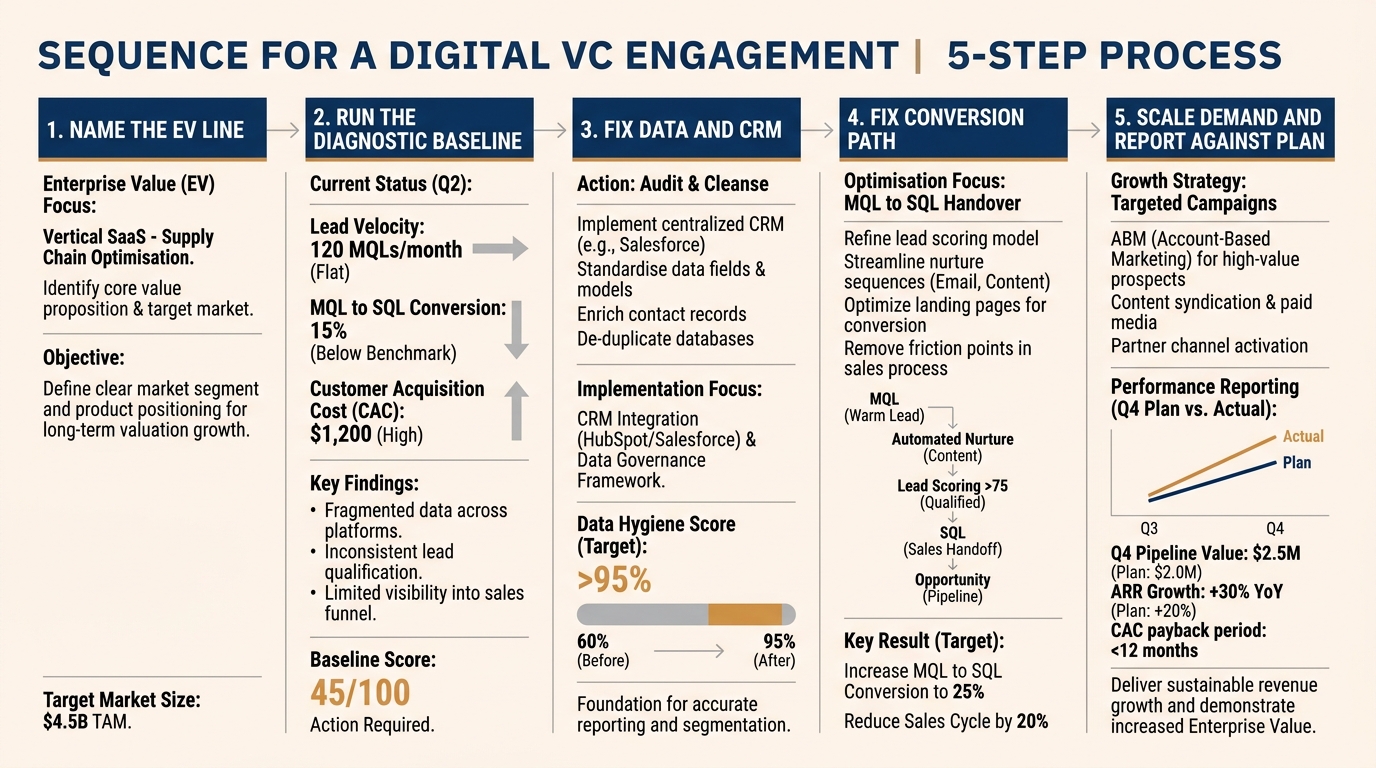
A credible engagement opens with a diagnostic that produces a baseline you did not have: search visibility by commercial intent, conversion by funnel stage, data completeness in the CRM, attribution good enough to trust a pipeline number. If the first deliverable is a strategy deck rather than a measured baseline, you are buying opinion.
The discipline here is the same one that separates a real technical assessment from a checklist, described well in how to read a technical due diligence report before you sign off. Evidence first, then the plan the evidence supports.
6. Match the operating model to the portfolio company’s capacity
Most portfolio companies in the lower-middle market do not have a full internal RevOps function, which shapes the engagement. An embedded model puts operators inside the company’s systems and cadence rather than delivering from the outside, and that distinction matters when the company cannot staff the follow-through itself.
The trade-offs between an embedded team and an internal hire are covered in fractional RevOps for private equity and what the operating partner actually buys. The short version for a budget owner is that embedded capacity buys speed and adoption without a permanent headcount decision you may not want to make pre-exit.
7. Scope the platform work before the demand work
Demand generation aimed at a broken conversion path wastes budget in a way the board sees quickly. The order of operations usually runs: fix the data and CRM, fix the conversion path, then turn up demand. The middle step is often underestimated, and the argument in conversion rate optimization for portfolio companies explains why the owner has to decide the sequence rather than let the vendor default to whatever it sells best.
Where the revenue system runs on a platform like Salesforce, the configuration decisions carry integration risk into every future add-on, which is the case made in Salesforce RevOps for PE portfolio companies.
8. Decide build versus buy on anything custom
When a consultant proposes custom software, a portal, an internal tool, or a bespoke integration, the owner is now making a technical debt decision that outlives the engagement. The build decisions an operating partner actually owns are set out in custom software development for portfolio companies, and the default should be to buy unless the build is genuinely tied to the thesis.
McKinsey’s private capital research has consistently pointed to operational discipline as the durable source of returns as multiple expansion becomes harder to rely on (see McKinsey private capital research). A custom build that nobody can maintain post-exit is the opposite of operational discipline.
9. Set the reporting the board will actually read
Reporting activity, impressions, tickets, features, traffic, trains the board to distrust the workstream. Report against the value-creation line instead, and classify each claim honestly: realized in the period, run-rate exiting the period, forecast, or enabled but not yet converted. A consultant who reports a forecast number as if it were realized is creating a problem for whoever presents the exit.
PitchBook and S&P Global publish the market data that boards use to sanity-check whether a portfolio company’s growth is real or just tracking the market (see PitchBook research and data and S&P Global Market Intelligence). Hold your own reporting to that same skepticism.
10. Price the engagement against the value at stake
An embedded digital value-creation retainer at the $15,000 to $50,000-plus per month range is priced to sit inside a value-creation plan, not a marketing budget. The way to judge it is against the enterprise-value swing it underwrites, not against an hourly rate. A retainer that costs less than one point of EBITDA and credibly moves several is cheap; one that moves nothing is expensive at any price.
The same logic that governs what a diligence advisor should cost applies here, and it is worth reading how that argument runs in technical due diligence cost before you benchmark on rate alone.
11. Vet the consultant the way you vet a diligence advisor
Ask the same questions you would ask when choosing a private equity operating specialist. Have they worked inside a hold period against a value-creation plan, or only inside marketing departments. Can they name a baseline, a method, and a period for any result they claim. Will they commit to a decision-rights split in writing. The evaluation discipline in how to choose a technology due diligence advisor transfers directly.
12. A next-step checklist for the owner
- Write down the single enterprise-value line this engagement must move, and the date the board will check it.
- Require a measured baseline as the first deliverable, before any strategy deck.
- Put the decision-rights split in writing: owner decisions versus consultant execution.
- Sequence platform and data work ahead of demand generation, and say so in the scope.
- Insist that every reported number is classified as realized, run-rate, forecast, or enabled.
- Benchmark the retainer against EBITDA at stake. The right comparison is the financial consequence of the work, not the hourly rate you are asked to pay.
- Tie the kickoff to a real trigger: diligence, the first 100 days, or an incoming add-on.
If the engagement clears that checklist, the workstream will be defensible at the exit rather than something the seller’s advisers have to explain away.
To scope an embedded digital value-creation engagement against a specific hold-period thesis, review the DevriX private equity offer and where it fits a portfolio company’s value-creation plan.