The revenue number in the model was underwritten before anyone looked at how the two companies actually capture, report and act on their pipeline. Post-acquisition revops integration is where that assumption gets tested, usually in the first ninety days, and the operating partner who treats it as an IT task has already lost a quarter. A portfolio company executive who inherits two CRMs, three definitions of a qualified lead, and a forecast built in spreadsheets is looking at a value-creation plan that cannot be measured, which means it cannot be defended at the first board meeting.
This guide is for the person accountable for revenue systems in a newly acquired business, and for the operating partner who signs off on their plan. It covers what to decide, in what order, and how to judge whether the work is on track.
1. Why revenue systems break first after close
Commercial synergies carry most of the upside in the deal model, and they depend on data the acquired business often cannot produce cleanly. When the CRM is uneven and attribution runs on last touch, the operating partner has no baseline to measure against plan. Bain’s annual private equity report has tracked for years how hold-period returns increasingly rest on operating improvement rather than multiple expansion, and revenue operations is where a large share of that improvement either shows up or quietly disappears.
The practical consequence is simple. If you cannot see bookings, pipeline conversion and churn on one definition within the first quarter, every board update becomes a debate about the numbers instead of a decision about the business.
2. Decide the integration posture before you touch a system
The first real call is how much integration the thesis actually requires. A bolt-on that feeds a shared commercial engine needs deep consolidation. A platform acquiring an adjacent capability may be better served keeping the acquired revenue motion separate for a year and standardizing only reporting.
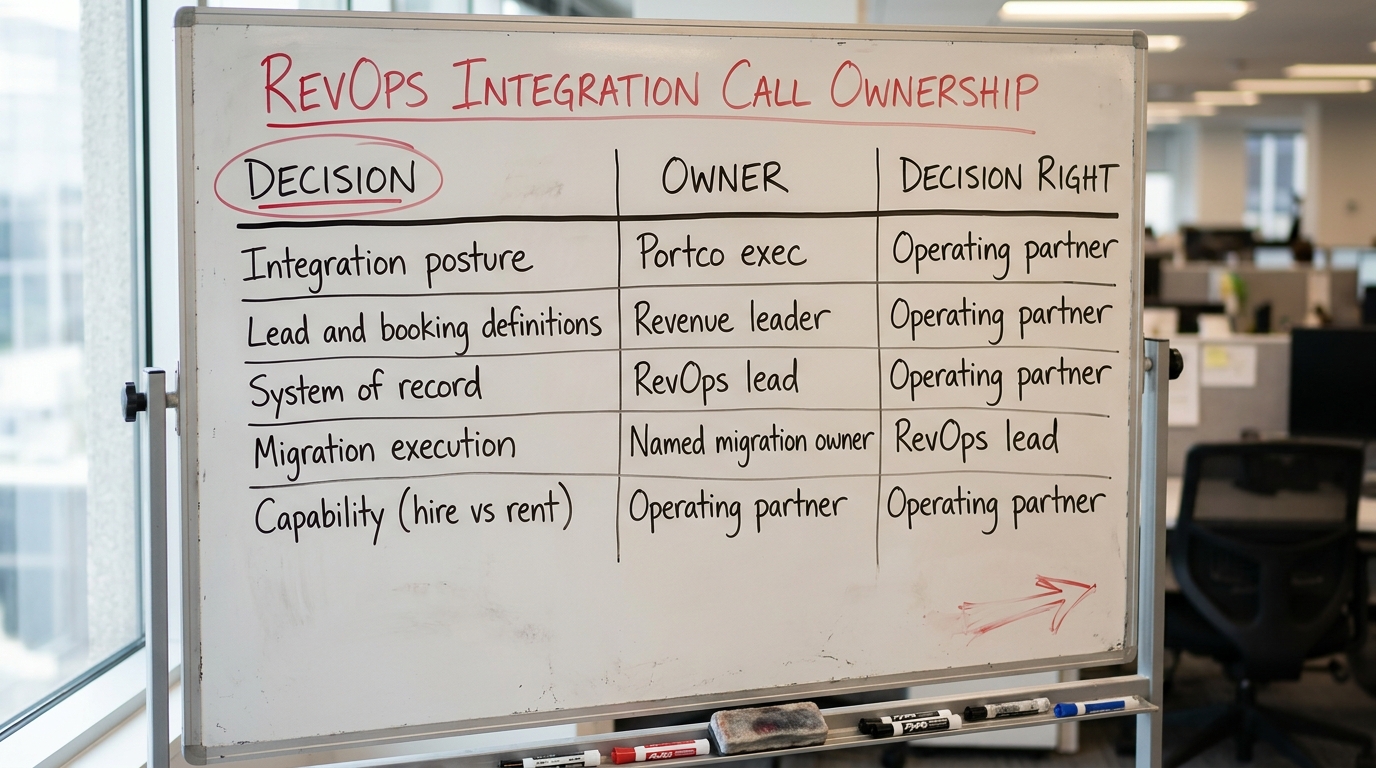
Get this wrong in either direction and the cost is real. Over-integrate a business with a different buyer and sales cycle, and you break a working motion. Under-integrate a true bolt-on, and the synergy case never materializes. This call belongs with the operating partner and the portco executive together, and it should be settled in the first 100 days, not drifted into.
3. Fix the data foundation before the clever work
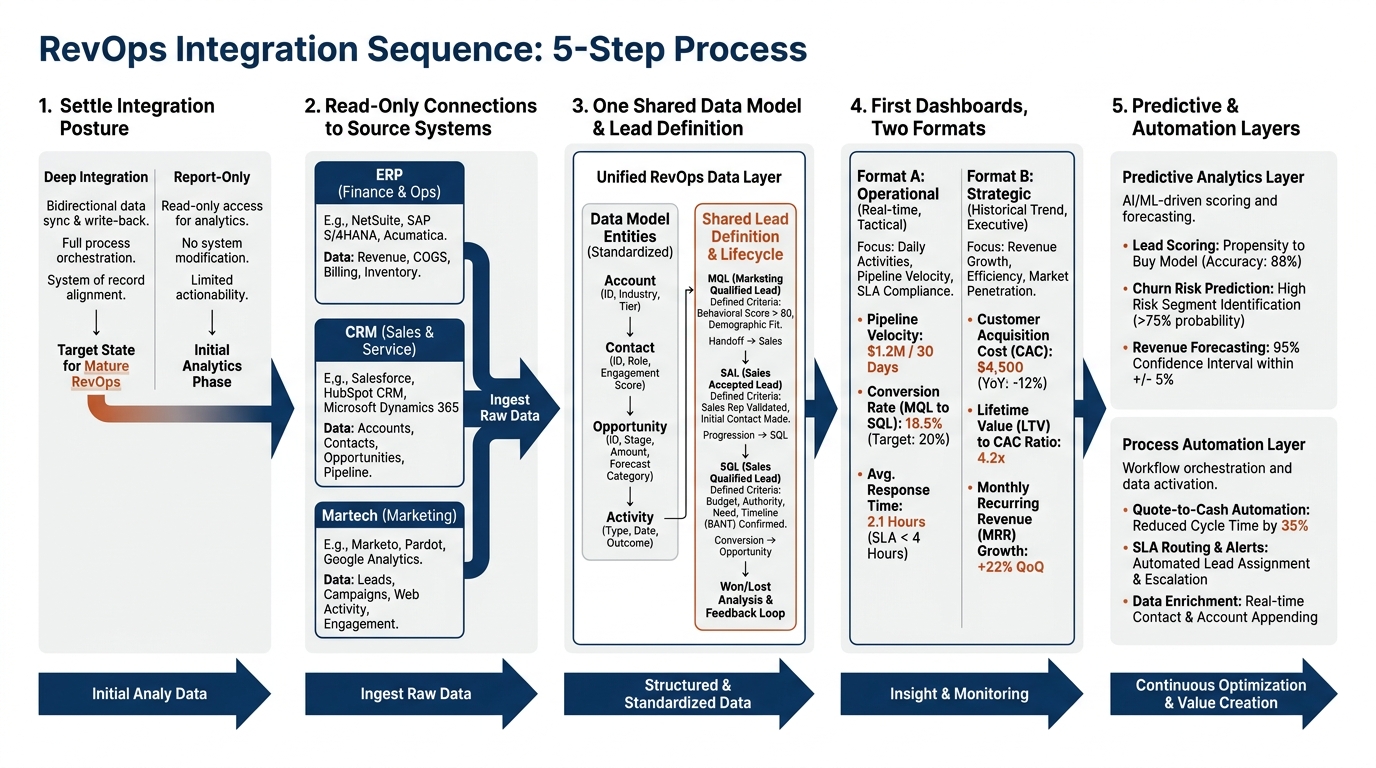
Teams reach for AI copilots and automated enrichment before the records underneath them are trustworthy, and the result is faster production of unreliable numbers. The sequence that holds is read-only connections into the ERP, CRM and marketing stack first, then one shared data model, then the first dashboards, and only after that the predictive and automated layers.
This is the unglamorous part, and it is where most of the value sits. A forecast the CFO trusts is worth more in the first board meeting than any dashboard that looks impressive and cannot be reconciled to the accounts.
4. Settle the single definition of a qualified lead and a booking
Two companies rarely count the same things the same way. One treats a signed order as a booking, the other recognizes it at kickoff. One calls a hand-raise a qualified lead, the other requires a scheduled meeting. Until these definitions are reconciled, consolidated pipeline is a number nobody can act on.
This is a commercial decision, not a technical one, and it should be owned by the revenue leader with the operating partner as the decision right of last resort. Document it, publish it, and make every downstream report inherit it.
5. Choose the system of record and who owns the migration
Once posture and definitions are set, the system of record follows from them rather than from which tool the louder team prefers. The deciding question is which platform can carry the combined revenue motion with the least rework, judged against the technology due diligence findings from the deal rather than internal preference.
Name one accountable owner for the migration, with a clear decision right over scope. A migration run by committee stalls, and a stalled migration means two quarters of blended reporting that neither side trusts. For the mechanics of consolidating revenue systems specifically, the detailed walk-through in post merger integration for revenue systems covers the calls the operating partner keeps.
6. Build the forecast in two formats from day one
Finance will keep working in Excel, and that is correct. The board and the leadership team need a visual view with insights flagged. Both should run off the same underlying data model so that the two never diverge, because the moment the dashboard and the spreadsheet disagree, the whole exercise loses credibility.
The operating partner should insist on this duality early. It is cheap to build when the data model is first assembled and expensive to retrofit after two incompatible reporting habits have set.
7. Protect the revenue motion during the transition
The fastest way to miss the forecast in the integration quarter is to disrupt the sellers while changing their tools. Sequence the migration so that quota-carrying reps keep a working pipeline view throughout, run the old and new systems in parallel where needed, and cut over on a date that does not land in the middle of a quarter close.
McKinsey’s private capital research has repeatedly made the point that value leaks during integration when operational continuity is treated as secondary to structural tidiness. In revenue systems, continuity is the point.
8. Decide the capability question honestly
Most acquired businesses do not have a RevOps function that can absorb an integration on top of its day job. The real decision is whether to hire a RevOps lead, promote from inside, or rent the capability for the integration window and hand off a clean operation afterward.
There is no single right answer, but there is a wrong way to decide it, which is to default to whoever is already in the seat because reassigning them feels disruptive. The parallel logic for technical leadership is laid out in fractional CTO PMI and the five decisions an operating partner cannot delegate, and the reasoning transfers cleanly to revenue operations.
9. Benchmark the work against the deal model, not against activity
Hours logged, tickets closed and dashboards shipped are a vendor’s register, not evidence that the thesis is on track. Judge the integration against the commercial baseline the deal was underwritten on: is pipeline conversion holding, is churn where the deal team expected, is the forecast reliable enough to run the business against.
If you want a structured way to set those reference points, the piece on what belongs in a digital value creation benchmark covers how to separate real movement from reported effort. The discipline is the same one Bain and BCG both press in their private equity work: measure against plan, early and often.
10. Connect the integration plan to the wider value creation thesis
RevOps integration does not stand alone. It feeds the commercial synergies that sit inside the broader plan, and the decisions that cannot wait until Day 1 should already be mapped in the pre-close work. If that groundwork was thin, the integration quarter becomes a catch-up exercise instead of an execution one.
For the connective tissue, see pre-close value creation planning and the companion view on building a portfolio value creation strategy that survives the first board meeting. Both explain how the revenue-system work ladders into the enterprise-value case the deal team actually cares about.
11. A checklist for the first ninety days
Work through these in order, and name an owner for each before you start the next:
- Integration posture decided and documented (deep consolidation, report-only, or hold separate), with the operating partner signed off.
- Read-only connections live across ERP, CRM and marketing, with a single shared data model assembled.
- One published definition of a qualified lead and a booking, inherited by every downstream report.
- System of record chosen on the basis of which platform carries the combined motion, with one named migration owner.
- Forecast running in two formats, finance in Excel and leadership in dashboards, both off the same data.
- Migration sequenced to protect the active pipeline, with cutover away from quarter close.
- Capability decision made deliberately: hire, promote or rent for the integration window.
- Progress judged against the deal-model baseline, not against hours or tickets.
12. When this matters most
The trigger points are predictable. The posture call should be settled before Day 1. The data foundation and definitions should be in place before the first board meeting, because that is where the forecast gets scrutinized. The capability decision should be made early enough that a rented team can hand off cleanly rather than being extended by default. Research hubs like PitchBook and reporting on operational value creation across PE Hub consistently show that integrations lose time at exactly these handoffs, which is why naming the owner in advance matters more than the tooling.
Revenue-system integration is the part of the plan that either produces a defensible number or produces a quarter of arguments. The decisions above determine which one you get.
If you are scoping the first ninety days of a revenue-system integration and want it run against the deal model rather than against activity, review the 100-Day Digital Execution offer for private equity owners and bring the integration posture call to the conversation.