By the time a deal clears the investment committee, the value creation plan is already a line item in the model. Someone has committed to EBITDA expansion the current management team cannot deliver on its own, and the operating partner now has to find the capacity to make the plan real inside the hold period. That is the moment most buyers start shopping for a value creation consulting firm for private equity, and it is also the moment they are most likely to overpay for a deck that restates the thesis back to them.
This guide is for the person accountable for revenue systems in the portfolio company, the operating partner or the portfolio CEO who has to turn a diagnostic into realized value before the next board meeting. It covers what to decide, in what order, and how to judge the firm you are about to retain.
1. Decide what you are actually buying before you take a single meeting
A value creation consulting firm in private equity sells one of two things, and the two command very different prices. The first is analysis: a diagnostic that tells you where enterprise value is trapped and what it would take to release it. The second is execution: people who sit inside the business and move the number. Confusing them is the most common way deal teams waste the first quarter of a hold.
The commercial reality is narrow. A PE-backed buyer is purchasing measurable enterprise-value improvement inside a defined window. Bain’s annual Global Private Equity Report has tracked for years how much of fund returns now depend on operational improvement rather than multiple expansion or leverage, which is why the firm you hire should be judged on outcomes that appear in the P&L, not deliverables that fill a shared folder.
2. Separate the diagnostic from the 100-day plan, and price them separately
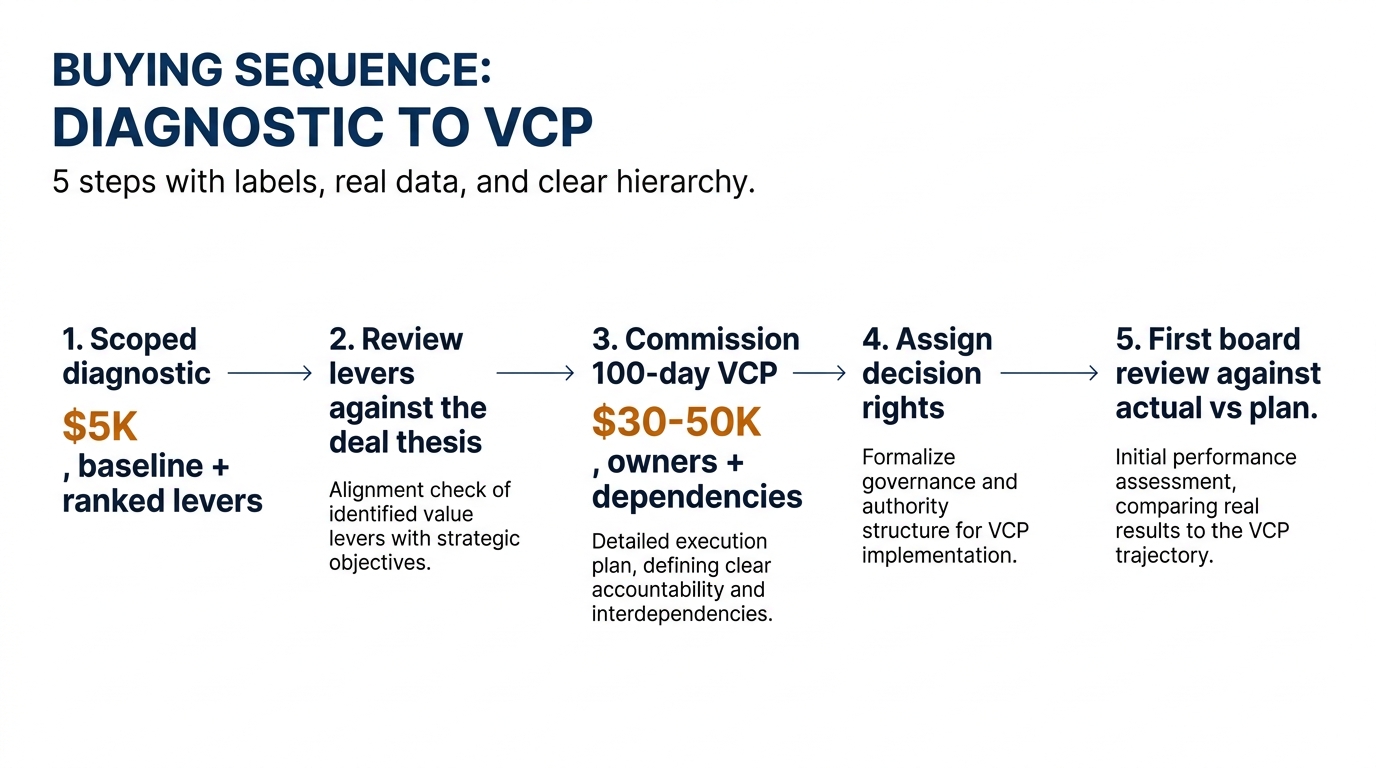
The cleanest buying sequence starts with a scoped diagnostic, typically a $5K engagement, that establishes a baseline and a ranked list of value levers. Only after that do you commission a 100-day value creation plan, which runs considerably higher because it carries owners, dependencies and a delivery schedule. A firm that insists on selling both as one undifferentiated retainer is removing your ability to walk away cheaply if the diagnostic is thin.
Ask for the diagnostic first. It tells you whether the firm can read your P&L and your revenue systems before you let it near your operating budget.
3. Make the firm name the levers in your numbers, not in theirs
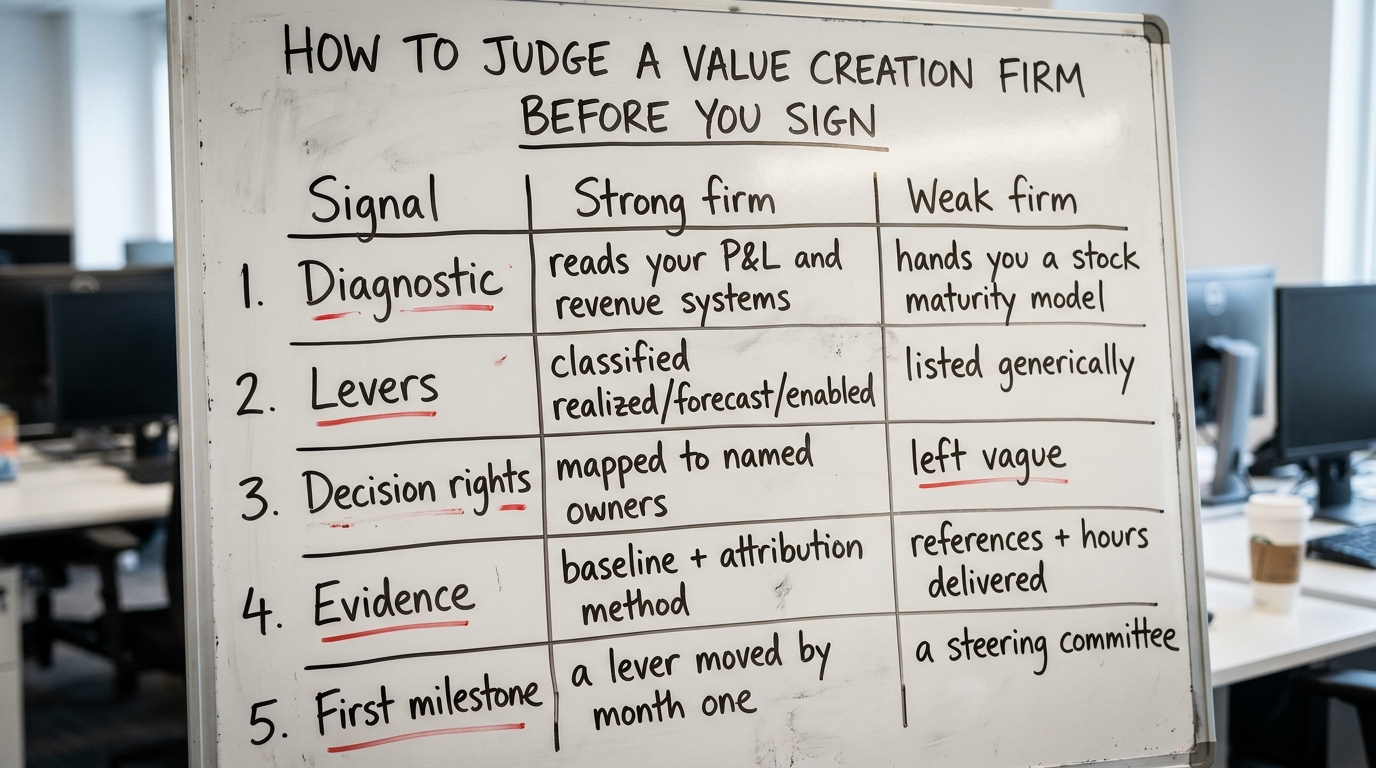
Any competent firm can describe the generic value levers: pricing, retention, sales efficiency, cost to serve. The test is whether it can tie each lever to a number in your business and a mechanism to move it. A firm that hands you a maturity model and a benchmark without connecting both to your revenue system is selling a framework, not value creation.
Push every claimed lever to a classification. Is this realized value already in the run rate, forecast value you expect to capture, or enabled value that only exists if someone builds something first? If the firm cannot classify its own levers, the plan is softer than it looks. The site’s guide to what belongs in a digital value creation benchmark is a useful filter for separating a real baseline from a stock one.
4. Confirm who holds the decision rights the firm cannot take
A consulting firm executes inside decisions it does not own. Pricing authority, headcount, system of record, which contracts get renewed: those sit with the operating partner and the portfolio CEO. The best firms are explicit about this boundary and build it into the plan. The weak ones leave it vague, which is how a 100-day plan stalls in week six waiting for an approval nobody was assigned to give.
Before you sign, map every workstream to a named owner on your side and a named owner on theirs. The piece on the five decisions an operating partner cannot delegate is a good reference for drawing that line in technology-heavy plans.
5. Judge the firm on its evidence standard, not its references
References tell you who liked the firm. The evidence standard tells you whether the firm can prove it moved anything. Ask how it establishes a baseline, how it attributes change to its own work versus market movement, and how it reports actual against plan. McKinsey’s private capital research and BCG’s principal investors practice both publish regularly on why attribution discipline, not activity reporting, is what separates value creation that holds at exit from value creation that evaporates under a quality-of-earnings review.
If a firm’s case material leads with hours delivered, tickets closed or traffic gained, you are looking at the vendor register, not an enterprise-value claim.
6. Test the firm against a real diligence artifact
The firm you hire for value creation should be fluent in what came out of diligence. If you ran a technology due diligence workstream before close, the risk register and the remediation list are the firm’s first reading assignment. A value creation firm that ignores the diligence findings and starts from a blank page is rebuilding knowledge you already paid for.
Hand the firm one real artifact in the first meeting and watch what it does with it. The useful ones fold it straight into the plan.
7. Insist on a plan built for the first 100 days, not the first board deck
The first 100 days is where a value creation plan either gets traction or becomes a document people reference in meetings. A credible plan names what ships in weeks one to four, what the integration dependencies are, and which items are blocked until a decision gets made. It reads like a delivery schedule because it is one.
Be wary of any plan whose first milestone is a steering committee. The firms worth their fee are moving a lever within the first month, and they name which one at the pitch.
8. Price the engagement against the value at stake, not the day rate
A $30K to $50K 100-day plan looks expensive next to a staff-augmentation quote and cheap next to a half-point of multiple at exit. The right comparison is the value the plan is supposed to release. If the diagnostic identified levers worth several turns of EBITDA and the plan is the thing that captures them, the fee is a rounding error. If the levers are soft, no day rate makes the engagement worth running.
This is why the diagnostic comes first. It is the only honest basis for pricing the plan.
9. Decide how the firm hands off, and to whom
Every consulting engagement ends. The question is what remains inside the business when it does. A firm that builds capability leaves the portfolio company able to run the revenue system without it. A firm that builds dependency leaves you re-hiring it every quarter. For revenue-system work specifically, the handoff is where most value leaks, which is why the guide on post-merger integration for revenue systems is worth reading before you scope the exit.
Write the handoff into the statement of work. Name the internal owner who inherits each workstream and the date they take it.
10. Match the firm to the stakeholder who has to live with it
A deal partner wants thesis, risk and exit. A CFO wants forecast reliability, cash and a plan that survives a QoE. The portfolio CEO wants adoption. A firm that pitches the same deck to all three has not understood that the operating partner is the one who signs and the CEO is the one who carries it afterward. The guides on what a value creation partner has to own and what a value creation advisor actually owns both work through where that accountability sits.
11. Your pre-signature checklist
- You commissioned the diagnostic before the plan, and priced them separately.
- Every lever is tied to a number in your business and classified as realized, forecast or enabled.
- Each workstream has a named owner on your side and theirs, with decision rights mapped.
- The firm read your diligence findings and folded them into the plan.
- The plan’s first milestone is a lever moved by month one.
- The fee is sized against the value at stake.
- The handoff names an internal owner and a date for each workstream.
- The firm reports actual against plan with a stated attribution method.
For broader context on how operators are structuring these engagements across portfolios, the Harvard Law School Forum on Corporate Governance publishes regularly on value creation governance and sponsor accountability, which is useful background before you fix the reporting cadence with the firm.
12. Where to start
If you are approaching close or already inside the first 100 days and need the diagnostic-to-plan sequence run properly, review the DevriX private equity value creation offer and scope the diagnostic before you commit to the full plan.