The forecast is slipping in the second quarter after close, the two sales teams are quoting the same account against each other, and the finance function is still reconciling two ledgers by hand. This is the moment an operating partner or portfolio CEO starts pricing post merger integration consulting, and it is also the moment where a bad engagement burns six figures and three months without moving enterprise value. The decision is not whether integration is hard. It is which parts you own internally, which parts you buy, and what evidence tells you the money is working.
This guide is written for the person accountable for revenue systems in the combined entity. It assumes budget, a signed deal, and a value creation plan that already carries integration synergies. The question is execution, and how to judge whether the consultant across the table will produce it.
1. Start from the synergy line, not the org chart
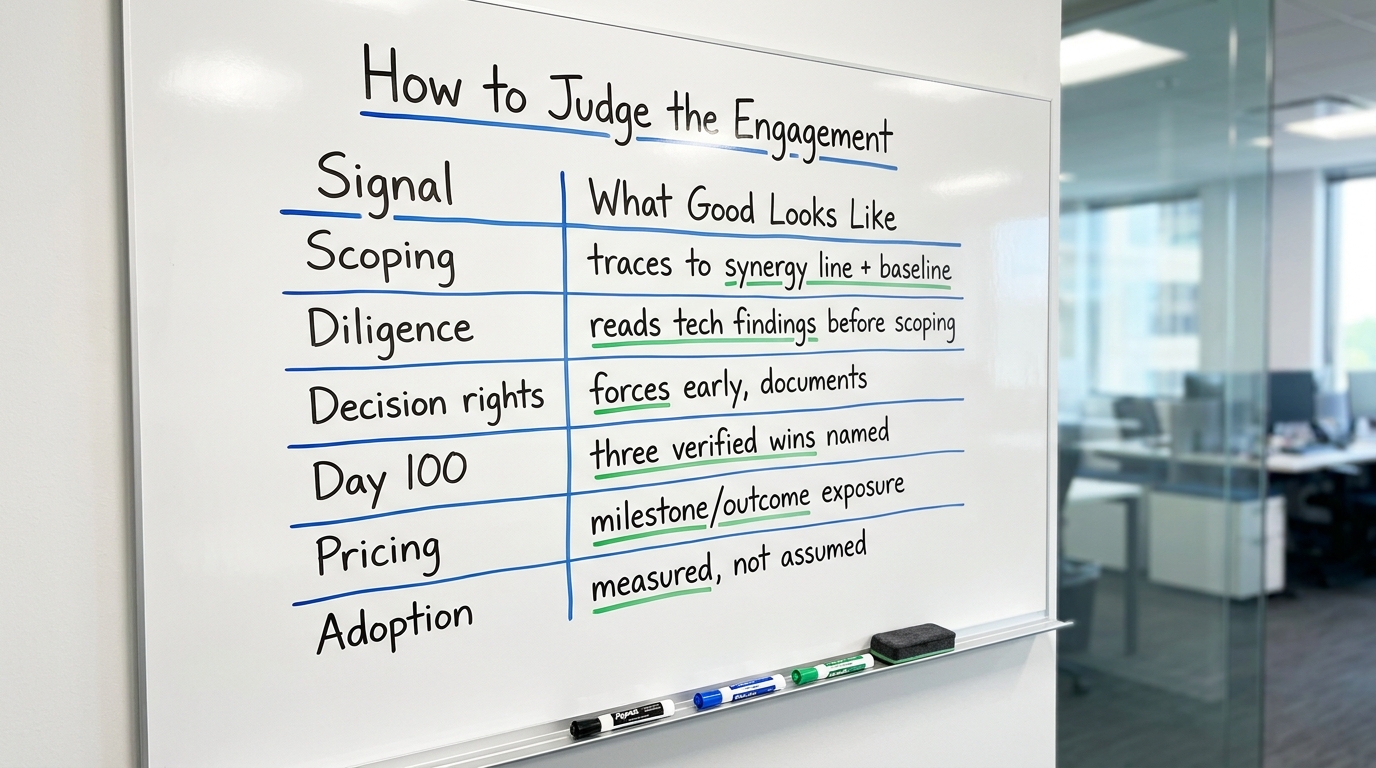
Most integration engagements are scoped around a functional wish list: merge the CRMs, consolidate finance, unify the brand. That framing produces activity, not outcome. The value creation plan committed to specific dollar figures, cross-sell revenue, headcount rationalization, procurement savings, churn reduction. Every integration workstream should trace back to one of those lines with a named owner and a baseline.
If a consultant cannot tell you which synergy line their workstream serves and how they will measure the baseline before Day 1 changes anything, that workstream is a cost with no attached return. Bain’s annual private equity report has tracked how much of the industry’s returns now depend on operational improvement rather than multiple expansion, which is exactly why integration execution gets scrutinized at the board level. You can review that research through Bain’s Global Private Equity Report.
2. Separate the three things you might actually be buying
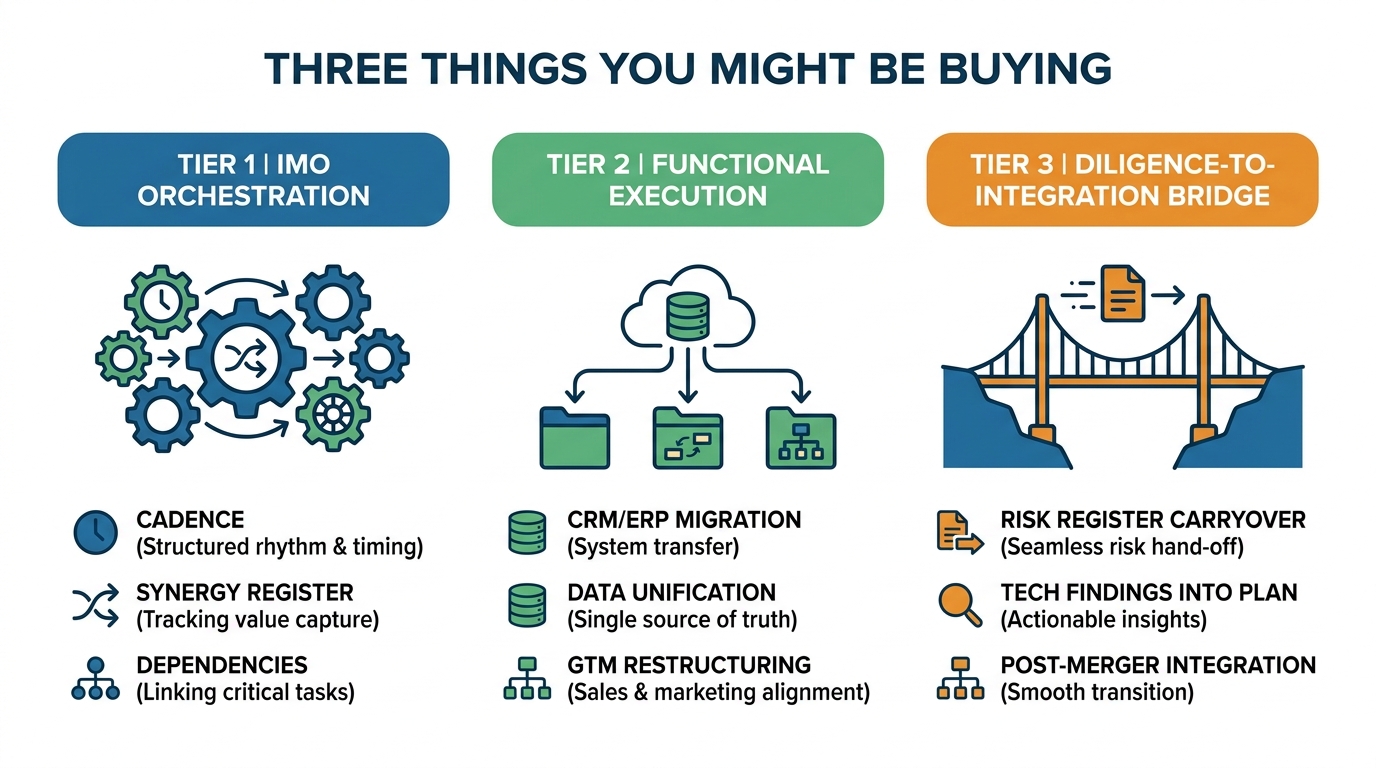
“Post-merger integration consulting” is sold as one thing and is really three. Deciding which you need governs the budget, the seniority, and the success metric.
- IMO orchestration. A program office that runs the integration cadence, tracks the synergy register, and manages dependencies across functions. This is coordination capacity, not domain execution.
- Functional execution. Hands on the systems, CRM consolidation, ERP migration, data unification, GTM restructuring. This is where the synergy actually gets realized or lost.
- Diligence-to-integration bridge. Carrying the risk register and technology findings from the deal into the integration plan so nothing gets rediscovered on Day 60.
A common failure is buying expensive IMO orchestration when the real risk sits in functional execution nobody can staff. The program office produces status decks while the CRM migration quietly slips a quarter.
3. Insist the consultant reads the diligence, not just the value creation plan
The technical findings from diligence are the integration plan’s opening balance. If confirmatory technology due diligence flagged brittle CRM architecture, undocumented integrations, or a data model that will not survive consolidation, that belongs in the integration risk register on Day 1, not as a surprise in month two.
A capable integration partner asks for the diligence outputs before scoping. One who scopes off the value creation plan alone will re-run discovery on your clock and rediscover known problems. For the technical mechanics of merging conflicting systems, the site’s post-merger integration guide on unifying conflicting CRM architectures is a useful reference for what “hard” actually looks like at the system layer.
4. Fix the decision rights before the first workstream opens
Integration stalls on ambiguity about who decides. Two CROs, two CFOs, two tech stacks, and no clarity on which one wins produces a quarter of politics. Before the engagement starts, name the decision right for each contested area: which CRM is the system of record, which pricing model governs, whose data schema survives.
Good integration consulting forces these decisions early and documents them. Weak consulting defers them to “alignment workshops” that consume the first 100 days without resolving anything. McKinsey’s private capital and M&A research has repeatedly linked integration underperformance to slow, unclear decision-making rather than to strategy, and you can review that body of work at McKinsey.
5. Judge the plan against the first 100 days, not the eventual end state
Every integration has a two-year target state. The money is made or lost in the first quarter. The first 100 days should deliver a small number of high-confidence wins, a single revenue reporting view, one deduplicated customer master, a working lead-routing model across the combined pipeline, not a Gantt chart that puts every benefit past month twelve.
Ask the consultant to name three things that will be measurably true by Day 100 and how each will be verified. If the answer is entirely governance and workshops, the plan is optimized to bill, not to realize synergy. The DevriX view on structuring that window is set out in their first 100 days framework.
6. Watch the revenue system, because that is where integrations leak
Finance consolidation is visible and gets attention. The quieter, more expensive leak is in revenue operations: overlapping territories, conflicting CRM data, duplicate accounts, and a pipeline nobody trusts. Cross-sell synergy, often the largest line in the value creation plan, depends entirely on a unified revenue system that most integrations underinvest in.
Before signing, decide whether CRM consolidation is inside this engagement or a separate workstream. The site’s operator’s decision guide on CRM consolidation and its RevOps playbook on CRM standardization both cover the calls you need to make here so the cross-sell number is not stranded behind a data problem nobody owns.
7. Price the engagement against realized value, not hours
Consulting priced purely on time and materials rewards duration. For an integration tied to committed synergies, structure the commercial terms so the consultant carries some outcome exposure, milestone-based fees tied to a verified deliverable, or a defined scope with a hard end date and named acceptance criteria.
Classify what each workstream produces. A unified reporting view is realized value once it is live. A cross-sell motion is forecast value until pipeline actually converts. Do not let a consultant present enabled or forecast benefit as though it were already in the P&L. HBR’s coverage of mergers and acquisitions has documented how often projected deal synergies fail to materialize on the original timeline, which is worth reading before you accept an aggressive synergy schedule at Harvard Business Review.
8. Test the consultant on adoption, not just delivery
A migrated system that the sales team routes around has produced negative value. Integration consultants who talk only about technical delivery and never about adoption are selling you a project, not an outcome. Ask how they will measure that the merged sales team actually uses the unified CRM, that the new pricing model holds in real quotes, that reps stop working the old system.
This is the same discipline you would apply to any revenue systems hire. The site’s guides on judging a revenue operations consultant for private equity and hiring and judging a GTM strategy consultant lay out the reference-check and evidence questions that separate operators from deck-builders.
9. Connect integration to the exit story early
The combined entity gets sold on repeatable systems and clean numbers, not on a heroic one-time integration. An integration that leaves behind a fragile stack and undocumented processes creates diligence risk for the next buyer. Ask the consultant what management visibility and system documentation the engagement leaves behind, because that is what a future acquirer’s diligence will test.
For how integration feeds the broader value creation and exit narrative, see the site’s guide on GTM value creation for portfolio companies, which frames the same decisions from the growth side. BCG’s principal investors research also covers how operational value creation ties to exit readiness, available at BCG.
10. The decision checklist before you sign
Run the engagement through these questions. If more than two return weak answers, renegotiate the scope before the money moves.
- Does every workstream trace to a named synergy line with a pre-Day-1 baseline?
- Has the consultant read the diligence risk register and technology findings?
- Are decision rights assigned for every contested system and process before kickoff?
- Are there three measurable, verifiable wins committed inside the first 100 days?
- Is the revenue system, CRM, territories, pipeline data, explicitly in or out of scope?
- Do commercial terms carry outcome exposure, not just hours?
- Is there an adoption metric, not just a delivery milestone?
- Does the engagement leave documentation and management visibility that survives to exit?
11. When this matters most
The trigger points are specific. At LOI, decide who will own integration execution and budget it. During confirmatory diligence, insist the technology findings are structured to hand straight into an integration plan. In the two weeks before Day 1, lock decision rights. At the first board meeting after close, the integration partner should be reporting against synergy baselines, not against a task list. If the first board update is a slide of completed activities with no dollars attached, the engagement is already off track.
The broader mechanics of running private equity value creation across a portfolio put integration in context: it is one execution window inside a longer plan, and the same evidence discipline applies to RevOps across the portfolio.
12. Next steps
Before you approve spend, do three things. Map each proposed workstream to a synergy line and reject any that cannot trace. Get the diligence risk register in front of the consultant and watch whether they scope around it. Define what “true by Day 100” means and put it in the statement of work with verification attached. That converts an open-ended consulting relationship into a measured execution engagement you can hold accountable at the next board meeting.
If you want an integration and 100-day execution partner that scopes against synergy lines and reports in enterprise value rather than hours, review the DevriX private equity execution offer and how their 100-Day Digital Execution engagement is structured.