In a roll-up, the website migration decision usually arrives late, buried under integration tasks that feel more urgent, and that is exactly when it costs the most. By the time an operating partner is consolidating three or five acquired brands onto one platform, organic traffic is a line in the deal model, and a botched migration can cut it by a third before anyone in finance notices. Website migration for a roll-up touches the demand that the revenue forecast assumes. The person accountable for revenue systems in the portfolio company needs a view on it well before the first redirect goes live, because forgetting it is a technical chore that can be delegated carries real consequences.
This guide is for that person: the operating partner, the portfolio company executive, or the revenue leader who owns the number. It covers what to decide, who owns each decision, and how to judge whether the work is being done well enough to protect the traffic the deal paid for.
1. Why the migration sits in the deal model, not the IT backlog
A roll-up buys several businesses with overlapping customers and competing digital footprints. Each acquired company arrives with its own site, its own domain authority, its own ranking content, and its own CRM and analytics wiring. The thesis usually assumes some of that demand consolidates into a single stronger brand, and that cross-sell becomes easier once the estate runs on one stack.
The migration is where that assumption gets tested. Move the content badly and the consolidated domain ranks worse than the sum of its parts did. Bain’s Global Private Equity Report has tracked for years how much of today’s value creation depends on commercial growth rather than leverage, and organic demand is a real input to that growth. Treating the migration as an IT ticket means nobody is holding it against the revenue line it affects.
2. Decide the domain structure before anyone touches a server
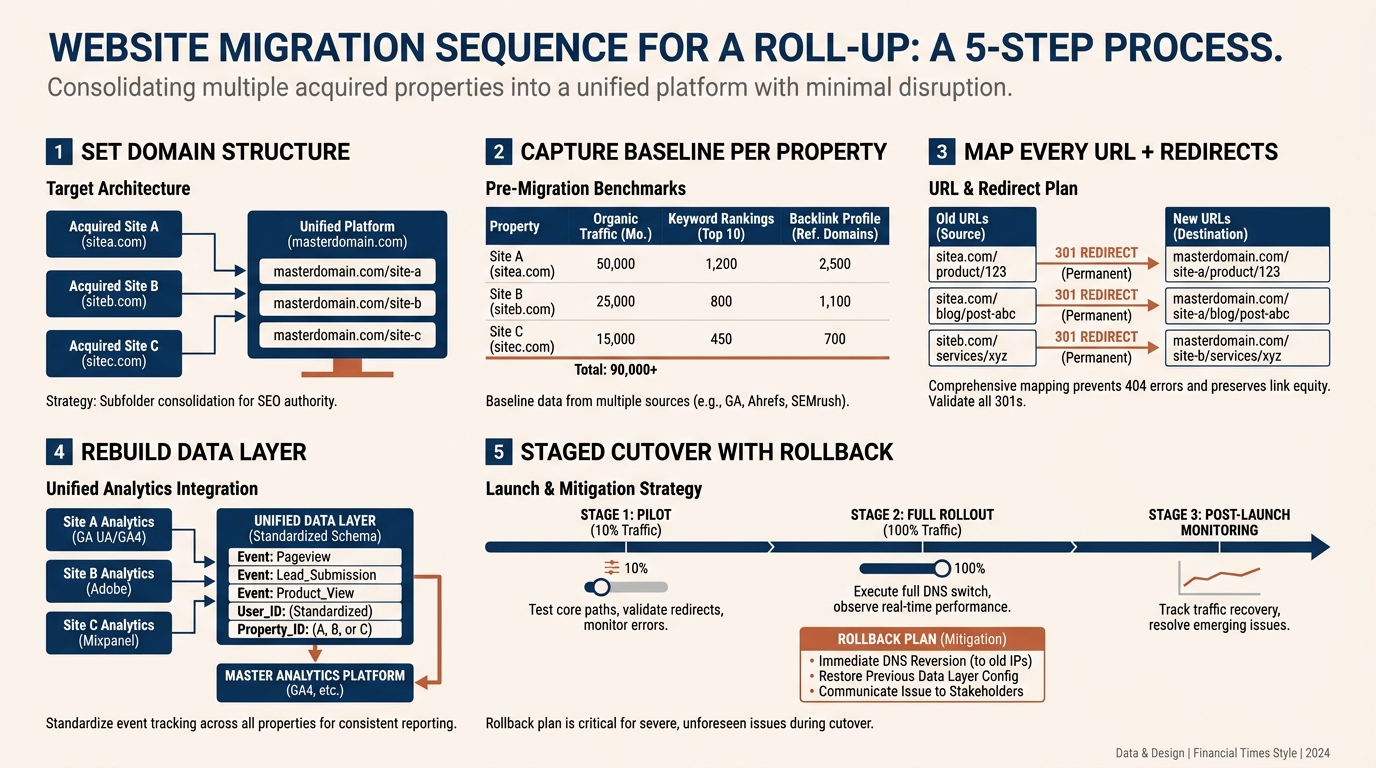
The first real decision is architectural, and it cannot be unwound cheaply. The operating partner has to choose whether the acquired brands fold into one master domain, sit as subfolders, keep their own domains with shared infrastructure, or persist as standalone sites during a transition period.
Each path carries a different demand consequence. Folding everything into one domain concentrates authority but risks diluting brand-specific rankings that acquired customers still search for. Keeping separate domains preserves those rankings but splits your SEO investment across properties. This is a commercial call about where demand comes from, not a preference, and it belongs to the same people deciding the broader portfolio value creation strategy.
Who owns this decision
The revenue leader proposes the structure, backed by traffic and ranking data per property. The operating partner approves it, because it determines how much demand the consolidated entity can realistically carry into the forecast.
3. Build the baseline before you change anything
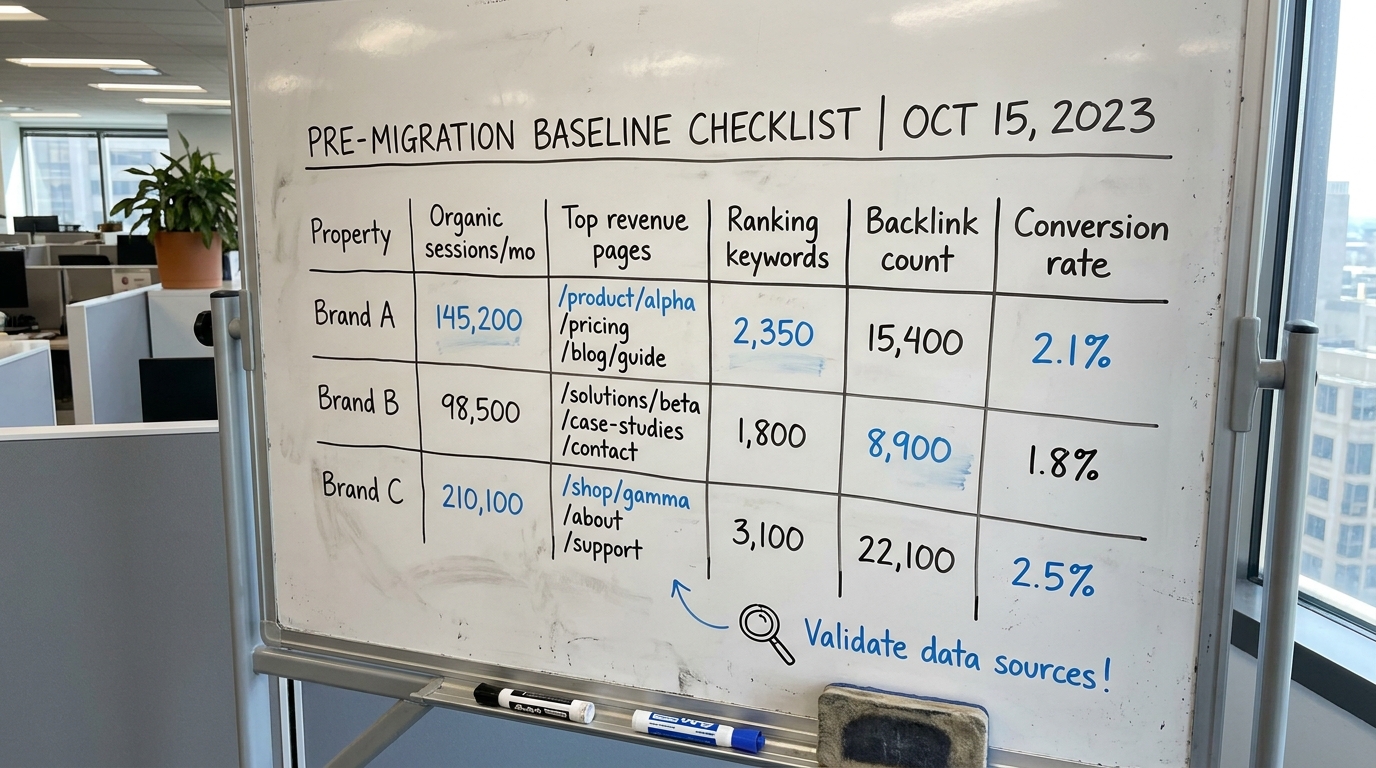
No migration should start without a documented baseline for every property moving. That means current organic sessions, top landing pages by revenue contribution, ranking keywords, backlink profiles, and conversion paths, captured and dated. Without it, you cannot tell afterward whether a traffic drop is the migration or the market.
This is the same discipline that applies in technology due diligence: you document the current state as evidence so that performance after Day 1 can be measured against something real. If the baseline was never captured, the first board meeting becomes an argument about whether the number was ever there, and that argument has no winner.
4. Map every URL that earns traffic or revenue
The single most common failure in website migration for a roll-up is a redirect map that misses pages. Every URL on every property that ranks, converts, or holds inbound links needs a destination on the new structure. Pages that earn nothing can be retired deliberately, but that has to be a decision, not an accident.
A proper map pairs each old URL with its new target and the redirect type, flags any page with no sensible destination for review, and gets checked against server logs so nothing that still gets traffic is quietly dropped. On a single site this is tedious. Across five acquired properties with thousands of URLs each, it is the workstream most likely to be rushed, and the one that does the most damage when it is.
5. Consolidate the data layer, not just the pages
A roll-up migration is also a data migration. The acquired companies ran their own analytics, their own CRM, and their own attribution, and the point of consolidating is to see the whole estate in one model. If the website moves but the measurement stays fragmented, the operating partner still cannot answer basic questions about where demand originates across brands.
This is where the migration overlaps with post-acquisition RevOps integration. Analytics tracking, lead routing, and conversion events have to be rebuilt on the new structure and reconciled against the old ones. Plan the data layer in the same sequence as the pages, because a clean site on top of broken measurement tells you nothing you can act on.
6. Sequence the cutover so it can be reversed
The migration should not go live as one irreversible event across the whole estate. Stage it. Migrate one property or one section, confirm redirects resolve and rankings hold, then proceed. A staging environment that mirrors production lets the team validate the redirect map, the analytics, and the page rendering before any live URL changes.
The operating partner should insist on a rollback plan in writing before the first property moves. If organic traffic on the migrated property falls outside an agreed tolerance within the first weeks, the team needs a defined path back rather than a scramble. This is the same prevention logic that governs any system change in the first 100 days: build the fire break before you light anything.
7. Set the signals that tell you it worked or it did not
Define the success and failure signals before launch, with numbers attached. Organic sessions, indexed pages, ranking positions for priority keywords, and conversions per property should all have a baseline and an agreed tolerance band. A short dip after a large migration is normal; a sustained decline beyond the band is a problem that needs owners and a timeline.
McKinsey’s work on private capital and value creation keeps returning to the point that measurement discipline separates deals that hit plan from deals that drift. A migration without defined signals cannot be judged, which means it cannot be defended at a board meeting or corrected while there is still time.
8. Judge the partner by the redirect map, not the deck
Most agencies that pitch a roll-up migration lead with a polished deck and a timeline. Neither tells you whether they can do the work. Ask to see how they handle the redirect map, how they capture and reconcile the baseline, and how they validate rankings after a staged cutover. A partner who treats the data layer as an afterthought, or who has only ever migrated single SaaS sites, is a risk on a multi-brand estate.
The same scrutiny applies here as in evaluating any value creation firm: you are buying execution against your forecast, not slideware. The Harvard Business Review’s work on M&A integration makes the broader case that integration failures are usually execution failures, not strategy failures, and a migration is integration made concrete.
9. Where this connects to the wider integration
The website migration does not stand alone. It sits inside the consolidation of the whole digital estate, and the calls made here echo the ones made in commercial due diligence about where the acquired demand actually came from. If diligence overestimated the strength of an acquired brand’s organic traffic, the migration will expose it, and better to know in a staging environment than after the redirects are live.
For deals where digital demand is a material part of the thesis, treat the migration plan as part of pre-close value creation planning rather than a Day 90 task. The structural decisions are cheaper to make before close, when you still have leverage over the acquired companies’ cooperation and access to their systems.
10. The next-step checklist
Before approving any website migration for a roll-up, the operating partner should confirm the following are in place and owned:
- A domain structure decision, documented, with the demand consequence stated per brand.
- A dated baseline for every property: organic sessions, revenue pages, rankings, backlinks, conversions.
- A complete URL-to-URL redirect map, checked against server logs, with retirement decisions made deliberately.
- A data-layer plan covering analytics, CRM, and attribution, reconciled old to new.
- A staged cutover sequence with a written rollback plan and agreed tolerance bands.
- Defined success and failure signals with numbers, owners, and a review date.
- A named owner for each workstream and a single accountable executive for the whole migration.
If any line has no owner, that is the gap to close first. A migration run across a multi-brand estate without clear decision rights tends to protect the timeline at the expense of the traffic, and the traffic is what the deal paid for. Industry data providers like PitchBook track how large a share of roll-up value creation now rests on commercial execution rather than financial engineering, which is the reason this work belongs in front of the people who own the forecast.
Roll-up estate consolidation done well turns several weaker digital footprints into one asset that carries more demand than the parts did separately. Done without these controls, it quietly erodes the growth case while the integration dashboard shows green. The difference is almost entirely in the decisions made before the first redirect goes live.
If you are consolidating a multi-brand estate and want the migration run against the deal model rather than the IT backlog, review how DevriX and GrowthShuttle support private equity operators on estate engineering and roll-up consolidation.