An operating partner staring at a signed LOI has roughly three weeks to know whether the target’s technology will support the deal thesis or quietly break it. The forecast assumes the platform can scale, the engineering team can ship the roadmap, and integration will not consume the first year of ownership. If any of those assumptions are wrong, the model is wrong, and the person accountable for revenue systems in the portfolio company inherits the gap. That is why hiring the right technology due diligence advisor for private equity is a commercial decision, not a procurement task. This guide is for a buyer with budget who needs to know what to commission, what to expect, and how to judge the output before it lands on the deal partner’s desk.
1. Start with the decision the diligence has to inform
Technology diligence exists to answer one question: does the asset’s technology raise or lower the probability of hitting the return model? Everything else is supporting evidence. Before scoping any engagement, write down the specific decisions the report must inform. Common ones: whether to proceed to close, whether to adjust the purchase price, what to put in the risk register, and what the first 100 days must fund.
An advisor who opens with a generic checklist of frameworks and cloud certifications is answering the wrong question. The right one starts from the thesis. If the model assumes 40% revenue growth over three years, the platform’s ability to carry that load, and the cost of getting it there, is the headline finding. Bain’s annual Global Private Equity Report has repeatedly flagged operational value creation as the dominant source of returns as multiple expansion becomes harder to rely on, which puts more weight on knowing what the technology can actually deliver.
2. Match the scope to the deal stage
Two triggers call for two different products. Pre-LOI, the buyer wants a fast read on whether the asset is worth pursuing and where the obvious landmines are. That is a lightweight engagement, often a few days, sized to inform the bid, not to satisfy confirmatory diligence.
Confirmatory diligence after the LOI is a different order of rigor. Here the advisor is producing evidence that will feed the price, the reps, and the integration plan. This is where a structured technology due diligence engagement earns its fee, and where cutting corners shows up later as a Day 1 surprise. If cost is the open question, the guide to technical due diligence cost on this site sets out what drives the number and what a fair scope looks like.
3. Insist on evidence, not opinion
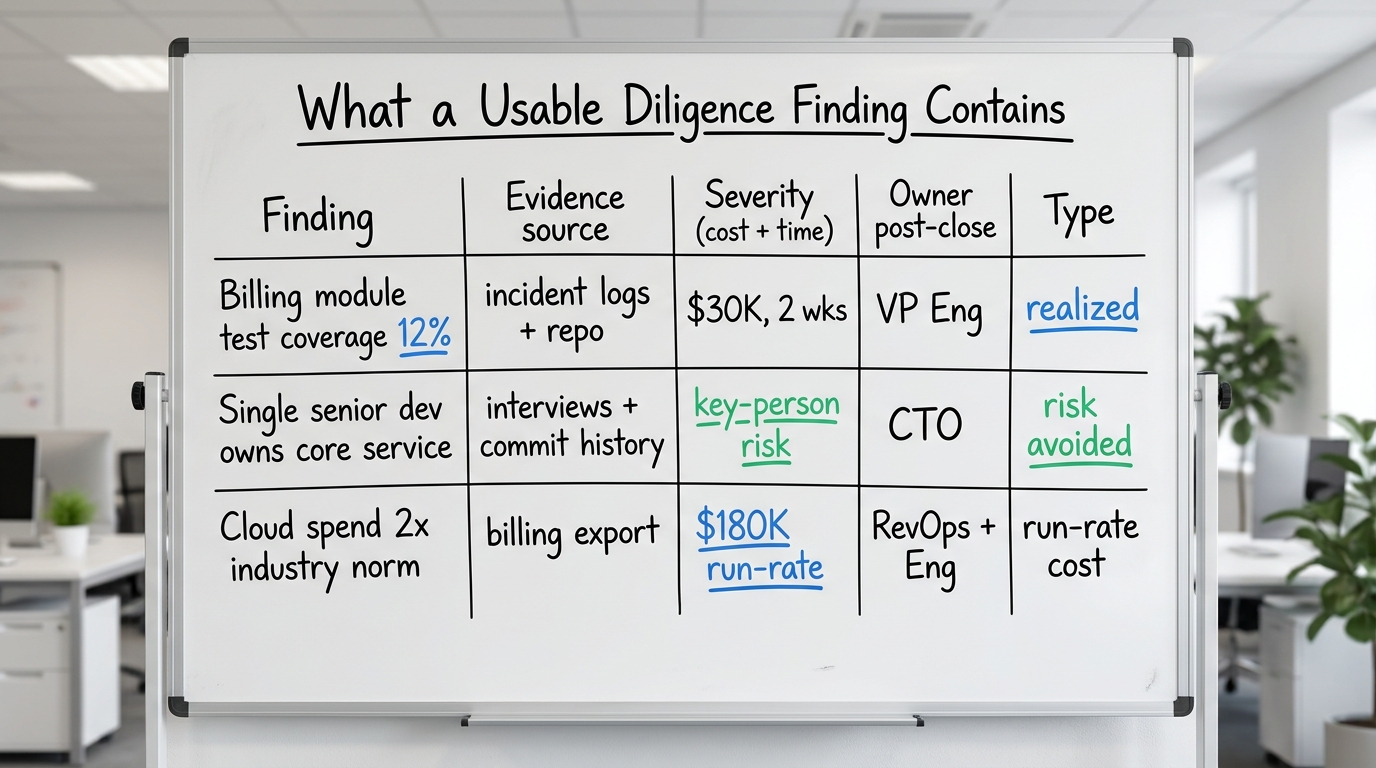
The difference between a useful advisor and an expensive one is whether findings are backed by evidence. “The codebase looks solid” is an opinion. “Test coverage is 12% on the billing module, which processes 60% of revenue, and the last three production incidents traced to that module” is evidence. The second kind survives a challenge from the deal partner and from the target’s management.
Ask any candidate advisor how they source evidence: repository access, incident logs, cloud spend data, architecture walkthroughs, and interviews with named engineers. If the method is a management questionnaire and a slide review, the buyer is paying for a summary of what the seller wants heard.
4. Require a clear owner and severity for every finding
A report full of observations with no owner and no severity is a document, not a decision tool. Every material finding should carry three things: how bad it is, what it costs to fix or contain, and who owns the remediation once the deal closes. That structure is what makes a diligence report usable in the first 100 days rather than shelved after signing.
Severity should tie to money and time, not to abstract risk labels. A “high” finding that costs $30K and two weeks is not the same as a “high” that requires a nine-month replatform and blocks the growth thesis. The advisor should classify each item by whether it is a realized problem today, a run-rate cost, or a risk that may or may not materialize.
5. Cover the five areas that move the model
A thesis-driven scope concentrates on what changes the return, not on a generic audit. Five areas carry most of the commercial weight.
Scalability against the growth plan
Can the architecture carry the volume the model assumes, and what does it cost to get there? This is the difference between a growth story and a capital sink.
Key-person and team risk
If one engineer holds the only working knowledge of the core system, that is a valuation issue, not an HR footnote.
Security and data exposure
A breach or a compliance gap can reset the price or kill the deal. This deserves evidence, not a policy PDF.
Technical debt with a price tag
Debt only matters when it is converted into dollars and quarters. “The stack is dated” is useless; “modernization is a $400K, three-quarter program that blocks the roadmap until done” is a board input.
Integration and carve-out complexity
For an add-on or a carve-out, the cost and duration of standing the asset up on its own systems is often the single largest post-close line. The work involved in a carve-out digital standup and transition services agreement is frequently underestimated at signing, and the diligence advisor should size it before close.
6. Judge the advisor before you judge the target
The quality of the report depends on who is doing the work. A few tests separate operators from resellers of templates.
- Do the people doing the review have run engineering organizations, or are they analysts filling in a framework?
- Can they translate a technical finding into an EBITDA or timeline consequence without being prompted?
- Will they name what they could not verify, rather than papering over gaps?
- Do they distinguish between what the target claims and what they confirmed?
An advisor comfortable saying “we could not get access to the production environment, so this finding is provisional” is more trustworthy than one who presents every item with equal confidence. McKinsey’s private capital research and BCG’s work on principal investors both point to disciplined, evidence-led diligence as a differentiator in a market where paying up for assets leaves less room for surprises.
7. Connect the findings to the value creation plan
Diligence that ends at signing wasted half its value. The findings should flow directly into the operating plan: which items are Day 1 must-fixes, which are funded projects in year one, and which are watch-items on the risk register. This is where technology diligence connects to the broader private equity value creation agenda rather than sitting as a standalone gate.
The same discipline applies downstream. If the deal is a merger, the diligence findings should feed the integration plan, and the guidance on what to buy and how to judge post-merger integration consulting becomes the next decision. Where the thesis rests on go-to-market, the technology findings on CRM and data quality should inform the GTM value creation plan rather than being handled twice.
8. Watch for the vendor patterns that signal weak work
Some patterns reliably predict a report that will not hold up.
- Activity dressed as insight. Counts of files reviewed, tools scanned, and hours spent are inputs, not findings.
- Severity without economics. A risk rating with no cost and no timeline cannot inform a price or a plan.
- No named owners. If nobody owns a fix, it will not get fixed after close.
- Generic benchmarks. “Below industry standard” with no attribution is filler. Real comparisons cite a source.
The Harvard Law School Forum on Corporate Governance has published extensively on diligence discipline and deal governance, and the throughline is consistent: findings that cannot be traced to evidence do not survive contact with a contested negotiation.
9. Size the RevOps consequences early
For the person accountable for revenue systems, the technology diligence should surface the state of the CRM, the data model, the reporting stack, and the integrations that actually run the commercial engine. A fragmented CRM across a platform and its add-ons is a value-creation project, and often a large one. The CRM standardization decision guide for operators lays out how to scope that once the diligence flags it. Sizing this at diligence, rather than discovering it in month four, is the difference between a planned program and a fire drill.
10. A next-step checklist before you commission the work
Before signing an engagement letter with any advisor, the buyer should be able to answer these:
- Which specific deal decisions must this report inform, and by when?
- Is the scope sized to the stage: a fast pre-LOI read, or full confirmatory rigor?
- Will every material finding carry evidence, severity in cost and time, an owner, and a type (realized, run-rate, or risk)?
- Do the people doing the work have real operating depth, and will they name what they could not verify?
- Does the output feed the first 100 days and the value creation plan, not just the go/no-go gate?
- Are the RevOps and integration consequences sized before close, including any post-merger integration or carve-out standup work?
Reputable market data from PitchBook and S&P Global Market Intelligence underscores why this rigor pays: entry multiples leave little room to absorb a technology surprise, so the diligence has to be right the first time. For a carve-out specifically, the questions shift again, and the carve-out consulting guide for operating partners covers what the diligence must resolve before separation.
The right advisor produces a report a deal partner can price against, an operating partner can execute against, and a portfolio executive can staff against. If a technology diligence engagement, sized to a fast pre-LOI read or a full five-day confirmatory review, would sharpen the decision in front of you, review the DevriX private equity offer and technology diligence engagements to see how the scope maps to your deal.