When a carve-out closes and the target loses access to the parent’s shared IT within 90 to 180 days under a transition services agreement, someone has to own the technology stand-up before the clock runs out. Most lower-mid-market portfolio companies do not have a full-time CTO worth hiring on day one, and the deal thesis rarely justifies the cost. That is why fractional CTO PMI has become a standard line in the integration budget. The question for the operating partner is not whether to use one, but what to decide before the engagement starts and how to judge the work once it does.
This guide is written for the person accountable for the revenue and technology systems in a newly acquired company, not for someone deciding whether fractional leadership exists. The decisions below are the ones that determine whether the engagement produces a working operation or a stack of recommendations nobody executed.
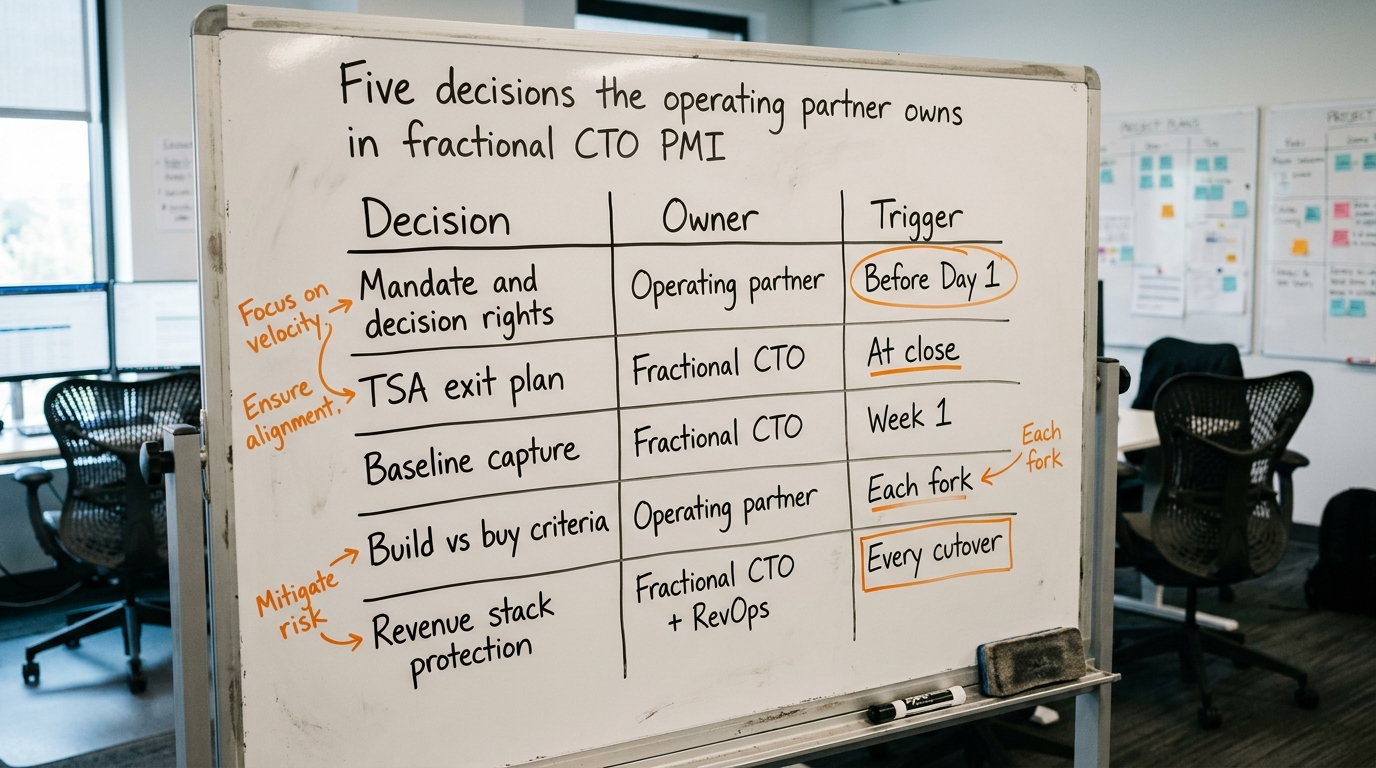
1. Decide what the fractional CTO owns before Day 1
The most common failure in a private equity integration is hiring senior technology help without a decision right attached to it. A fractional CTO who can advise but cannot approve architecture, sign off on vendor contracts, or direct the internal engineers is a consultant, and the TSA clock does not wait for consensus.
Write the mandate down before the engagement starts. Name the systems in scope (ERP, CRM, data warehouse, identity, the website and its revenue tooling), name the decisions the fractional CTO can make alone, and name the ones that escalate to the board or the operating partner. Bain’s annual PE report has tracked for years how value creation now depends on operational execution rather than multiple expansion, and execution stalls first where authority is unclear. Read Bain’s findings in its Global Private Equity Report.
2. Separate the TSA exit workstream from everything else
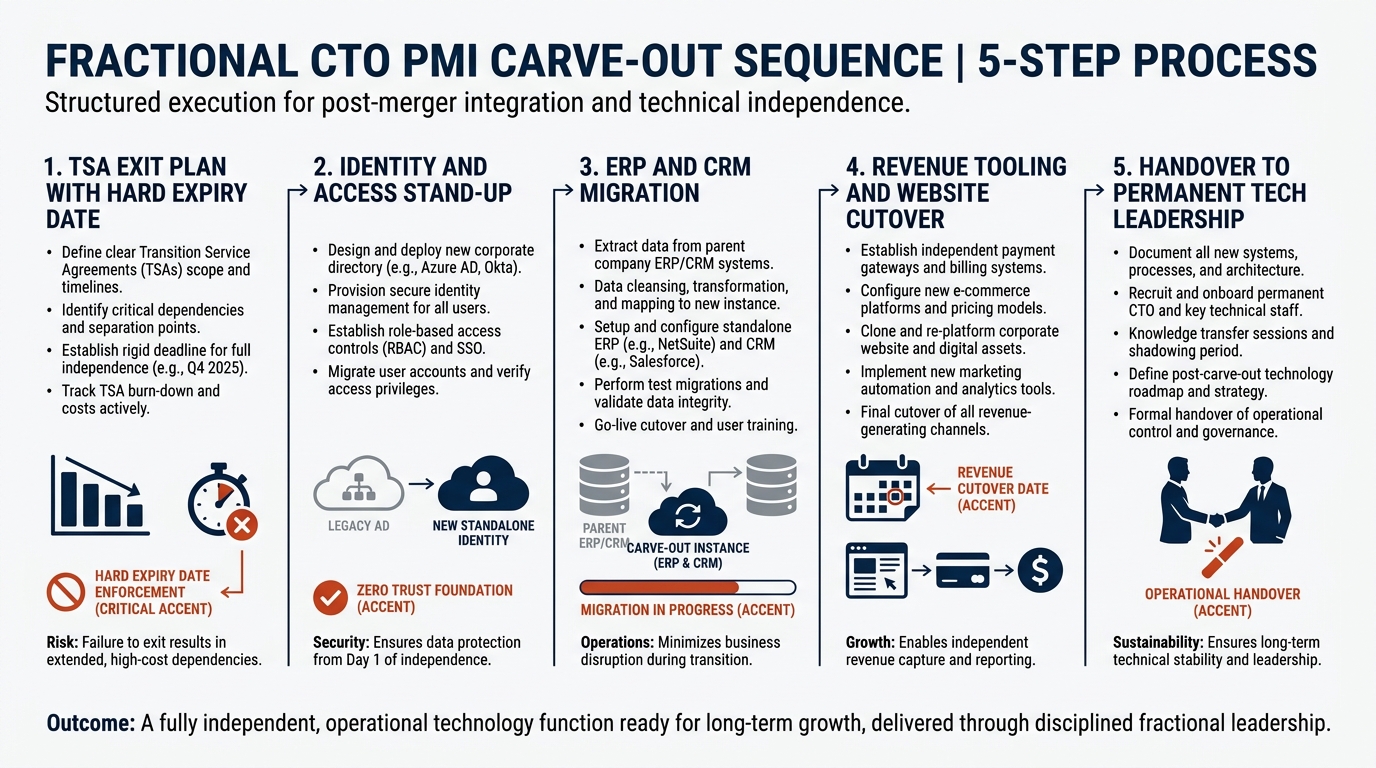
In a carve-out, the fractional CTO’s first job is the migration off the seller’s systems before the transition services agreement expires. That workstream has a hard date, a cost that rises the longer it runs, and a dependency map that touches almost every function. Treat it as a distinct plan with its own owner and its own risk register, separate from the longer roadmap.
Mixing the TSA exit into a general “modernize the stack” program is how firms miss the expiry date and end up paying the seller for extension months at a premium. The first 100 days of a carve-out are mostly about getting off borrowed infrastructure without breaking order-to-cash.
3. Judge the candidate on carve-out reps, not a résumé of big titles
A CTO who scaled one company from Series B to IPO has done impressive work that has little to do with pulling a business off a parent’s shared services under a 120-day deadline. Ask for two or three carve-out or integration engagements they ran, and ask specifically what broke and how they handled it. Someone who describes a clean migration with no surprises has either done very few or is not telling you the whole story.
The judging criteria overlap heavily with how an operating partner should judge a digital transformation partner for portfolio companies. The difference in PMI is the deadline pressure, which surfaces judgment faster than any reference call.
4. Set the baseline before the fractional CTO changes anything
You cannot show enterprise-value improvement from a technology engagement without a starting point. Before the fractional CTO begins moving systems, capture the current state: what the target runs, what it costs monthly, where the data lives, what integrations exist, and which of them the parent controls. Much of this should already sit in the technology due diligence file, and if it does not, that gap is itself a finding.
The diligence report is your baseline document, which is why knowing how to read a technical due diligence report before you sign off matters before the PMI starts. If the report says the CRM is “well-maintained” without naming the data quality, the license count, or the integration debt, the fractional CTO inherits a problem the deal team never priced.
5. Decide the build-versus-buy questions the fractional CTO will raise
During a stand-up, the fractional CTO will hit forks where the company can adopt a standard SaaS product or build something custom. Those decisions carry cost and timeline consequences that outlast the engagement, so the operating partner should own the criteria even if the CTO owns the recommendation.
The default in PMI should favor buying and configuring over building, because custom code creates a maintenance liability the next owner will discount at exit. Where a build is genuinely warranted, the reasoning should be explicit, which is the same discipline covered in the build decisions an operating partner owns. McKinsey’s private capital research has repeatedly documented how post-close technology spend erodes returns when it is not tied to a specific value lever; its private capital research is worth reading before approving any custom build.
6. Protect order-to-cash and the revenue stack during cutover
The systems that generate revenue are the ones a migration is most likely to break, and the ones a portfolio company can least afford to lose for a week. The CRM, the billing engine, the website, and the tooling that moves a lead to a closed deal all sit in the revenue stack, and every cutover should have a rollback plan tested before it runs.
This is where fractional CTO work intersects with revenue operations, and why many operating partners pair the CTO with fractional RevOps during integration. If the company runs on Salesforce, the migration risk concentrates there, which is covered in more detail in Salesforce RevOps for PE portfolio companies.
7. Define the handover to permanent leadership from the start
A fractional CTO engagement that never ends is a cost the exit model did not account for. Decide at the outset whether the endpoint is a full-time hire, a promoted internal engineer, or a managed service, and set the milestone that triggers the transition. The fractional CTO should be building documentation and internal capability from week one, not hoarding knowledge that leaves when the contract does.
Write the handover artifacts into the deliverables: system documentation, vendor contracts and renewal dates, the architecture decisions and their reasoning, and a runbook the next owner can operate from. Without those, the company pays twice, once for the fractional work and again to rediscover it.
8. Judge the engagement on outcomes tied to enterprise value
Hours billed and tickets closed tell the operating partner nothing about whether the engagement worked. Judge it on outcomes the board recognizes: the TSA exited on time and on budget, the revenue stack ran through cutover without lost bookings, monthly IT run-rate cost moved in the direction the deal team projected, and management gained visibility it did not have before.
Set these measures before the engagement, not after, so the fractional CTO is working toward the same target the deal team underwrote. The same principle applies when you judge a digital transformation consultant before signing the retainer: agree the definition of done in writing.
9. A checklist before you approve the engagement
- The mandate names systems in scope, decisions the CTO makes alone, and decisions that escalate.
- The TSA exit is a distinct workstream with its own owner, expiry date, and risk register.
- The candidate has two or more carve-out or integration engagements they can discuss in detail.
- A current-state baseline is captured before any system moves, cross-checked against the diligence file.
- Build-versus-buy criteria are set by the operating partner, with a documented reason required for any custom build.
- Every revenue-stack cutover has a tested rollback plan.
- The handover endpoint, milestone, and documentation deliverables are written into the contract.
- Success measures are agreed in writing and tie to run-rate cost, TSA timing, revenue continuity, and management visibility.
PitchBook’s data on carve-out activity shows this deal type has grown as corporates shed non-core units, which means more portfolio companies arrive without their own technology function; PitchBook’s research and data tracks the volume. The recurring pattern is that the technology stand-up is underestimated at close and rushed near the TSA deadline, which is exactly when a clear mandate pays for itself.
10. Where fractional CTO work connects to the broader integration
The fractional CTO is one workstream inside a wider first-100-days plan that also covers commercial systems, data, and reporting. Decisions on conversion and demand, such as those in conversion rate optimization for portfolio companies, depend on the revenue stack the CTO stands up. Getting the sequence right, infrastructure first, then the commercial layer on top of it, is what keeps the integration from stalling.
DevriX and GrowthShuttle run 100-Day Digital Execution engagements built for exactly this window, pairing fractional technology leadership with the revenue systems work a carve-out needs. See how the PE offer is structured at the DevriX private equity hub.