When a corporate parent agrees to sell a division, the sale agreement usually gives the buyer a Transition Services Agreement (TSA) that runs for six to eighteen months. During that window the carved-out company still runs on the seller’s ERP, its email tenant, its identity systems, its data warehouse and often its help desk. IT carve-out advisory is the work of turning that borrowed infrastructure into a standalone technology stack before the TSA clock runs out, and the operating partner who owns the value creation plan is the one accountable for whether it lands on time and on budget. Miss the exit date and the seller can charge punitive TSA extension fees, or the standalone entity ends up running critical systems it does not control.
This guide is written for the person holding the deal thesis and the integration budget. It lays out the decisions that belong to the buyer and how to judge whether the advisor in front of them is answering the right questions.
1. The commercial problem the TSA creates
A TSA is a temporary arrangement, and its pricing is set by the seller, who has no incentive to make separation cheap or fast. The longer the carved-out company depends on the parent, the more it pays and the less control it has over its own roadmap. Bain’s annual private equity report has tracked how carve-outs have become a larger share of buyout activity as corporates shed non-core divisions, which means more deal teams are managing this exact separation risk. See Bain & Company’s Global Private Equity Report for the market context.
The operating partner’s job is to convert a vague “we’ll stand up IT during the TSA” line in the model into a dated, costed, owned plan. That plan is what IT carve-out advisory produces, and the quality of the plan determines whether the first year is spent building enterprise value or firefighting.
2. Decide the separation scope before you scope the vendor
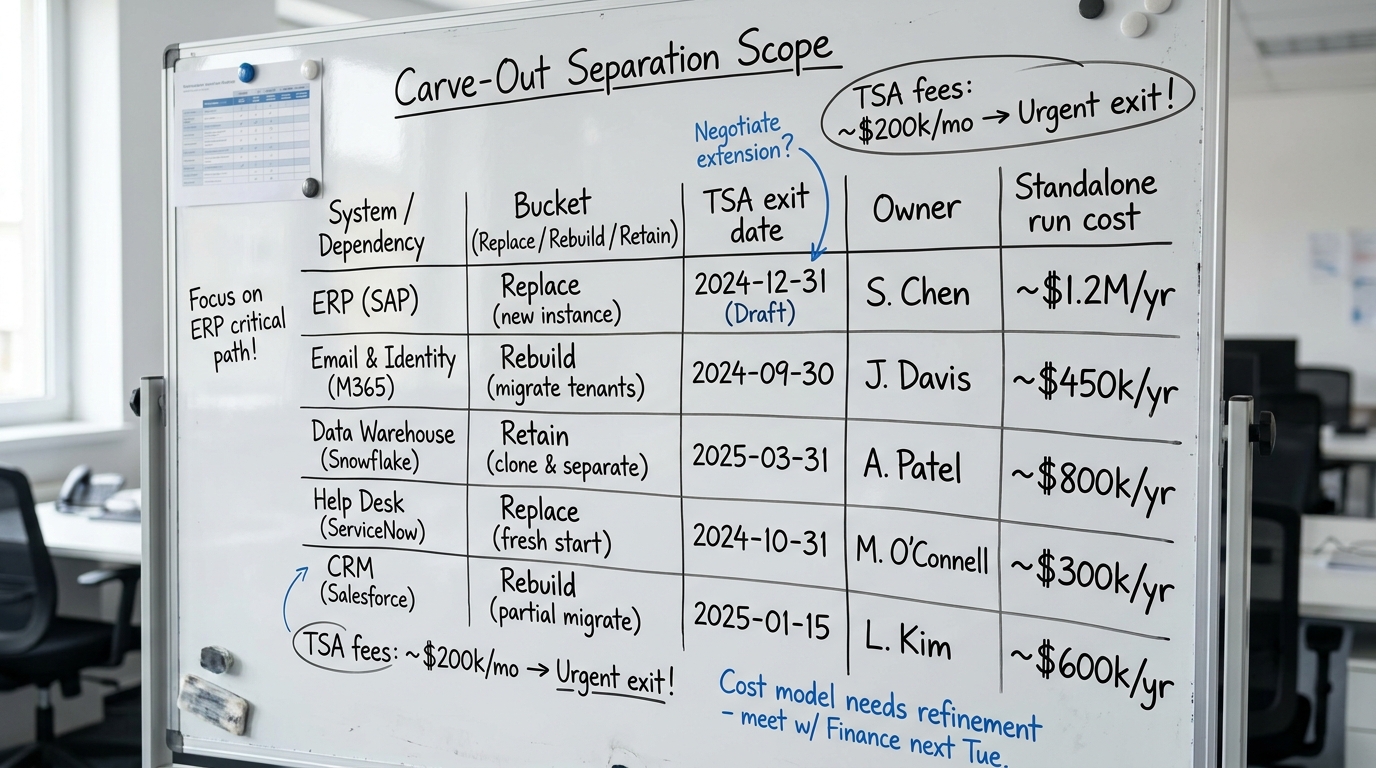
The first question is what systems actually have to separate. Some systems must be replaced outright because the seller will not license them past the TSA. Others can be cloned, migrated or rebuilt. A few are better left to a clean-sheet SaaS deployment because the parent’s version was never fit for a smaller standalone business.
An advisor who starts by proposing a tool before mapping this scope is selling capacity, not judgment. The same test applies to any transformation retainer, which is why it is worth reading how to judge a digital transformation consultant before you sign.
Group every dependency into one of three buckets
- Replace: systems the seller will not carry past the TSA, requiring a new platform and a migration.
- Rebuild: processes that ran on the parent’s shared services and now need a standalone owner and toolset.
- Retain temporarily: systems where a paid TSA extension costs less than an accelerated migration, decided on the numbers in the run-cost model.
3. Confirm what diligence already found
Most of the separation risk should already be documented if the deal ran proper technology due diligence. The carve-out advisor’s first task is to read that work, not to repeat it. If the entanglement map, the license inventory and the shared-services list are missing, the diligence was incomplete and the TSA window is now shorter than anyone thinks.
For buyers still upstream of close, the standard for that work is covered in technology due diligence and in the site’s guide to reading a technical due diligence report before you sign off. When the target is a software business, the entanglement questions shift again, which is why technical due diligence for a SaaS acquisition is worth a separate read.
4. Sequence the migration against the TSA calendar, not the roadmap
The separation plan runs backward from TSA exit dates, because those are the only fixed deadlines in the whole program. A system that costs the most to extend and takes the longest to rebuild goes first, regardless of how interesting the standalone version is. This is where a generic transformation roadmap fails a carve-out: it optimizes for capability instead of for the contractual clock.
McKinsey’s private capital research has repeatedly documented how the first year sets the trajectory of a hold, and separation programs that slip early tend to stay behind. The first 100 days of a carve-out are largely spent standing up the systems that let the business report and operate on its own numbers. General context is at McKinsey.
5. Fix data ownership before the first migration
Carved-out companies often discover they never had clean ownership of their own data, because customer records, financials and product telemetry lived inside the parent’s consolidated systems. Deciding what data comes across, in what structure, and who validates it, is a separation decision the operating partner cannot delegate to a migration vendor working on a fixed bid.
The reporting stack matters here because the CFO needs standalone financials the moment the TSA ends. If the CRM and revenue systems are being rebuilt in parallel, the buyer should read the Salesforce RevOps decisions the operating partner owns so the commercial data model is designed once, not twice.
6. Decide build versus buy for each rebuilt system
Some rebuilt systems are commodities best served by SaaS, and some encode a real operational advantage worth building. A carve-out is the rare moment when a company gets to choose its stack from scratch, and the temptation to custom-build everything is expensive. The default should be configured SaaS, with custom build reserved for genuine differentiation.
That decision belongs to the operating partner, not to whichever vendor is closest to the code. The site’s guide to the build decisions an operating partner owns lays out where custom work pays back and where it becomes a liability at exit.
7. Judge the advisor on separation evidence, not headcount
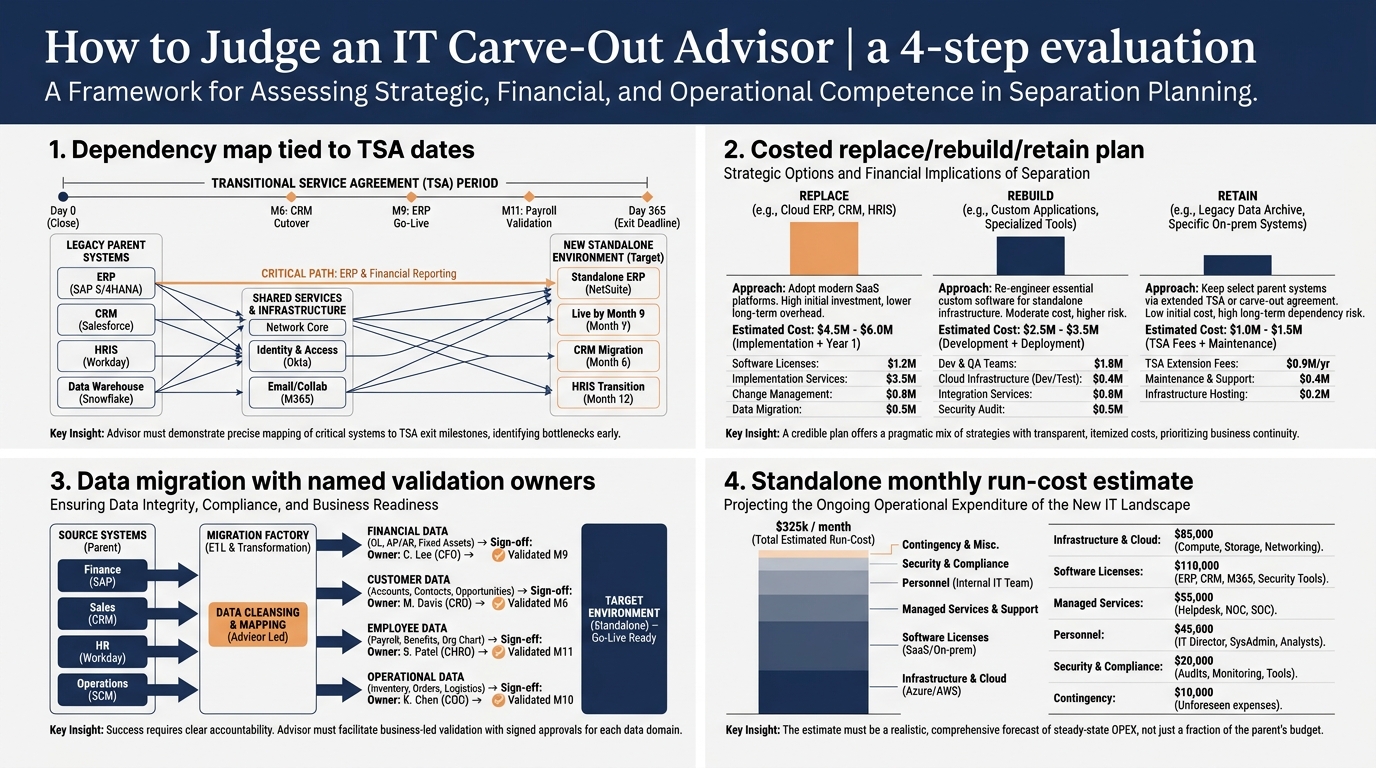
The right IT carve-out advisory partner produces a small set of artifacts early: a dependency map tied to TSA dates, a costed replace-rebuild-retain plan, a data migration approach with validation owners, and a run-cost estimate for the standalone stack. A firm that leads with a staffing table and an hourly rate is offering capacity to a problem that needs sequencing.
Ask these before signing
- Which dependencies do they consider highest risk to the TSA exit date, and why?
- What is their evidence baseline: did they read the diligence, or are they starting cold?
- Who owns each workstream on the buyer side, and what decision rights stay with the operating partner?
- What does the standalone stack cost to run per month after separation?
8. Watch the cost that shows up after separation
The build cost is visible in the plan. The run cost is not, and that is where standalone carve-outs quietly erode the margin you planned for. A parent’s shared services absorbed licensing, security, and support at scale that a smaller entity now pays for alone. PitchBook and S&P Global both publish data on how operating costs move through a hold, and the carve-out is the point where those costs get set for years. See PitchBook and S&P Global Market Intelligence.
The advisor should hand over a standalone run-cost model and a project budget. If they cannot produce the run-cost model, the buyer is signing up for a surprise on the first standalone P&L.
9. Keep revenue systems in the same plan
Separation is not only back-office plumbing. The carved-out company usually loses access to the parent’s marketing tools, analytics, and sometimes its lead flow, which means the revenue engine has to be rebuilt alongside the ERP. Treating that as a later phase is how portfolio companies come out of a TSA with clean financials and a broken pipeline.
Where the commercial motion depends on named accounts, the account list has to survive separation intact, which is the point made in this guide to ABM and the deal thesis. Buyers standing up a revenue function from scratch should also read what fractional RevOps actually buys.
10. The next-step checklist
Before an operating partner commits to an IT carve-out advisory engagement, the following should exist in writing:
- A dependency map with every shared system tagged replace, rebuild, or retain, each with a TSA exit date.
- Named owners on the buyer side for every workstream, with the operating partner’s decision rights spelled out.
- A migration sequence built backward from TSA deadlines.
- A data ownership and validation plan for every record set crossing over.
- A build-versus-buy call on each rebuilt system, defaulting to configured SaaS.
- A standalone monthly run-cost model, separate from the one-time build budget.
- A revenue-systems track running in parallel, so the pipeline is not stranded at TSA exit.
This work sits inside the broader private equity value creation agenda, and the carve-out is one of the few moments where getting the technology decisions right compresses the path to a cleaner exit.
11. Where to take the separation plan next
Portfolio companies facing a TSA clock can move faster with a structured separation and standalone build. Review the DevriX Carve-Out Digital Standup and the full DevriX private equity offer to scope the plan against your TSA exit dates.