The value creation plan a sponsor approves at close is usually a list of ambitions with dollar signs attached. By the first board meeting, the operating partner has to turn it into owned workstreams, dated commitments, and a baseline the CFO can defend. That gap, between the thesis the deal team wrote and the plan the company can actually run, is where most of the first year leaks. A portfolio value creation strategy is only useful if it names who owns each lever, what the starting number is, and how the board will know it is working before the exit model demands it.
This guide is written for the operating partner or portfolio company executive accountable for that conversion. It walks through the decisions you make and the questions you use to judge whether the plan in front of you is real or decorative.
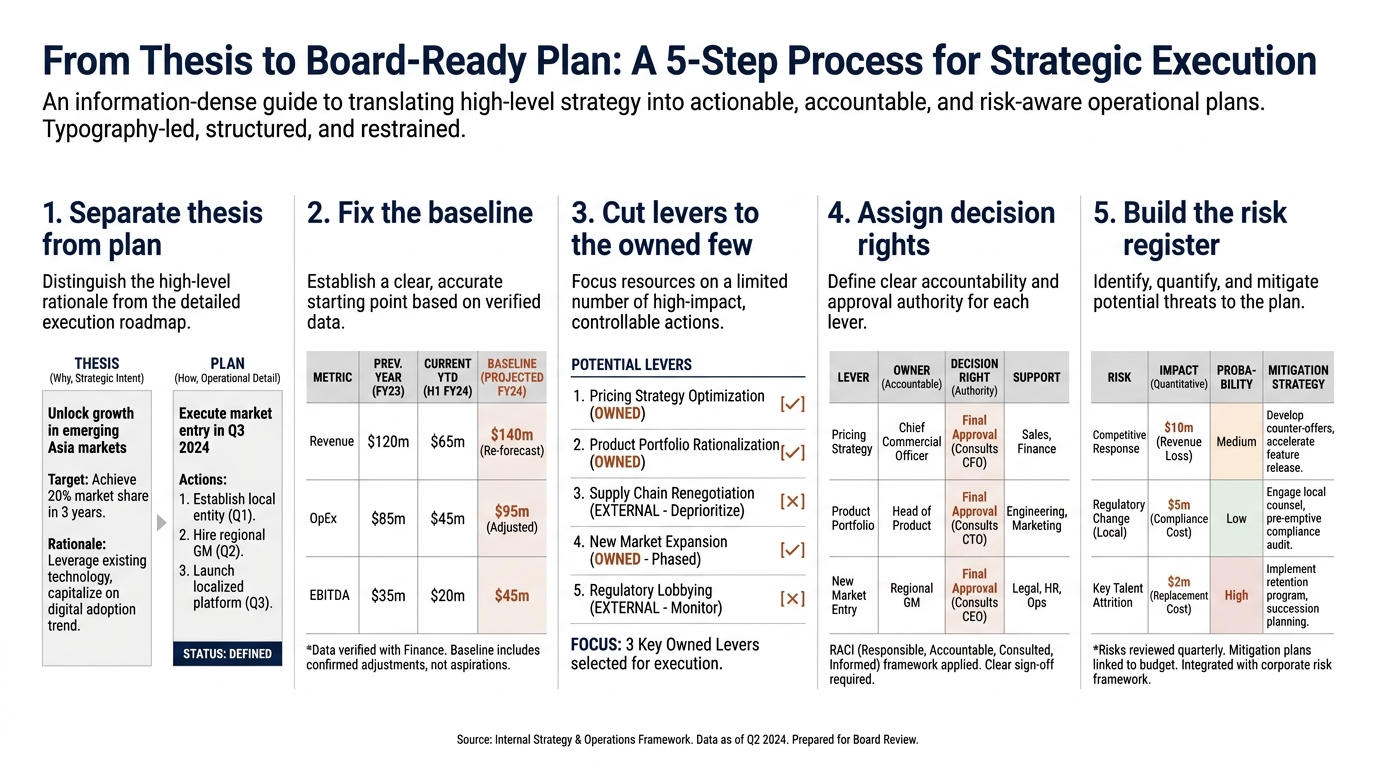
1. Separate the thesis from the plan before you commit to anything
The investment thesis says where the money comes from: a pricing correction, a cross-sell motion, a cost takeout, a roll-up with synergy assumptions. The plan is the set of actions that produce those numbers with named owners and dates. These are different documents, and treating the first as if it were the second is the most common early error.
Bain’s annual private equity report has tracked for years how much of the industry’s return now depends on operational improvement rather than multiple expansion or leverage. You can read the current state in the Bain & Company Global Private Equity Report. The practical takeaway for an operating partner is narrow: if the thesis leans on EBITDA growth, the plan has to show the mechanism and the owner of the work that produces it.
2. Fix the baseline before you set a single target
A target without a verified baseline is a guess. Before the plan goes to the board, the CFO and the operating partner need agreed starting numbers for the two or three levers that carry the thesis: current gross margin by segment, actual sales cycle length, real CAC, churn as the finance team calculates it rather than as the sales deck claims it.
The baseline work is unglamorous and it is where diligence findings get reconciled against the operating reality. If the quality of earnings flagged a revenue recognition issue, that finding belongs in the baseline assumption, reconciled and visible, so the first forecast starts from a clean number. Good technology due diligence during the deal gives you a head start here, because the systems that produce the numbers have already been examined.
3. Decide which levers you actually own in year one
Most approved plans carry more initiatives than any management team can execute while still running the business. The operating partner’s job is to cut the list to the three or four levers that move enterprise value and can show progress inside twelve months. Everything else goes on a later list or gets killed.
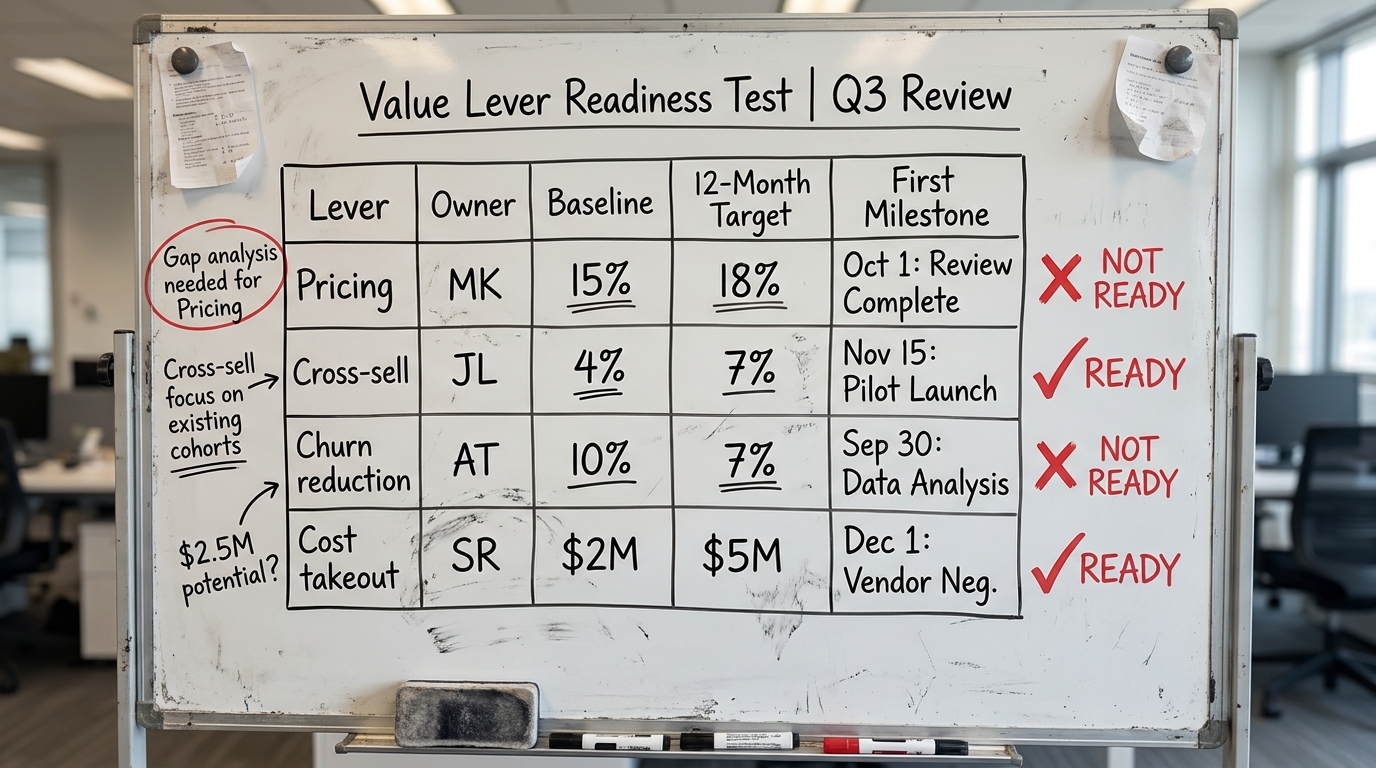
The test for inclusion is whether you can name the owner, the baseline, the target, and the first measurable milestone. If any of those is missing, the lever is not ready to be funded. A strategy with eleven workstreams and four real owners is a strategy with four workstreams and seven liabilities.
4. Assign a decision right to every workstream
A workstream without a single accountable owner drifts back to the operating partner’s desk, which does not scale past three companies. For each lever, decide who holds the decision right: the CEO, a functional leader, a fractional specialist, or the sponsor’s operating team. Write it down where the board can see it.
This is the part most plans skip, and it is the part that determines whether month four is a status update or a scramble. For the mechanics of what an owner is actually accountable for, the breakdown in what a value creation advisor in private equity actually owns is a useful reference when you are deciding where to place accountability.
5. Make the first 100 days produce evidence, not activity
The early window is for proving the plan can be executed and for establishing which assumptions hold. The output of the first 100 days should be a short list of validated assumptions, two or three quick wins with measured results, and a cleaned baseline the board trusts. McKinsey’s private capital research has consistently found that the value creation programs that hold up are the ones that establish operating cadence early; you can follow their work at McKinsey.
Build the window around decisions that unlock later work: which systems stay, which data gets cleaned, which roles get filled. For the sequencing, the DevriX view on the first 100 days lays out what belongs in that window and what should wait.
6. Treat revenue systems as a dependency, not a line item
Cross-sell targets, pricing changes, and retention plays all assume the CRM, billing, and reporting stack can execute and measure them. When the systems cannot, the lever fails quietly and the board sees it two quarters late. Put the revenue system readiness question in the risk register during planning, not after the forecast misses.
If the thesis depends on commercial execution, decide early whether the company needs embedded operating capacity to run it. The trade-offs are laid out in fractional RevOps for private equity and what the operating partner actually buys, which is worth reading before you assume the in-house team has the bandwidth.
7. Build the risk register the board will actually use
Every lever has a way it fails. A pricing increase drives churn above the model. A cross-sell motion needs a product the roadmap has not built. A cost takeout removes capacity the growth plan still needs. The strategy document should name these failure modes next to the levers they threaten, with an owner for each mitigation.
A risk register that lists generic risks (“market conditions,” “talent retention”) is theater. A useful one ties a specific risk to a specific lever and a specific person, and it gets reviewed at every board meeting. The Harvard Law School Forum on Corporate Governance publishes governance research worth tracking at corpgov.law.harvard.edu.
8. Handle integration levers differently from organic ones
If the thesis includes an add-on or a carve-out, the integration work is a separate category with its own dependencies and its own timeline. Revenue system consolidation, data migration, and org design cannot be run as side effects of the organic plan. They need their own owner and their own milestones.
The decisions an operating partner cannot push down are specific. The discussion in post merger integration for revenue systems and in IT carve-out advisory and the separation decisions the operating partner owns covers the calls that stay with you. If the plan treats integration as a line item under “synergies,” it is not ready.
9. Set the measurement the board sees from day one
Decide early what three or four numbers the board will track, and make them the ones tied to the thesis rather than the ones that are easy to report. Activity metrics (tickets closed, campaigns launched, features shipped) tell you the team is busy, not that enterprise value is moving. Prefer the financial consequence: margin, run-rate revenue, cash conversion, retention.
Mark each number as realized, run-rate, or forecast, and never let a forecast number read as money already in the bank. PitchBook and S&P Global both publish data useful for benchmarking what “good” looks like in a given sector; see PitchBook and S&P Global Market Intelligence.
10. Decide where you buy capacity and where you build it
The plan will expose roles the company does not have: a RevOps lead, a data owner, a technology executive who can translate systems work into EBITDA terms. For each gap, decide whether to hire, use a fractional specialist, or source it from the sponsor’s bench. The decision affects speed and cost, and it belongs in the plan rather than in a reactive hire three months later.
For the technology gaps specifically, the five decisions covered in fractional CTO PMI and the five decisions an operating partner cannot delegate and the framework in how to judge a digital transformation partner for portfolio companies help you decide what to buy and how to judge who delivers it.
11. A checklist for judging whether the strategy is board-ready
Before the plan goes in front of the board, run it against these questions. If the answer to any is no, the plan has a gap that will surface later as a missed forecast.
- Does every funded lever have a named owner with the decision right written down?
- Is there a verified baseline for each lever, reconciled against diligence findings?
- Are the three or four board metrics tied to the thesis, and classified as realized, run-rate, or forecast?
- Does each lever have its failure mode and a mitigation owner in the risk register?
- Is revenue system readiness assessed before any lever that depends on it is committed?
- Is integration work carried as its own workstream with its own timeline, not folded into “synergies”?
- Does the first 100 days produce evidence and quick wins rather than a full build?
- Have the capacity gaps been decided as hire, fractional, or sponsor bench, with cost and speed named?
The commercial work behind most of these decisions is covered in what digital value creation consulting buys a private equity owner, which is a useful companion when you are pressure-testing the plan with the management team.
12. Where this work usually starts
A portfolio value creation strategy that survives the first board meeting is one where the baseline is real, the levers are owned, and the measurement is honest about what has been earned versus what is still a forecast. The diagnostic that produces that clarity is a contained piece of work, usually a few weeks, and it feeds directly into the 100-day plan the board approves.
If you are converting a thesis into an owned plan right now, DevriX runs the diagnostic and the value creation plan for portfolio companies. Start with the private equity practice to see how the diagnostic and 100-day engagement are scoped, and bring the levers you are least confident about to the first conversation.