By the time a deal clears the investment committee, most of the value creation thinking has already been outsourced to optimism. The deal team modeled a revenue ramp, assumed a few cost lines would tighten, and penciled in a multiple on exit. Nobody has yet named who owns the first revenue system change, what the baseline actually is, or which assumptions break if the data turns out worse than the dataroom suggested. That gap is the reason pre-close value creation planning matters, and it matters most in the weeks between a signed LOI and confirmatory diligence, when you can still price the work into the thesis rather than discover it in month four.
This is written for the operating partner or portfolio executive who will be held to the plan, not the person building a deck for the committee. The question is whether the plan names decisions, owners, and evidence, and whether you can judge it before you commit capital to execute it.
1. Why the pre-close window is the only cheap time to decide
Every decision you defer past close gets more expensive to make. Before signing, a weak revenue system is a diligence finding you can price or walk away from. After Day 1, it is a cost you carry while the clock on the hold period runs. Bain’s annual Global Private Equity Report has tracked for years how much of fund returns now depend on operational improvement rather than multiple expansion, which means the plan you write before close is doing more of the work than the entry price.
The commercial consequence is simple to state. A plan that only lists initiatives tells you nothing about whether the thesis survives contact with the actual business. A plan that ties each initiative to a baseline, an owner, and a dated decision tells you what you are buying and what it costs to realize.
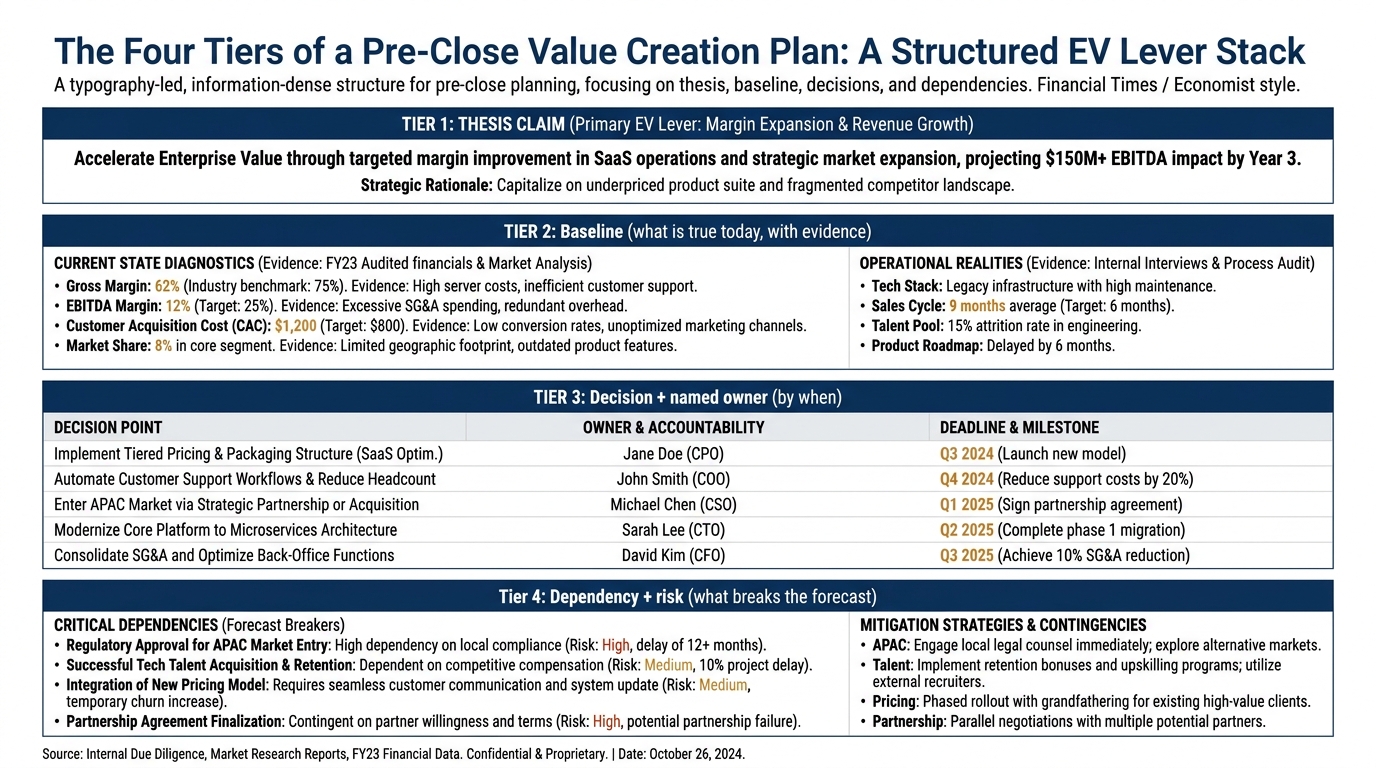
2. The four tiers of a plan worth executing
A usable pre-close value creation plan separates into four tiers. Each tier answers a different question, and skipping one is how plans fail quietly between the LOI and the first board meeting.
- Tier 1, the thesis claim. Name the enterprise-value lever this workstream delivers: revenue growth, EBITDA expansion, cash conversion, faster integration, or reduced operating risk. A workstream that cannot attach to one of these five levers belongs in a wish list.
- Tier 2, the baseline. State what is true today, with evidence. Record the current conversion rate, the current system of record, the measured data quality, and the current billable utilization rate against available capacity.
- Tier 3, the decision and owner. Name what has to be decided, the person who holds the decision right, and the date by which that decision must be made. A function cannot decide; a named individual can.
- Tier 4, the dependency and risk. What this workstream needs from another, and what breaks the forecast if the baseline is wrong.
3. Tier 1 forces the plan to name an enterprise-value lever
A PE buyer is not purchasing campaigns, a CRM migration, or engineering capacity. It is purchasing measurable enterprise-value improvement, and every workstream in the plan should trace back to a number the fund will be judged on. The test at this tier is whether you can delete a workstream and still hit the thesis. If you can, the workstream was activity dressed as value.
This is where most pre-close plans read well and mean little. A line item like “improve digital presence” names no lever. A line item like “lift inbound-sourced pipeline from 12 percent to 25 percent of bookings to reduce CAC dependency on paid” names a lever, a baseline, and a target you can later check against actuals.
4. Tier 2 is where diligence either earns its fee or does not
The baseline is the part buyers most often take on faith and most often regret. A revenue plan built on a reported conversion rate that nobody has traced to source data is a forecast built on a story. Confirmatory diligence is the window to replace assertion with evidence, and the systems and data review should feed the plan directly rather than sit in a separate report nobody opens after close.
This is the overlap between the value creation plan and technology due diligence: the diligence process should produce the baselines the plan depends on, in the same units the plan will measure. If diligence tells you the pipeline looks healthy but the revenue ramp you are modeling assumes a 40 percent lift, someone has to reconcile those two numbers before, not after, you own the business.
What a real baseline includes
- The actual system of record for revenue, and whether it matches what the business says it is.
- Data quality on the fields the plan will act on, not the fields that are easy to export.
- Current capacity and utilization, so a growth assumption is checked against whether anyone can deliver it.
- The last 12 to 18 months of actuals versus plan, which tells you how reliable this management team’s forecasts have been.
5. Tier 3 assigns decision rights before anyone needs them
The fastest way to lose the first 100 days is to arrive at Day 1 with a plan full of initiatives and no named owners. Work that belongs to everyone belongs to no one, and the gap shows up in the first board meeting as a column of items marked “in progress” with no accountable name attached.
Some of these decisions cannot be delegated to the portfolio company’s existing team, because that team may be the subject of the decision. The reasoning on which calls an operating partner has to keep is laid out well in this piece on the five decisions an operating partner cannot delegate, and the pre-close plan is where you decide which of those sit with you versus the management team you are inheriting.
6. Tier 4 writes the risk register the deck left out
Most pre-close plans show the upside case and bury the dependencies. The dependency tier makes them explicit: the revenue system change that cannot happen until the data migration completes, the sales hire that cannot close the gap until the ICP is redefined, the integration milestone that slips if a single carve-out system runs late.
When a deal involves a carve-out, this tier carries most of the real risk, because separation sequencing determines what the business can and cannot do on Day 1. The separation calls worth mapping before close are covered in detail in this breakdown of the IT carve-out separation decisions the operating partner owns.
7. How to judge a plan someone else wrote
If a diligence provider or advisor hands you the value creation plan, you still own the judgment on whether it is usable. Three tests do most of the work.
- Can you trace every number to a source? If a target rests on a baseline nobody can point to, it is a hope with a decimal point.
- Does every workstream have a named owner and a date? Not a function, a person, and not “Q1,” a decision date.
- Does the plan say what it would take to be wrong? A plan with no downside case has not been pressure-tested.
The same standard applies to the people you hire to build or execute it. The criteria for judging a value creation advisor are worth reading before you sign anyone, and this walkthrough of what a value creation advisor actually owns sets a reasonable bar.
8. An illustrative scenario, a lower-middle-market services business
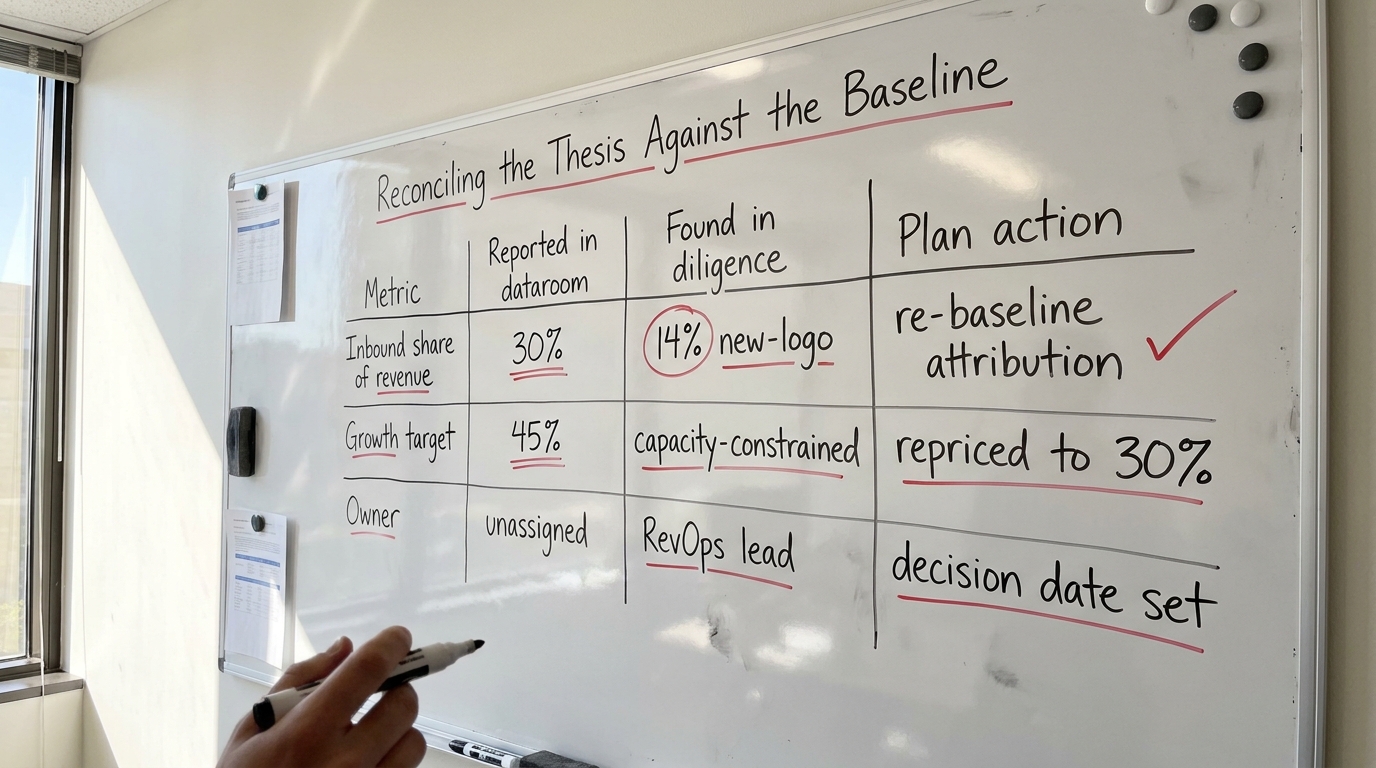
The following is an illustrative scenario, not a client result. Take a professional-services business with a signed LOI, a reported 30 percent of revenue from inbound and a thesis that assumes lifting that to 45 percent over the hold period.
The first tier names the lever: revenue growth with lower acquisition cost. The second tier, run during confirmatory diligence, finds the inbound figure includes existing-client expansion miscoded as new inbound, so the true new-logo inbound rate is closer to 14 percent. The third tier assigns the RevOps owner to re-baseline attribution before any spend decision. The fourth tier flags that the growth assumption depends on billable capacity that the resource plan shows is already near full. The plan does not die, but the target gets repriced from 45 to 30 percent and the deal math gets honest before close rather than at the second board meeting.
9. Where the plan hands off to the first 100 days
A pre-close plan is only worth the ink if it survives into execution. The handoff point is the first 100 days, where the tiers become a sequenced workstream with owners already named and baselines already measured. A plan that arrives at Day 1 with those decisions still open has pushed the expensive work into the most expensive window.
For revenue systems specifically, the operating partner owns a set of integration calls that cannot be left to the teams merging, and those are set out in this piece on post-merger integration for revenue systems. If the capacity to execute does not exist in-house, the fractional RevOps model is one way to buy it without a permanent hire.
10. What the research says about getting this wrong
The pattern of value creation moving earlier in the deal lifecycle is well documented. McKinsey’s private capital research has repeatedly made the case that operational value creation now separates top-quartile funds from the rest, and the Harvard Law School Forum on Corporate Governance has published extensively on how diligence quality and post-close governance drive outcomes. The common thread is that the decisions priced before signing are the ones that hold, and the ones deferred to execution are the ones that erode return.
11. A next-step checklist before you commit
- Confirm every workstream in the plan traces to an enterprise-value lever, and delete the ones that do not.
- Replace each assumed baseline with a measured one during confirmatory diligence, in the units the plan will track.
- Assign a named owner and a decision date to every Tier 3 item before Day 1.
- Write the dependency and the downside case for each workstream, so the risk register exists before the first board meeting.
- Decide which decisions you keep and which the inherited management team owns.
- Sequence the surviving plan into the first 100 days with owners already in place.
The commercial fit here is usually staged: a focused diagnostic to pressure-test the plan and its baselines during diligence, then a scoped 100-Day value creation plan the operating team actually runs. If you want that work mapped against your deal, see how the DevriX private equity team structures the diagnostic and the 100-Day plan, and start there.