An operating partner who signs an integration engagement in the week after close is making a staffing decision under time pressure, and getting it wrong means a quarter of lost momentum against the deal model, a management team that stops trusting the integration workstream, and a revenue system that drifts further apart while everyone waits for a plan to arrive. The decision to hire post-merger integration for private equity is really a decision about who will own execution when the deal team moves on, and most of the firms pitching for that work are better at the diagnosis than the delivery.
This guide is written for the person accountable for the numbers inside a portfolio company or across a portfolio, not for someone learning the category. It covers what you actually have to decide, in what order, and how to judge the provider you are about to pay.
1. Decide what the integration has to protect before you brief anyone
The brief most firms respond to is “integrate the acquisition,” which is a category rather than a scoped instruction. The version that produces useful work names the one or two things the deal model depends on and protects them first. For a bolt-on bought for its customer base, that is usually revenue continuity and a clean customer record. For a platform buying scale, it is more often the ability to report consolidated numbers to the board on a single definition of revenue.
Write down the two or three outcomes the integration exists to serve, in the language of the private equity thesis, before any provider shows you a template. Bain’s annual Global Private Equity Report has tracked for years how often value creation plans slip because the integration scope was never tied back to the thesis that justified the price.
2. Separate the plan from the people who will run it
The expensive mistake is buying a plan and assuming execution comes with it. A well-built 100-day integration plan is a document. Running it means someone sits inside the business every week, owns the risk register, chases the dependencies, and tells you when actual is diverging from plan while there is still time to act.
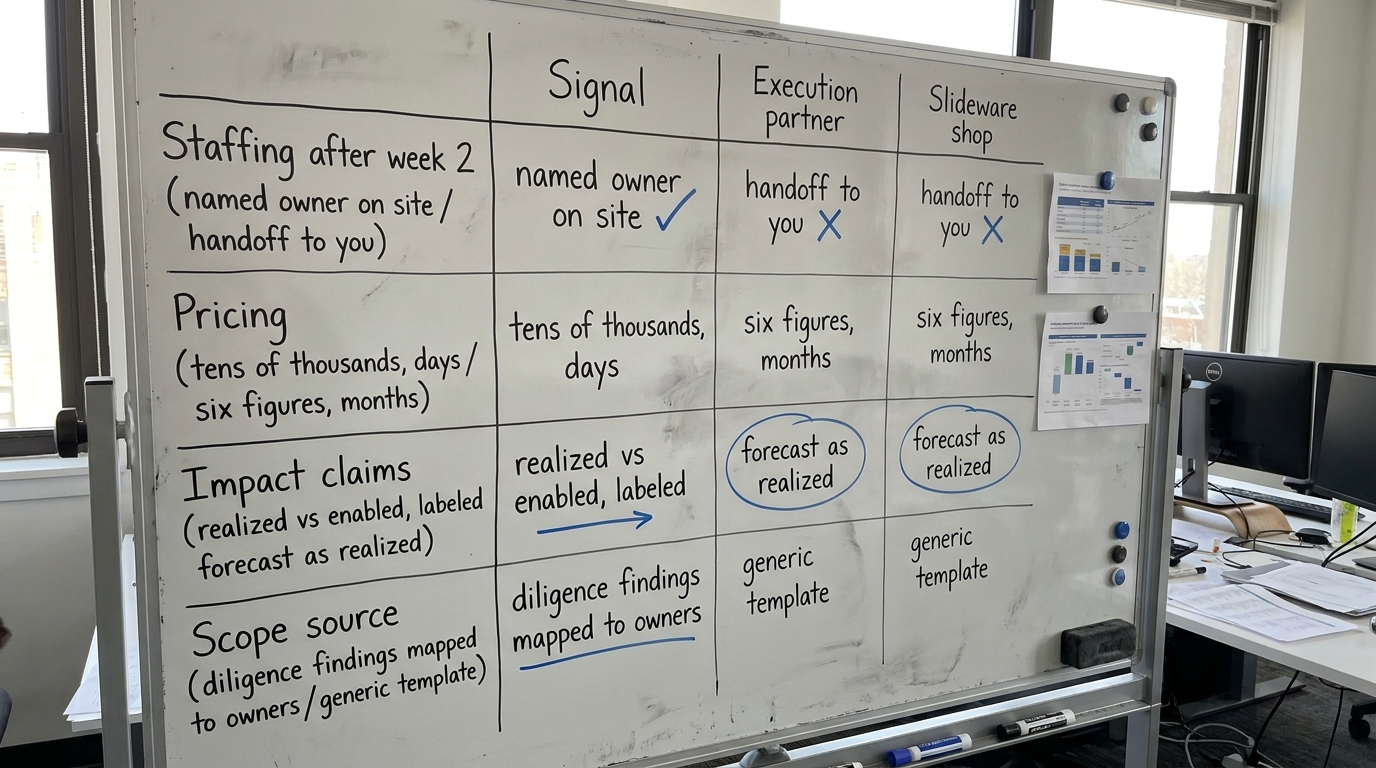
Ask any provider to show you the difference in their own staffing. Who writes the plan, and who is physically accountable for the workstreams after week two? The answer separates a slideware shop from an execution partner, a line drawn well in how to hire post-merger integration experts without buying a deck you cannot execute.
3. Get the sequencing right, because everything else inherits it
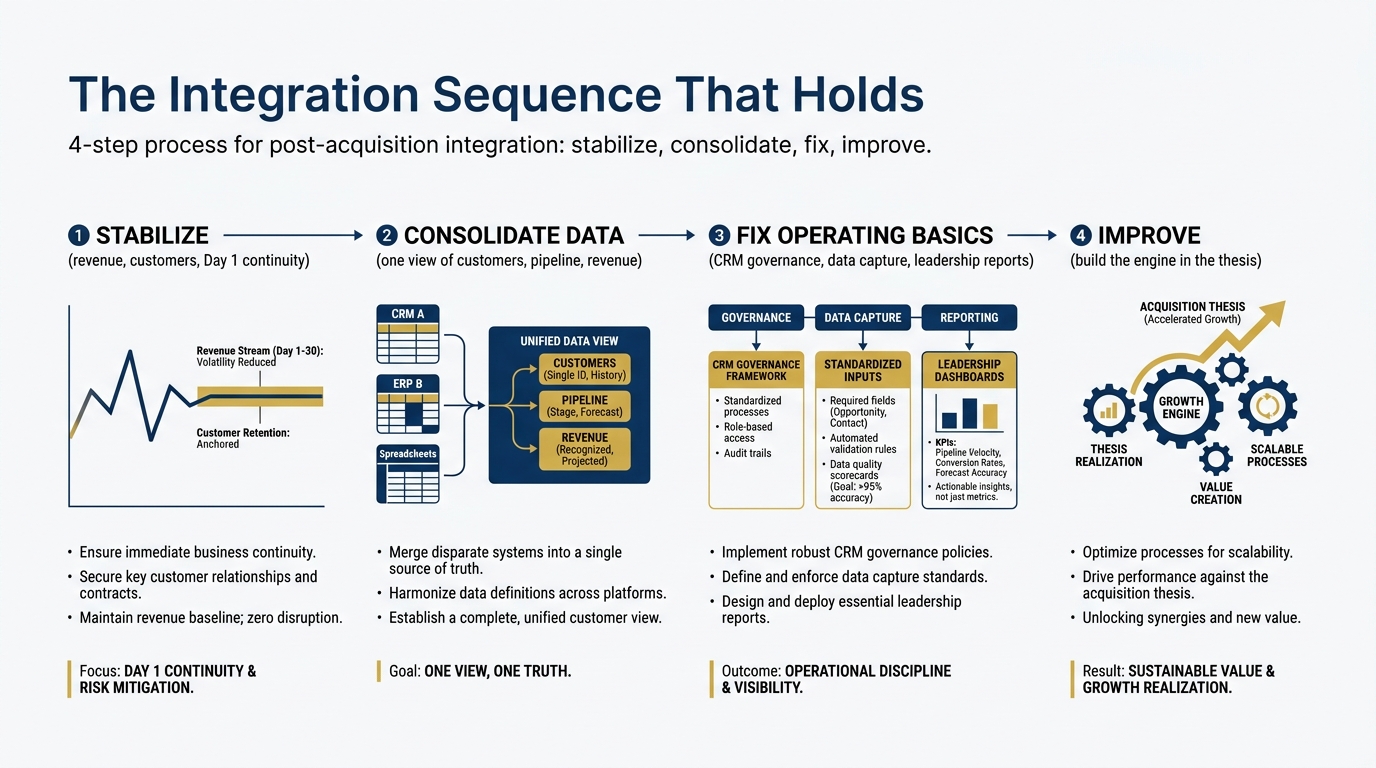
Integration work has a natural order, and firms that skip steps create rework you pay for twice. The sequence that holds across most deals:
- Stabilize. Keep revenue, customers and core systems running through Day 1 and the weeks after. Nothing clever happens here.
- Consolidate data. Get to one view of customers, pipeline and revenue before anyone proposes automation or a new tool.
- Fix the operating basics. CRM governance, consistent data capture, the reports leadership actually needs.
- Improve. Only once the foundation holds do you build the engine that was in the thesis.
Advanced automation pitched before the data foundation exists is the most common way integration budgets get burned with nothing durable to show for it.
4. Decide the systems calls before they decide themselves
The hardest integration decisions involve systems and data rather than organizational structure. Which CRM survives, how customer records get reconciled, whether two brands keep separate sites or consolidate. These calls compound, and deferring them costs more than making them does. The judgment involved in one of them is laid out in multi-brand website consolidation for portfolio companies and the calls an operating partner has to make.
A good integration provider arrives with a point of view on these from the outside-in work, not a workshop to discover them with you three weeks in. The earlier version of this discipline, done before signing, is covered in exit readiness and post-merger integration start with decisions you make before close.
5. Judge the provider on evidence, not credentials
Logos and tenure tell you very little about whether a firm can run your integration. Three tests separate the serious providers:
They did the homework before the first meeting
A partner who arrives already understanding your acquisition’s business model, having looked at the public footprint and the obvious data gaps, is a different purchase from one who needs to be briefed and corrected through the whole engagement.
They name the baseline
Credible firms talk in terms of current state versus plan, with a measurable baseline, owners and decision rights. Firms that talk in hours, tickets and campaigns are selling activity and leaving the outcome to you.
They classify their impact honestly
Ask whether a claimed result is realized, run-rate, or merely enabled. A firm that lets forecast value read as money already in the bank will do the same thing in your board pack.
6. Price it against what this work costs now, not what it cost in 2020
The cost of data consolidation and RevOps setup has dropped as tooling and AI have compressed the build. Entry-stage integration work that genuinely moves in days should be priced in the tens of thousands, not opened at six figures with a multi-month discovery phase. PitchBook and PitchBook research and McKinsey’s private capital work both document the pressure on holding periods and returns that makes slow, expensive integration a losing trade. If a quote starts high and moves slowly, benchmark it before you sign.
The companion question of what a scoping diagnostic should cost is handled in what a value creation diagnostic costs and how to judge the spend.
7. Match the hire to the actual need, not the category
“Post-merger integration” covers several different jobs, and the right provider for one is wrong for another:
- Data visibility. The acquired business runs on Excel and disconnected systems. You need read-only connections, a unified model and the first dashboards in days.
- RevOps hygiene. The basics are missing. You need CRM governance and the right reports before anything is built on top.
- GTM engineering. The foundation holds but the revenue engine needs to run with fewer people.
Naming which of these you are buying prevents the common failure of hiring a strategy firm for an execution problem. The RevOps-specific version of this decision is covered in post-acquisition RevOps integration and the calls that decide whether the deal model holds.
8. Connect integration scope to the diligence you already paid for
The findings from technology due diligence are the input to the integration brief, not a separate document to file. Every risk flagged in diligence should map to an owner and a workstream in the integration plan, or you have a gap nobody is accountable for. The Harvard Law School Forum on Corporate Governance publishes governance research on how poorly integration follows through on diligence findings, and the pattern is consistent enough to plan against.
9. Build the measurement in from Day 1
An integration you cannot measure is one you cannot defend at the first board meeting. Agree the baseline, the actual-versus-plan cadence, and the two formats leadership needs: Excel on the same data for finance, dashboards with insights flagged for the board. The first 100 days is where this discipline is either established or lost, and the plan you should be able to stand behind is described in the post-merger integration 100-day plan an operating partner should be able to defend.
10. The checklist before you sign
- The two or three outcomes the integration protects are written down and tied to the thesis.
- You know who writes the plan and who is on site owning workstreams after week two, and they are not the same slide.
- The provider has a point of view on the systems and data calls from outside-in work, not a workshop to find them later.
- Pricing is benchmarked against current build costs, and entry work moves in days.
- Every diligence finding maps to an owner and a workstream.
- Impact is classified as realized, run-rate or enabled, and nothing forecast is presented as banked.
- The baseline, the cadence, and both reporting formats are agreed before Day 1.
If a provider cannot pass this list in a single working session, the gap is in execution, and execution is the whole reason to hire for post-merger integration in the first place.
When you are ready to brief a partner who runs the plan rather than hands it over, see how DevriX and GrowthShuttle structure 100-day digital execution for private equity.