Marketing for private equity rarely fails because a campaign underperforms. It fails because the operating partner inherits a portfolio company where the marketing budget is real, the pipeline number is a guess, and nobody can connect spend to the revenue line the deal underwriting assumed. When the first board meeting arrives and the CEO presents a demand-generation plan, the operating partner has to decide whether the spend buys enterprise value or just activity that reads well on a slide.
This guide is for the person accountable for revenue systems in a portfolio company: the operating partner setting the mandate, the portco CEO defending the plan, and the CFO who has to tie it back to the forecast. It assumes budget, not beginners. The sequence below is how to decide what marketing a portfolio company should fund, in what order, and how to judge whether it is working.
1. Start with the thesis, not the funnel
Every marketing decision inside a private equity portfolio company should trace back to the investment thesis. If the deal underwrote organic growth from a fragmented market, marketing has to produce net-new pipeline in a defined segment. If the thesis is buy-and-build, marketing exists to support integration and cross-sell, not to chase brand awareness.
Bain’s annual private equity report has tracked how value creation has shifted toward operational improvement rather than multiple expansion, which means marketing now has to defend a revenue line, not a reach metric. Before approving any plan, the operating partner should be able to state in one sentence which part of the thesis the spend serves. If nobody can, the plan is premature.
2. Baseline what you actually bought
Most lower-middle-market targets arrive with marketing that was never measured. The CRM is half-populated, attribution is last-touch or nonexistent, and the pipeline report in the data room was built in a spreadsheet the week before diligence. That gap is a diligence finding, not a surprise to discover in month three.
Before close, technology due diligence should establish whether the marketing and revenue stack can produce reliable numbers at all. The companies that cannot see their own numbers (ERP, CRM, and martech disconnected, the business running on Excel) are the ones where the first 100 days get spent building visibility instead of growth. Deciding that early changes what you underwrite and what you budget.
3. Fix the revenue operations foundation before funding demand
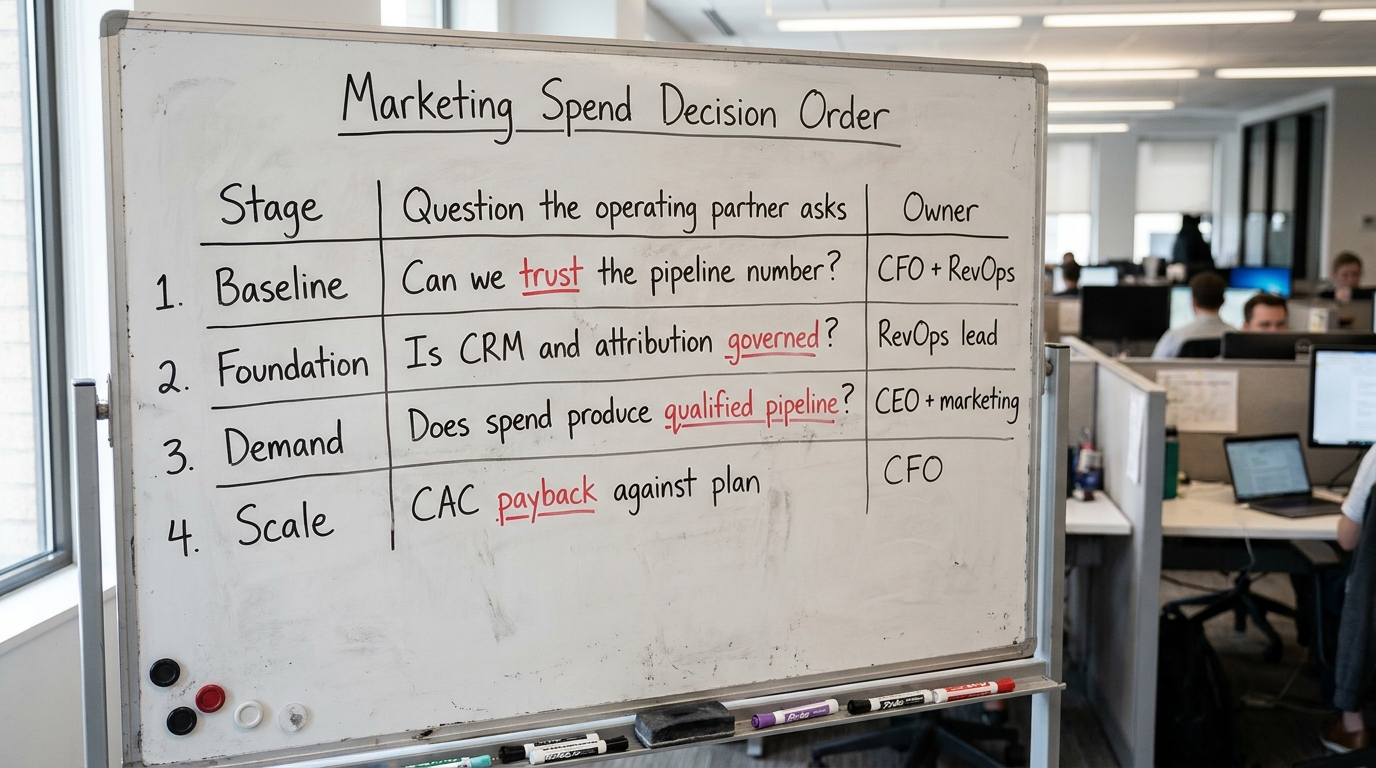
Advanced demand generation pitched on top of broken data capture wastes the budget and hides the result. If the CRM has no governance, leads are not scored consistently, and reporting answers the wrong question, then more spend produces more noise. The foundation has to come first: consistent data capture, a shared pipeline definition between sales and marketing, and reporting the board can actually read.
This is the unglamorous work that determines whether every later dollar is measurable. It is also the work that makes post-acquisition RevOps integration hold up when the deal model assumes a specific conversion rate the acquired company has never tracked.
4. Decide build, buy, or rent the capability
The operating partner usually faces a staffing question before a strategy question: hire a RevOps lead, hire a GTM engineer, or rent the capability as a service. Each path carries a different speed and a different lock-in. A full-time hire takes a quarter to recruit and ramp. A fractional or outsourced team can stand up the foundation in weeks but needs a clear handoff plan.
The right answer depends on the hold period and the number of portfolio companies with the same gap. McKinsey’s private capital research has documented how firms increasingly centralize operating capabilities across the portfolio rather than rebuild them deal by deal. A capability you need in five companies should probably not be rebuilt five times.
5. Separate net-new demand from cross-sell in a roll-up
In a buy-and-build, marketing has two different jobs and they get confused constantly. Net-new demand grows the top of the funnel in a target segment. Cross-sell and consolidation grow revenue per account across brands you already own. They need different data, different budgets, and different owners.
When a roll-up consolidates its web presence, the marketing decisions ride on top of hard technical calls about domains, redirects, and SEO equity. Those calls belong in a planned website migration for a roll-up and in any multi-brand website consolidation, because a botched migration can erase years of organic demand before a single campaign runs.
6. Judge AI search visibility, not just Google rankings
Buyers now shortlist vendors inside AI assistants before they contact anyone, and the first answer takes most of the demand. For a portfolio company selling into a defined ICP, the question is no longer only where it ranks on Google. It is whether it appears at all when a buyer asks an assistant to name options in its category, and how it shows up against named competitors.
This is measurable. It starts with the prompts a real buyer would use, the company’s visibility on those prompts, and a weekly loop to close the gaps. On our own network we pull Semrush keyword and competitor data across the 60-plus domains we track, which is the same discipline a portfolio company should apply to its own category.
7. Set the metrics the board will actually use
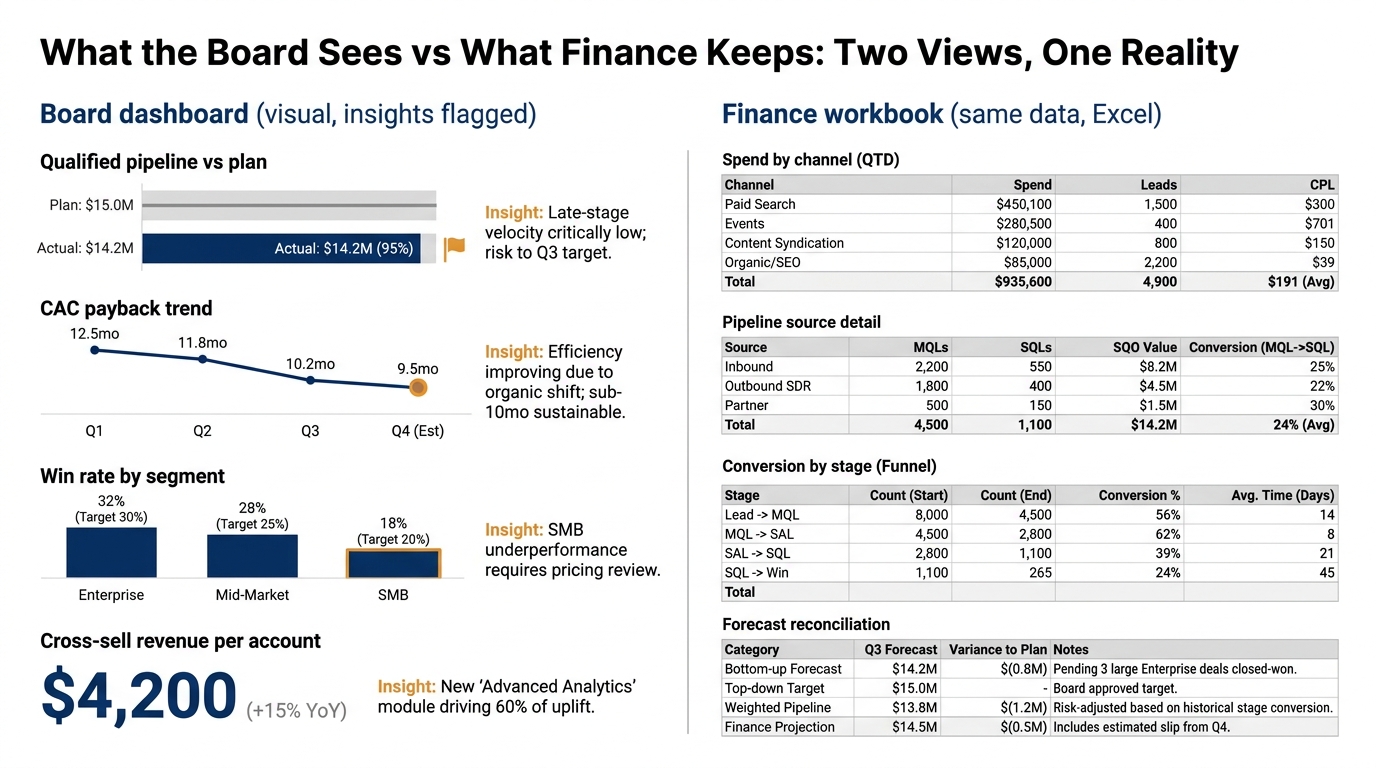
The CFO needs marketing reported in terms that tie to the forecast: qualified pipeline created, pipeline-to-close conversion, customer acquisition cost, and CAC payback against plan. Leadership and the board need a visual read on the same data. Finance keeps the spreadsheet; the board gets the dashboard, with the insights flagged rather than buried.
Harvard Business Review’s coverage of mergers and acquisitions has repeatedly made the point that integration value shows up in operating metrics. A marketing dashboard that counts impressions and emails sent, with no line to revenue, tells the board nothing it can act on.
8. Tie the plan to the first 100 days
The marketing decisions above are not a standalone workstream. They sit inside the broader integration calendar. The first 100 days is when the operating partner establishes baselines, assigns owners, and decides which fixes happen now and which wait. A marketing plan that ignores the integration calendar competes with it for the same scarce attention.
The sequence that holds up is the one an operating partner can defend line by line, which is the same standard set out in the post-merger integration 100-day plan. Before approving spend, the operating partner should confirm it has an owner, a baseline to measure against, and a place in the integration calendar.
9. Avoid the patterns that waste the budget
A handful of patterns reliably burn marketing spend in portfolio companies. Watch for all of them before approving a plan.
- SaaS templates on a non-SaaS business. A playbook built for a software company applied to a distributor, a project-delivery firm, or a clinic group will measure the wrong things.
- Automation before the foundation. Advanced workflows layered on ungoverned data produce confident reports that are wrong.
- Ad-spend-centric RevOps for companies that barely advertise. Many B2B portfolio companies grow through relationships and referral, not paid media, and a paid-first plan misreads the business.
- A one-off audit with no plan. A report that names problems needs a sequenced path to fix them, or the board cannot decide what to do next.
PitchBook’s data and S&P Global Market Intelligence both track how operational levers now drive a larger share of returns than they did a decade ago, which raises the bar on whether marketing spend can be defended as a value-creation lever rather than a cost of doing business.
10. Connect marketing to the exit narrative
What you build now has to read cleanly to the next buyer. A portfolio company with a documented demand engine, clean attribution, and a repeatable pipeline is worth more than one whose growth cannot be explained. Exit readiness is built into the operating decisions, not assembled at the end, as laid out in how exit readiness starts with decisions you make before close.
When the capability itself (the team, the stack, the playbook) matters to the thesis, the hiring call deserves the same scrutiny as any other, which is the point of hiring post-merger integration without buying a plan nobody can run.
11. A checklist the operating partner can defend
Before the next board meeting, the operating partner should be able to answer each of these in a sentence:
- Which part of the investment thesis does this marketing spend serve?
- Can we trust the current pipeline number, and if not, what is the fix and who owns it?
- Is the CRM and attribution foundation governed before any demand spend is approved?
- Are we building, buying, or renting the capability, and why that choice for this hold period?
- Are net-new demand and cross-sell budgeted and owned separately?
- Do we appear when a target buyer asks an AI assistant to name options in our category?
- Does the board dashboard tie every metric to revenue, with finance keeping the same data in Excel?
- Is the marketing plan inside the 100-day calendar with an owner and a baseline?
If any answer is missing, the plan is not ready to fund. The commercial due diligence habit of owning the decisions rather than reviewing them, covered in M&A commercial due diligence, applies here just as directly.
If the portfolio company cannot see its own numbers yet, the first step is read-only access to the stack and a unified view of pipeline and spend, which can be standing in days rather than a six-month project. See how the DevriX and GrowthShuttle private equity team scopes that work and what the first low-risk engagement looks like.