An operating partner staring at a technical due diligence quote is not really pricing an engineering review. They are pricing the risk of a surprise showing up ninety days after close, when the platform they underwrote as a growth asset turns out to need a rebuild the model never funded. The question is never “what does technical due diligence cost” in the abstract. It is “what does it cost to not know, and how much confidence does each dollar of diligence actually buy.” Get that framing wrong and a deal team either overpays for a report nobody reads or, worse, skips the check on the exact system the thesis depends on.
This guide is for the person who has budget authority on the deal and the accountability for the number afterward. It sets out what technical due diligence cost actually reflects, how to size the engagement to the deal, and how to judge whether the bill you were handed is defensible.
1. Why the price varies so much
Two quotes for the same target can differ by a factor of five, and both can be honest. The spread comes from scope, not from padding. A review that reads a repository, interviews the CTO, and files a memo is a different product from one that runs static analysis, maps every third-party dependency, tests the deployment pipeline, and stress-tests the security posture against a named framework.
Bain’s annual private equity report has tracked how holding periods and value-creation expectations have tightened, which raises the cost of getting the technology read wrong. When the plan depends on the platform absorbing three add-ons in eighteen months, a shallow review is not cheaper. It is a deferred liability priced at zero.
2. What you are actually buying
A technical due diligence cost buys evidence against a set of decision-relevant questions, not a generic “is the code good” verdict. The useful engagement is scoped to the thesis. If the plan is a roll-up, the diligence has to answer whether the architecture can absorb acquisitions without a re-platform. If the plan is margin expansion, it has to surface where engineering spend is buying nothing.
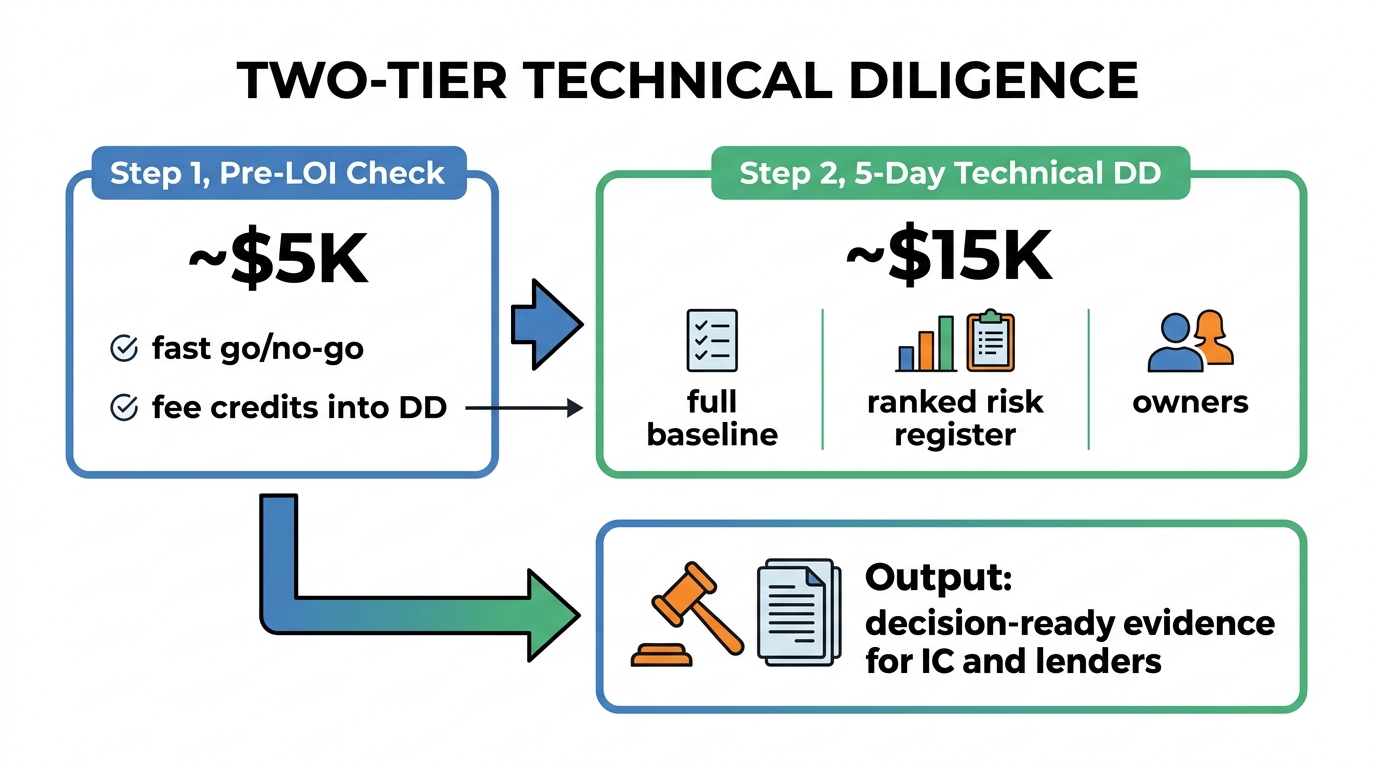
DevriX frames technology due diligence as producing evidence a deal team can act on: a baseline, a ranked risk register, and an owner for each item. That is the output to insist on, whatever the price.
3. The two-tier structure most deals need
Most mid-market deals do not need one large diligence event. They need a cheap early filter and a deeper confirmatory pass, run in that order.
A pre-LOI check
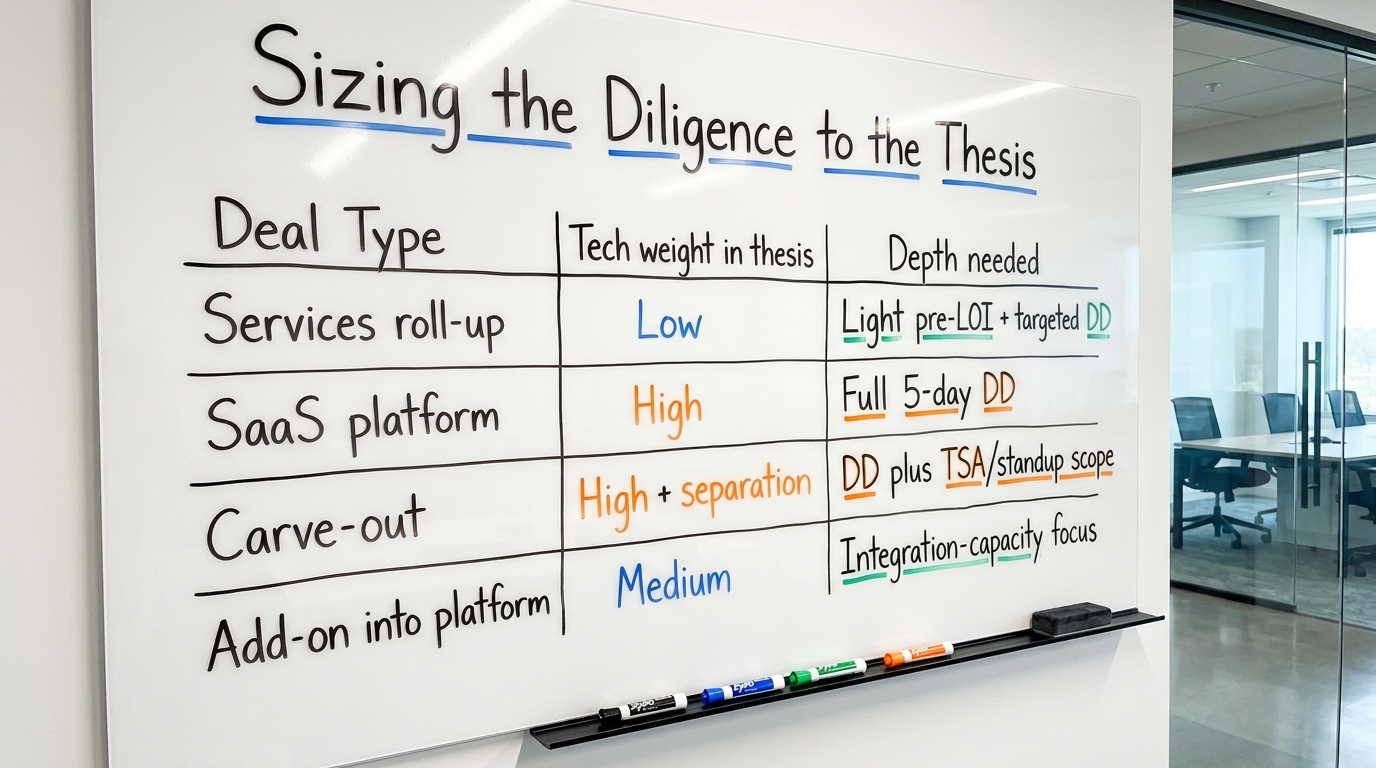
Before the letter of intent, a light review, often priced around $5,000, answers one question: is there anything here that should change the price or kill the deal. It is not a full audit. It is a fast look for the disqualifying problem, run before the deal team spends real money and calendar time. A sensibly structured pre-LOI check credits its fee into the full diligence if the deal proceeds, so it is not a sunk cost.
A confirmatory technical due diligence
After the LOI, when the deal is real, a full pass, commonly in the $15,000 range for a focused five-day engagement, produces the evidence the investment committee and the lenders will want. This is where the architecture, security, delivery process, and key-person risk get documented against a baseline.
4. What drives the cost up, legitimately
Some cost is scope creep. Some is real. The legitimate drivers are worth paying for:
- Codebase size and age. A fifteen-year-old monolith takes longer to read than a small modern stack.
- Carve-out complexity. When the target shares systems with a parent, the review has to untangle what actually transfers. This is its own workstream, and it connects directly to the carve-out digital standup and transition services agreement that follows at close.
- Regulatory surface. Health, financial, or data-heavy targets require security and compliance depth that a low-regulation SaaS does not.
- Add-on ambition. A platform being underwritten as an acquirer needs its integration capacity tested, not assumed.
5. What does not justify a higher bill
Watch for cost that buys activity rather than answers. A vendor register full of hours, tool licenses, and page count is not the same as a decision. McKinsey’s private capital research has repeatedly made the point that value creation follows disciplined operating focus, not volume of analysis. Apply that lens to the diligence itself. If a quote scales with headcount and duration but the deliverable is still a narrative memo with no ranked risks and no owners, the extra spend is buying reassurance, not evidence.
6. How to size the engagement to the deal
The diligence budget should track the technology’s weight in the thesis, not the enterprise value. A $40M services business where software is a cost center needs a lighter check than a $12M SaaS platform where the code is the asset. A workable rule of thumb: the more of the value-creation plan that runs through engineering, the deeper the technical read has to go.
For deals where the platform will be standardized or consolidated post-close, the diligence should look ahead to that work. The findings that matter feed directly into the post-merger integration plan and, on the revenue side, into any CRM standardization decision the portfolio faces.
7. How to judge the deliverable
Price is judged against output, so know what a defensible output contains. A technical due diligence report that earns its cost includes:
- A documented baseline of the current architecture, stack, and team, in terms a non-engineer investment committee can read.
- A ranked risk register, each item scored by likelihood and cost to remediate, with a named owner.
- Findings tied to the investment thesis, not a generic scorecard.
- A first-90-days view of what has to happen, which should map cleanly into the first 100 days integration plan.
- Dollar figures where possible: what a fix costs, what a delay costs.
If the report cannot survive being read by the CFO and the lenders, it was priced as theater. The Harvard Law School Forum on Corporate Governance has published extensively on how diligence quality shapes post-close outcomes, and the pattern holds here: the report’s value is in what it lets the buyer decide, not in its length.
8. When to spend more, when to spend less
Spend more when the technology is the asset, when a carve-out is involved, when the plan depends on rapid add-ons, or when the seller is unusually resistant to giving engineering access. That last one is a signal, not a scheduling problem.
Spend less when the target is small, the tech is commodity, and the value-creation plan runs through sales and GTM rather than the platform. In those cases the harder question is the revenue system, and the money is better weighted toward a read on RevOps for the portfolio company and its GTM strategy.
9. The cost of skipping it
The real comparison is not $15,000 versus $5,000. It is the diligence fee versus the cost of the problem it would have found. PitchBook’s deal data shows how often technology-driven integration issues surface after close, and the remediation on a mispriced platform routinely runs into six or seven figures, plus the timeline slip on the value-creation plan. Against that, a five-figure diligence spend is not the expensive line item. Skipping it is.
10. A short checklist before you approve the spend
- Have you decided which thesis questions the diligence must answer? Scope follows those, not the other way around.
- Are you running a cheap pre-LOI filter before committing to a full pass?
- Does the quote credit any pre-LOI fee into the full engagement?
- Does the deliverable include a baseline, a ranked risk register, and named owners, in writing?
- Will the report feed directly into the integration and first-100-days plan?
- Is the technology’s weight in the thesis matching the depth you are paying for?
- Has the seller granted real engineering and repository access? If not, treat that as a finding.
Run that list and the technical due diligence cost stops being a number handed to you and becomes a number you can defend. The point of the exercise is the same as the point of the whole deal: buy measurable enterprise-value confidence, not a document. For the broader operating context, DevriX’s work with private equity sets the diligence inside the value-creation plan rather than treating it as a standalone gate.
11. Next step
If a deal is approaching LOI or confirmatory diligence and the technology is material to the thesis, scope the check to the thesis and run the pre-LOI filter first. See how the DevriX / GrowthShuttle private equity offer structures the pre-LOI check and the five-day technical due diligence so the early fee credits into the full engagement and the output arrives ready for the investment committee.