By the time a technical due diligence report for private equity lands in the deal room, the operating partner or portfolio executive has days, not weeks, to decide whether the technology stack supports the thesis or quietly undermines it. The report is not a document to file. It is the input to a specific decision: does the buyer proceed at the modeled price, adjust the price, add conditions to the deal, or walk. A weak read here shows up later as blown integration timelines, surprise re-platform spend, and a forecast that misses because the systems could never carry the plan.
This guide is for the person accountable for that call. It assumes budget, authority, and a live deal. It walks through what the report must answer, how to judge whether it actually answers it, and where to push before sign-off.
1. Start with the decision the report has to serve
Most technical diligence reports are written to describe. The buyer needs one written to decide. Before reading a single finding, the operator should write down the three or four decisions the report exists to inform:
- Does the technology support the revenue and margin thesis at the modeled scale?
- What must be spent in the first 12 to 24 months to keep the plan intact, and is that in the model?
- What risks would change the price or require deal conditions?
- What breaks on Day 1 if this is a carve-out?
If the report cannot be mapped to those answers, it is a technical description, not a diligence product. Bain’s annual private equity report has consistently pointed to value creation discipline as the separator between funds, and technology is now a line item in that discipline, not a footnote. Read the report against the Bain & Company Global Private Equity Report lens: every finding should ladder up to enterprise value.
2. Check that the scope matched the thesis
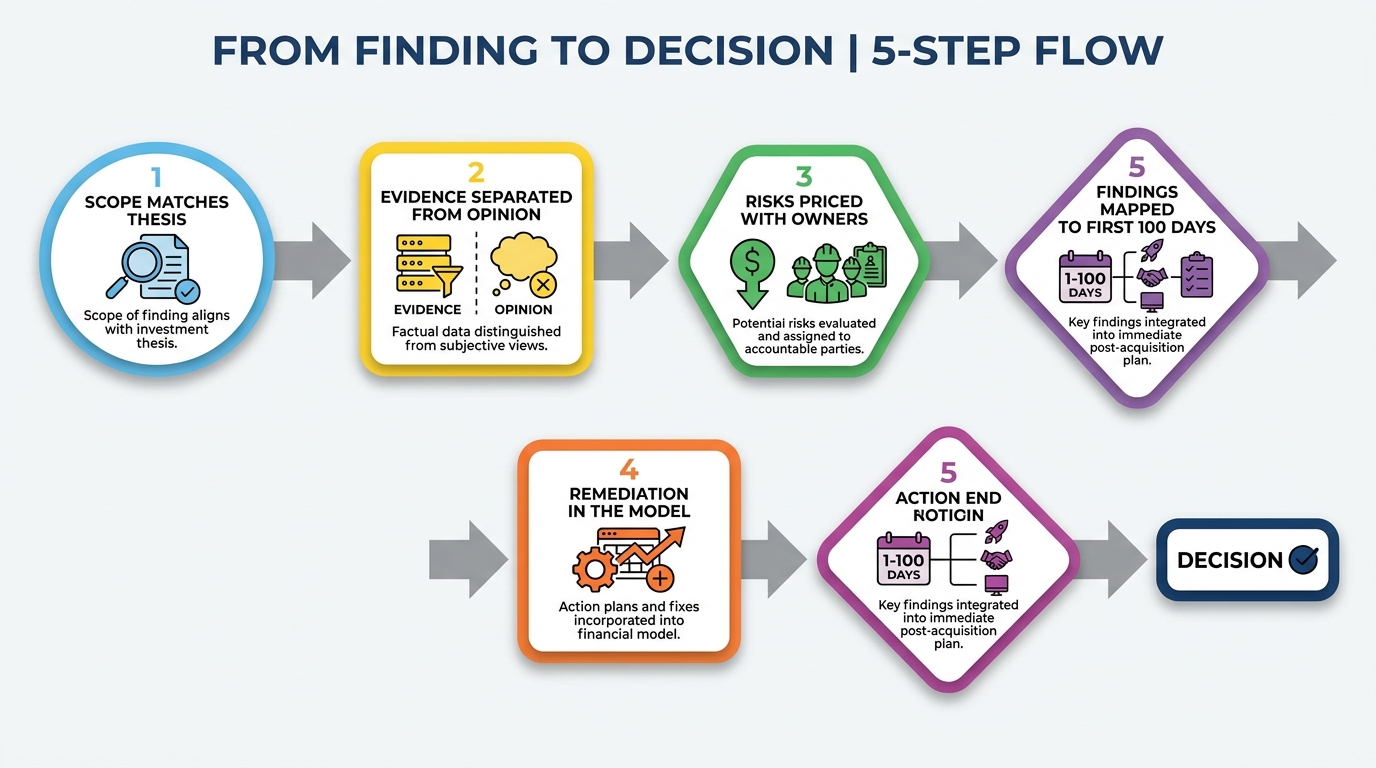
A generic scope produces a generic report. If the thesis is a multi-year roll-up, the report must cover whether the platform can absorb acquisitions, not just whether the current code is clean. If the thesis is margin expansion through automation, the report must assess data quality and system integration, because those cap what automation can reach.
The operator should confirm the scope statement names the thesis explicitly. A technology due diligence engagement that ignores the value creation plan is measuring the wrong things well.
3. Separate what is true from what is opinion
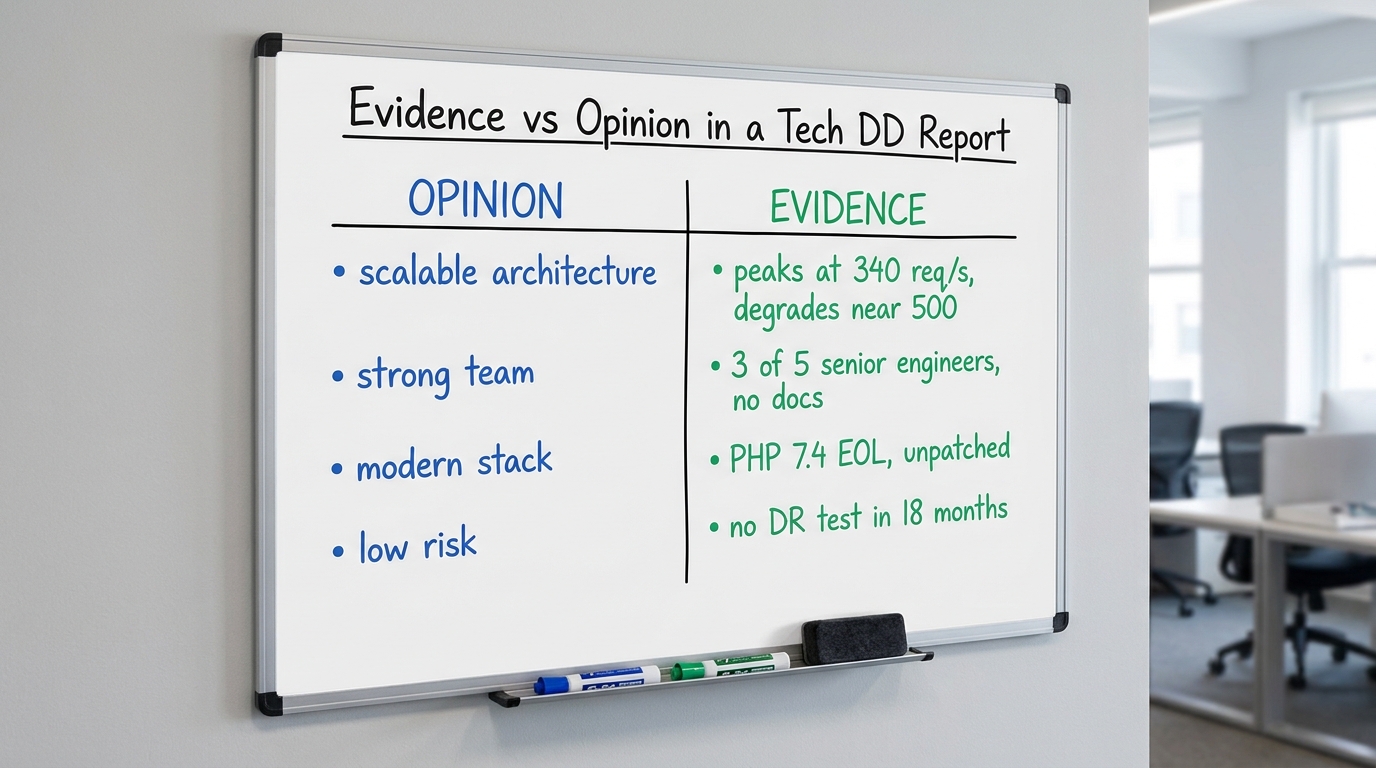
Strong reports show their evidence. For every material claim, the operator should be able to see the baseline: what was measured, when, from what source, and by whom. “Architecture is scalable” is an opinion. “Peak load is 340 requests per second against a database that begins to degrade at roughly 500, with no read replicas provisioned” is evidence the buyer can act on.
What evidence looks like
- Named systems, versions, and hosting arrangements, not “modern cloud stack.”
- Actual usage and load figures pulled from monitoring, not estimates from a management interview.
- Code and infrastructure the assessors accessed directly, with the level of access stated.
- A clear line between what was verified and what management asserted.
Where the report leans on assertions it could not verify, that is a finding in itself. McKinsey’s work on private capital has repeatedly stressed operational rigor as the driver of returns; the same standard applies to how a diligence report handles its own uncertainty. Cross-check claims against the discipline described in McKinsey private capital research.
4. Read the risk register, not just the summary
The executive summary is written to be readable. The risk register is where the deal actually lives. The operator should confirm each risk carries four things: what it is, its likelihood, its commercial consequence in dollars or timeline, and an owner for the fix. A risk with no cost attached and no owner is a sentence, not a finding.
Sort the register by commercial impact, not by severity label. A “medium” security gap that costs $2M to remediate matters more to the model than a “high” code smell that costs a sprint.
5. Force the report to price the remediation
This is where most reports go soft. The buyer does not need a list of problems. The buyer needs the cost and time to fix the ones that threaten the thesis, and a view on which are optional. The operator should reject any report that lists technical debt without translating it into a remediation budget and sequence.
Three buckets are enough to be useful:
- Must fix before scale: work the thesis depends on, with cost and timeline.
- Fix during the hold: real debt that can be scheduled, not emergency spend.
- Accept: noted, not worth the capital.
Those numbers belong in the model. If the report’s remediation total is not reflected in the deal economics, the price is wrong.
6. Judge the people risk honestly
Systems do not run themselves. The report should assess key-person concentration, documentation quality, and whether the engineering team can execute the plan or needs to be rebuilt. A stack that works only because two founders hold it in their heads is a liability the moment they vest and leave.
For deals structured as carve-outs, this compounds fast. Shared services, shared IT staff, and shared tooling all have to be untangled, and the timeline is set by the transition services agreement. The mechanics of that separation are covered in detail in this walkthrough of the carve-out digital standup and transition services agreement, and the report should flag every dependency the TSA has to cover.
7. Trace the findings into the integration plan
A diligence report that ends at close has done half the job. The findings become the backbone of the first 100 days. Security gaps become Day 1 tasks. Integration dependencies become sequenced workstreams. Data quality issues become the reason the CRM migration slips a quarter if nobody plans for them.
The operator should be able to draw a straight line from each material finding to a named owner in the integration plan. Where that line does not exist, the value at risk is real. The connection between diligence and execution is the same theme running through this guide to post-merger integration consulting and how to judge it.
8. Confirm the report addresses the revenue system, not just the product
Technical diligence often over-indexes on the product engineering stack and under-covers the revenue systems that carry the growth plan. For a portfolio company, the CRM, marketing automation, billing, and data flows between them determine whether the GTM thesis is executable at all. A pristine product codebase sitting on a broken revenue data layer will still miss the plan.
The operator should confirm the report assessed data integrity across the revenue stack, because that is what caps forecast reliability and reporting. This is the exact terrain covered in this RevOps decision guide for portfolio companies, and where CRM fragmentation across a portfolio surfaces, the reasoning in this CRM standardization decision guide applies directly to what the report should have flagged.
9. Test the report against a second lens before you sign
The operator should stress-test the report by asking what a skeptical co-investor would attack. Governance research collected by the Harvard Law School Forum on Corporate Governance repeatedly shows that diligence gaps surface post-close as governance and reporting problems, which is exactly when they are most expensive to fix. If the report would not survive a hard read from the investment committee, it is not ready to close on.
10. A sign-off checklist before you clear the deal
Before the operator signs off on a technical due diligence report for private equity, run this list:
- The scope names the investment thesis and measures against it.
- Every material claim shows its evidence and access level.
- The risk register carries cost, likelihood, and an owner per line.
- Remediation is priced in three buckets and reflected in the model.
- Key-person and team risk is assessed, not assumed.
- Revenue systems and data integrity are covered, not just product code.
- Findings map to named workstreams in the first 100 days.
- For carve-outs, every shared dependency is flagged against the TSA.
- The report survives a skeptical read from the investment committee.
If any line fails, the gap is a question to send back before close, not a problem to discover after. The difference between a report that describes and one that decides is whether the buyer can act on it under time pressure without guessing.
When the deal is live and the read has to be right, route the decision to a diligence and execution partner built for it. See how the private equity practice at DevriX runs technical diligence and turns the findings into an executable plan.