By the time a signed LOI lands on your desk, the technology question is no longer academic. The forecast in the model assumes a product that ships, a codebase someone can maintain, and a revenue system that will not stall the day integration starts. If the target’s engineering reality does not match those assumptions, the gap shows up in your first board meeting as a missed number, an unplanned rebuild, or a key-person dependency that no one priced. Buying technical due diligence services in the mid-market is a decision about which of those risks you retire before close, and which you accept and fund.
This guide is written for the operating partner or portfolio executive who owns that decision. It assumes you have budget and a deal timeline, not that you need standard terms explained. The goal is narrow: help you scope the work, judge the provider, and read the output so it changes what you do in the first 100 days.
1. The problem you are actually buying against
Most mid-market deals do not fail on the financials the QoE team already covered. They stall on operational drag that was invisible in the data room: a monolith only two people understand, a customer database no one has migrated in years, security debt that becomes a covenant problem, or a “platform” that is three acquired products duct-taped together. Bain’s annual global private equity report has tracked how much of the return thesis now rests on operational improvement rather than multiple expansion, which means the systems that run the business are part of the value case, not a back-office footnote.
So the real purchase is not a report. It is a decision aid: evidence that tells you whether the enterprise-value improvement in your model is achievable on the technology you are inheriting, and what it costs if it is not.
2. What the deal actually needs to decide
Before you scope anything, be explicit about the decisions the work has to inform. In practice there are four:
- Price and structure. Does anything found here justify a retrade, an escrow, or a walk?
- Integration cost and sequence. What has to be rebuilt, migrated, or re-staffed, and when?
- Risk you fund on purpose. Which items you accept and put on the register with an owner and a budget.
- Day 1 readiness. What breaks the moment the deal closes if no one acts.
If a provider’s proposal does not map to these four, it is selling activity, not a decision.
3. Scope the two entry points: pre-LOI check versus full diligence
There are two distinct jobs, and buying the wrong one wastes money and time.
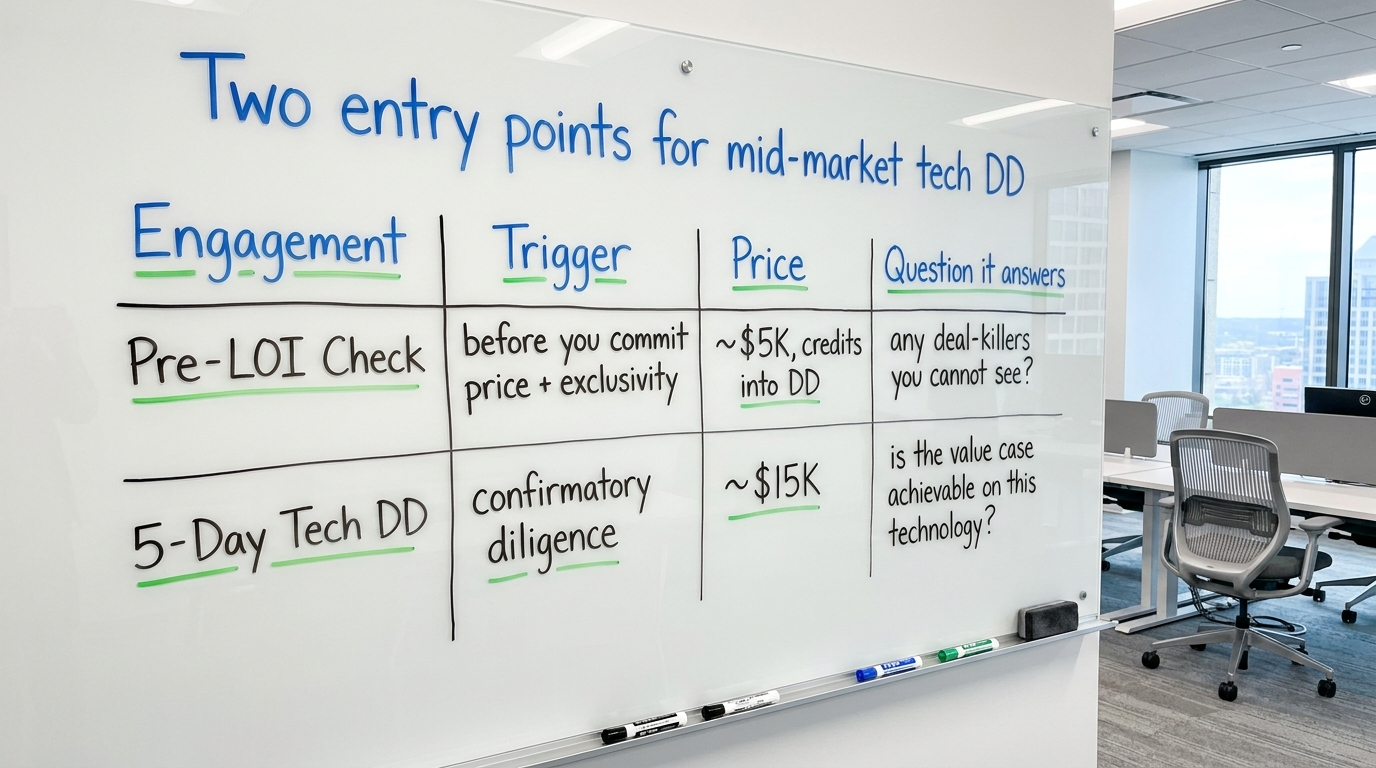
Pre-LOI check
Before you commit price and exclusivity, a light-touch review answers one question: are there deal-killers you cannot see from the outside? Architecture red flags, obvious key-person risk, a security posture that will not survive a customer audit. This is a fast, cheap look that protects you from paying for confirmatory work on a deal that should die early. A Pre-LOI Check priced around $5,000 fits this, and the sensible version credits that spend into the deeper engagement if the deal proceeds.
Full confirmatory diligence
Once you are in confirmatory diligence, you need the complete picture: code quality, architecture, scalability against the growth plan, security and compliance exposure, engineering team depth, and the cost of everything that has to change. A structured 5-Day Tech DD at roughly $15,000 is calibrated to the mid-market, fast enough for a live timeline and deep enough to move the risk register. This is the range where dedicated technology due diligence earns its fee, because it changes the number or the plan.
4. The scope any credible provider covers
Ask for the coverage map before you sign. Mid-market technical due diligence services should touch, at minimum:
- Architecture and scalability against the specific growth the model assumes, not in the abstract.
- Code quality and technical debt, quantified where possible into remediation effort.
- Security and compliance exposure, framed as risk to revenue and covenants.
- Team and key-person risk, including who holds knowledge that is not written down.
- Data and integration readiness, because the migration you inherit is a Day 1 issue.
- Vendor, license, and open-source exposure that can become a liability post-close.
The RevOps reader should push hard on that last-mile point: the CRM, billing, and analytics stack that the revenue engine runs on. A diligence that scores the product but ignores the revenue system leaves you blind on the piece you will be measured on first.
5. Judge the provider on translation, not vocabulary
The failure mode in this market is a report full of engineering vocabulary that no one on the deal team can act on. A good provider translates every finding into money, time, and a decision. “The billing service has no test coverage” is a fact. “The billing service has no test coverage, so any pricing change carries a two-to-four-week regression risk, which delays the price increase in the value plan” is a decision aid.
Judge candidates the way you would judge a revenue operations consultant for private equity: on whether their output changes what you do, not on how impressive the analysis sounds. McKinsey’s private capital research and BCG’s work on principal investors and private equity both keep pointing to execution capability as the differentiator between funds that hit plan and funds that miss it. The diligence provider is your first read on whether execution is even possible.
6. Read the output as a risk register, not a grade
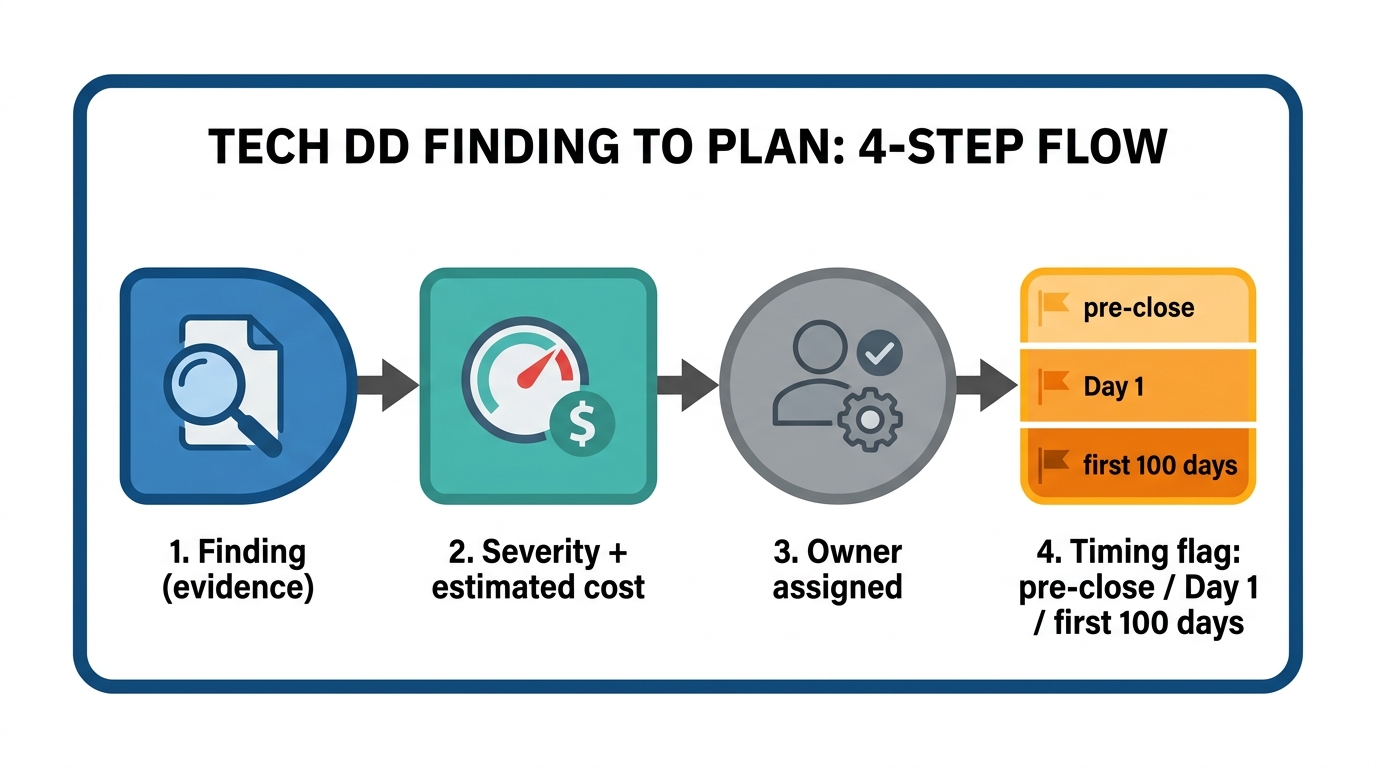
A score out of 100 tells you nothing you can fund. What you need is a ranked list where every item has a severity, an owner, an estimated cost, and a timing flag: pre-close, Day 1, or first 100 days. That structure is what lets the finding flow straight into your first 100 days plan without a translation step.
When you review the draft, ask for three things explicitly: the two or three findings that would change the price, the items that must be resolved before Day 1, and the dependencies that block integration workstreams. If the provider cannot rank their own findings, you are holding a document, not a decision.
7. Connect diligence to the deal type you are running
The right depth depends on the deal shape. A carve-out inherits systems that were never designed to stand alone, so the diligence has to flag every shared dependency that a transition services agreement will temporarily paper over. If you are running one, the sequencing in this guide to carve-out consulting and the mechanics in the carve-out digital standup and TSA should shape what the diligence looks for.
For a platform-plus-add-on thesis, the diligence question shifts to whether the target’s stack can absorb acquisitions without a rebuild. That is where the findings feed directly into your post-merger integration plan and, on the revenue side, into any decision about CRM standardization across the portfolio.
8. Time the work to real deal triggers
Diligence spend should track the deal, not a calendar. The pre-LOI check belongs before you grant exclusivity. The full 5-Day Tech DD belongs inside confirmatory diligence, timed so findings land before you are locked into price. And the output should be structured to survive past close, because the same document becomes your Day 1 briefing and your first board meeting’s technology narrative. PitchBook’s research and data on holding periods and the pressure to show early value make the case plainly: the diligence you buy at the front is the plan you execute at the back.
9. What good looks like on the revenue side
For the operator accountable for revenue systems, the diligence has a specific bar. It should tell you whether the current stack can support the growth in the model, what it costs to fix the gaps, and how those fixes sequence against your integration timeline. That is the same discipline you would bring to GTM value creation: name the outcome, price the path, and assign an owner. A diligence that stops at “the platform is fine” has not done that work.
10. A buyer’s checklist before you sign
- Does the proposal map to the four decisions: price, integration cost, funded risk, Day 1 readiness?
- Is the entry point right for your stage: pre-LOI check versus full confirmatory diligence?
- Does the scope include the revenue system, not only the product?
- Will you get a ranked risk register with owner, cost, and timing, not a score?
- Can the provider point to the two or three findings that would change the price?
- Does the timing put findings in front of you before you are locked into price?
- Will the output feed your first 100 days plan without a rewrite?
If the answer to any of those is soft, tighten the scope before you commit the fee. The cost of an under-scoped diligence is not the fee you save. It is the finding you discover in month three, priced at full remediation, with no leverage left.
11. Where this sits in the value-creation stack
Technical due diligence is the front door to a longer program. The register it produces becomes the integration backlog, the RevOps roadmap, and the technology story you tell the board. Governance research from the Harvard Law School Forum on Corporate Governance keeps underlining how much scrutiny operational and technology risk now draws at the deal level, which is exactly why the diligence you buy has to be built to hand off, not to sit in a folder. Done right, it is the cheapest leverage you will have on the entire deal.
For portfolio companies moving from diligence into execution, the same team that reads the risk register should be able to work the plan across the portfolio, from integration to CRM consolidation and revenue systems that hold up under a growth thesis. To scope a pre-LOI check or a 5-day technical diligence against a live deal, review the private equity offer at the DevriX and GrowthShuttle PE hub and bring the deal timeline you are working to.